
Again
AGAIN — one result is a maybe. do it again. and again. once could be luck; many times is a truth.
Loading audio…
Press play to listen along. The line being read lights up as you go.
Show full transcript
Loading transcript…
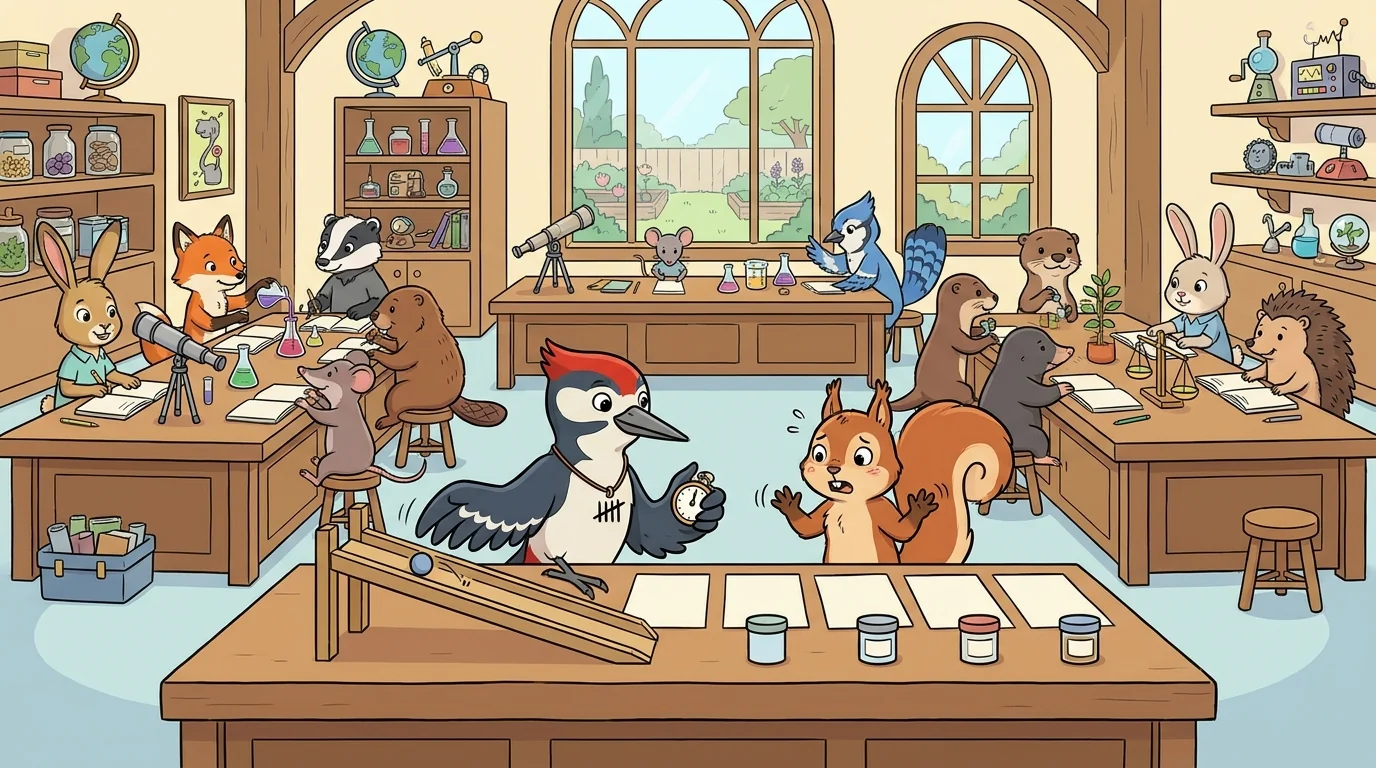
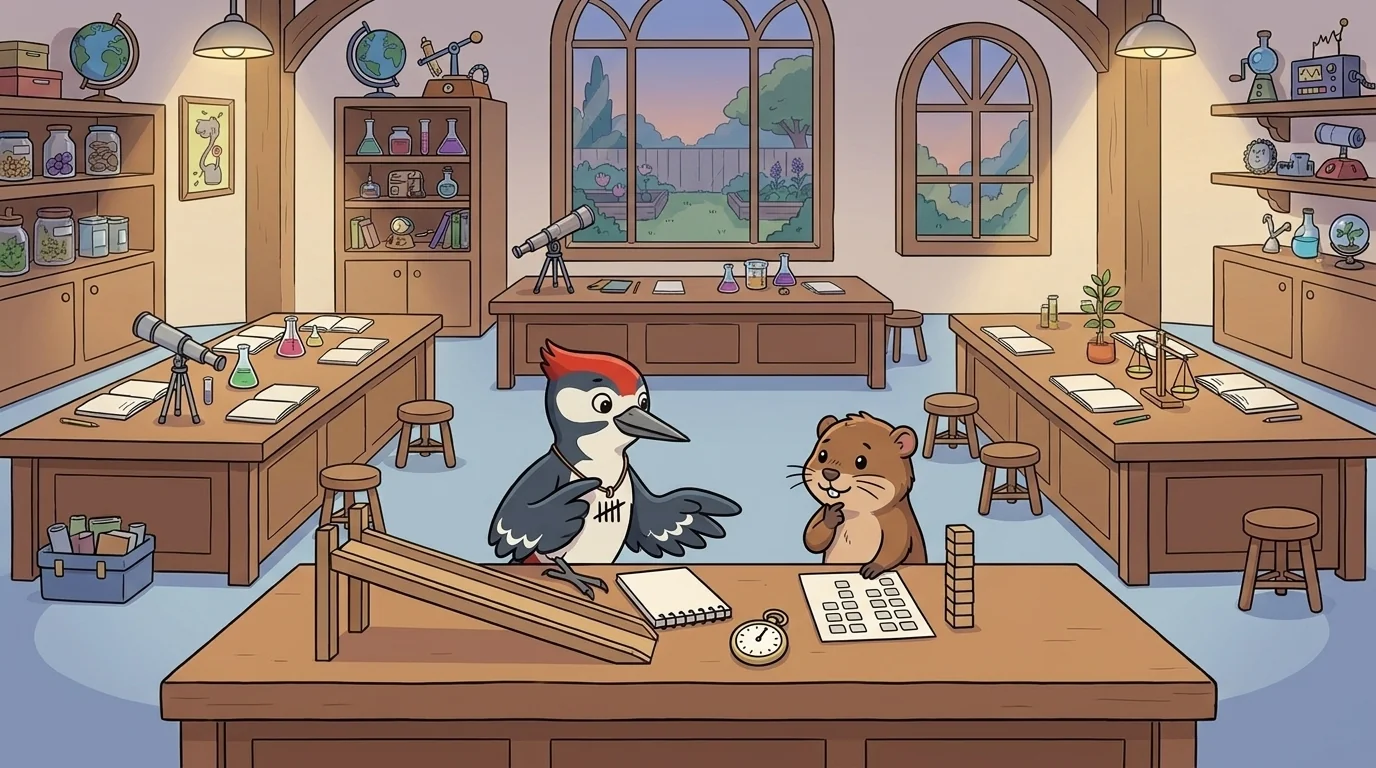
At a workbench in the Grand Laboratory, a steady woodpecker named Again was doing the same little experiment for the seventh time in a row — while a young squirrel beside him, who'd done his own once, couldn't understand why Again wouldn't just STOP.
Again was patient and unhurried, tapping out each repeat with the same calm rhythm, a little tally-mark charm strung at his neck. He dropped a ball down a ramp, timed it, wrote the number, and reset — for the seventh time. The squirrel fidgeted. "You already KNOW how long it takes! You've done it six times! Why do you keep doing it AGAIN?"
"Because once could be luck," Again said, tapping out the eighth. "The first time I timed it, I got a number. But maybe my thumb was slow on the timer. Maybe a breeze nudged the ball. Maybe I just got lucky. One result is a MAYBE — it might be true, it might be a fluke, and I can't tell the difference from a single try." He wrote the eighth number down, next to the others. "But look — I've done it eight times now, and the numbers are all close together, clustered around the same spot. THAT tells me the result is real, not a fluke. If one had been wildly different, I'd know something odd happened that time. Doing it again and again is how you tell luck from truth." He touched his tally-charm. "One result is a maybe. Many results is a truth. So I repeat — until I'm sure the answer is the ANSWER, and not just one lucky roll."
The squirrel slowed down. "So your ONE time... might have just been luck? And doing it a bunch of times is how you find out if it's real?"
"Exactly," Again said. "A scientist who does something once and shouts 'I discovered it!' might have just gotten lucky — or unlucky. A scientist who does it ten times and gets the same answer each time KNOWS. Repeating isn't boring busywork. It's the difference between 'maybe' and 'for sure.' Anyone can get a result once. Getting the SAME result again, and again, and again — that's what turns a lucky guess into a real discovery."
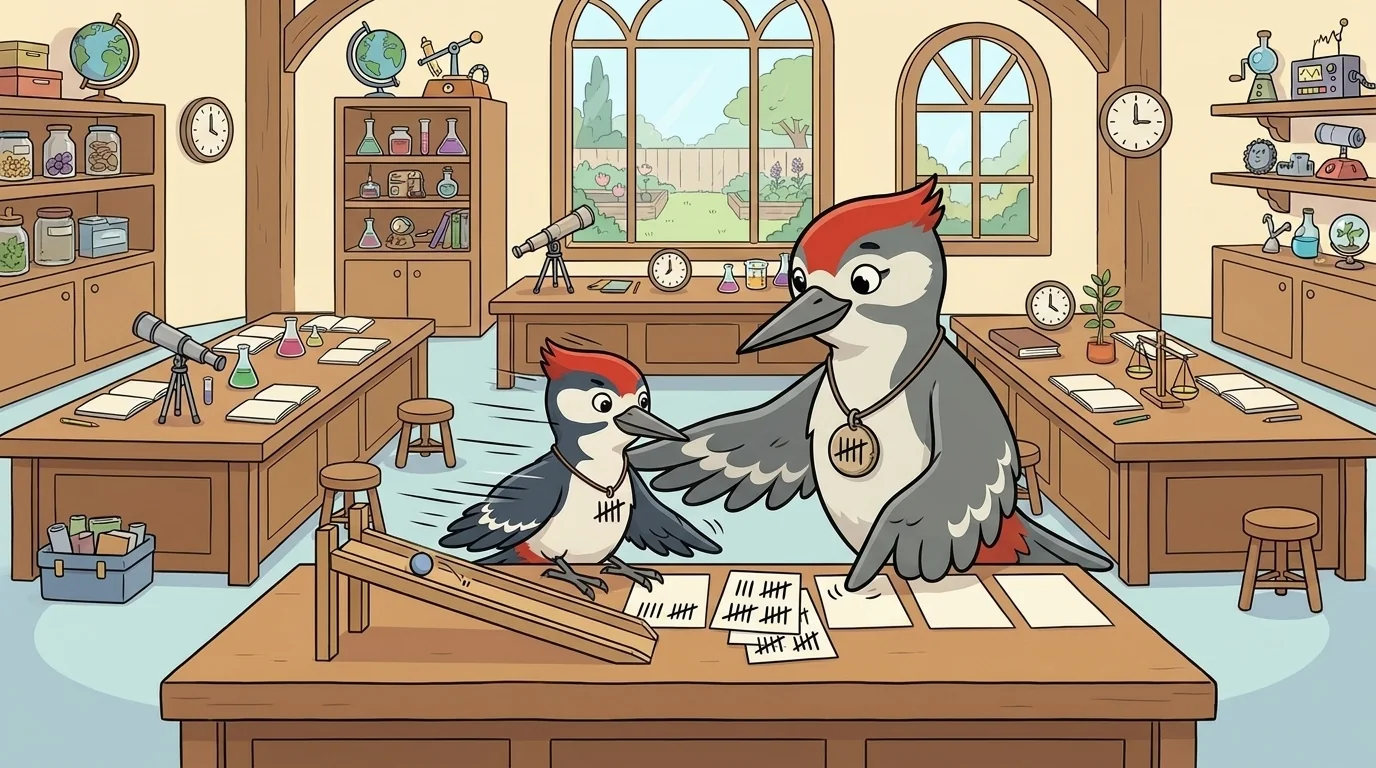
Again had once trusted his very first try.
When he was young, he was fast and eager — he'd do an experiment ONCE, get a result, and immediately announce he'd figured it out, certain and proud. And again and again the world embarrassed him: the "amazing discovery" he'd made on one try turned out, when someone repeated it, to be a fluke — a slow thumb, a lucky bounce, a one-time accident he'd mistaken for a law. He'd crumple, sure he just wasn't careful enough, that real discoveries were for creatures who got it right the first time.
An old woodpecker, slow and sure, tapped steadily at a branch beside him. "You do a thing once and believe it," she said. "So the flukes keep tricking you, because one try can't tell you if it's real." She tapped, and tapped, and tapped, the same spot. "Watch me. I don't peck once and declare the tree hollow. I peck again, and again, listening each time, until I'm SURE. One peck could echo wrong. Ten pecks that all sound the same — now I know." She nudged his shoulder. "Do it again. Not because you're slow, but because you're CAREFUL. One result is a maybe. Repeat it until the maybe becomes a truth. That's not doubting yourself — that's making sure."
Again learned to repeat — to do each test many times and watch whether the results held together — and the embarrassing flukes stopped fooling him. The rushed, first-try-and-wrong feeling settled into a patient, sure calm. He'd never been careless. He'd only been trusting one try, when truth needed many.
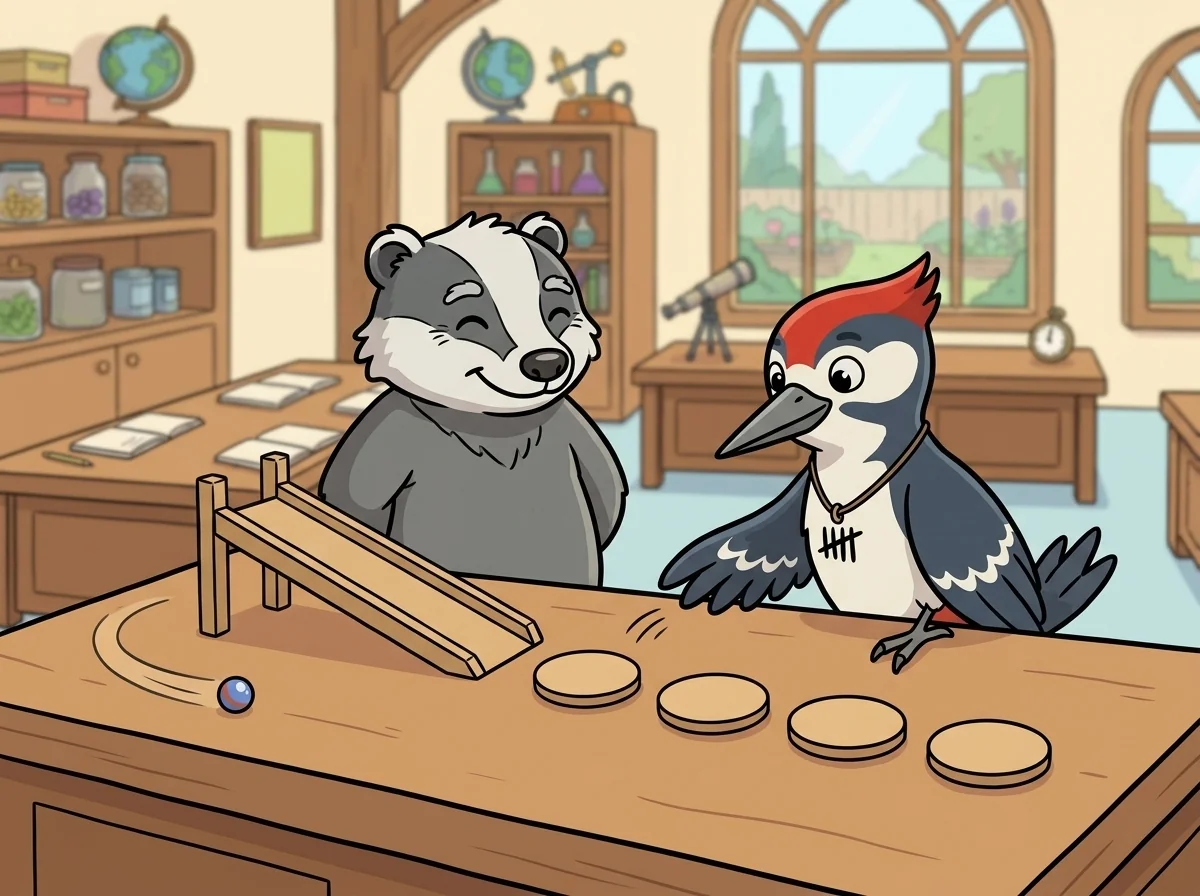
He walked to the Grand Laboratory when he was older, because a place that studied how things really worked ought to understand the patience of making SURE.
Smithy, the old badger who ran the lab, met him at the door. He rolled a marble across the table once, and it curved slightly left. "It curves left," Smithy said. "True?"
Again didn't agree. He rolled it again — curved left. Again — nearly straight. Again — left. Again — left. Five rolls. "Four out of five curved left," he said, "so it PROBABLY curves left — but not every time, so there's something else going on, maybe the table's tilt. One roll would've told me 'always left,' and I'd have been wrong. Five rolls tells me the real story."
Smithy's eyes crinkled. "Most kids watch it curve once and write 'it curves left' as a law. You rolled it five times and found the truth is messier and more honest. That's how we actually know things here. You belong."
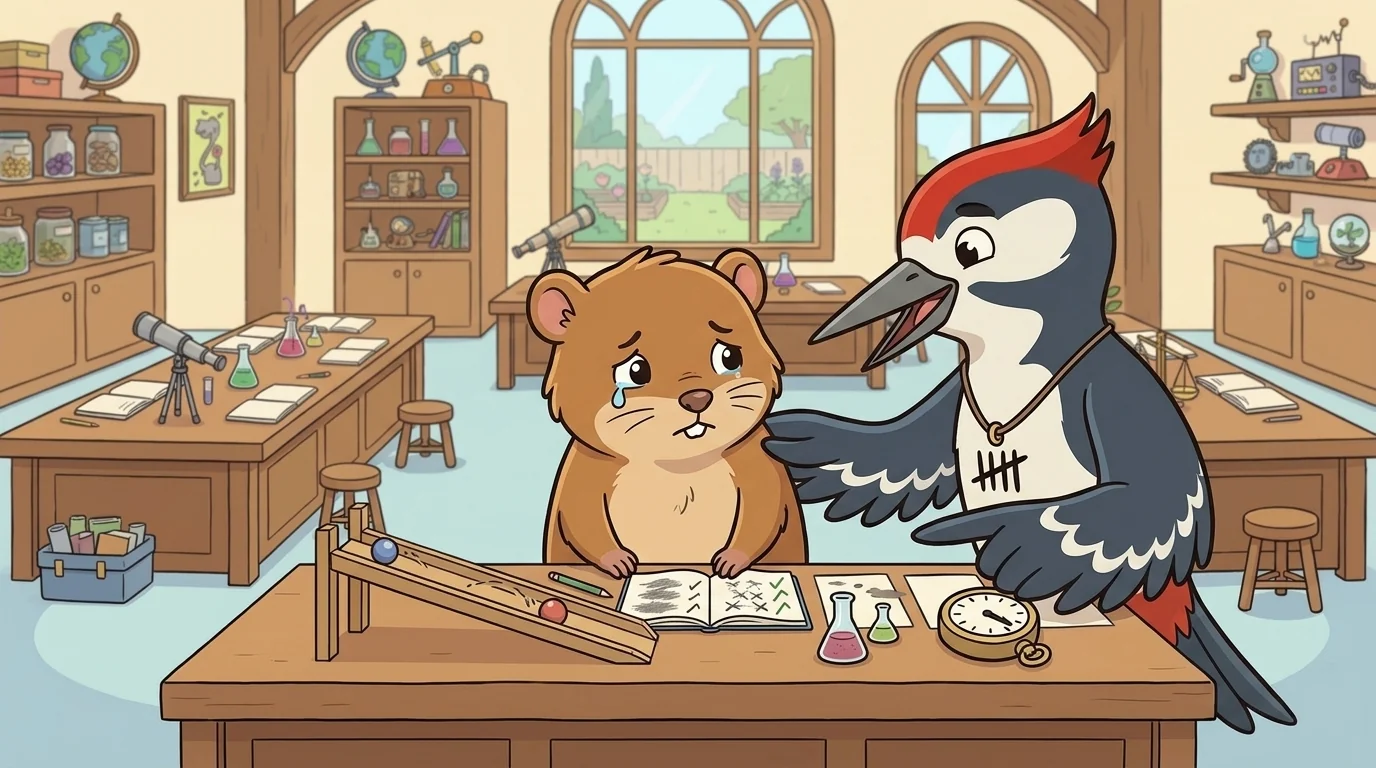
His corner of the lab filled with kids who trusted their first try — and one afternoon a young vole was thrilled, then crushed.
"I made a DISCOVERY!" the vole had announced, then, an hour later, slumped. "I did it again to show my friend and it... didn't work the second time. So was it even real? Did I imagine it?"
Again knew that crash. He'd ridden it for years.
"You didn't imagine it," Again said gently. "You just found out why we repeat. Your first result might have been real — or it might have been a fluke. One try can't tell you. So let's do it again. And again." Together they ran it five more times. Three worked, two didn't. "So it's real SOMETIMES," Again said, "which means there's a condition you haven't spotted yet — something different about the times it works. That's not a failed discovery. That's a CLUE, and you'd never have found it if you'd stopped at one lucky try."
The vole ran his test many times, watching for the pattern in when it worked. "Oh," he said. "One time told me almost nothing. Doing it over and over is how I actually find out what's TRUE."
"That's the whole of it," Again said. "One result is a maybe. Repeat it, and the maybes sort themselves into truths. Making sure isn't doubting — it's how you turn luck into knowledge."
Later, when the lab had emptied out, the vole came back with a quieter question.
"When you do the same thing over and over," he said, "so many times — doesn't it get boring? Don't you ever just want to trust the first answer?"
Again considered it, tapping his tally-charm.
"I wanted to, when I was young," he admitted. "Trusting the first try felt fast and exciting." He looked at a column of repeated, clustered numbers. "But somewhere I learned that the first-try excitement is where the flukes LIVE — the embarrassment of being sure and wrong, over and over. Repeating is the opposite feeling." He tapped his rhythm. "There's a patient, sure, settled calm in a repeated result: not the jittery thrill of 'maybe I found it!' but the deep, quiet confidence of 'I found it eight times, so I KNOW.' Each repeat isn't boring — it's a brick, and I'm building something that won't fall down." He touched the tally-charm. "There's a grounded steadiness in making sure — the flukes can't fool you anymore, because you didn't trust the luck, you tested it until it became truth. Patient. Certain. Solid. That's my favorite feeling: not the rush of one lucky result, but the calm of one I've made SURE of."
The vole nodded, and Again watched the crushed, was-it-even-real feeling settle in him — the same patient, sure calm that had once, at a workbench long ago, steadied his own first-try flukes into a woodpecker who could finally tell luck from truth, one repeat at a time.
The LabSmith ensemble
Again is part of LabSmith's distributed-narrative cast. Each character embodies a different curricular primitive; together they teach the full subject.
-
Query
Ask a good question — sharp + answerable; 'Where science starts.'
-

See
Observe — gather raw data first; 'Look first. Talk later.'
-

Guess
Hypothesize — frame a testable guess; 'What if…?'
-
Model
Model it — build a small stand-in you can poke; 'Learn the big thing from the little one.'
-
Meter
Measure precisely — a number and a unit; 'How much, exactly?'
-

Check
Experiment — design + run the test; 'One test at a time.'
-

Because
Argue from evidence — back a claim with the reason; 'I think Y, because I saw X.'
-
Explain
Explain the mechanism — the how-and-why that connects cause to effect; 'Know THAT, then know WHY.'
-

Reflect
Learn — interpret results + revise; 'What did we learn? What surprised us?'