
Model
MODEL — you can't shrink a mountain or slow the moon. so build a small stand-in you CAN poke — and learn about the big thing from the little one.
Loading audio…
Press play to listen along. The line being read lights up as you go.
Show full transcript
Loading transcript…
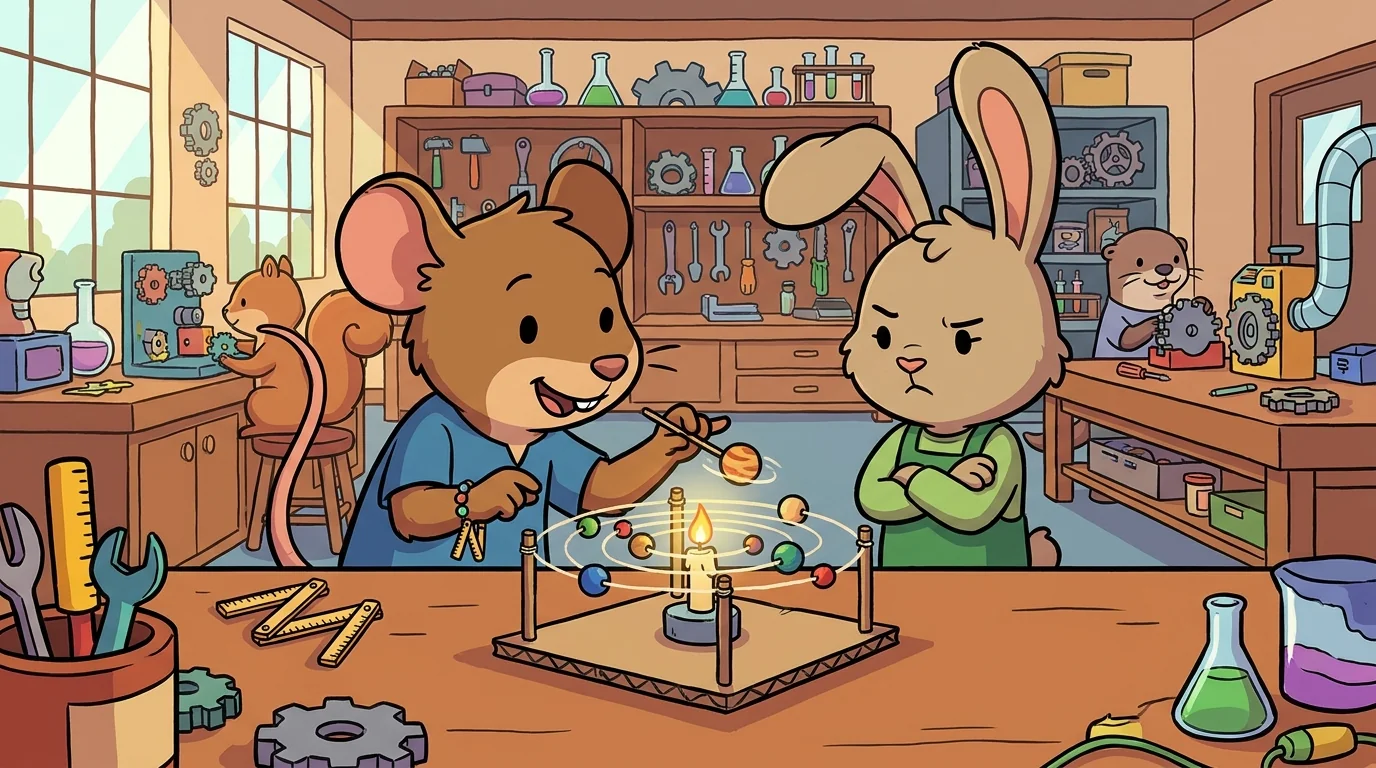
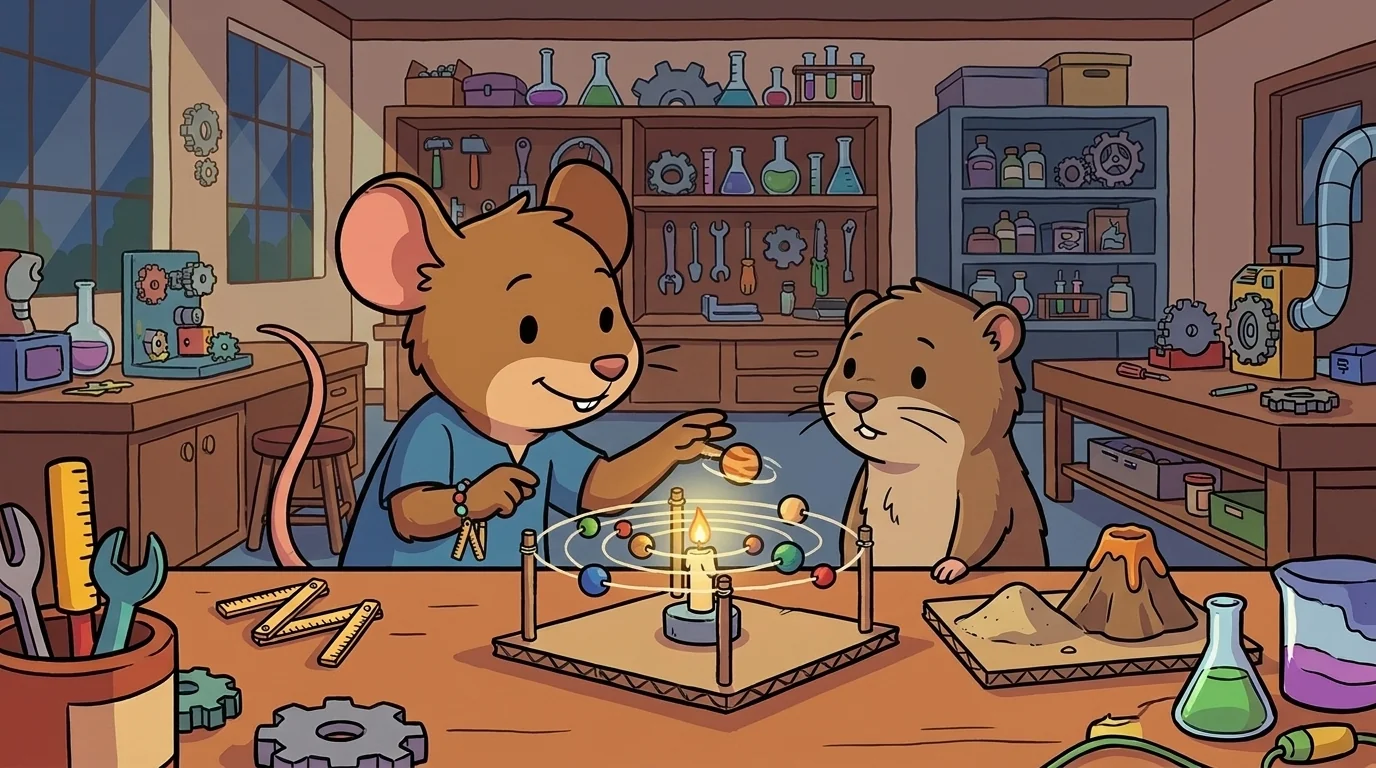
At a workbench in the Grand Laboratory, a clever mouse named Model was building a tiny cardboard-and-string version of the solar system — while a young rabbit beside her insisted you could never understand the real planets, because they were too enormous and too far away to ever poke.
Model was inventive and quick-pawed, always cutting and folding something into a small stand-in for a big thing, a little folding-ruler charm at her wrist. The rabbit sighed at her tiny wobbling planets. "That's not REAL, though. The real planets are gigantic and millions of miles away. You can't learn anything real from little balls on strings."
"You can learn a LOT," Model said, spinning a bead-planet around a candle-sun. "I can't shrink a real planet down and hold it, and I can't fly out to poke Jupiter. It's too big, too far. So instead I build a SMALL version I CAN poke — and it teaches me about the big one." She spun the bead. "Watch. When I move this planet-bead closer to the sun-candle, it has to swing around faster to stay in orbit — see? Now I've LEARNED something about the real planets: the closer ones probably go around faster. I couldn't test that on the real solar system. But my little stand-in lets me poke it, and change it, and see what happens." She touched her folding-ruler charm. "A model isn't the real thing — I know these are beads, not worlds. But a good small stand-in behaves LIKE the big thing in the ways that matter, so you can experiment on the little one and learn about the giant one you could never touch."
The rabbit blinked at the spinning beads. "So even though it's just cardboard and string... it can teach you real things about the actual planets?"
"That's the whole power of it," Model said. "Some things are too big to shrink, too far to reach, too slow or too fast or too dangerous to poke directly — a mountain, the moon, a hurricane, the inside of a volcano. You can't experiment on those. So you build a SMALL stand-in that works the same way in the important parts, and you experiment on THAT. The model isn't perfect — it leaves things out — but it lets you ask 'what if?' and actually SEE. A little thing you can touch, teaching you about a big thing you can't."
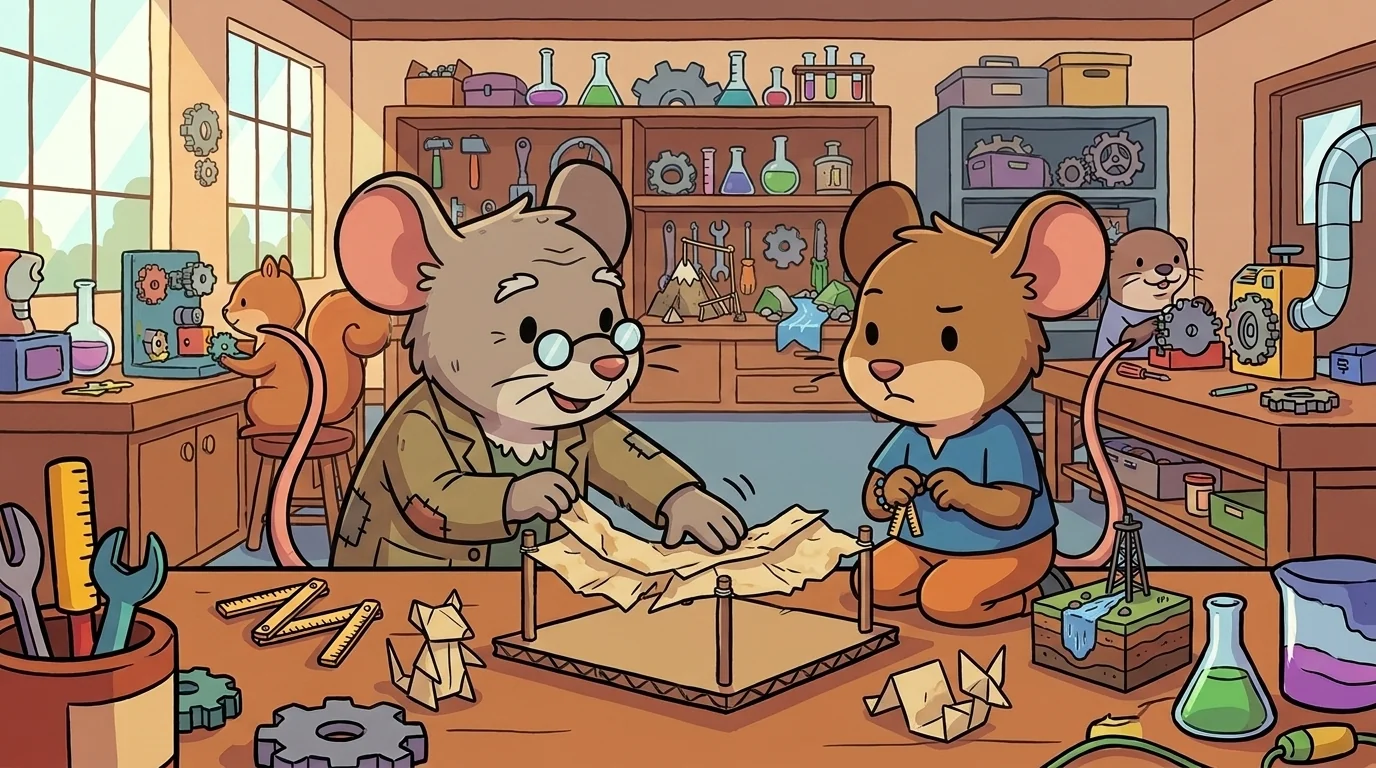
Model had once believed the big things were simply unknowable.
When she was young, anything too huge or too far felt hopeless to her — how could she ever understand the sky, the sea, the deep earth, when she couldn't hold any of it? She'd give up on the big questions entirely, sure they were locked away from a small creature like her, that only giants could study giant things. She'd sit small and shut-out, certain the enormous world was forever beyond her paws.
An old mouse, surrounded by tiny handmade contraptions, was folding a little paper bridge beside her one afternoon. "You think the big things are locked away," she said, "because you can't hold them. But look—" she pressed on her paper bridge until it buckled "—I can't test a real stone bridge with a thousand animals on it. So I built this little one, and I press on it, and I learn where a real one would break." She handed it over. "You don't need to hold the mountain. You need to build something small that ACTS like the mountain in the way you're asking about. Then you poke the little one all you like. The big things aren't locked away from small creatures. They're just waiting for you to build a stand-in you CAN reach."
Model learned to build stand-ins — small versions she could poke and change to learn about the big things she couldn't touch — and the enormous, unknowable world opened up under her paws. The shut-out, too-small feeling turned into a bright, capable delight. She'd never been too small for the big questions. She'd only been trying to grab the giants directly, when she could have built little ones to learn from.
She walked to the Grand Laboratory when she was older, because a place that studied how things really worked ought to understand how to study the things you can't touch.
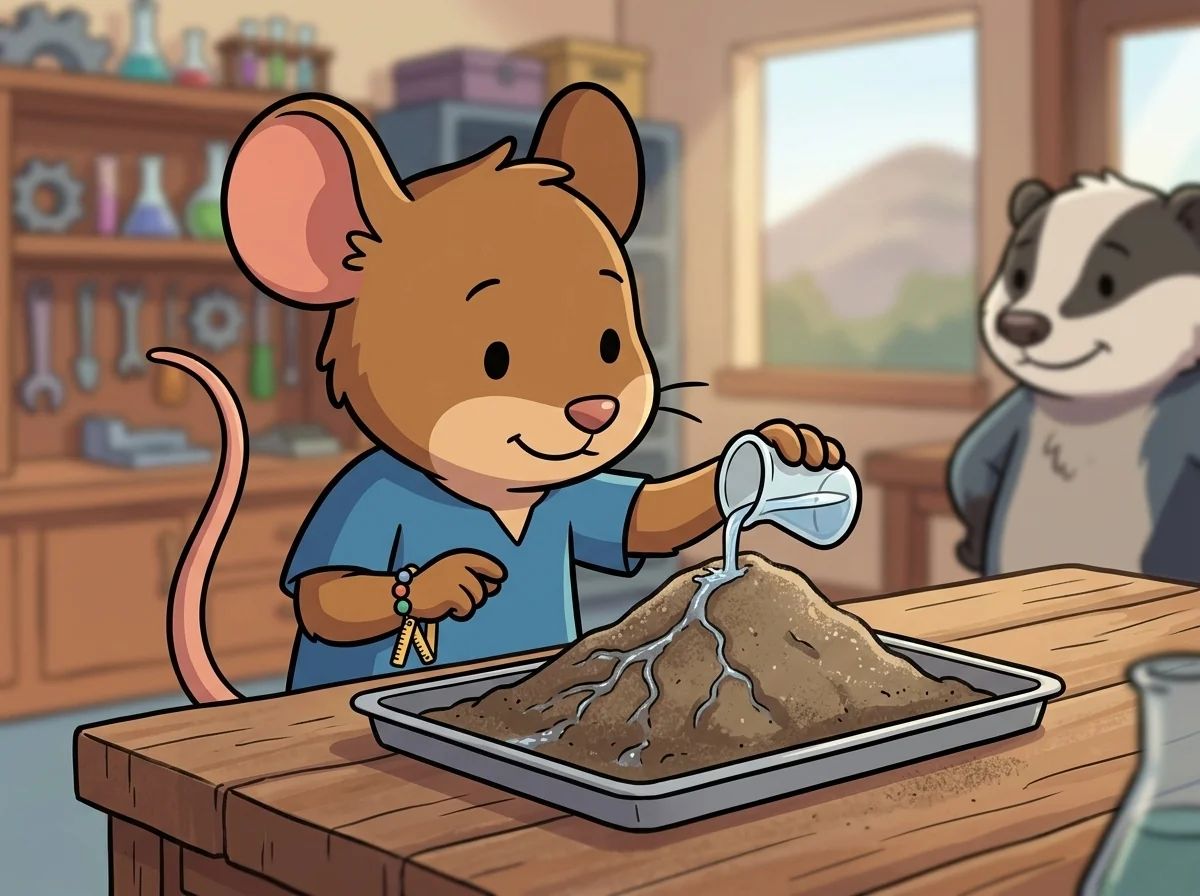
Smithy, the old badger who ran the lab, met her at the door. He pointed out the window at a distant, unreachable hill. "How would you find out how water runs down that hillside," he asked, "without walking all the way up there?"
Model didn't say I couldn't. She grabbed a tray, heaped a little mound of damp sand into a slope, and dribbled water down it, watching the tiny channels form. "I'd build a small hill, like this," she said, "and pour water on it, and watch where the streams go. It's not the real hill — but if I shape my little slope like the real one, the water will carve it the same way. The small hill teaches me the big hill."
Smithy watched the tiny streams branch down her sand. "Most kids say the far hill is unknowable. You built one on a tray. That's how we study the untouchable here. You belong."
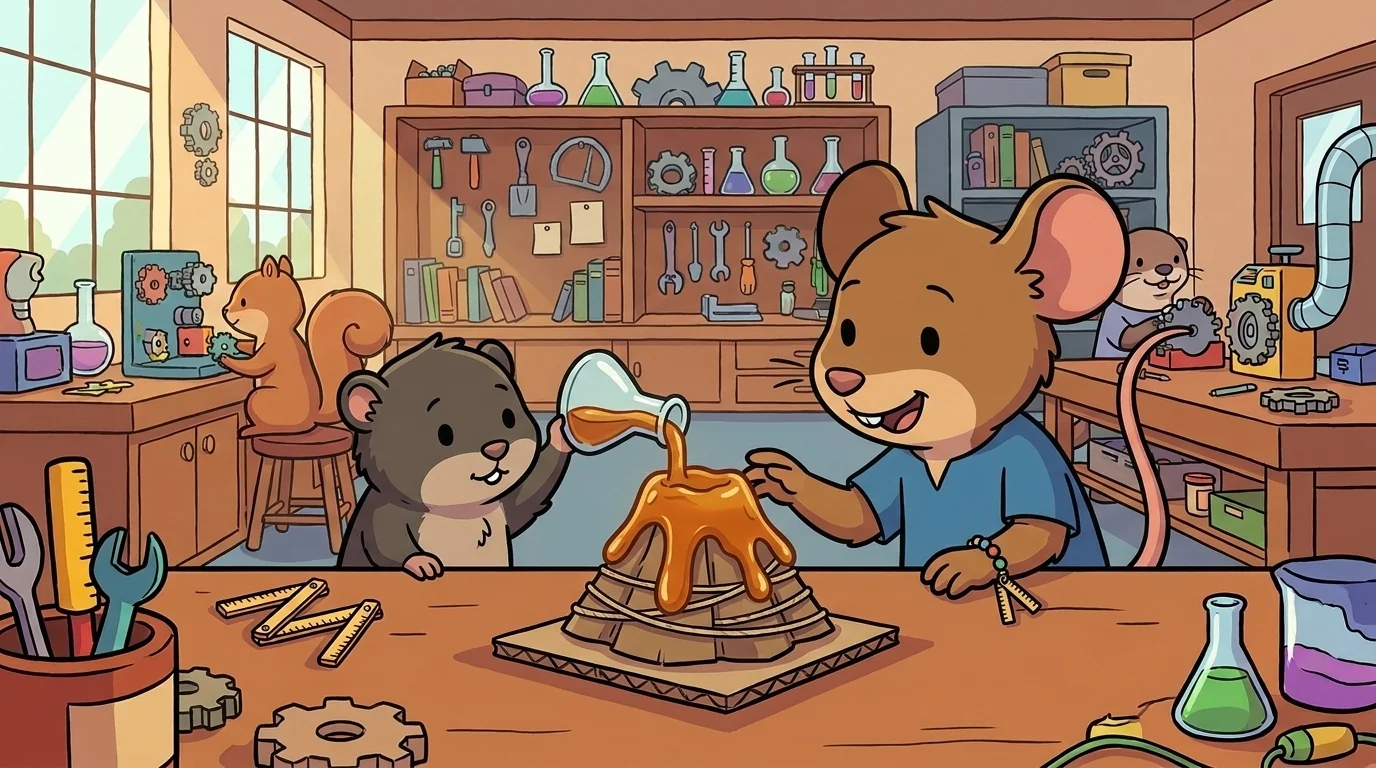
Her corner of the lab filled with kids stumped by things too big to poke — and one afternoon a young vole despaired over a project about volcanoes.
"I'm supposed to figure out how lava flows," the vole said, "but I can't exactly go POKE a volcano! It's impossible. I give up."
Model knew that locked-out feeling. She'd thought the giants unreachable for years.
"You can't poke a volcano," Model agreed, "so let's build a small stand-in that flows like one." Together they made a little mound with a warm, thick syrup 'lava.' "Now pour it, and watch. Does it flow faster down a steep side? Does it pool in the dips?" The vole poured, and watched the syrup branch and slow exactly the way he'd read real lava did. "It's not real lava," Model said, "but it FLOWS by the same rules — thick liquid down a slope — so it teaches you about the real thing you could never touch." The vole's eyes lit up. "Oh — I don't have to poke the actual volcano. I build a little one that acts the same, and poke THAT."
"That's the whole trick for the untouchable," Model said. "Too big, too far, too dangerous — you don't grab it directly. You build a small stand-in that works the same way in the part you care about, and you learn the giant from the little one. Nothing's truly out of reach when you can model it."
The vole built his syrup-volcano and learned real things about lava from it — and his given-up slump lit into an inventive grin.
Later, when the lab had emptied out, the vole came back with a quieter question.
"When you build a little version of a huge thing," he said, "and it teaches you about the real one — doesn't it bother you that it's not the REAL thing? That you're only playing with a copy?"
Model considered it, tapping her folding-ruler charm.
"It bothered me at first," she admitted, "back when I thought only the real, giant thing counted." She looked at her tiny spinning solar system, her sand hill, her syrup volcano. "But somewhere I learned that a good stand-in isn't a lesser thing — it's a KEY. There's a bright, capable, oh-NOW-I-get-it feeling in building a model: not the shut-out helplessness of staring at something too big to hold, but the delight of shrinking a giant down to something you can actually turn in your paws, poke, change, and understand." She touched the charm. "The model leaves things out — I always know it's beads, not worlds — but it hands me the untouchable. There's a warm, unlocked feeling in it: the enormous world made graspable, one small stand-in at a time. Clever. Capable. Reaching the unreachable. That's my favorite feeling — holding a whole solar system in my two paws, and learning the real one from it."
The vole nodded, and Model watched the locked-out helplessness open up in him — the same bright, capable delight that had once, at a workbench long ago, unlocked her own too-small hands into a mouse who could build a giant down to something she could finally hold.
The LabSmith ensemble
Model is part of LabSmith's distributed-narrative cast. Each character embodies a different curricular primitive; together they teach the full subject.
-
Query
Ask a good question — sharp + answerable; 'Where science starts.'
-

See
Observe — gather raw data first; 'Look first. Talk later.'
-
Guess
Hypothesize — frame a testable guess; 'What if…?'
-
Meter
Measure precisely — a number and a unit; 'How much, exactly?'
-
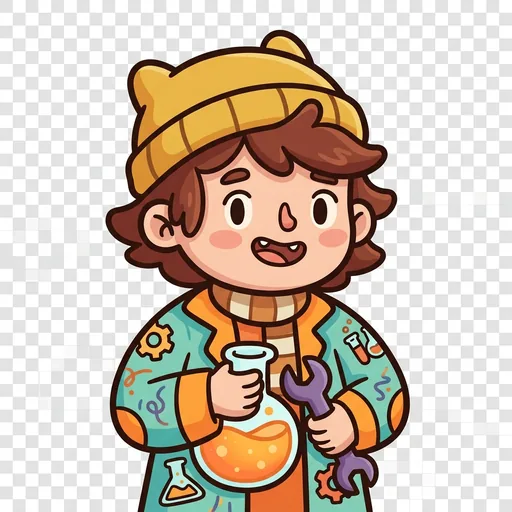
Check
Experiment — design + run the test; 'One test at a time.'
-
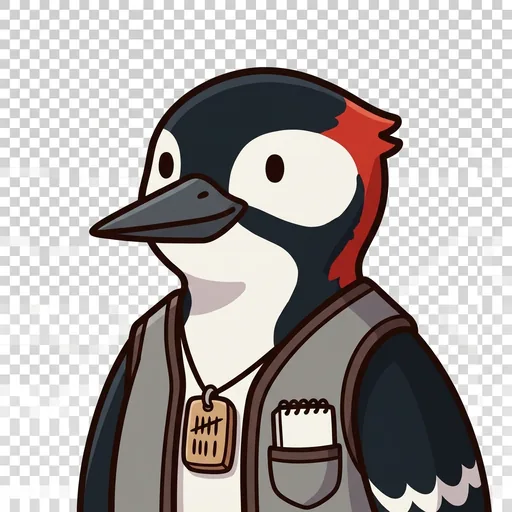
Again
Replicate — repeat to be sure; 'One result is a maybe. Do it again.'
-
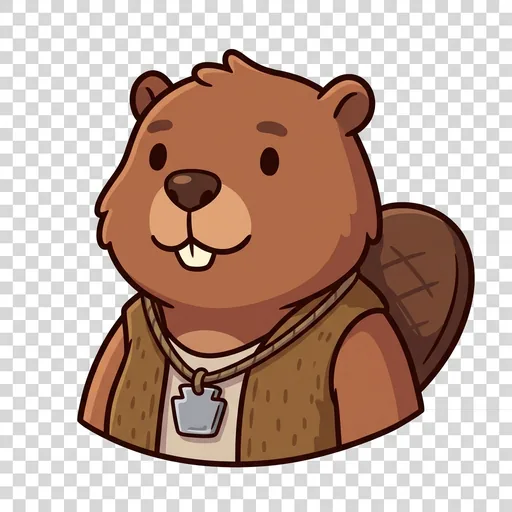
Because
Argue from evidence — back a claim with the reason; 'I think Y, because I saw X.'
-
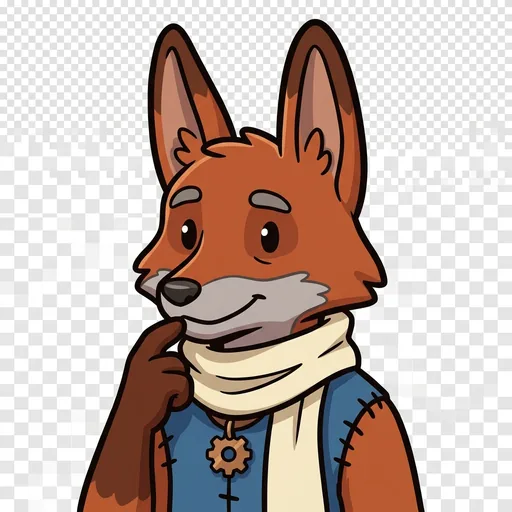
Explain
Explain the mechanism — the how-and-why that connects cause to effect; 'Know THAT, then know WHY.'
-
Reflect
Learn — interpret results + revise; 'What did we learn? What surprised us?'
