
Model
MODEL — you can't shrink a mountain or fly out to poke a planet. so build a small stand-in you CAN poke, that behaves like the big thing where it matters — and learn the giant from the little.
Loading audio…
Press play to listen along. The line being read lights up as you go.
Show full transcript
Loading transcript…
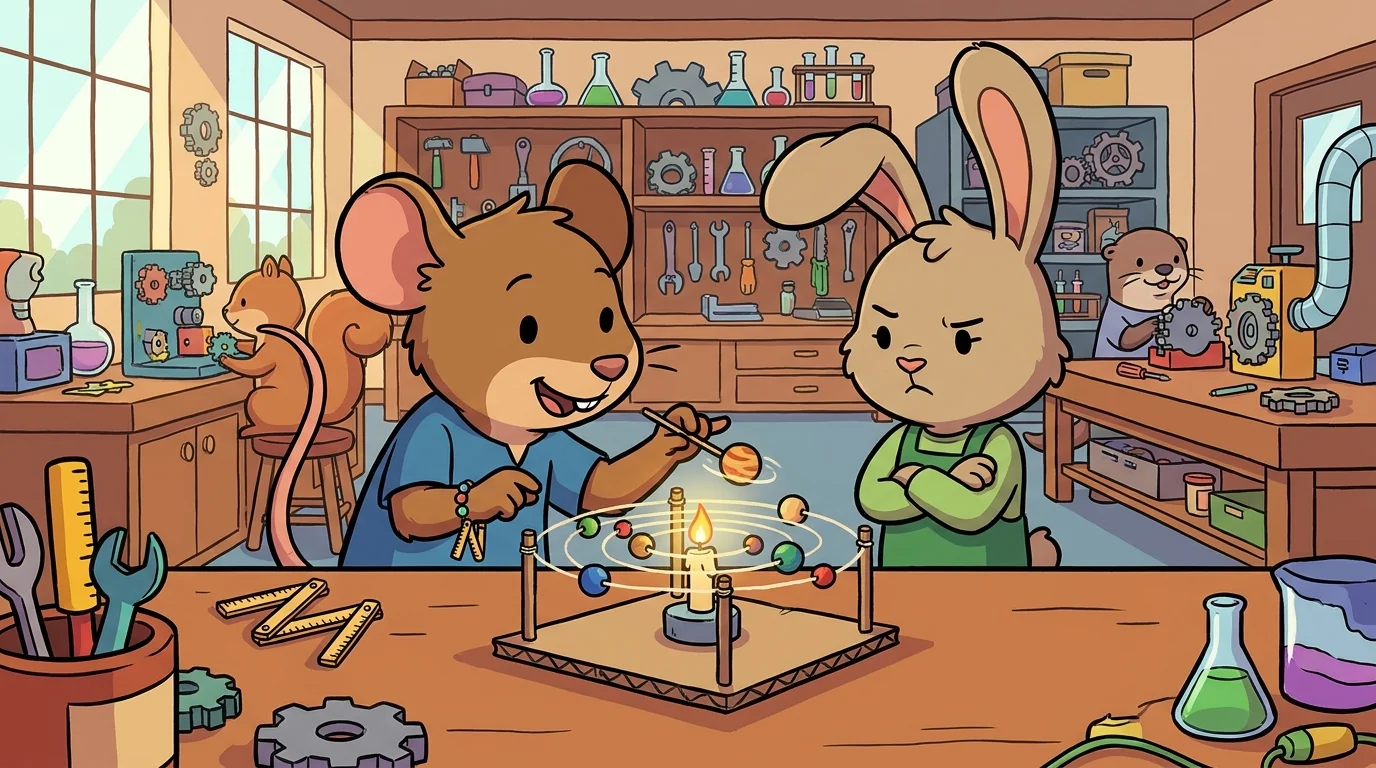
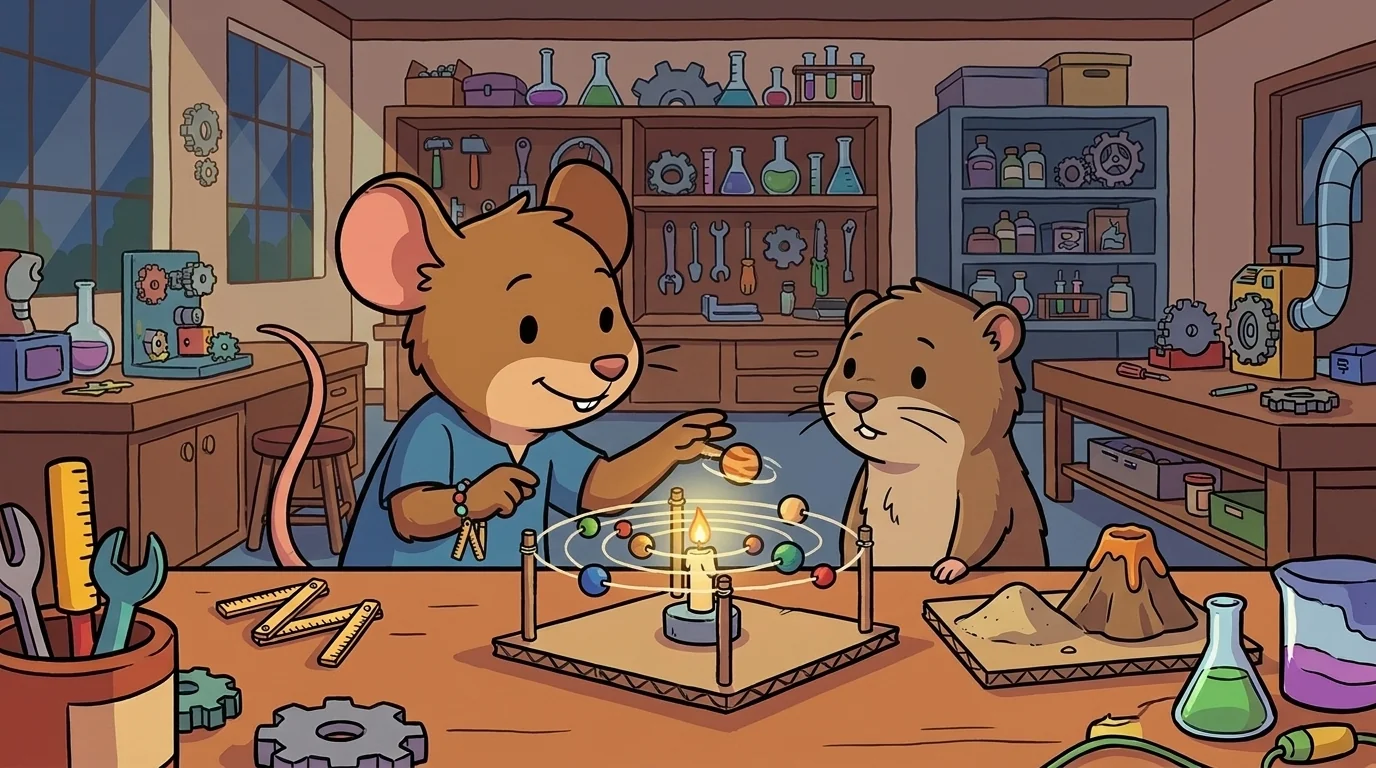
At a workbench in the Grand Laboratory, a clever mouse named Model was building a tiny cardboard-and-string solar system — while beside her a rabbit insisted, glumly, that you could never understand the real planets, because they were far too enormous and far too far away to ever poke.
Model was inventive and quick-pawed, always cutting and folding something into a small stand-in for a big thing, a little folding-ruler charm at her wrist. The rabbit sighed at her wobbling bead-planets. "That's not real, though. The real planets are gigantic and millions of miles away. You can't learn anything real from little balls on strings."
"You can learn an enormous amount," Model said, spinning a bead-planet around a candle-sun. "Look — I can't shrink Jupiter down and hold it in my paw, and I certainly can't fly out and poke it. It's too big, too far, too impossible. So instead I build a small version I can poke — and I make sure it behaves like the real one in the parts that matter." She nudged the bead closer to the candle. "Watch. When I move this planet-bead nearer the sun, it has to swing faster to hold its orbit — see it speed up? Now I've learned something about the real planets I could never test directly: the closer ones probably go around faster. I didn't touch a real planet. But my little stand-in let me poke it, change it, and see what happens." She touched her folding-ruler charm. "A model isn't the real thing — I know these are beads, not worlds, and it leaves a thousand things out. But a good model behaves like the big thing where it counts, so I can experiment on the little one and learn about the giant one I could never reach."
The rabbit blinked at the spinning beads. "So even though it's just cardboard and string... it can teach you real things about the actual planets?"
"That's the whole power of it," Model said. "Too big, too far, too slow, too dangerous — a mountain, the moon, a hurricane, the inside of a volcano. You can't experiment on those. So you build a small stand-in that works the same way in the important parts, and you experiment on that."
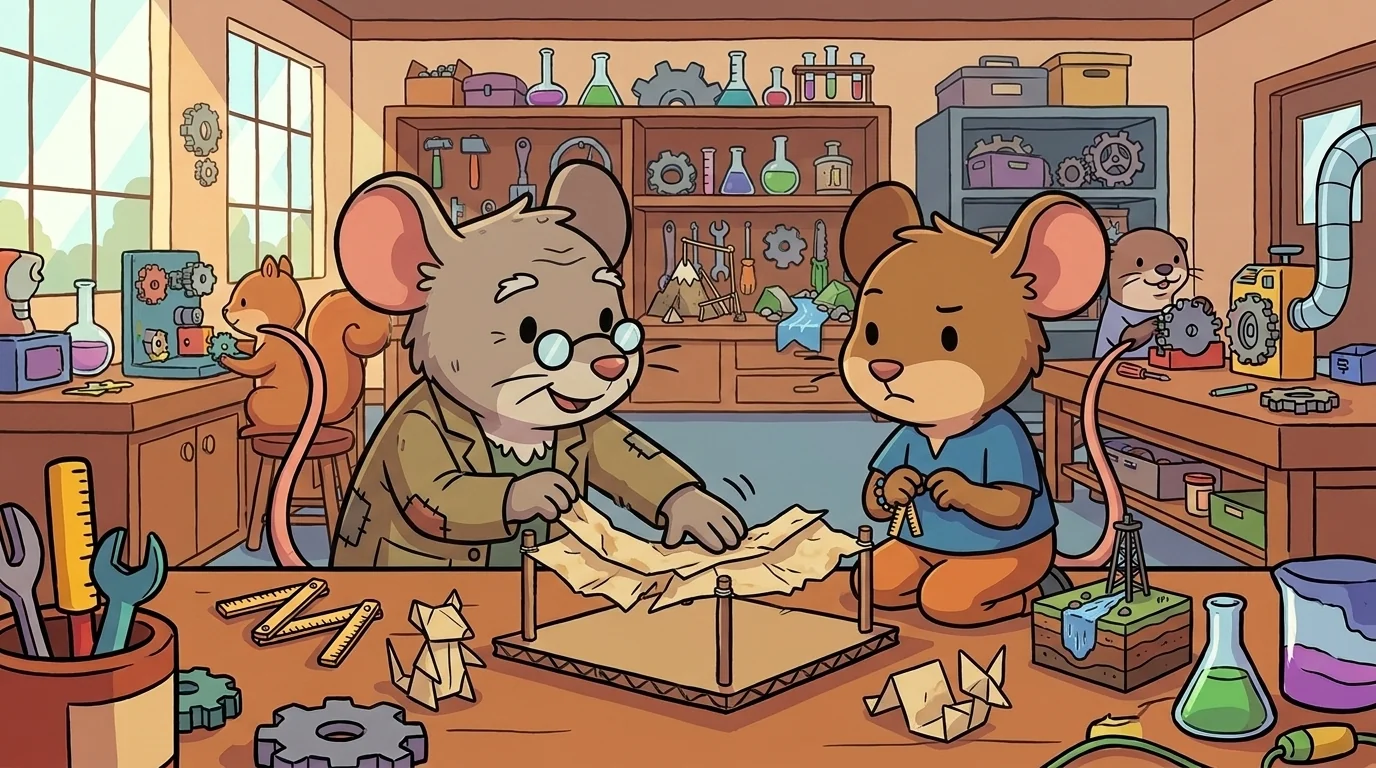
Model had not always trusted small things to teach big ones. When she was young, she'd frozen up in the face of anything too large to hold.
There was a river near her home that flooded every spring, and she was terrified of it — a huge, roaring, unpokeable thing. She wanted to understand why it flooded some years worse than others, but the river was so vast and so dangerous that she felt utterly helpless before it. So she did nothing. She just stayed afraid, because the thing she feared was too big to study and too big to fight, and that helplessness sat in her like a stone.
It was her aunt, a builder, who dug a little channel in the mud behind the burrow, no longer than an arm, and poured water down it. "Watch," she said, and dropped in pebbles to make a dam, and let the water back up and overflow. "Your river is just this — bigger." And Model watched her tiny mud-river flood exactly the way the real one did, and something enormous loosened in her chest. The real river was still huge, still dangerous, still un-pokeable. But now she had a version she could poke — could dam, could flood, could understand — and through it she finally had a grip on the giant that had frightened her for years. The stone of helplessness turned into something she could hold in one paw.
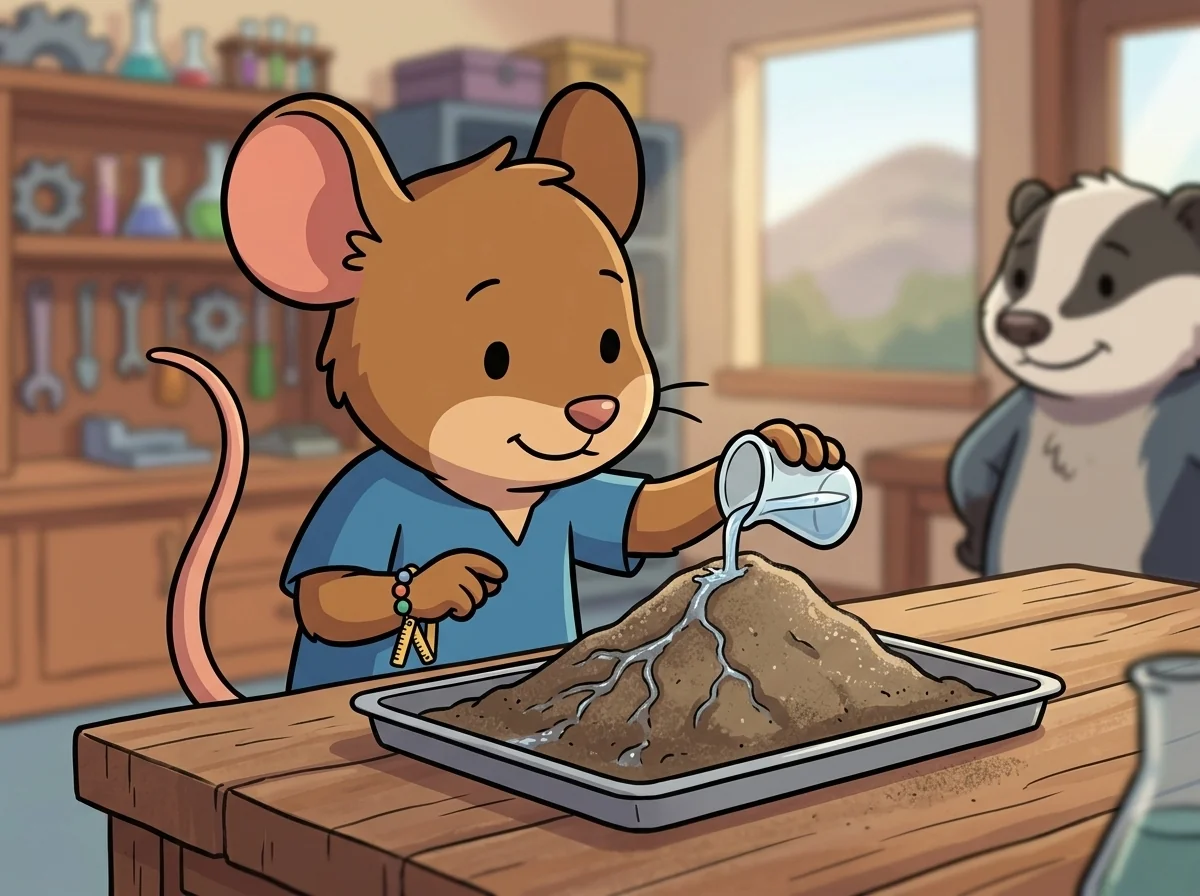
She walked to the Grand Laboratory at twelve, drawn to the one place that treated a cardboard stand-in as a serious instrument.
Smithy, the badger who ran the lab, met her at the door and set down a sealed glass globe with clouds swirling inside it. "How would you study a storm," he asked, "without standing in one?"
The old, frozen Model would have said you couldn't. This Model didn't hesitate. "I'd build a small one I could stand next to. A jar with warm water at the bottom and cold air at the top, so I can watch the clouds form where I can actually see them. It wouldn't be a real storm — but if it makes clouds the same way, I can poke it, change the temperature, and learn what makes the real one bigger." She nodded at the globe. "A stand-in I can reach beats a real thing I can't, every time."
Smithy turned the little globe in his paws. "Most young ones tell me a storm's too big to study," he said. "You told me how to shrink it down to your bench. That's the move that lets us study everything from atoms to galaxies. You belong here."
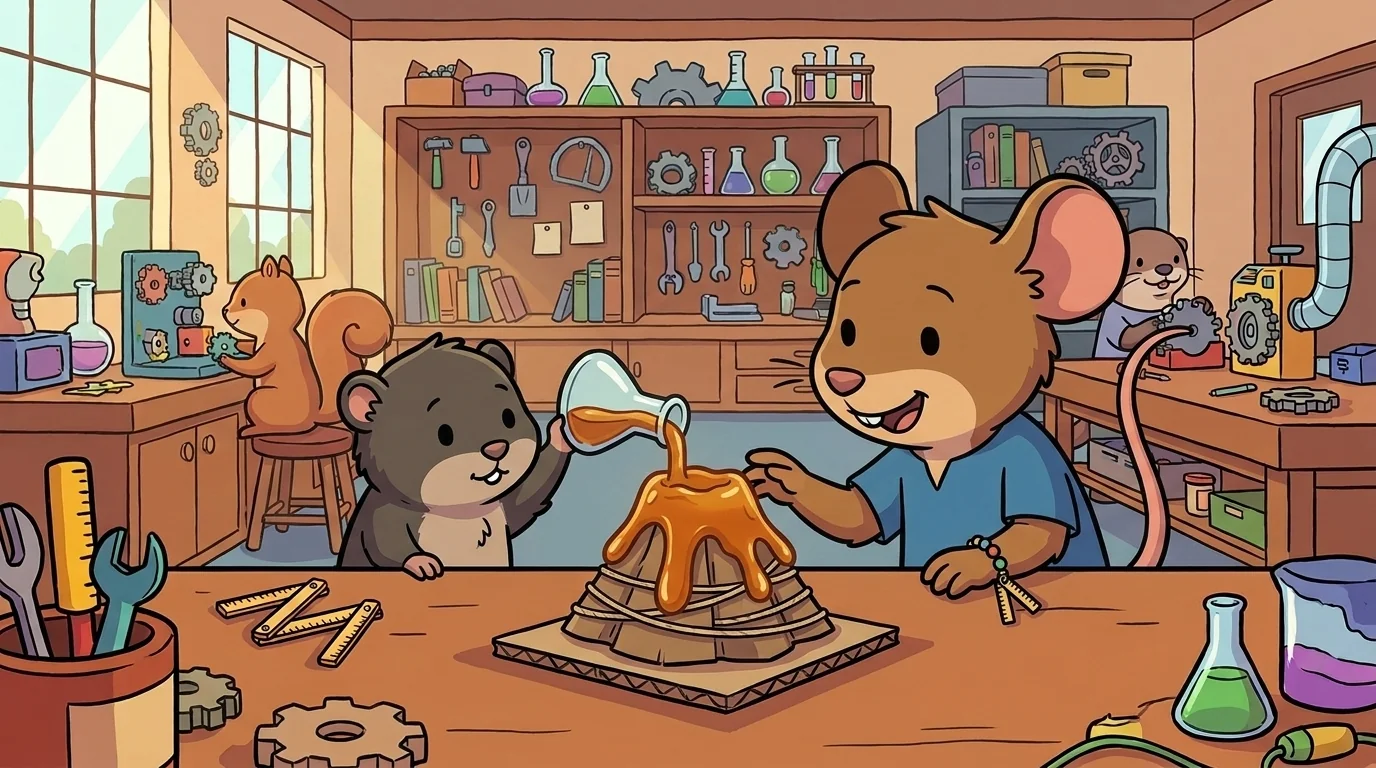
Over the years, Model's bench filled with kids stopped cold by things too big to touch.
One afternoon a girl slumped down beside a poster of the whole water cycle. "I have to understand how all of this works," she said, gesturing at oceans and clouds and mountains and rain. "It's too much. I can't hold it in my head, let alone test it." Model recognized the flattened, helpless look — the river-stone look. "You don't have to hold the whole thing," she said. "You build a piece of it, small enough to poke. Watch." She set a bowl of warm water under a plate of ice. "There's your ocean and your cold sky. Wait." Soon, tiny droplets gathered under the plate and fell. "Rain," Model said. "You just made the water cycle on a bench. Not all of it — but the part where warm water rises, meets cold, and falls. Now you can change it: warmer water, colder plate. You can experiment on a thing that felt too big to even look at." The girl stared at the falling droplets. "So I don't understand the whole cycle at once... I understand it one little pokeable piece at a time?" "That's the only way anyone ever has," Model said. "Nobody holds the whole ocean in their head. We build small pieces we can touch, and the giant becomes understandable one stand-in at a time." She touched her charm. "A thing too big to study isn't a wall. It's an invitation to build something small enough to poke." The girl reached for a bowl of her own, and Model watched the helpless slump lift as the impossible thing became a bench-sized experiment.
When the lab had emptied and the light had gone gold, the girl came back with a smaller question.
"Doesn't it bother you," she asked, "that a model is always wrong? It always leaves things out. It's never really the thing."
Model thought about a river that had terrified her, and a little mud-channel that had let her finally hold it.
"It used to bother me," she said. "I wanted my stand-in to be the real thing, and it never could." She turned her folding-ruler charm slowly. "But a model isn't supposed to be the real thing. It's supposed to be pokeable. Being a little wrong is the price of being small enough to touch — and something you can touch and change and learn from beats something perfect you can only stand helplessly beside. The model gives you a grip on the giant. That's the whole gift."
She felt it as she said it — that capable, grounded steadiness spreading warm through her chest, her quick paws going still and certain, her breath easy in the way of someone who no longer feels helpless before big things. Not the frozen dread of the river-stone years. The bright, resourceful calm of someone who knows that anything too big to poke can be shrunk to something that fits on a bench.
"That's the feeling I build toward now," she told the girl, and her folding-ruler charm gleamed. "Not standing helpless before the giant. Building the small thing that lets me finally get my paws on it."
The LabSmith ensemble
Model is part of LabSmith's distributed-narrative cast. Each character embodies a different curricular primitive; together they teach the full subject.
-
Query
Ask a good question — sharp + answerable; 'Where science starts.'
-

See
Observe — gather raw data first; 'Look first. Talk later.'
-

Guess
Hypothesize — frame a testable guess; 'What if…?'
-
Meter
Measure precisely — a number and a unit; 'How much, exactly?'
-

Check
Experiment — design + run the test; 'One test at a time.'
-
Again
Replicate — repeat to be sure; 'One result is a maybe. Do it again.'
-

Because
Argue from evidence — back a claim with the reason; 'I think Y, because I saw X.'
-
Explain
Explain the mechanism — the how-and-why that connects cause to effect; 'Know THAT, then know WHY.'
-

Reflect
Learn — interpret results + revise; 'What did we learn? What surprised us?'