
Query
QUERY — a good question is where science starts. not a fog you can never enter, but a sharp door you can actually walk through — a question narrow enough to answer.
Loading audio…
Press play to listen along. The line being read lights up as you go.
Show full transcript
Loading transcript…
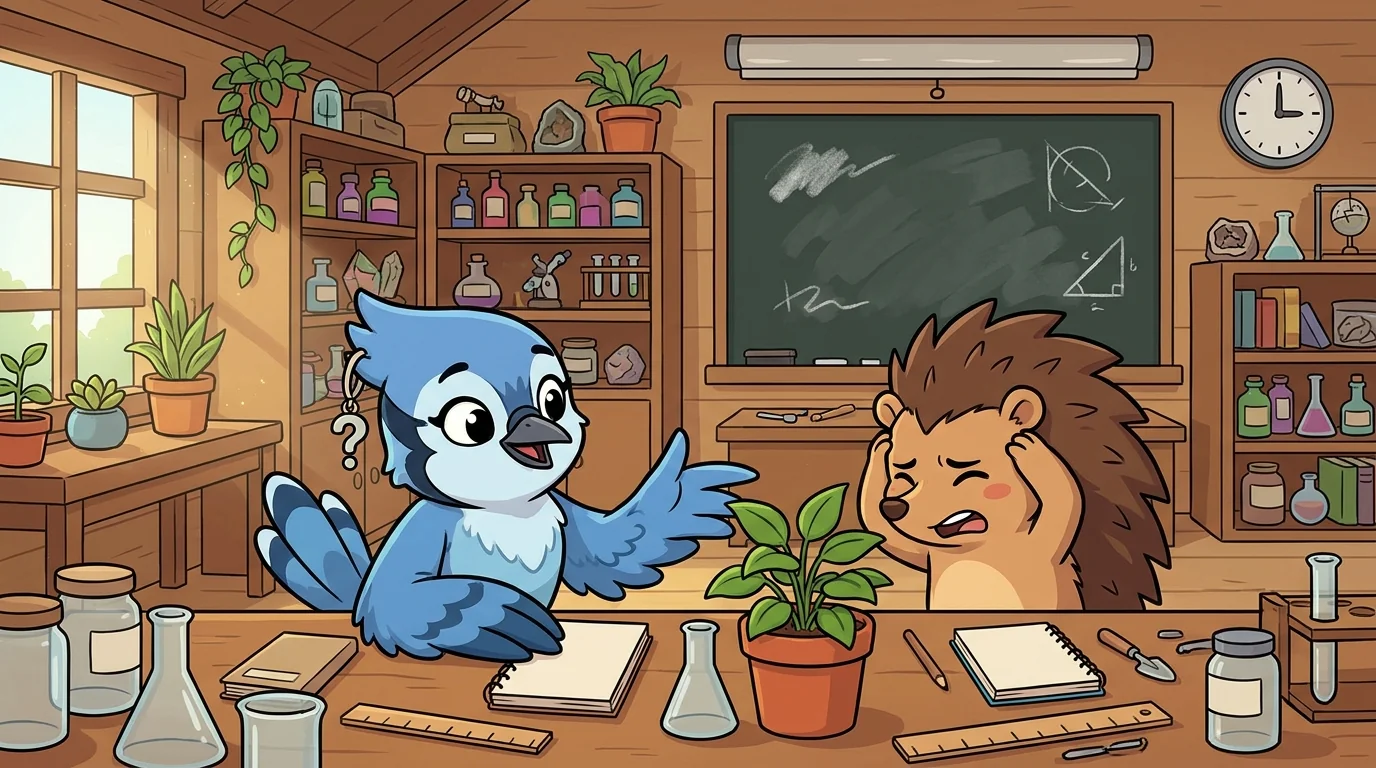
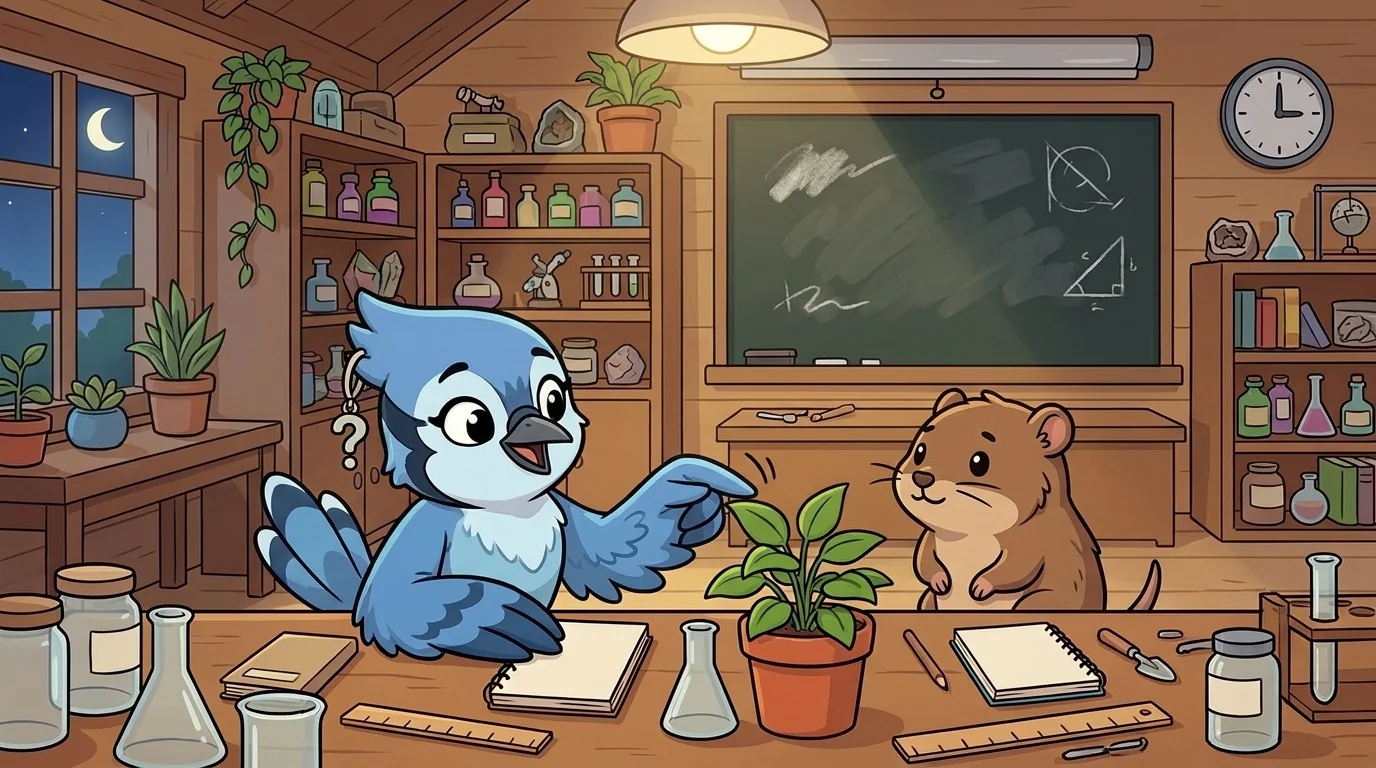
At a workbench in the Grand Laboratory, a bright-eyed jay named Query sat with her head tilted at a wilting fern, turning a huge fuzzy wondering into a small sharp one — while beside her a hedgehog held a question so enormous it had frozen him solid.
Query was quick and curious, her feathers half-fluffed with interest, a little question-mark charm swinging from a ribbon at her wing. The hedgehog glowered at the plant as though it had insulted him. "I want to know why plants grow," he announced. "That's my question. Why do plants grow." He folded his arms and waited, as if the fern might clear its throat and explain itself. It did not.
"That is a genuinely beautiful wondering," Query said, and she meant it. "It's also completely unanswerable — not because it's silly, but because it's shaped wrong for answering. 'Why do plants grow' has a thousand doors and no floor. Sunlight, water, soil chemistry, the whole invisible machinery of a cell — where would you even set your foot down? You'd need a hundred lifetimes and you still wouldn't know where to start tomorrow morning." She hopped a step closer along the bench. "So watch what I do to it. I don't throw it away. I sharpen it." She looked at the fern, then at a second fern on the far shelf. "Does this fern grow taller when it gets more light than that one? There. Feel the difference? That's a question with a floor under it. Put one in bright light, one in dim, wait a week, measure both. The fog just became a door you can walk through."
The hedgehog's spines settled a fraction. "So the huge one's no good?"
"The huge one is your north," Query said, tapping her charm. "It's the reason you're standing here at all — keep it. But you never answer your north directly. You answer it one small, sharp, walk-through-able question at a time, and each answer lights the next door. A vague question is a wish. A sharp question is an instruction."
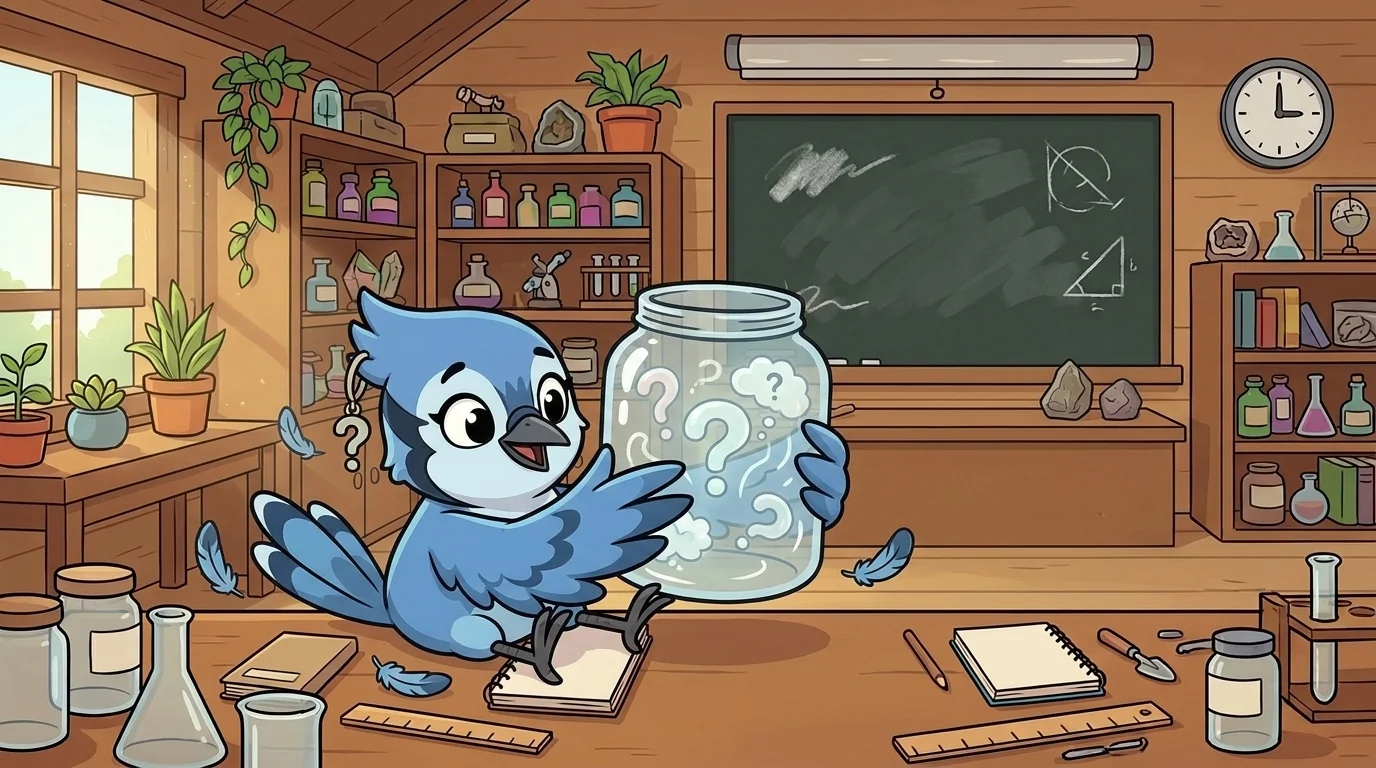
Query had not always known how to shrink a question. When she was younger, she'd been drowned by her own curiosity.
She had wanted to know everything about the sky — all at once, that summer. She'd lie on her back in the meadow and try to hold it in her head: why blue, why clouds, why the moon changed, why some stars were brighter, why the sun felt hot and the moon didn't. The questions came so fast and so wide that they piled on top of one another until she couldn't move under the weight of them. She stopped even going outside. What was the point of looking, when there was so much she'd never understand? The bigness of it hadn't inspired her. It had crushed her flat.
Then one dusk her grandmother found her lying in the dim burrow and asked, mildly, "What did the shadow of the fence post do today, from lunch to supper?"
Query didn't know. She hadn't looked.
"Small enough to check by tomorrow," her grandmother said, and left it there.
So Query went out and marked the shadow's tip at lunch, and again at supper, and it had crept a whole wing-length across the dirt. One thing. She had actually found out one true thing. And the strange part — the part she never forgot — was that the small answer didn't shrink the sky. It made the sky feel enter-able for the first time. She could get in. One sharp question was a foothold, and from a foothold you could climb.
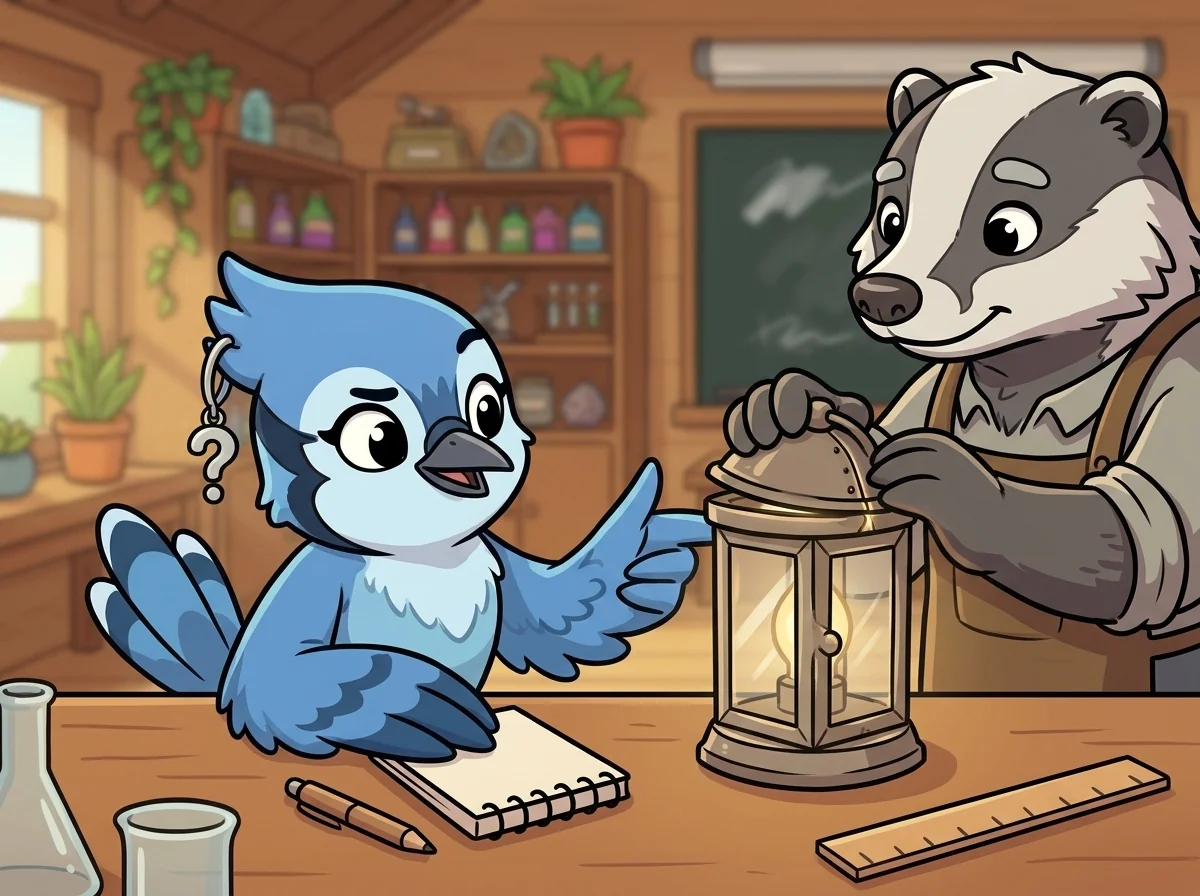
She walked to the Grand Laboratory at twelve, reasoning that a place built on finding things out would respect the difference between a wondering and a question.
Smithy, the badger who ran the lab, met her at the door and did not ask her to name a law or recite a fact. He set a sealed jar of murky pond water on the table, something drifting faintly inside it, and said only: "Ask me one thing about this that we could actually answer before you go home tonight."
The old Query — the meadow one — would have blurted what's alive in there, what's it all made of, where did it come from. This Query took a slow breath and looked. She did not ask the fog. "Does anything in that jar move on its own," she said, "when I hold a candle to one side?" A pause. "That's answerable. Light it, watch which way things drift, before dark."
Smithy's whiskers moved. "Most young ones hand me the ocean," he said. "You handed me a cup I can lift. That is the first move of the whole method — not the guess, not the test. The question you can close. You belong here."
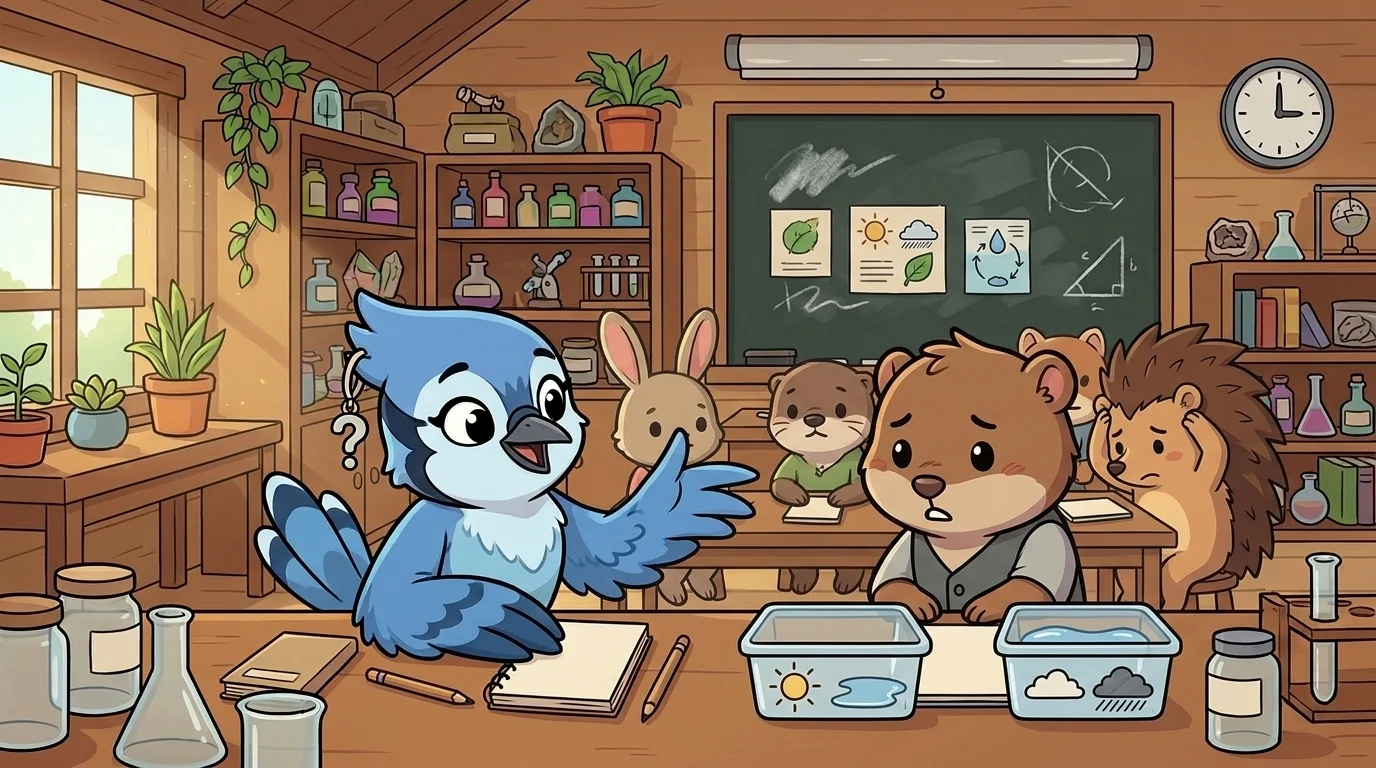
Over the years, Query's corner of the lab filled with kids stalled at the edge of questions too big to enter.
One afternoon a boy dropped onto the bench, deflated, staring at a tank of tadpoles. "I want to know why some grow faster than others," he said. "But every time I start, there's just... too much. I give up before I begin." Query recognized the flatness in his voice — the meadow weight, the crushed-by-vastness slump. She didn't tell him his question was bad.
"Your question isn't too big," she said gently. "It's just not cut yet. Watch." She tilted her head at the tank. "Pick two tadpoles. Feed one twice a day, one once. Same tank, same light. Measure both on Friday. Now — does the one fed more grow longer by Friday?" The boy blinked. "That's... I could actually do that." "You could do it this week," Query said. "And here's the trick you keep forever: whenever a question makes you feel that heavy, hopeless, don't-even-start feeling — that feeling isn't 'I'm not smart enough.' It's 'this question isn't cut small enough yet.' The feeling is information. It's telling you to sharpen, not to quit." The boy pulled the notebook toward himself, and Query watched the slump come out of his shoulders as the question got small enough to hold.
When the lab had emptied and the light had gone amber, the boy came back with a smaller, quieter question of his own.
"When you cut a huge question down to a tiny one," he said, "don't you ever feel like you gave up on the big beautiful thing?"
Query thought about a fence-post shadow, and a summer she'd spent flattened under the whole sky.
"I used to think so," she said. "I thought small meant surrender." She looked out the window at the first stars. "But it's the opposite. The big question stays whole — I never touch it. I just keep opening small doors, and every door I walk through shows me another. The sky I couldn't hold is still up there, entire. I'm just finally inside it instead of crushed beneath it."
She felt it as she said it — that light, unlocking ease spreading through her chest, her wings loosening from their fluffed-up guard, her breath coming easy and slow. Not the frantic dizziness of wanting to know everything at once. The steady, glad lightness of knowing exactly what she'd find out first.
"That's the feeling I chase now," she told the boy, and her question-mark charm caught the last of the light. "Not the whole sky in one gulp. One sharp door — and the walking through."
The LabSmith ensemble
Query is part of LabSmith's distributed-narrative cast. Each character embodies a different curricular primitive; together they teach the full subject.
-
See
Observe — gather raw data first; 'Look first. Talk later.'
-
Guess
Hypothesize — frame a testable guess; 'What if…?'
-
Model
Model it — build a small stand-in you can poke; 'Learn the big thing from the little one.'
-
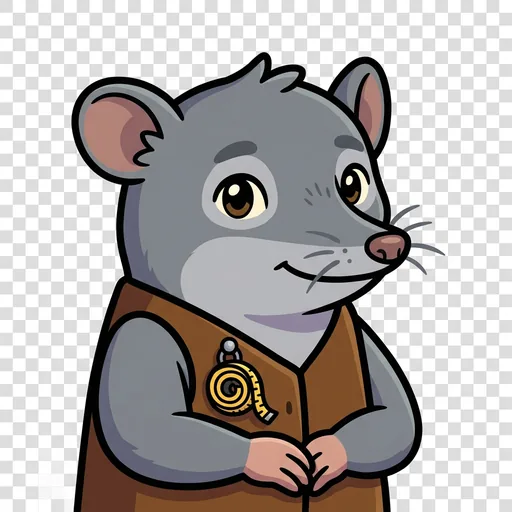
Meter
Measure precisely — a number and a unit; 'How much, exactly?'
-
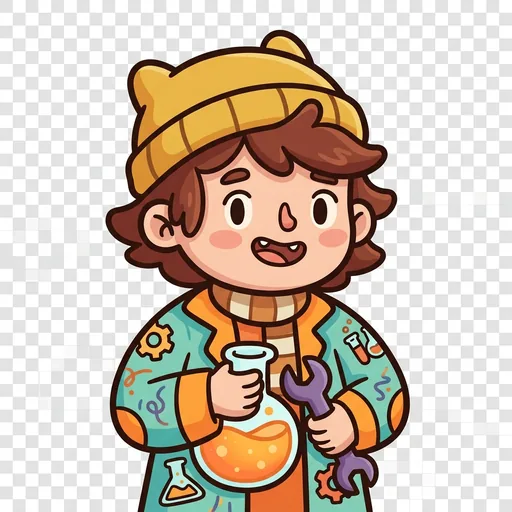
Check
Experiment — design + run the test; 'One test at a time.'
-
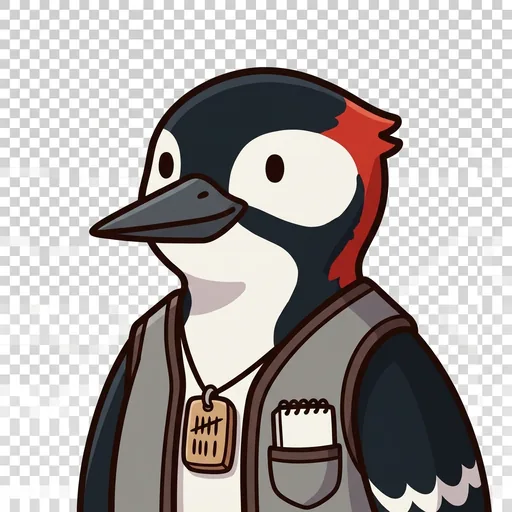
Again
Replicate — repeat to be sure; 'One result is a maybe. Do it again.'
-
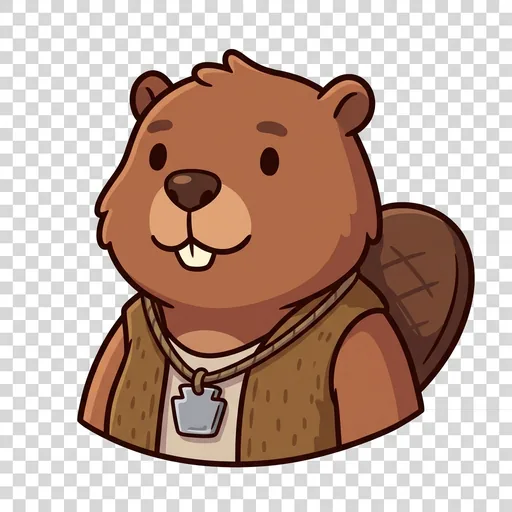
Because
Argue from evidence — back a claim with the reason; 'I think Y, because I saw X.'
-
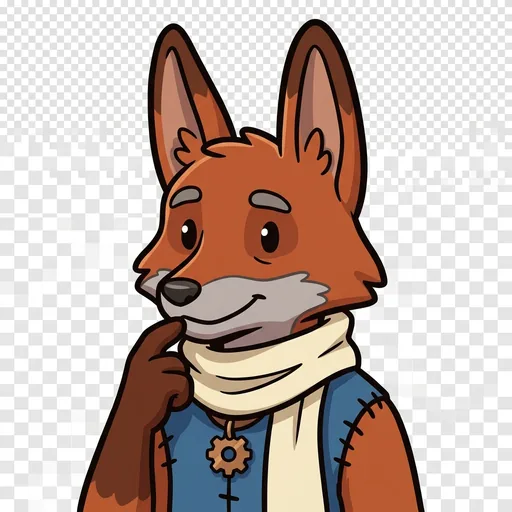
Explain
Explain the mechanism — the how-and-why that connects cause to effect; 'Know THAT, then know WHY.'
-
Reflect
Learn — interpret results + revise; 'What did we learn? What surprised us?'