
Reflect
REFLECT — *what did we learn? what surprised us? what's next?*
Listen along — Reflect
Loading audio…
Press play to listen along. The line being read lights up as you go.
Show full transcript
Loading transcript…
Chapter 4 — Reflect and the What-Did-We-Learn
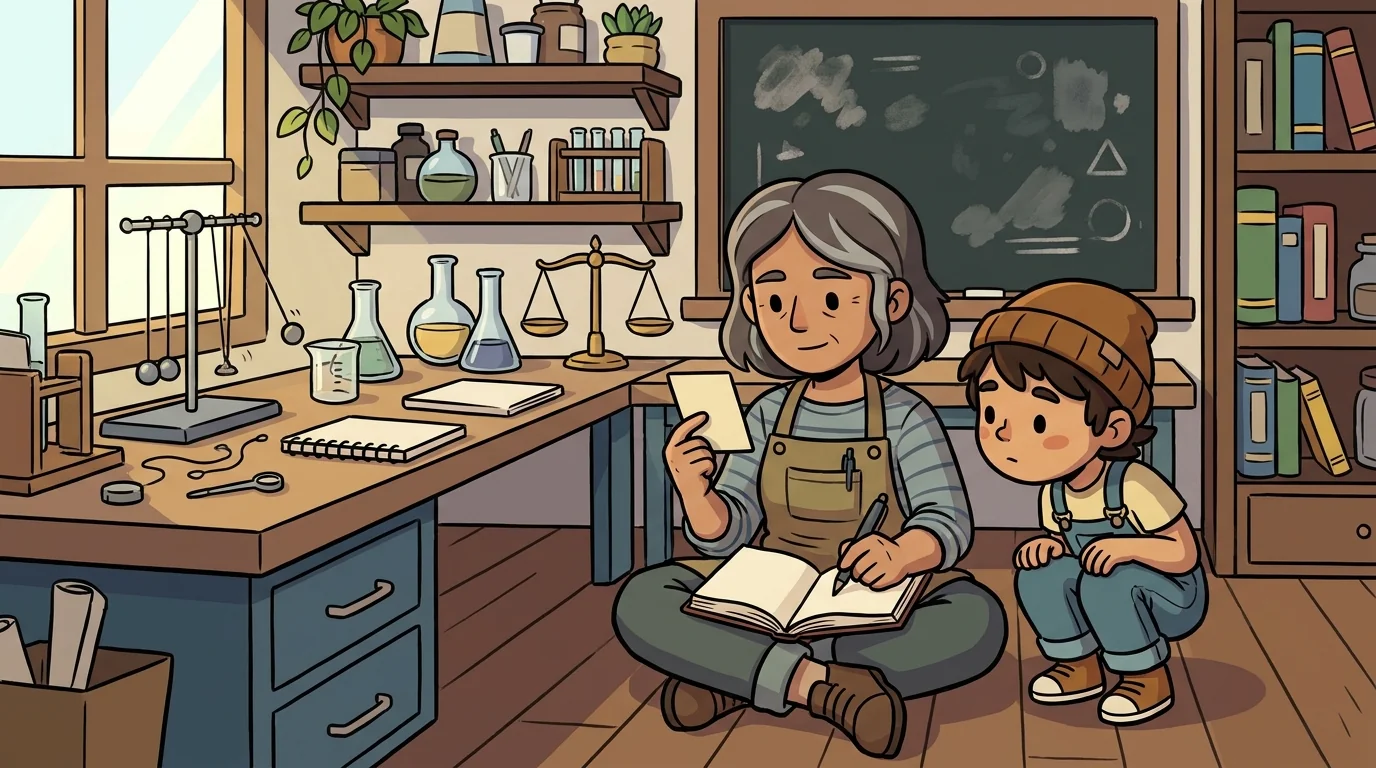
The pendulum experiment was finished, the data was collected, and the cast thought they were done. Reflect knew they were only halfway.
Check laid out the numbers: length thirty centimeters, period one-point-one seconds; fifty centimeters, one-point-four; seventy centimeters, one-point-seven. “There,” Check said. “Longer pendulums swing slower. Hypothesis supported. Done.”
“Almost,” Reflect said, opening the journal, unhurried as always. “The experiment doesn’t speak for itself. We have to ask it what it MEANS. So: what did we learn? Longer pendulums have longer periods — yes, the hypothesis held. But now the harder question. What SURPRISED us?”
The cast looked at the numbers again. Reflect traced them with a slow claw. “Thirty to fifty added three-tenths of a second. Fifty to seventy… also added three-tenths. The period isn’t growing in a straight line — it’s flattening out. That’s strange. That’s the data telling us something we didn’t predict.”
Reflect plotted the points on the revision-card, and a gentle curve appeared. “Look. This bends like a square root. The period might depend on the square root of the length, not the length itself — a deeper relationship than ‘longer equals slower.’ We didn’t guess that. The data taught it to us. And THAT,” Reflect said, tapping the card, “is the whole point. Raw data isn’t the answer. It’s the beginning of the next question.”
Check leaned in, curiosity kindling. “So what’s next?”
“New hypothesis: period is proportional to the square root of length. New experiment: more lengths, and check it against the math. And around we go again.”
Smithy the mentor smiled warmly. “Reflect closes the loop and opens the next one,” Smithy said. “See. Guess. Check. Reflect — and then observe again. Science isn’t a thing you finish. It’s a circle you walk, and every honest reflection sets your foot on the next step of it. Walk it once and you’ve learned. Keep walking it, and you’ve become a scientist.”
“What did we learn? What surprised us? What’s next?”
The LabSmith ensemble
Reflect is part of LabSmith's distributed-narrative cast. Each character embodies a different curricular primitive; together they teach the full subject.
-
Query
Ask a good question — sharp + answerable; 'Where science starts.'
-

See
Observe — gather raw data first; 'Look first. Talk later.'
-

Guess
Hypothesize — frame a testable guess; 'What if…?'
-
Model
Model it — build a small stand-in you can poke; 'Learn the big thing from the little one.'
-
Meter
Measure precisely — a number and a unit; 'How much, exactly?'
-

Check
Experiment — design + run the test; 'One test at a time.'
-
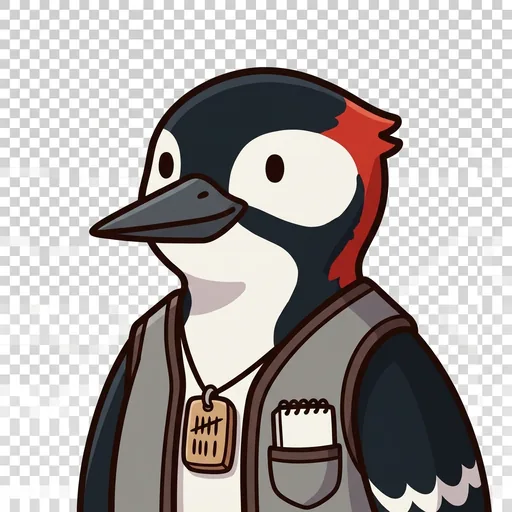
Again
Replicate — repeat to be sure; 'One result is a maybe. Do it again.'
-

Because
Argue from evidence — back a claim with the reason; 'I think Y, because I saw X.'
-
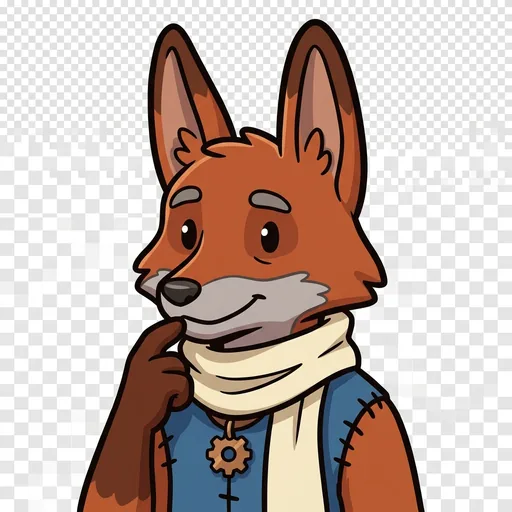
Explain
Explain the mechanism — the how-and-why that connects cause to effect; 'Know THAT, then know WHY.'