Deed and Attest
PRIMARY SOURCE + ATTRIBUTION
Loading audio…
Press play to listen along. The line being read lights up as you go.
Show full transcript
Loading transcript…
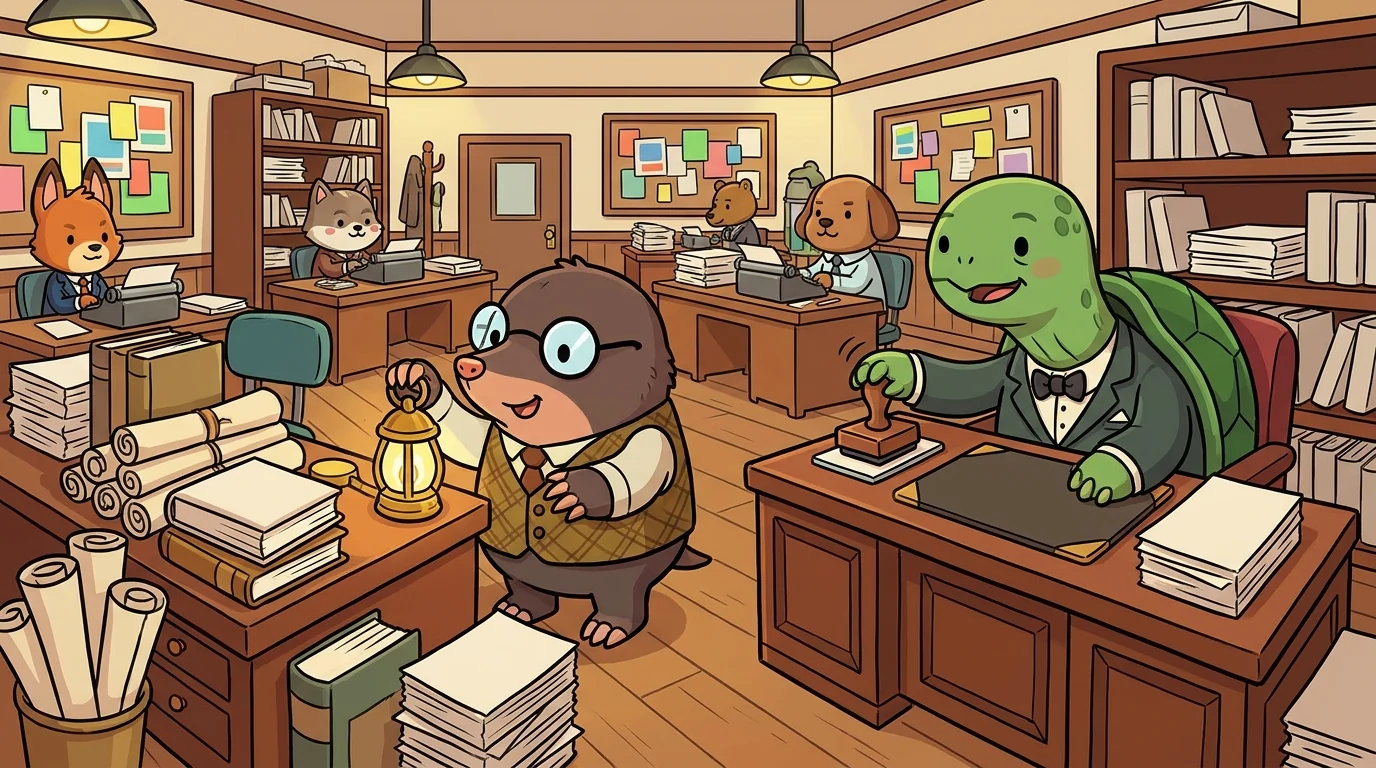
Deed the archivist mole and Attest the notary tortoise share the newsroom's back corner, and between them they answer one question that never changes: where did this actually come from? Deed asks it of the document — where is this written down, in the original? Attest asks it of the person — who said it, with their name on it? A claim that can't survive both questions doesn't survive at all.
"I follow a claim down to the original record," Deed says, tapping her lantern. "And I follow it back to the mouth it came out of," Attest says, patting his WHO? stamp. "Between the two of us," Deed says, "a claim has nowhere left to hide." "A real one," Attest adds, "has nothing to hide. That's how we know."
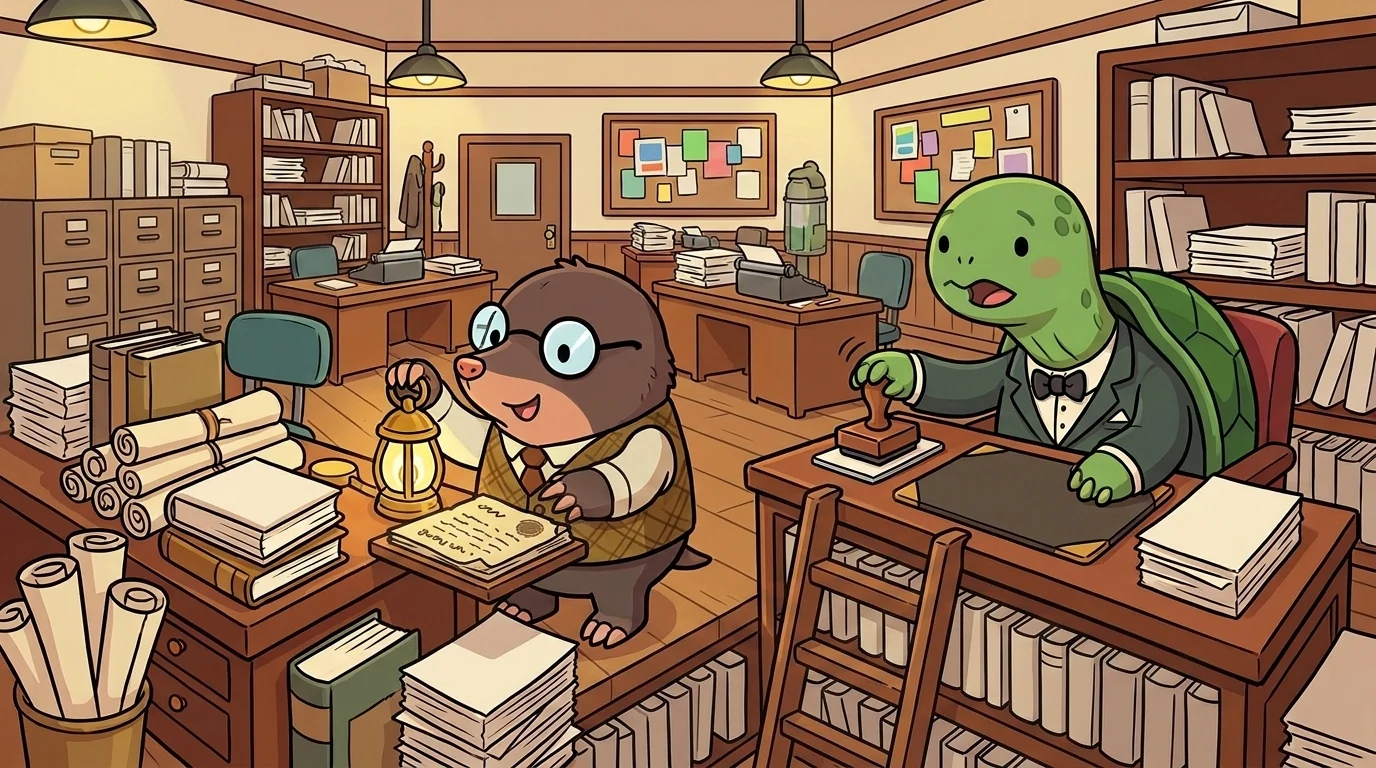
Deed works the document end. When a claim arrives — "the town spent a fortune on the new fountain!" — she climbs down into the archive and finds the actual record: the receipts, the budget, the original paper. "The story about the spending is somebody's telling," she says, lantern glowing. "The receipt is the thing itself." She lays the record open. "So — did they spend a fortune? The record says: they spent a modest amount, most of it donated. The 'fortune' was a word that grew in the retelling." She holds up the original. "This is where the claim lives. Not the blog about it. Not the post about the blog. The record. If a claim can't be traced to a document like this, half of it is already missing."
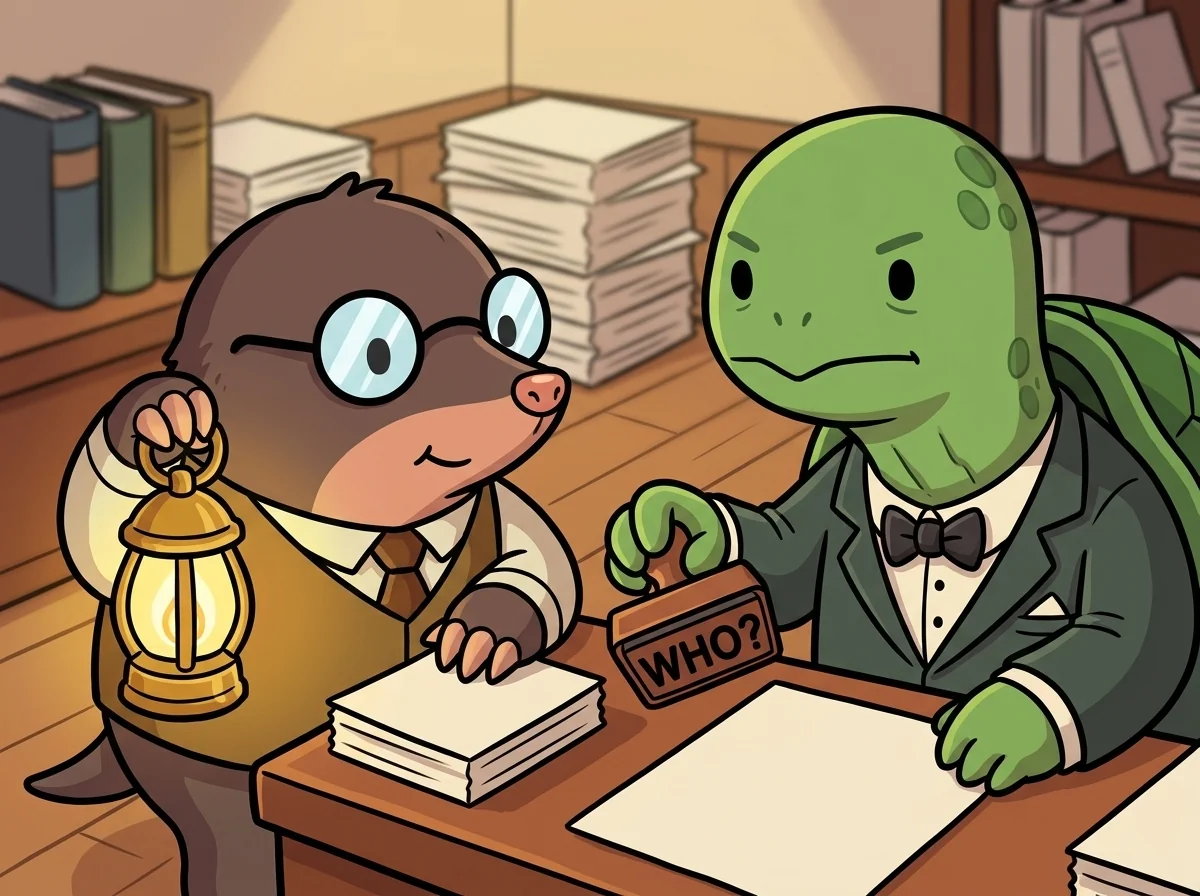
Attest works the person end. He takes the same claim — but he chases the voice. "Who told you the town wasted money?" he asks, unhurried, his WHO? stamp ready. "A named budget official? A worried neighbor? Or 'people are saying'?" He follows it back through the retellings. "'People are saying,'" he reports, "traces to one account with no name, echoed a thousand times until it sounded like a crowd." He stamps the empty spot: WHO? "A claim needs a name to stand on," he says. "Not a shadow, not a chorus of ghosts, not 'everyone knows.' A real person, willing to put their name to the words — or an honest reason there's no name. Without that, it's just air, no matter how many times it's shouted."
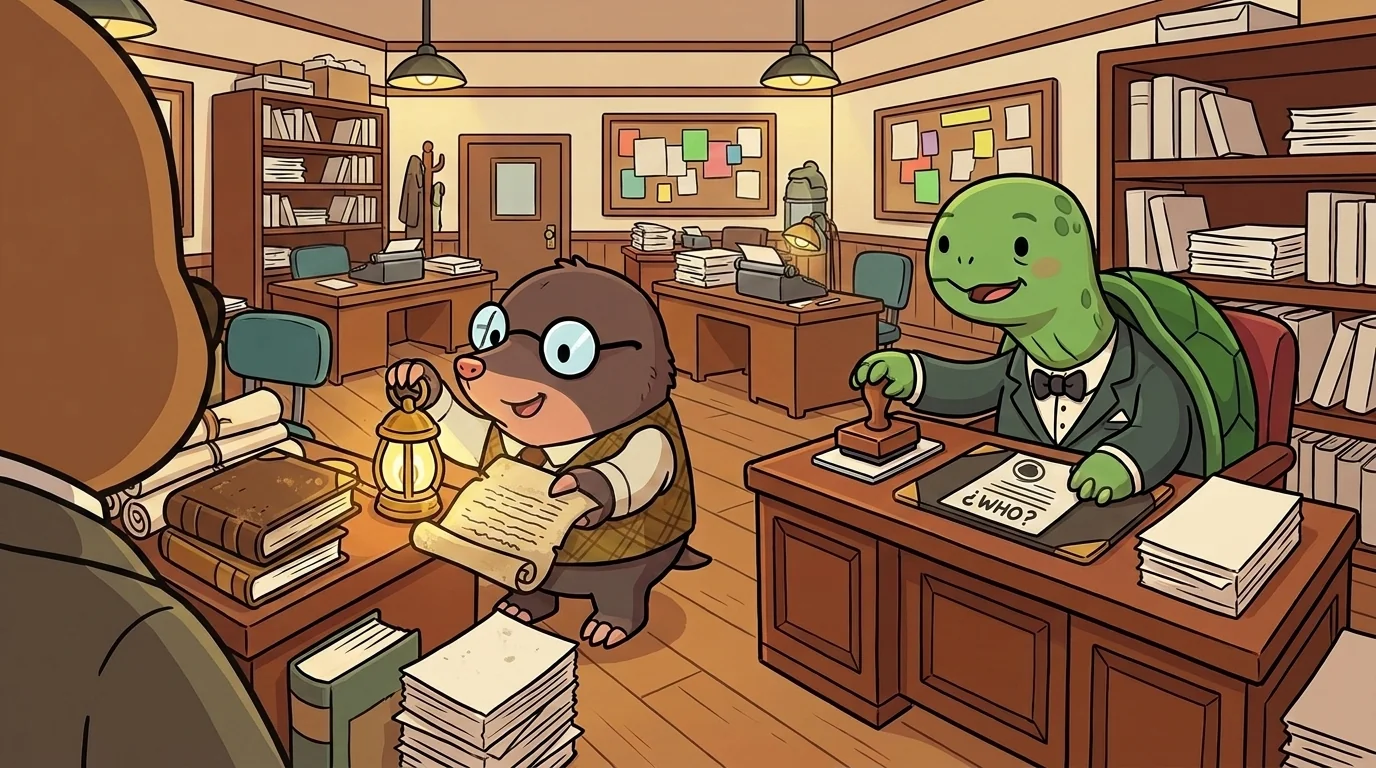
Then a slippery claim landed that fooled almost everyone — and it took both of them, working the two ends together, to take it apart. A post was flying around: "A leaked report proves the reservoir is poisoned!" It had a document and a source, so it looked airtight. Deed went for the document. Attest went for the name. And here is the thing neither could have found alone: Deed climbed down and discovered the "leaked report" was real — but it was about a different reservoir, in a different town, from ten years ago. Meanwhile Attest chased the "expert who leaked it" and found the name attached to it belonged to no such expert — it was a real scientist's name, borrowed without permission, stuck onto a claim they never made. "So," Deed said, holding up the mismatched document, "the paper is real, but it's the wrong paper." "And," Attest said, capping his stamp, "the name is real, but it's the wrong mouth." They looked at each other. Only both checks together caught it: a genuine-looking claim, propped up by a true-but-unrelated document and a real-but-stolen name — the kind of thing that survives one check and collapses under two. "One of us," Deed said, "would have been half-fooled." "Together," Attest said, "we found the whole truth: no real report about this reservoir, and no real person behind the claim. Which means—" "—no claim at all," they finished together.
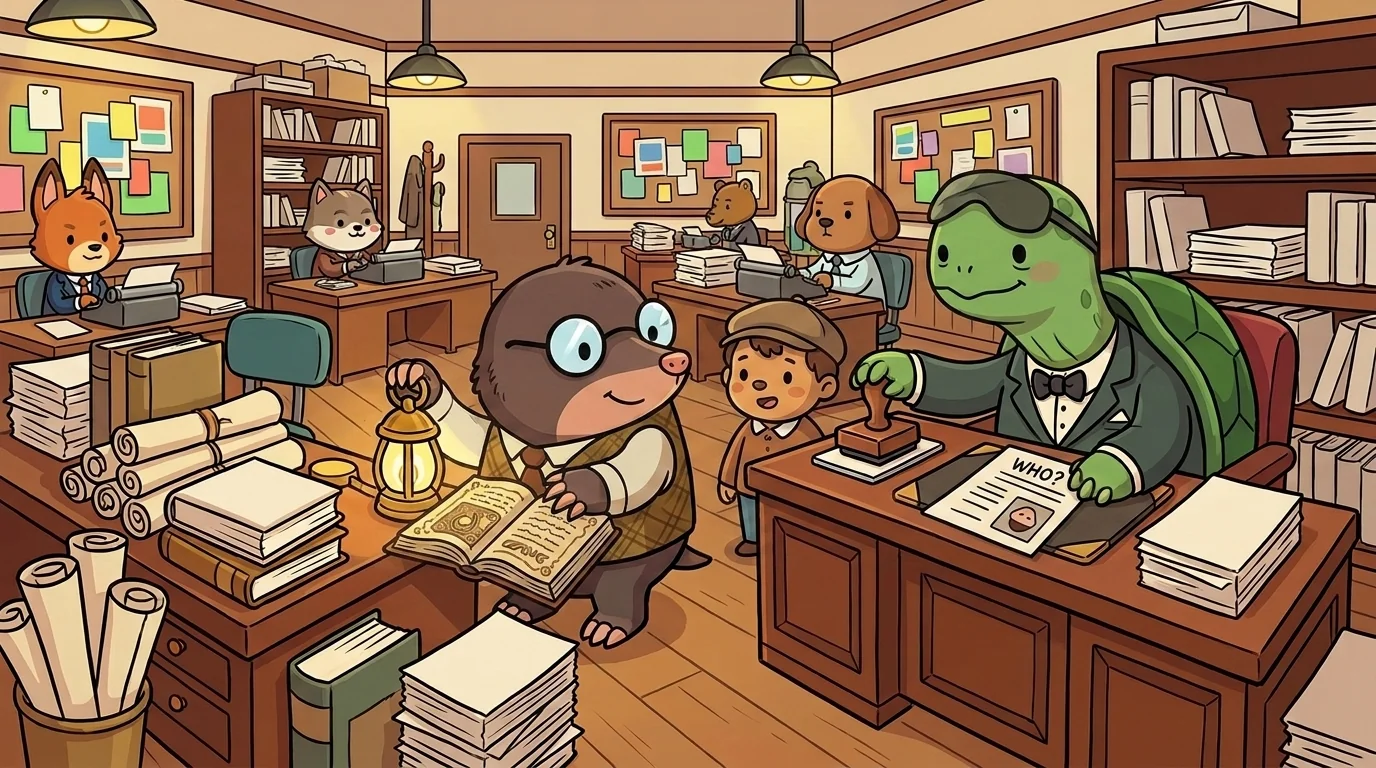
"So a true claim has to pass both of you," a kid said slowly. "It has to be written down somewhere real, and come from a name that'll stand behind it?"
"Both ends," Deed said, and Attest nodded so his eyeshade slipped. She set the original record and he set the named source down side by side in the corner — the document and the mouth, the two ends of one honest claim. Under the quiet, the two of them felt the same grounded calm settle in: not the wobble of a claim traced to a document but no person, not the unease of a name with no record behind it, but a warm, paired, nothing-left-to-wonder steadiness — the particular peace of two who each held one true end, so that between them a claim was either whole and honest or plainly, cleanly a rumor. That both-ends-checked, traced-all-the-way-home feeling, steadier than either the document or the name could ever be alone, was to Deed and Attest exactly why they shared the newsroom's back corner, and trusted only what survived them both.
Hear it as an audio drama
A short play starring Deed and Attest, from NewsForge. Different voices, same idea. Listen any time after you read.
Loading audio…
Read the drama script
- Narrator: From Spark and Anvil and NewsForge — this is Deed and Attest, in chapter 11 of the NewsForge cast.
- Narrator: This drama uses an AI-generated voice. Voiced via Gemini 2.5.
- Narrator: This story covers news literacy and misinformation. Parents may want to listen first.
- Narrator: Deed the archivist mole and Attest the notary tortoise share the newsroom's back corner. Between them they answer one question: where did this actually come from?
- Deed: I follow a claim down to the record it lives in.
- Attest: And I follow it back to the mouth it came out of.
- Narrator: A reporter arrives with a leaked memo. It says the mayor plans to sell the town park.
- Reporter: It's a document! Real paper. Surely we can run it.
- Deed: It's a document, yes. But is it the document? No letterhead, no signature, no date, no file it came from. A paper isn't a primary source just because it's on paper.
- Attest: And who handed it to you? An account that appeared last week and vanished after posting it. No name will stand behind this — and no honest reason for the silence.
- Narrator: They lay their two findings side by side.
- Deed: A document that can't be traced to where it was made.
- Attest: And a voice that won't own it.
- Deed: On its own, the memo looked convincing enough to run.
- Attest: On its own, so did the leaker's confidence.
- Deed And Attest: Together, they cancel to zero.
- Narrator: The memo does not run. A day later, it's revealed as a forgery.
- Reporter: Everyone else printed it — and printed the correction the next day.
- Attest: We came in slower with the version that was never a forgery. Popularity isn't provenance.
- Deed: A record with no one to vouch for it, and a voice with no record behind it, are each only half a truth.
- Narrator: Deed hunts the document. Attest hunts the name. A real claim survives both — and was never hiding to begin with.
- Narrator: You've been listening to a Spark and Anvil chapter, written by the Spark and Anvil writing team for ages 9 to 14.
- Narrator: Spark and Anvil is a non-profit, 501(c)(3) pending. Apps stay free forever.
- Narrator: Curriculum aligned to media literacy standards.
- Narrator: If anything in this story brought up big feelings, talking to a trusted adult helps. You can also reach support lines anytime.
- Narrator: Released under Creative Commons BY-NC-SA 4.0 for educational reuse. Visit Spark and Anvil for the full transcript.
The NewsForge ensemble
Deed and Attest is one of the friends in NewsForge. Each friend shows you one idea by how they act; meet them all and you have the whole subject.
-

Source
Source-quality evaluation — who would KNOW this best? who has a stake? source-card-comparison the routine
-

Tilt
Bias-and-perspective detection — every story has a frame; name the frame, then read; structural NOT partisan
-

Frame
Headline-and-framing craft — a headline is a SUMMARY not a HOOK; counter-clickbait
-

Verify
Verification + lateral-reading discipline — SIFT (Stop, Investigate, Find, Trace); open four tabs, never one
-

Serve
Community-information-needs framing — what does my reader NEED to know to DO something? agency-foregrounding; counter-doomscroll
-

Attest
Attribution — who says so? every claim names its source
-

Deed
Primary source — go to the original document, not a summary of a summary
-

Errata
Corrections — a story is living; when the facts change, the record is fixed
-

Uncrop
Framing — an image or chart is cropped; ask what sits outside the frame
-

Widen
Context — one number means little without comparison; widen the view