
Deed and Attest
PRIMARY SOURCE + ATTRIBUTION — *the document it lives in, and the person who put their name to it: a claim you can trace to neither is a rumor no matter how loud it gets.*
Loading audio…
Press play to listen along. The line being read lights up as you go.
Show full transcript
Loading transcript…
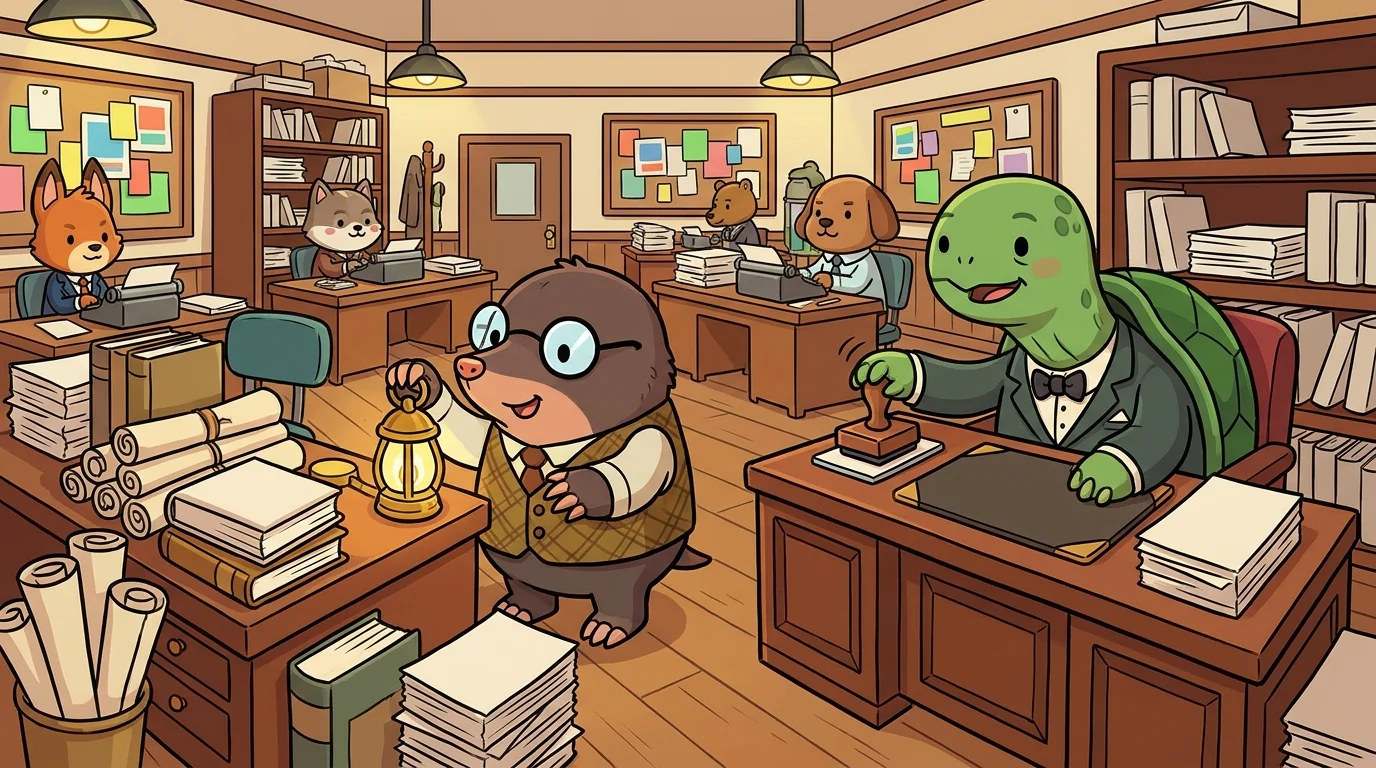
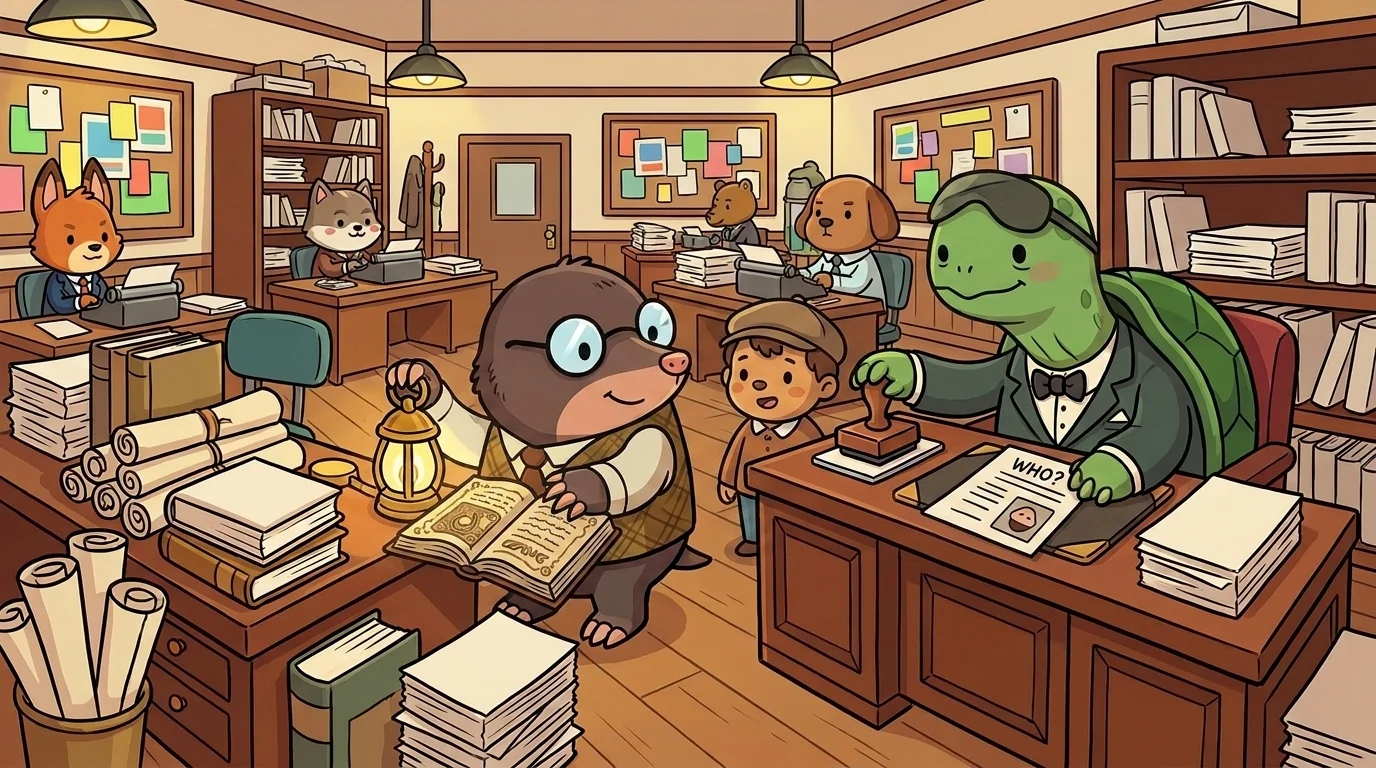
Deed the archivist mole and Attest the notary tortoise share the newsroom's back corner, and between them they answer the one question that never goes out of style: where did this actually come from? Deed puts it to the document — where is this written down, in the original, before any retelling touched it? Attest puts it to the person — who said it, and will they stand behind it with their name? A claim can survive one of these questions and still be hollow. Only a claim that survives both is solid enough to hand a reader.
"I follow a claim down to the record it lives in," Deed says, patting her lantern. "And I follow it back to the mouth it came out of," Attest says, tapping his WHO? stamp. "Between the two of us," Deed says, "a claim has nowhere left to hide." "A true one," Attest adds, "was never hiding. That's exactly how we can tell."
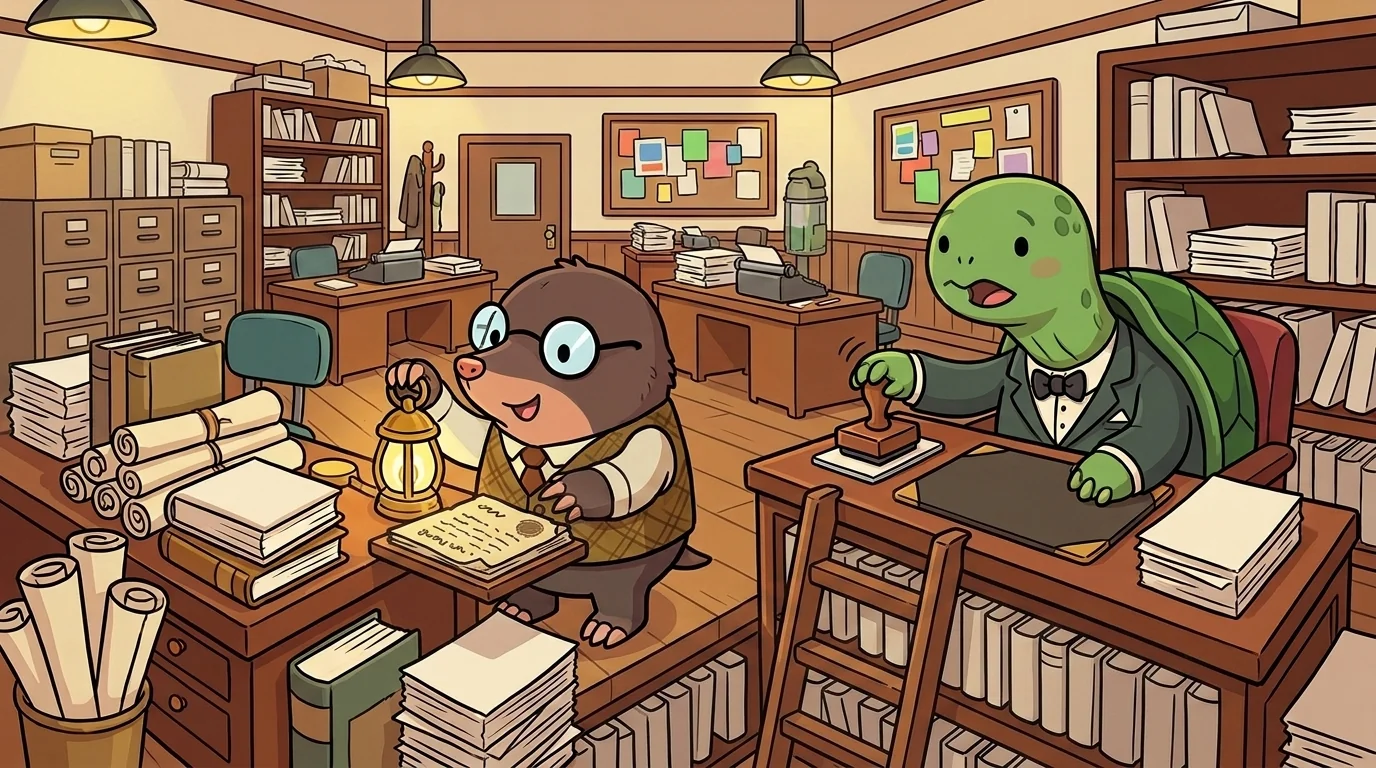
Deed works the document end, and she starts every hunt the same way: by refusing to read the story about the thing.
A claim comes roaring in — "the town spent a fortune on the new fountain!" — and while the newsroom repeats it, Deed climbs down into the archive and finds the actual paper: the receipts, the budget line, the original signed order. "The article about the spending is somebody's telling," she says, lantern glowing over the folder. "It's been summarized, sharpened, and passed along — and somewhere in that chain, 'a modest amount, mostly donated' grew into 'a fortune.'" She lays the record flat. "This is where the claim actually lives. Not the post about it, not the post about the post. The receipt. If a claim can't be walked back to a document like this one, then half of it has already gone missing in the retelling — and the missing half is usually the half that made it exciting."
She has a name for the danger: the claim that everyone repeats and no one has read. "The more places I hear it," she says, "the more I want to see the paper. Popularity isn't provenance. A thousand retellings of a receipt nobody reopened is just one old mistake, wearing a very big coat."
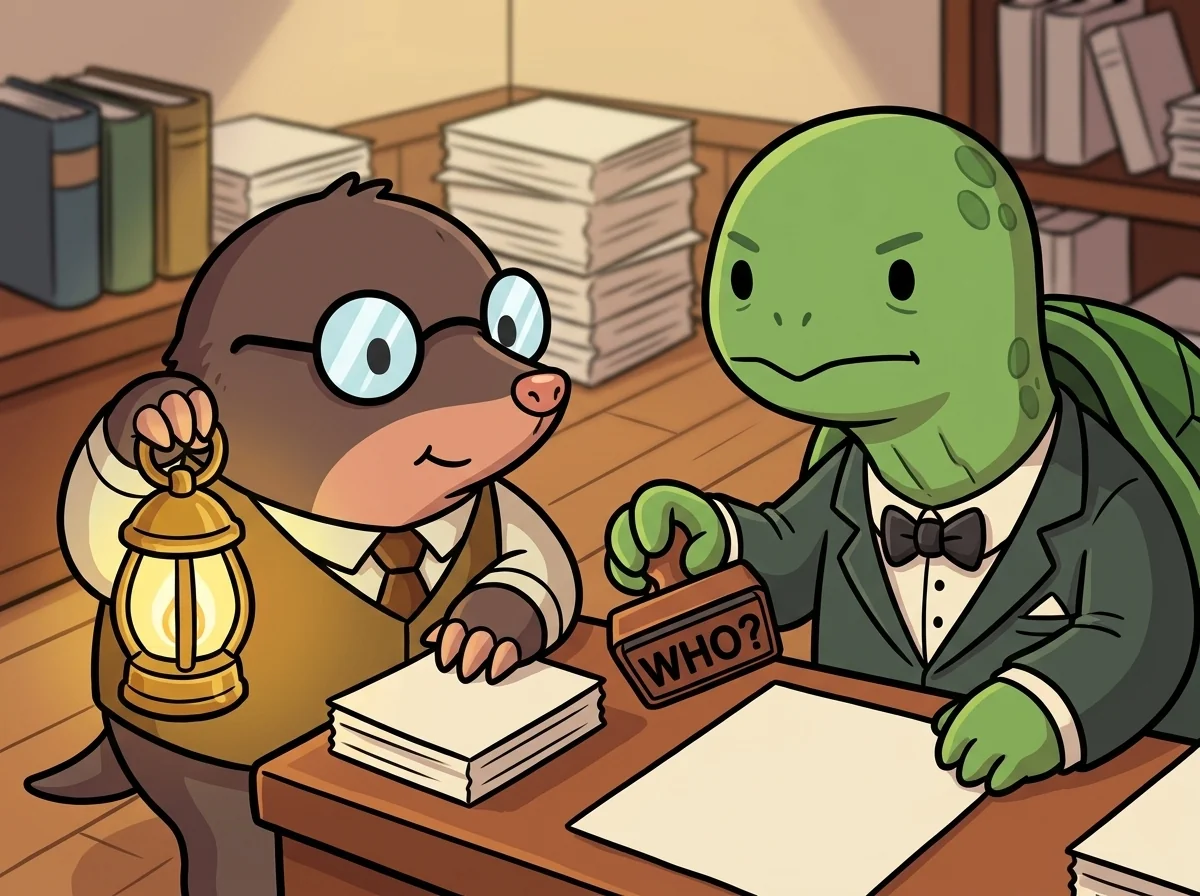
Attest works the person end, and he chases something the document can't give him: a name willing to be answerable.
He takes the same claim — but he follows the voice. "Who told you the town wasted money?" he asks, unhurried, the WHO? stamp ready. "A named budget official, on the record? A worried neighbor who saw the invoices? Or 'people are saying'?" He traces it back through the retellings, and more often than not it thins out to nothing. "'People are saying,'" he reports, "traces to a single account with no name, echoed until the echo sounded like a crowd." He stamps the empty place: WHO? "A claim needs a name to stand on," he says. "Not a shadow. Not a chorus of ghosts. Not 'everyone knows.' A real person willing to put their name to the words — or, if the name must be withheld to keep them safe, an honest reason, told plainly to the reader." He caps the stamp. "The document tells me the claim exists somewhere. The name tells me someone will answer for it. I need both, because a real record with no one willing to vouch for it, and a confident voice with no record behind it, are each only half a truth."
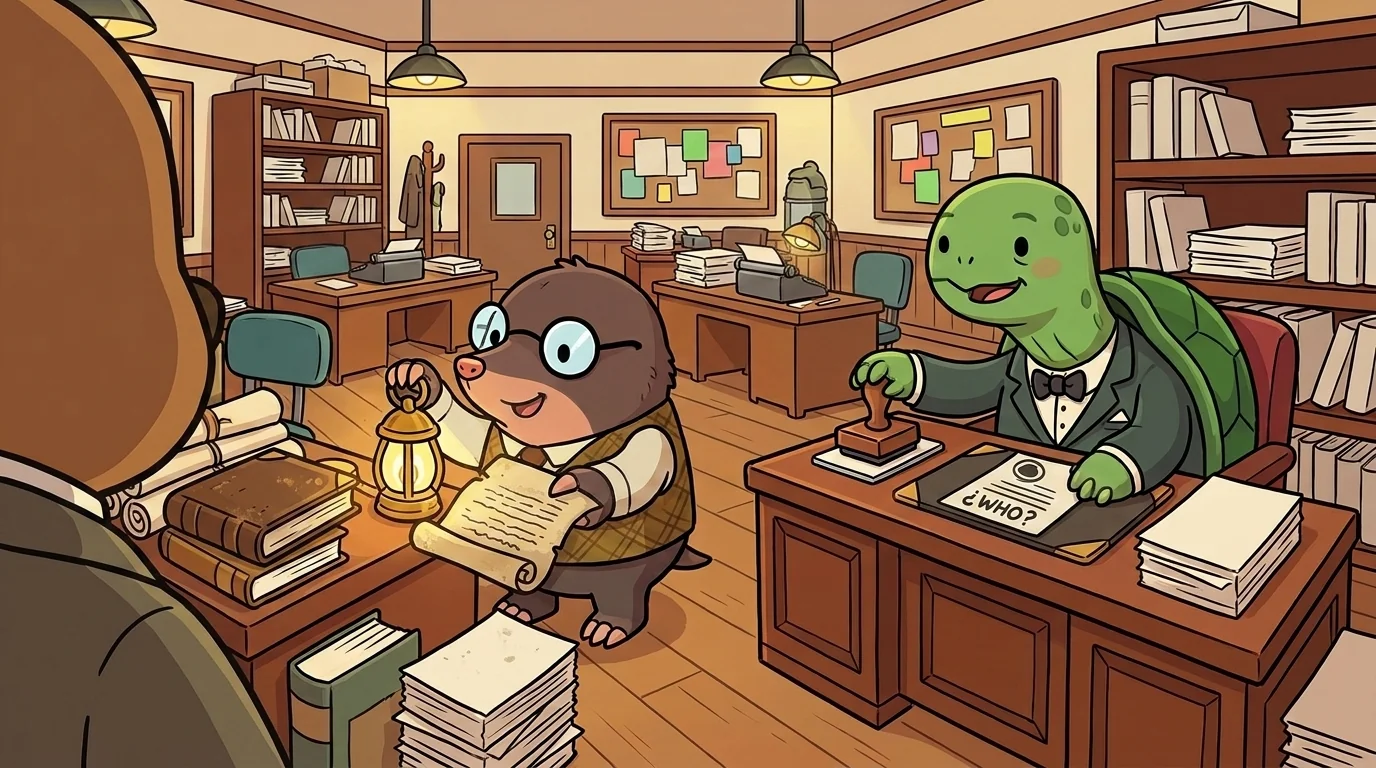
Where they truly become a pair is the claim that passes one test and fails the other — because those are the claims that fool careful people.
A reporter brings them a beauty: a leaked "official memo" saying the mayor plans to sell the town park. It looks like a document — Deed's territory — so the newsroom is halfway to printing it. But Deed holds it to the lantern and frowns. "It's a document, yes. But is it the document? There's no letterhead, no signature, no date, no file it came out of. A paper isn't a primary source just because it's on paper — it has to be traceable to where it was actually made." Meanwhile Attest is working the other end. "And who handed it to you? An account that appeared last week and vanished after posting it. No name will stand behind this — and there's no honest reason given for the silence, only the silence." They lay their two findings side by side: a document that can't be traced to an origin, and a voice that won't own it. "On its own," Deed says, "the memo looked convincing enough to run." "On its own," Attest agrees, "so did the leaker's confidence." "Together," they say, almost in unison, "they cancel to zero." The memo doesn't run. A day later it's revealed as a fake — and the newsroom that checked both ends is the only one that never printed it.
Later, when the back corner has gone quiet and the lantern and the stamp lie side by side, the reporter comes back with the question the pair always eventually gets.
"Doesn't it slow everything to a crawl," he asks, "running every claim past both of you? Everyone else prints the leaked memo, gets the traffic, and moves on. You two are still down here asking where it was written and who'll sign for it."
Deed and Attest look at each other, the old, patient look of two animals who have watched a great many exciting fakes come and go.
"Everyone else prints the memo," Deed says, "and then prints the correction when it turns out to be forged." "And loses a little trust each time," Attest adds. "We come in slower with the version that was never a forgery — because we checked the paper and the person before we spent the reader's belief on it." Deed sets her paw on the un-run memo. "A claim that can survive both our questions is one we can defend the day someone comes shouting that we got it wrong. We simply show them the record, and the name, and there's nothing left to argue." "And a claim that survives neither," Attest finishes, "was only ever air — no matter how many times, or how loudly, it was shouted." The reporter looks at the fake memo, then at the two quiet animals who caught it, and something in him settles: the pull of the fast, sourceless scoop loosening its grip, replaced by the steadier appeal of a story that never has to be walked back.
The NewsForge ensemble
Deed and Attest is part of NewsForge's distributed-narrative cast. Each character embodies a different curricular primitive; together they teach the full subject.
-

Source
Source-quality evaluation — who would KNOW this best? who has a stake? source-card-comparison the routine
-

Tilt
Bias-and-perspective detection — every story has a frame; name the frame, then read; structural NOT partisan
-

Frame
Headline-and-framing craft — a headline is a SUMMARY not a HOOK; counter-clickbait
-

Verify
Verification + lateral-reading discipline — SIFT (Stop, Investigate, Find, Trace); open four tabs, never one
-

Serve
Community-information-needs framing — what does my reader NEED to know to DO something? agency-foregrounding; counter-doomscroll
-

Attest
Attribution — who says so? every claim names its source
-

Deed
Primary source — go to the original document, not a summary of a summary
-

Errata
Corrections — a story is living; when the facts change, the record is fixed
-

Uncrop
Framing — an image or chart is cropped; ask what sits outside the frame
-

Widen
Context — one number means little without comparison; widen the view