
Loop
A FEEDBACK LOOP AMPLIFIES WHATEVER IT REWARDS — a system that measures something and spreads more of it creates a self-reinforcing loop, so knowing WHAT it counts lets you predict what it pushes; the feed is designed, not random, and a loop can run away if nothing balances it
Loading audio…
Press play to listen along. The line being read lights up as you go.
Show full transcript
Loading transcript…

Loop was the crew's systems-thinker, the one who never said "the algorithm is mysterious" because Loop refused to be mystified by a machine. When the young creators complained that the feed felt like unpredictable weather — sometimes it rained attention, sometimes drought — Loop shook its head.
"It only feels like weather," Loop said. "Weather isn't designed. This is. A feed is a machine with a rule inside it, and once you know the rule, you can read it like a detective reads a room."

Loop taught the first Advanced idea: the loop amplifies what it measures.
"Every feed measures something — how long you watch, how fast you react, how often you share," Loop said. "And here's the machine part: whatever it measures, it feeds more of. If it counts watch-time, it shows more of what holds you. If it counts reactions, it shows more of what makes you react. The measuring and the spreading form a loop — the thing that gets measured gets amplified, which makes it get measured more, which amplifies it further." Loop's eyes gleamed. "That's a feedback loop. Output feeds back into input. The system isn't random. It's a rule, running in a circle, getting louder."
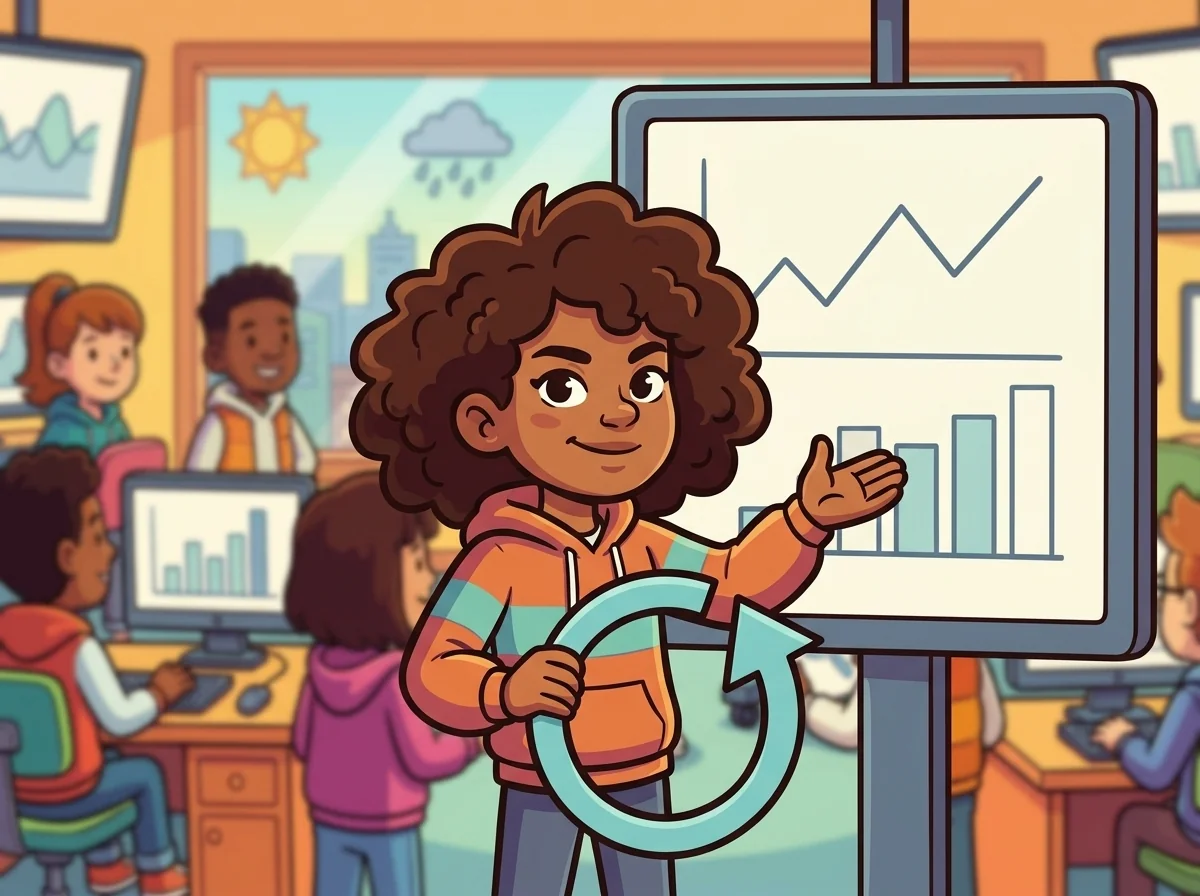
"So the detective's move," Loop went on, "is to ask one question: what does this system count? Answer that, and you can predict what it will push. If it rewards outrage, expect a feed full of outrage — not because the world is angry, but because anger scored well and the loop amplified it. If it rewards curiosity, you get curiosity. The feed is a mirror of its own scoring rule. You are not reading the world through the feed. You are reading the rule the feed optimizes for."
The young creators felt something shift. The feed stopped being a weather system happening to them and became a machine they could read.

Then Loop taught the deeper, slightly dangerous idea — runaway loops.
"A loop that only amplifies, with nothing to balance it, runs away," Loop said. "Success feeds more success feeds more success. A post that gets an early boost gets shown more, which gets it more boost, which gets it shown more — a small head start snowballs into domination, sometimes for no better reason than it went first. Engineers call the balancing force a brake: something that pushes back as the loop grows, so it settles instead of exploding. When you watch one thing take over a feed completely, ask whether it's truly that much better — or whether an unbraked loop just amplified a tiny early edge into a landslide." Loop tapped its temple. "A runaway loop rewards whatever started winning, not necessarily whatever's best."

The test came when Devi noticed one creator suddenly everywhere on the feed.
"Are they really that much better than everyone?" Devi asked.
"Maybe," Loop said. "Or maybe they got an early boost and the loop ran away with it. Ask what the feed counts, and whether anything's braking it." Devi thought about what the feed rewarded and saw how a small early lead could snowball. "The algorithm amplifies what it measures," Loop said, satisfied. "Learn what it rewards and you can read the feed like a machine, not the weather — and you'll never again mistake a runaway loop for pure talent."
The SignalForge ensemble
Loop is part of SignalForge's distributed-narrative cast. Each character embodies a different curricular primitive; together they teach the full subject.
-

Chief
Trust is the real metric — read every statistic by asking 'does this build trust that lasts?', not 'did it spike today?' (the editor-in-chief & mentor)
-

Retention
A retention curve shows where viewers leave — the steepest drop marks the exact moment something went wrong, so the shape of the line tells you what to fix
-

Sample
A small sample is noisy — a result from a few viewers can swing by luck; wait for enough data before you trust a difference
-

Split
A fair test changes only ONE thing — keep everything the same except the single variable, or you can never tell which change caused the difference (A/B testing)
-

Curve
Percent growth compounds — growing by the same percent each week bends upward faster and faster, so a small steady rate can overtake a big one-time jump
-

Bait
Outrage spreads fast but spends trust — rage-bait travels quickly, then burns credibility and collapses an audience; a number bought with anger is a debt (cautionary)
-

Base
Judge by the base rate, not the standout — for every viral hit you see, thousands of similar attempts failed and stayed invisible, so ask 'out of how many tries?'
-

Ledger
Trust is a ledger that builds slowly and crashes fast — many honest acts to earn it, one dishonest act to lose it; the math is not symmetric
-

Sponsor
Weigh return against cost — a deal is only worth it if what you gain exceeds what you give up, and the cost includes money AND trust (ROI / business math)