Dusk
The range from light to dark
Loading audio…
Press play to listen along. The line being read lights up as you go.
Show full transcript
Loading transcript…
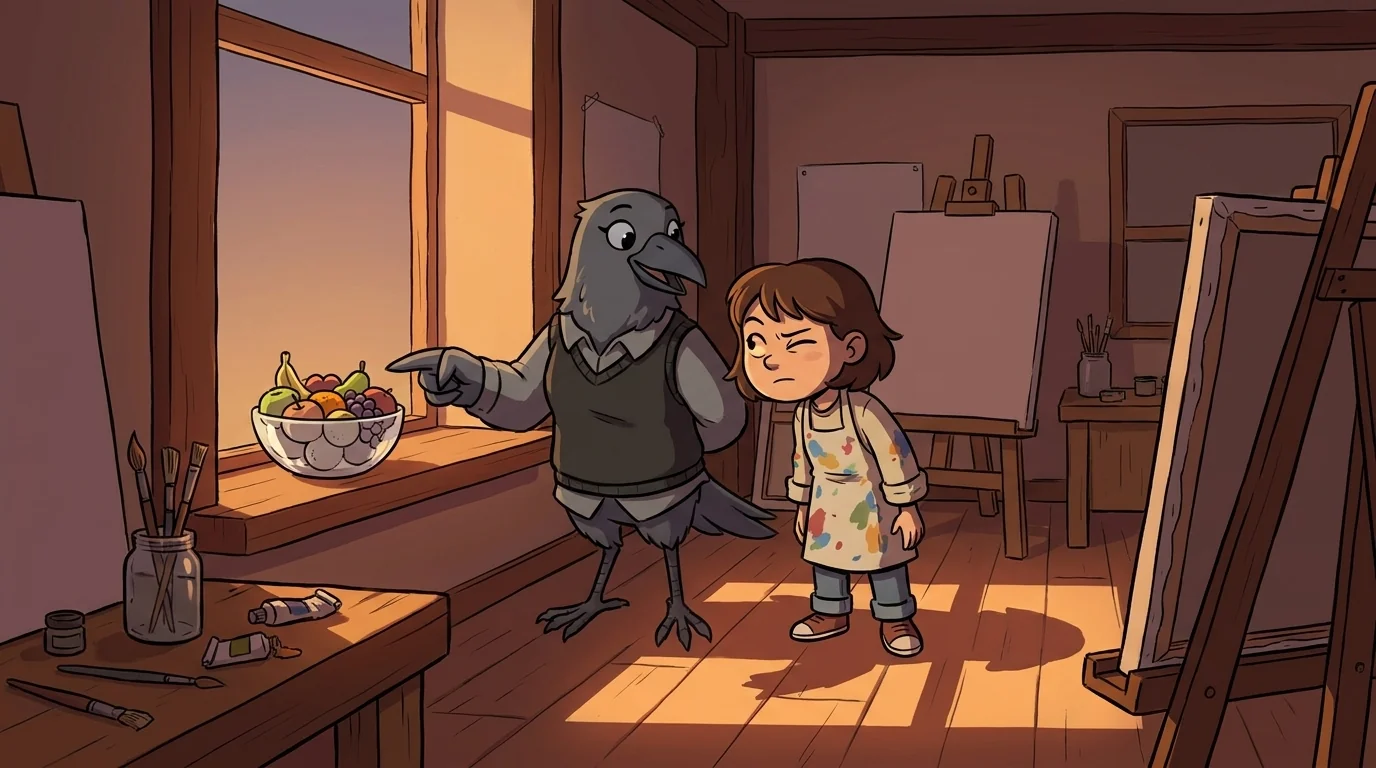
At the studio window as the evening light went grey, a smoky raven named Dusk squinted at a bright bowl of fruit until all its colors faded — and what was left was a shape made purely of light and shadow.
A young art student named Wren looked at the same colorful bowl. "I see red apples, yellow lemons, a blue bowl."
"Squint," Dusk said. "Squint until the colors blur away." Wren squinted — and the red and yellow and blue dissolved, leaving only patches of light and dark: the bright top of an apple, the shadow beneath the bowl, the glow on a lemon. "There," Dusk said. "That's value — the range from light to dark. And it's the bones of the picture, underneath all the color." She traced the light and shadow shapes. "People think color is what makes a picture work. But you can take away all the color — turn it grey — and if the lights and darks are right, the picture still holds together completely. It still reads. It still feels like something." She tapped the window. "Value is the skeleton. Color is the skin on top. A picture with beautiful colors but muddy, flat values falls apart — there's nothing holding it up. But a picture with strong lights and darks works even in plain grey. So before I worry about color at all, I get the bones right — where's the lightest light, where's the darkest dark, how does the light fall. Get the value right, and the picture already stands, before a drop of color touches it."
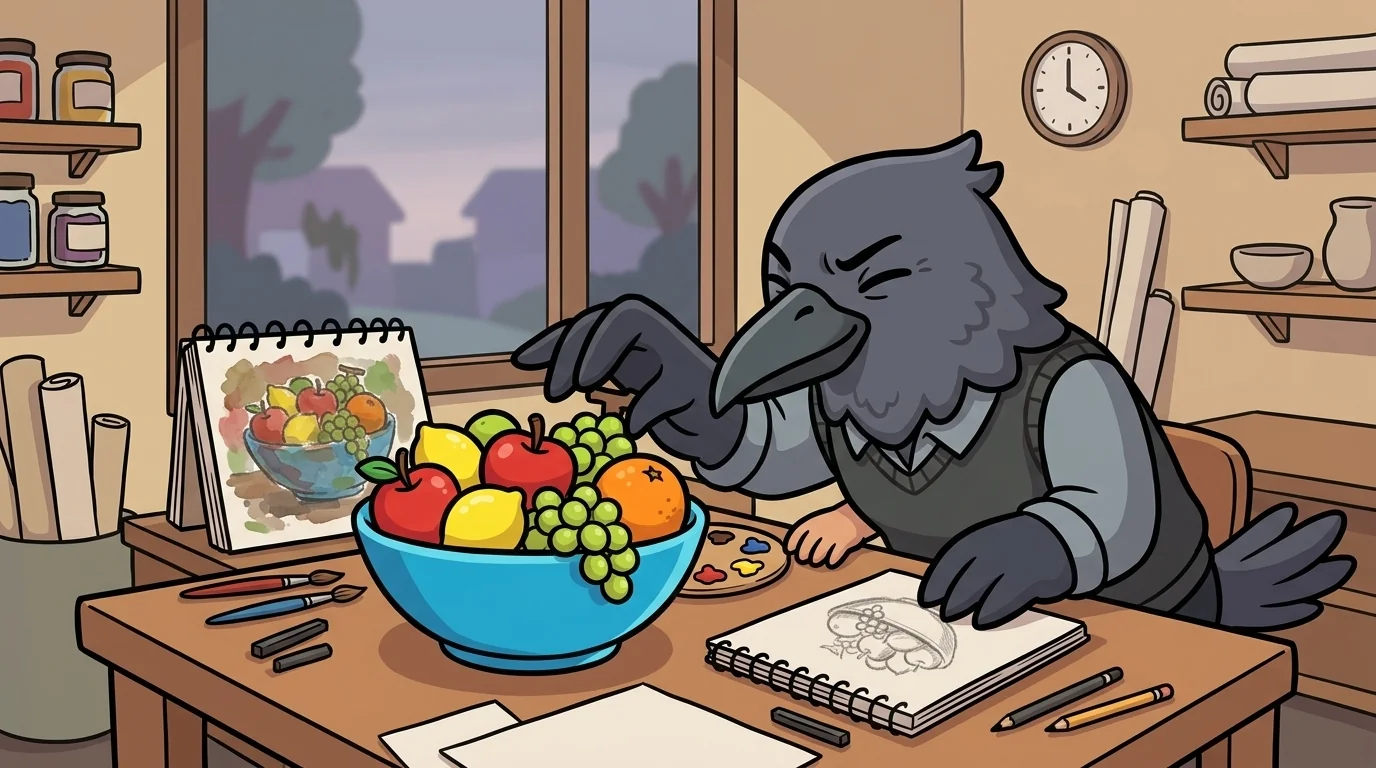
Dusk hadn't always seen the bones.
When she was little, she'd loved color so much she ignored everything else — piling on the brightest, boldest colors she could find — and her pictures always came out looking flat, muddy, somehow wrong, no matter how gorgeous the colors were. She couldn't understand why.
Her grandmother, an old raven with feathers of a hundred greys, looked at one of her muddy, colorful pictures one evening.
"Beautiful colors," she said. "Now squint at it."
Young Dusk squinted — and saw the problem at once. Under the color, everything was the same value — all mid-grey, no real lights, no real darks. The picture had no bones. "It's all... flat," she said, surprised.
"Because you gave it skin but no skeleton, little one," her grandmother said gently. "All those colors, but they're all the same lightness — so there's nothing for the eye to hold onto, no light to travel to, no shadow to give it depth. Color can't fix that. Only value can." She showed young Dusk how to build a picture in plain grey first — a bright light here, a deep shadow there, a full range from almost-white to almost-black — and even with no color at all, it popped, it had depth, it stood up. "Get the bones right first," she said, "in nothing but light and dark. Then, when you add color, you're painting onto a picture that already works. Skeleton first, skin second. Not the other way around." She smiled. "The most beautiful colors in the world can't hold up a picture with no bones."
Young Dusk started squinting at everything, seeing the light-and-dark bones beneath the color — and her pictures stopped being flat, and started to stand.
She walked the long road to SpectrumCanvas, the art school on the hill, where a wise old mentor named Pigment kept the studios.
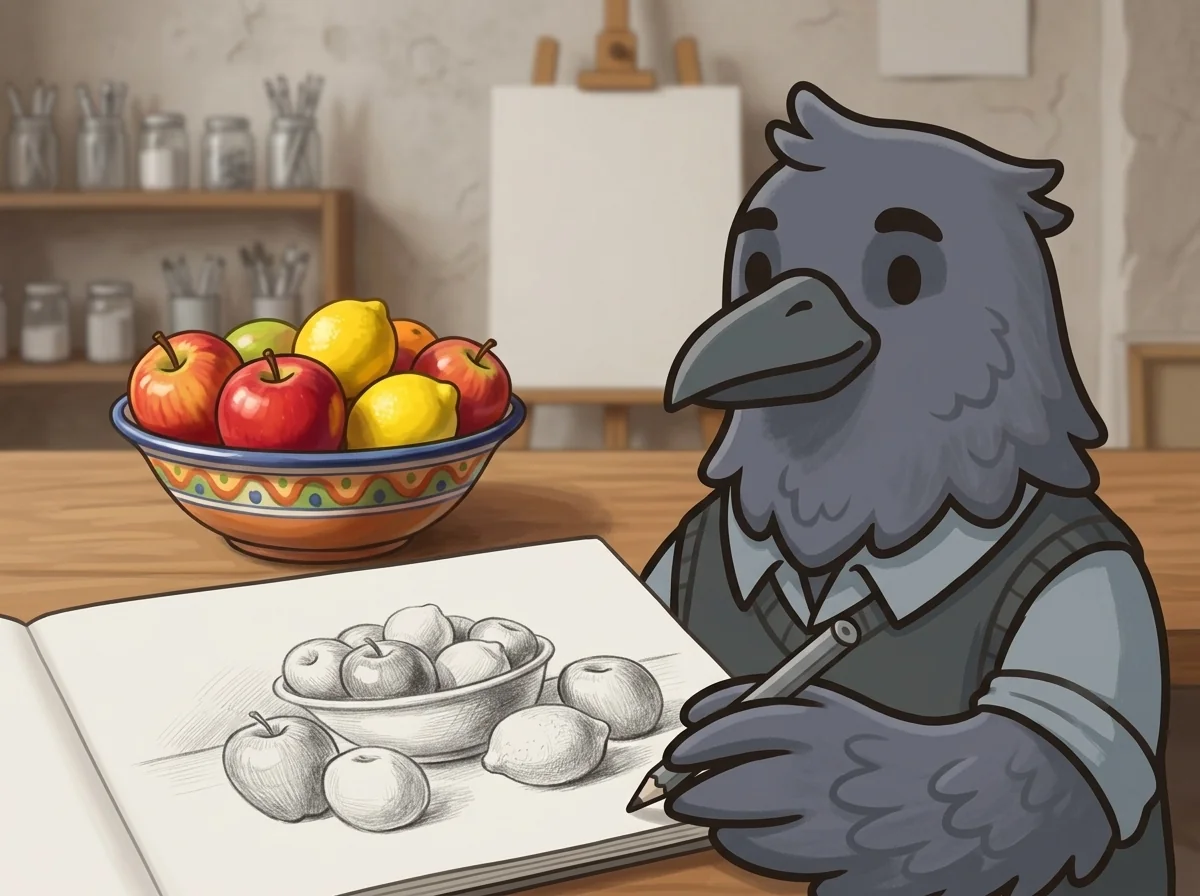
Pigment met her, set out a colorful still life, and asked one thing: "Show me why it works — without any color."
Dusk didn't answer with words. She took a plain grey pencil and drew the same still life in nothing but light and shadow — the bright glint, the mid-tones, the deep cast shadow — and even with every color stripped away, it had depth, it had form, it clearly stood. The bones were right, so the picture held.
Pigment looked at the colorless picture that worked completely. "You belong here," he said.
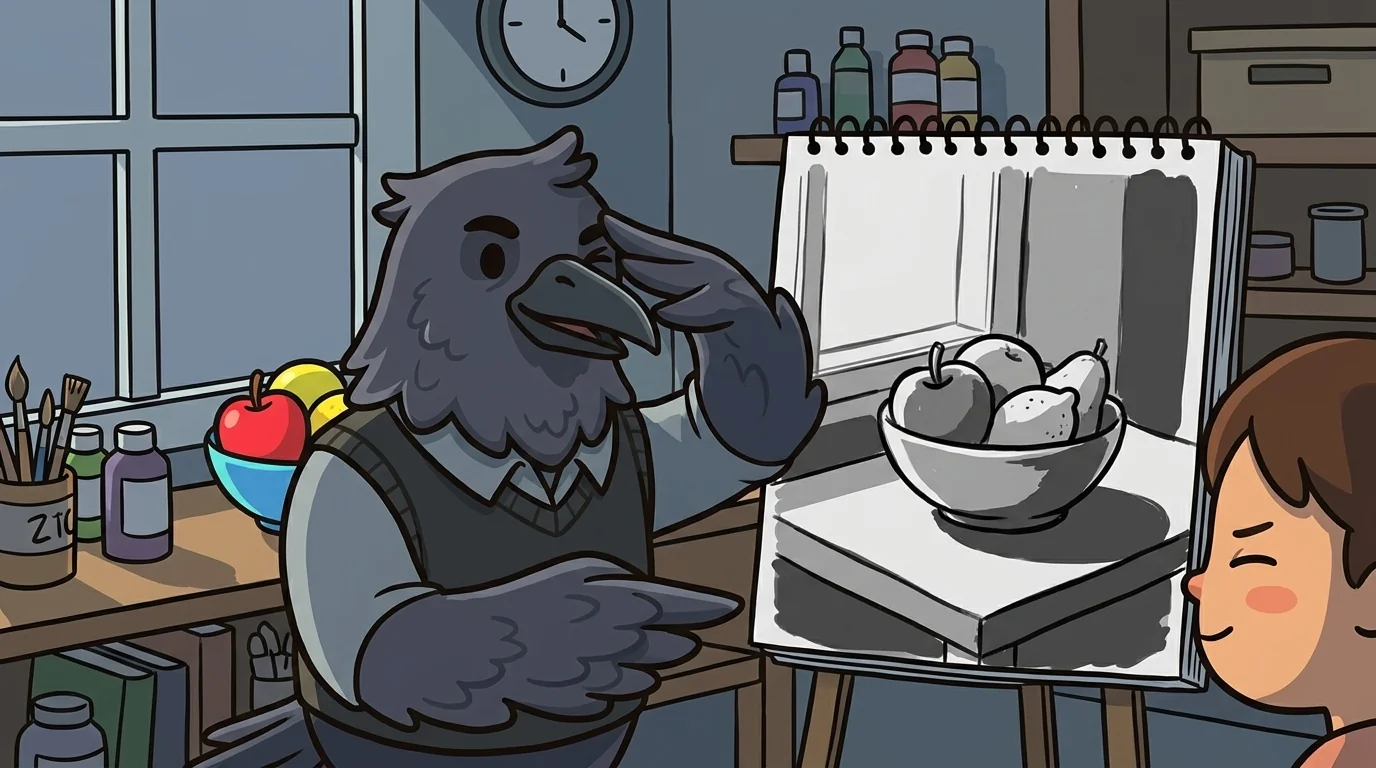
Which was how Dusk came to be at the window with Wren, whose colorful pictures kept looking flat.
"I use such bright colors," Wren said, "but it always looks muddy and flat. Why?"
"Squint at it," Dusk said. Wren did — and saw that under the bright color, it was all the same greyness, no real lights or darks. "Your colors are lovely," Dusk said, "but they're all the same value — so there are no bones holding the picture up. Color can't fix flat bones. Only value can." She showed Wren how to plan the lights and darks first, in plain grey — a brightest spot, a darkest spot, a full range between — before adding any color. Then she shared the whole craft: value is the range from light to dark, and it's the structure of a picture, underneath the color; a picture works or fails on its values first — strong lights and darks give it bones, while all-one-value goes flat no matter how bright the colors; and the way to check is simple — squint, let the color blur away, and see if the lights and darks alone hold the picture up. "Build the bones in light and dark first," Dusk said. "Then color is a joy to add, because it's landing on a picture that already stands."
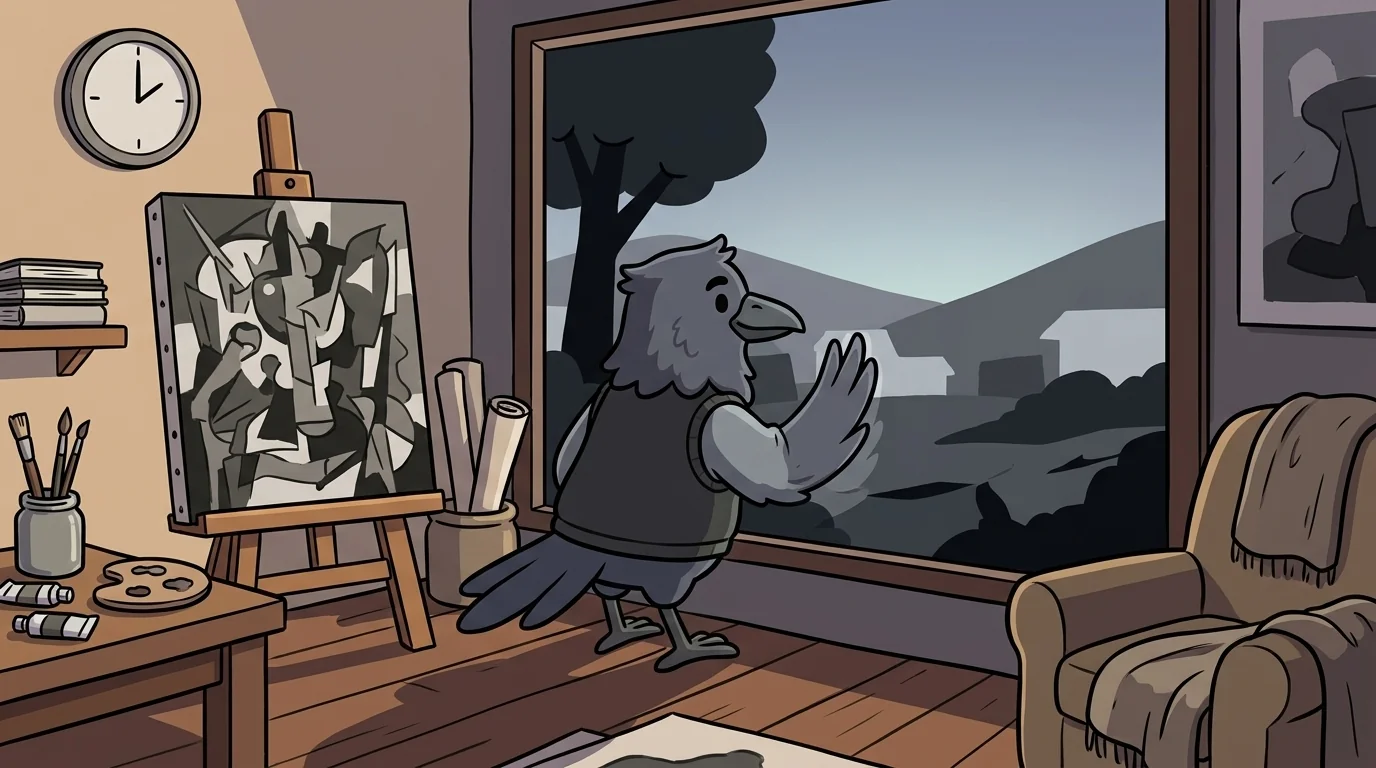
"So the lights and darks are the real structure," Wren said slowly, "and color goes on top?"
"Bones first, skin second," Dusk agreed, and she squinted once more at the greying evening, watching the whole world simplify into its calm, sure shapes of light and shadow — and felt a deep, settled contentment at the quiet order underneath everything. There was a warm, grounded happiness in it — the calm gladness of a raven who could see the bones beneath any color, who knew that a picture, like the dusk itself, held its shape in light and shadow long before color came or went, and that seeing that structure was a quiet, steadying kind of sight. It made her feel clear, and unhurried, and sure. That squint-away-the-color, bones-beneath-the-skin, structure-in-light-and-dark warmth — the grounded gladness of a creature who saw the skeleton of things — was, to Dusk, the quiet foundation hidden beneath every picture. "Value is the bones," she said softly, as the light went grey, "and the bones hold, with or without the color."
The SpectrumCanvas ensemble
Dusk is one of the friends in SpectrumCanvas. Each friend shows you one idea by how they act; meet them all and you have the whole subject.
-

Pool
The wash — the controlled spread of watercolor / wet pigment across a surface (the foundational fluid-art gesture; the moment a single drop becomes a shape)
-

Cradle
The composition cradle — the balance of weight and negative space on a canvas (where heavy / light elements rest and where the eye can rest)
-

Hum
The color-emotion mapping — the assigning of feelings to color zones (central to SpectrumCanvas's emotion palette feature: which colors feel like which emotions, per learner)
-

Soften
The sensory-soften gesture — any move that reduces visual / textural stimulation when it gets high (lower contrast, reduce saturation, calm the line weight, soften the edges)
-
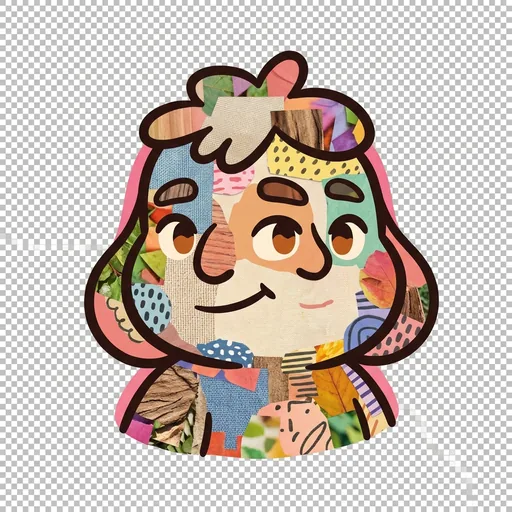
Weave
The collage weave — the layered overlay of textures + photos + drawn elements (central to social-story illustration and to multi-media composition)
-
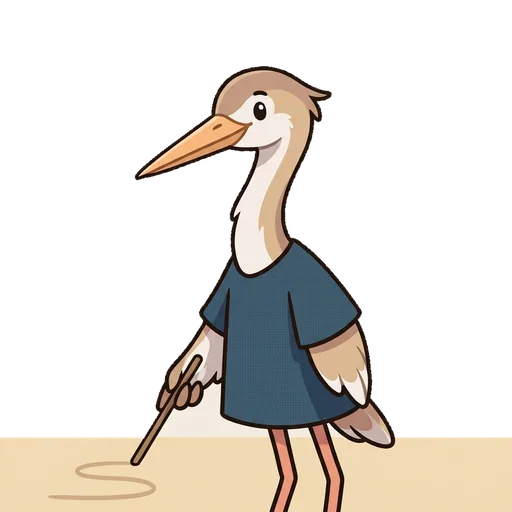
Etch
Line / gesture / mark-making
-

Lodestar
Focal point / emphasis
-

Grit
Texture
-

Accord
Color harmony / palette