Etch and Dusk
LINE + VALUE
Loading audio…
Press play to listen along. The line being read lights up as you go.
Show full transcript
Loading transcript…
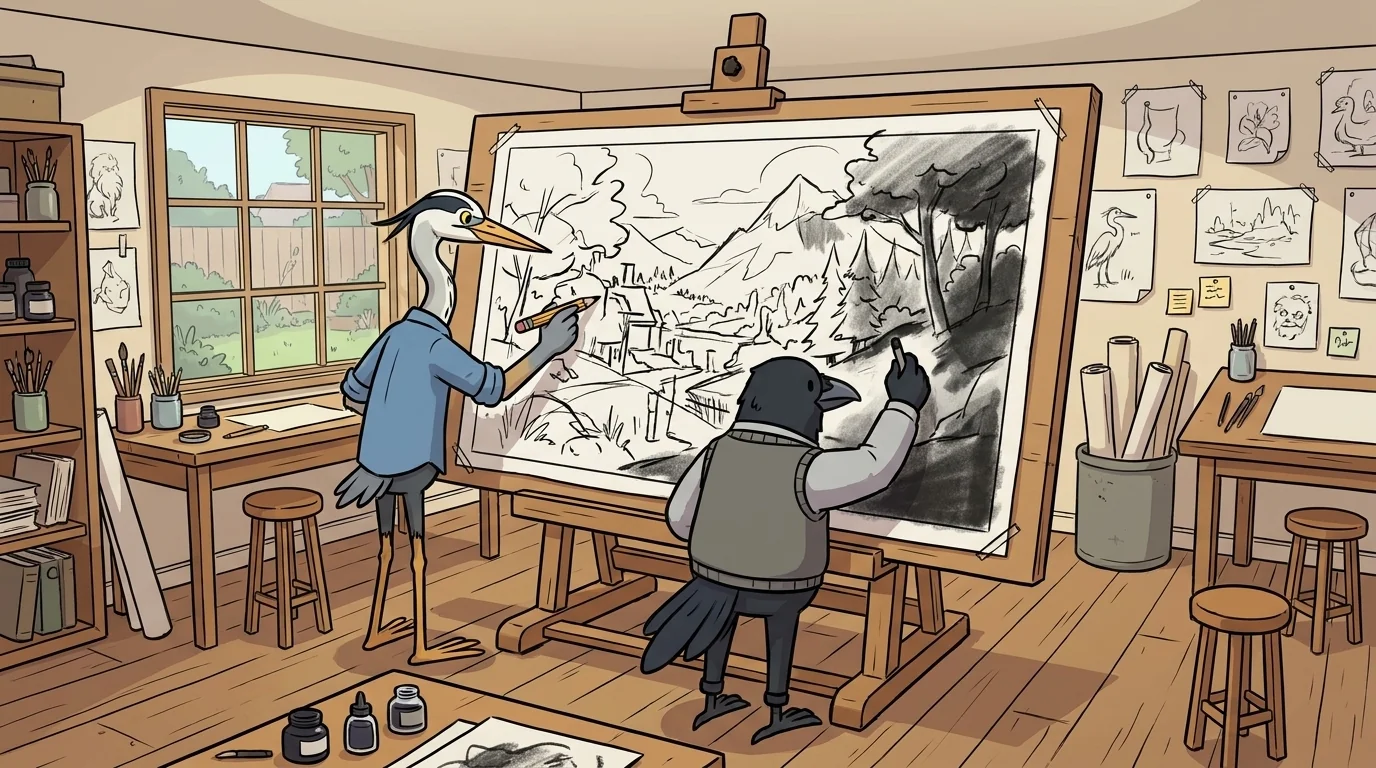
Etch the heron and Dusk the raven work side by side before any color is opened, and between them they build the thing every painting stands on: a complete picture, in nothing but black and white. Etch makes the edges — the expressive lines, the drawn boundaries, the gesture. Dusk makes the lights and darks — the value masses, the shadow and glow, the form. And they discovered, sketching together in greyscale, that these two crafts are the whole skeleton of a picture: line gives it its edges, value gives it its light and form, and together — with no color at all — they make an image that already reads, already feels, already stands. Color, when it comes, is just the skin on this shared skeleton.
"I make the edges," Etch says, tracing a line. "The lines, the gesture, where things begin and end." "And I make the lights and darks," Dusk says, squinting. "The shadow, the glow, the form." "Line gives the edges," says Etch. "Value gives the form," says Dusk. "Together, a whole picture — before a drop of color."
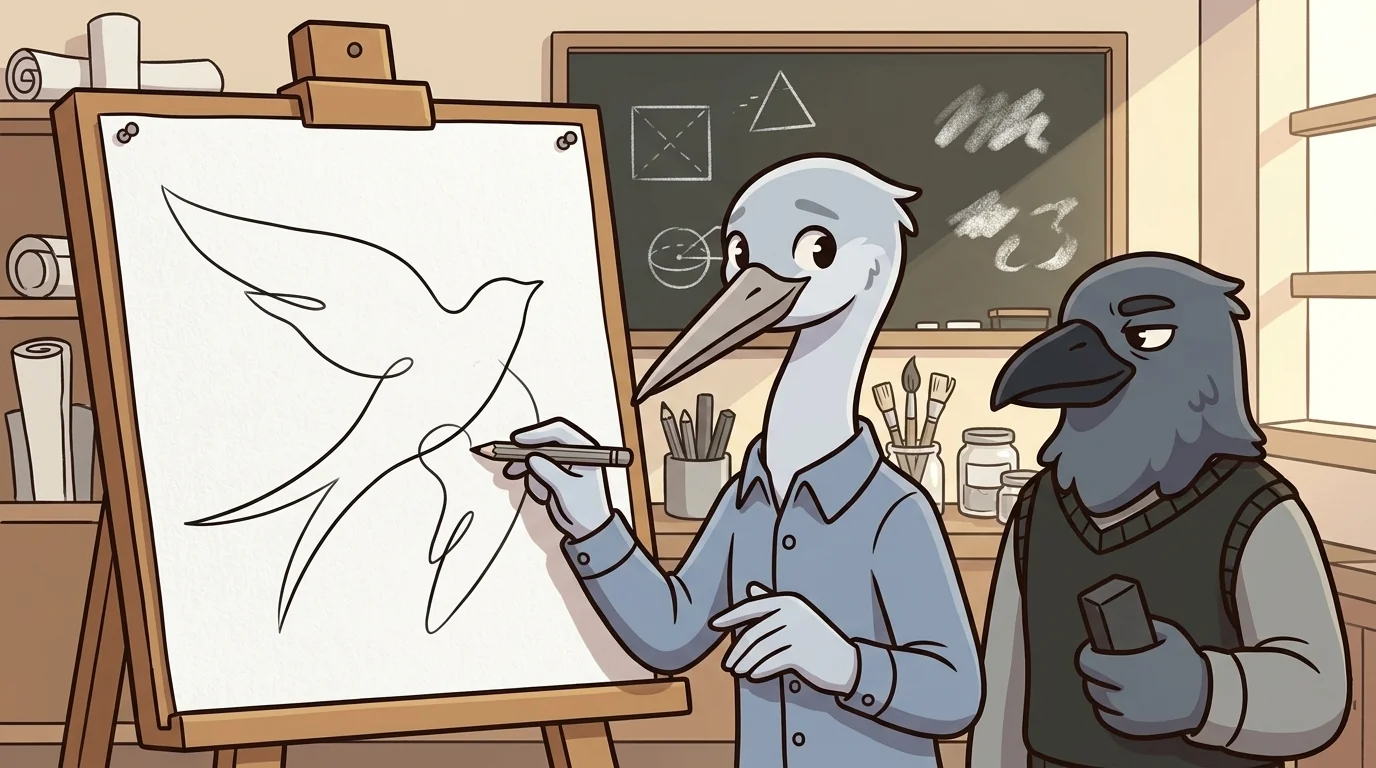
Etch makes the edges. She draws a bird with a single flowing line — a gesture that captures its whole shape and energy in one honest, alive mark. "This is my craft," she says. "The line — where the shape is, how it moves, its edges and its gesture. My line already says a lot: it's calm or wild, tender or sharp, depending on how my hand moved." She steps back from her pure line drawing. "But look what my line can't do alone. It shows you the edges of the bird — beautifully. But it's flat. There's no light on it, no shadow beneath it, no sense of round form or where the sun falls. It's an outline of feeling, but it has no weight, no depth." She glances at the raven. "My edges need something to fill them with light and shadow — to turn my flat outline into a form that sits in real light. And that filling isn't mine. It's Dusk's."
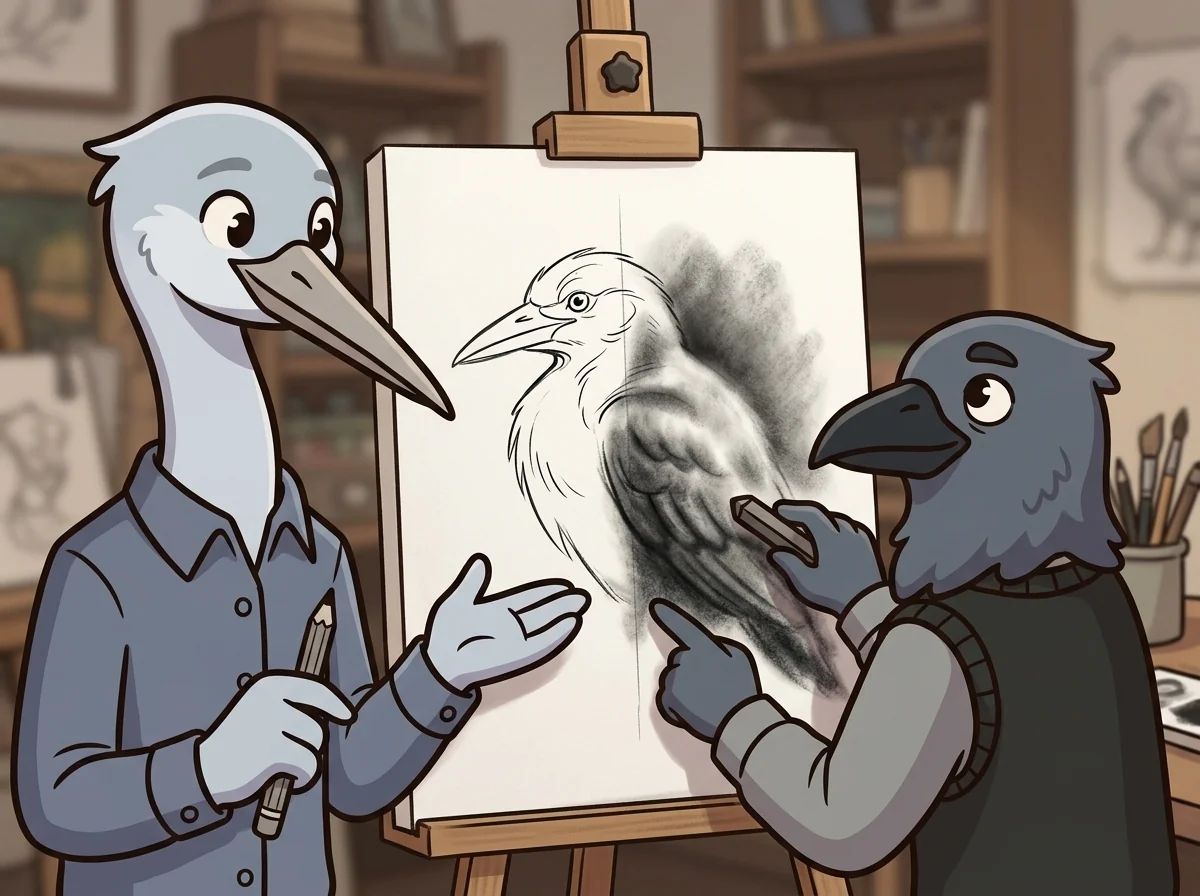
Dusk makes the lights and darks. She takes the same bird and, ignoring the edges for a moment, lays in the value — the bright glow on its back, the deep shadow under its wing, the mid-tones of its body. "This is my craft," she says. "The lights and darks — the form, the light, the weight." She builds the value masses, and the bird gains roundness and depth, sitting in real light. "My values give it body — you can feel the light falling, the form turning, the shadow grounding it." Then she looks at her value study without Etch's lines, and it's soft, a little vague. "But look what my values can't do alone. They give beautiful light and form — but without crisp edges, it's all a bit blurry, a soft cloud of tone with no clear where-does-it-begin. It has weight but no definition." She glances at the heron. "My lights and darks need edges — clear lines to say exactly where the shapes are. And those edges aren't mine. They're Etch's."
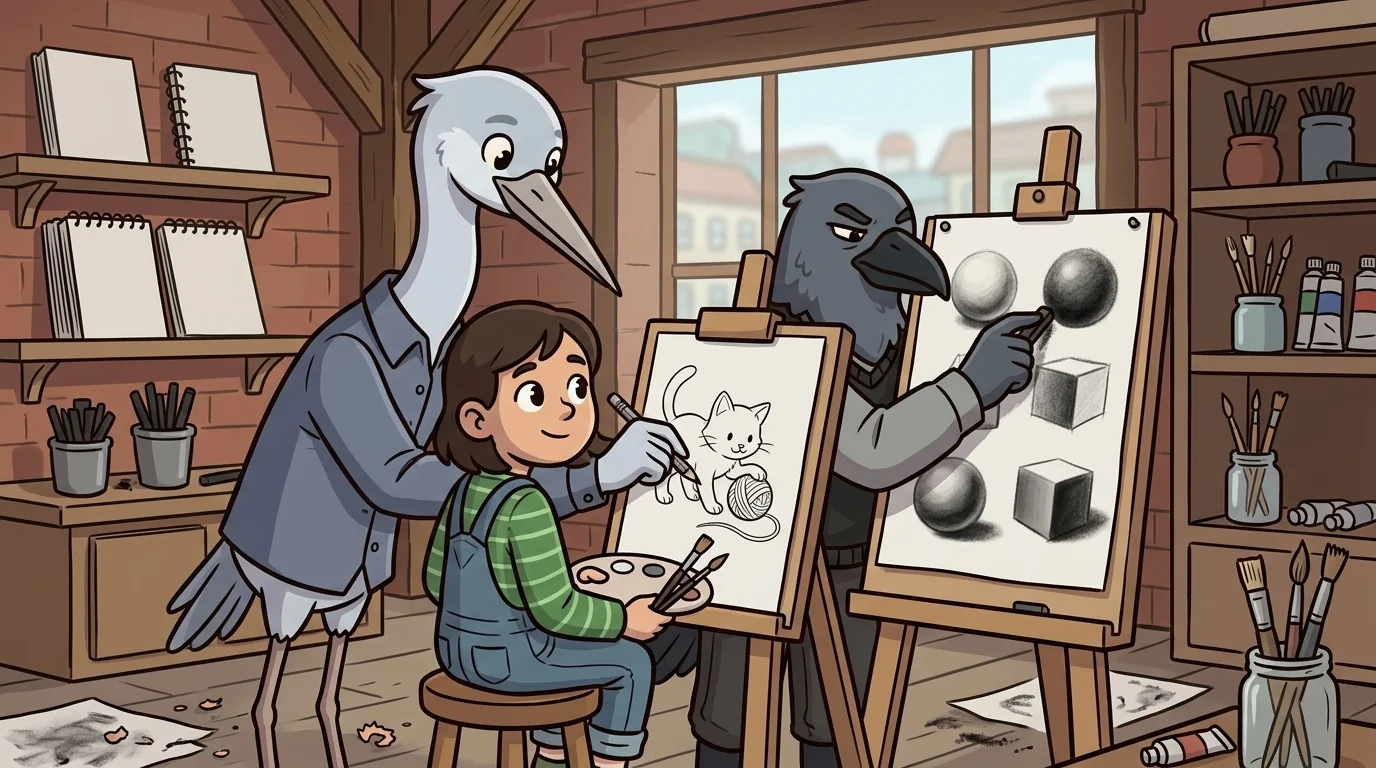
Then the two of them showed, together, the thing neither could do alone: a complete, powerful picture — full of feeling, form, light, and clarity — made in nothing but black and white. A young art student named Wren was frustrated. "I keep jumping straight to color," she said, "and my pictures come out flat and confused — no depth, no clarity, just a colorful mess. I don't know what's missing." And it took both of them. "You're missing the bones," Etch said, "and there are two of them, and we each make one." "First," Etch went on, "let me give you the edges — draw the shapes and the gesture in line, so you know exactly where everything is and how it moves." She sketched Wren's subject in clean, alive line. "Then," Dusk said, "let me give you the lights and darks — squint, find the brightest light and the deepest shadow, and lay in the value, so it has form and weight and sits in real light." She built the value over Etch's lines. And there it was — a complete picture, in nothing but greys and blacks: clear edges (Etch), real form and light (Dusk), full of feeling and depth, and it worked completely, with not one color yet. "Now that," they said together, "is a picture that stands. And color, when you add it, will land on something that already holds." Wren stared. "So it took both of you — the lines AND the lights-and-darks?" "Line alone," Dusk said, "is a flat outline with no weight." "And value alone," Etch said, "is a soft cloud with no clear edges." "But together," they finished, "line and value are the whole skeleton — a picture complete in black and white. Get these right first, and color becomes a joy instead of a rescue. The bones come first. And the bones are the two of us."
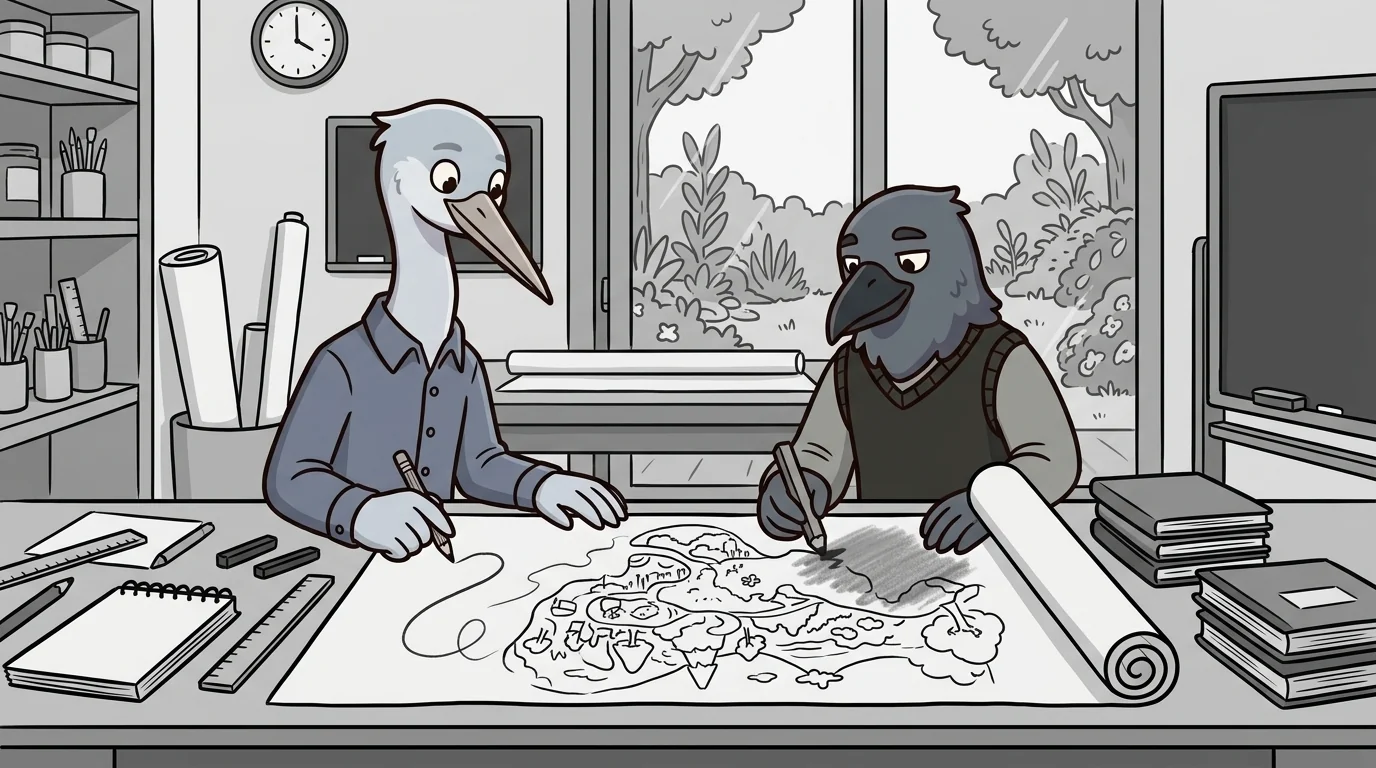
"So a picture is really line and value first," Wren said slowly, "and color goes on top of a picture that already works?"
"Bones in black and white first," Etch agreed, and Dusk nodded, squint-eyed. Etch set down her flowing edges — the line; Dusk set down her lights and darks — the value — side by side, the two halves of a picture that stands before color. Under the quiet, the two of them felt the same grounded, complete calm settle in: not the flat emptiness of line alone, not the vague softness of value alone, but a warm, paired, whole-in-greyscale steadiness — the particular satisfaction of two who each make one bone of a picture, so that between them an image could be built to full life and depth and feeling in nothing but black and white, ready for color but not dependent on it. That edges-and-lights-and-darks, whole-before-color, the-bones-come-first feeling, sturdier than either line or value alone, was to Etch and Dusk exactly why they work side by side before the paints are ever opened — and why the strongest, truest pictures are built, first, in black and white.
The SpectrumCanvas ensemble
Etch and Dusk is one of the friends in SpectrumCanvas. Each friend shows you one idea by how they act; meet them all and you have the whole subject.
-

Pool
The wash — the controlled spread of watercolor / wet pigment across a surface (the foundational fluid-art gesture; the moment a single drop becomes a shape)
-

Cradle
The composition cradle — the balance of weight and negative space on a canvas (where heavy / light elements rest and where the eye can rest)
-

Hum
The color-emotion mapping — the assigning of feelings to color zones (central to SpectrumCanvas's emotion palette feature: which colors feel like which emotions, per learner)
-
Soften
The sensory-soften gesture — any move that reduces visual / textural stimulation when it gets high (lower contrast, reduce saturation, calm the line weight, soften the edges)
-
Weave
The collage weave — the layered overlay of textures + photos + drawn elements (central to social-story illustration and to multi-media composition)
-
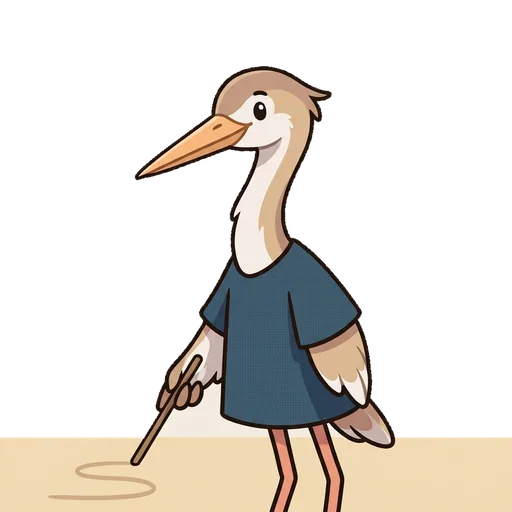
Etch
Line / gesture / mark-making
-
Lodestar
Focal point / emphasis
-
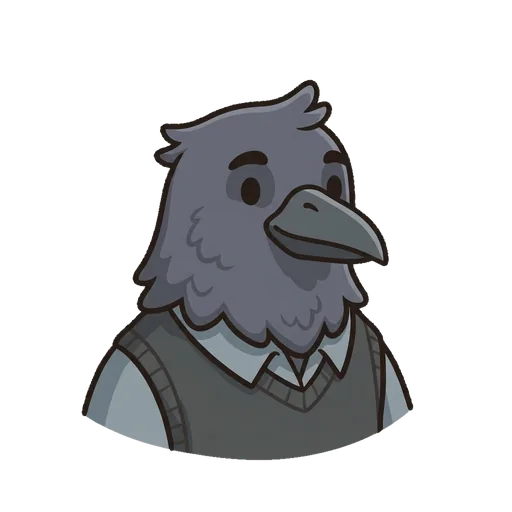
Dusk
Value / light and dark
-
Grit
Texture
-

Accord
Color harmony / palette