Spoor
You don't have to SEE an animal to know it was here
Loading audio…
Press play to listen along. The line being read lights up as you go.
Show full transcript
Loading transcript…
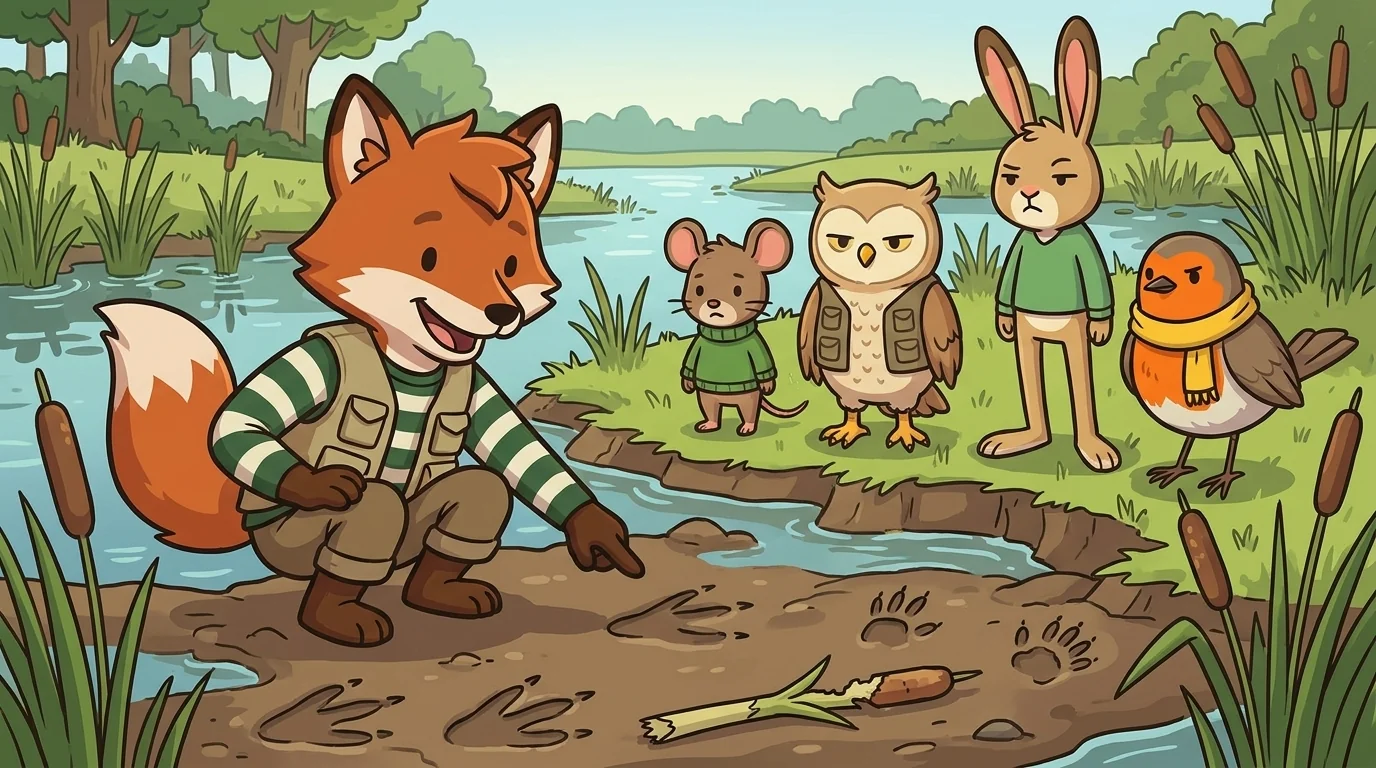
At the muddy edge of the wetland, while the class waited to SEE an animal and grew bored because none appeared, a young fox crouched low over the bank, grinning at the mud like it was full of secret letters.
Spoor was russet and neat, with a sharp curious nose and a field-vest full of little cards. She wasn't waiting to see anything. She was reading. "Everyone thinks nature-watching means WATCHING an animal," she said, tracing a shape in the mud with one claw. "But the animals are shy, and most of them left hours ago. They don't wait around for us." She pointed. "They leave notes instead. Look — a heron stood right here; see the long three-toed prints and the drag of the back toe? And there, a raccoon washed something; those are its little hand-prints. And that—" a chewed reed "—someone's been eating."
A classmate squinted at the mud. "But there's nothing HERE. It's just... mud."
"It's a page," Spoor said, delighted. "Covered in writing. You don't have to see an animal to know it was here. It leaves you notes — tracks, feathers, chewed leaves — if you learn to read them." She tapped a print. "This whole bank is a diary of who came by last night. Most people walk right over the words."
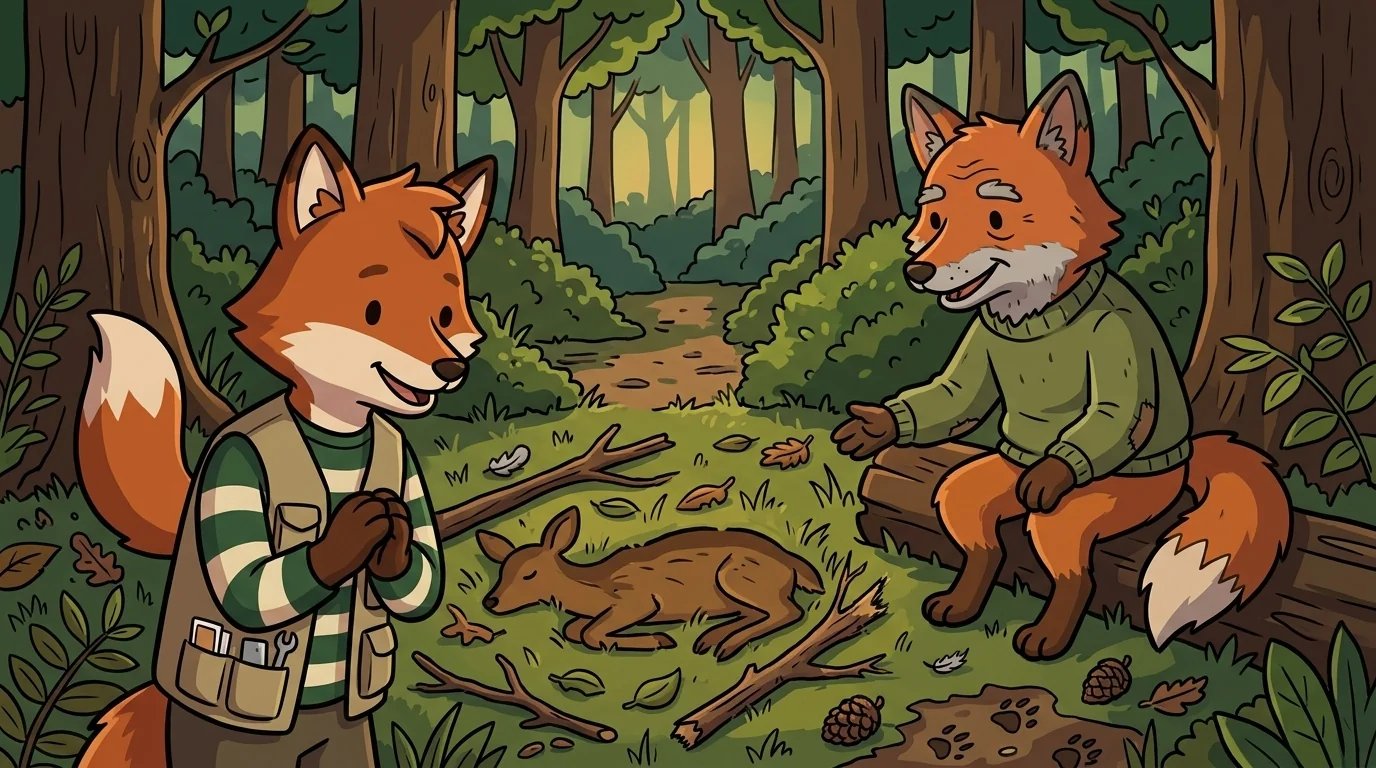
Spoor hadn't always been able to read the mud.
When she was small, she desperately wanted to see the shy creatures — the deer, the owl, the badger — and she'd sit for hours, still and hopeful, and see nothing, and go home certain the woods were empty and that she was bad at finding animals.
An old fox with a grizzled muzzle padded up to her one evening as she sulked. "You're waiting for the animals to show themselves," he said. "They almost never will — that's how they stay safe. But that doesn't mean they weren't here." He nosed at the ground beside her, at marks she'd never noticed. "Look. A deer bedded down right there last night — see the flattened grass, still shaped like its body? And it browsed this very branch; the twig's bitten ragged, the way deer bite, not clipped clean like a rabbit." He looked at her kindly. "The woods aren't empty. They're crowded. You've just been reading the wrong page — waiting for the animal, instead of reading the notes it left."
Spoor looked down, and the flattened grass and the ragged twig suddenly meant something. The empty woods filled up all around her — a deer HAD been here, and a rabbit, and something with small clawed feet. The disappointed, bad-at-this feeling turned into a bright, tingling wonder. The woods had been full the whole time. She'd only needed to learn to read.
Spoor walked to TerraWatch a few years later, because a place that studied the whole living world ought to understand the animals you never actually see.
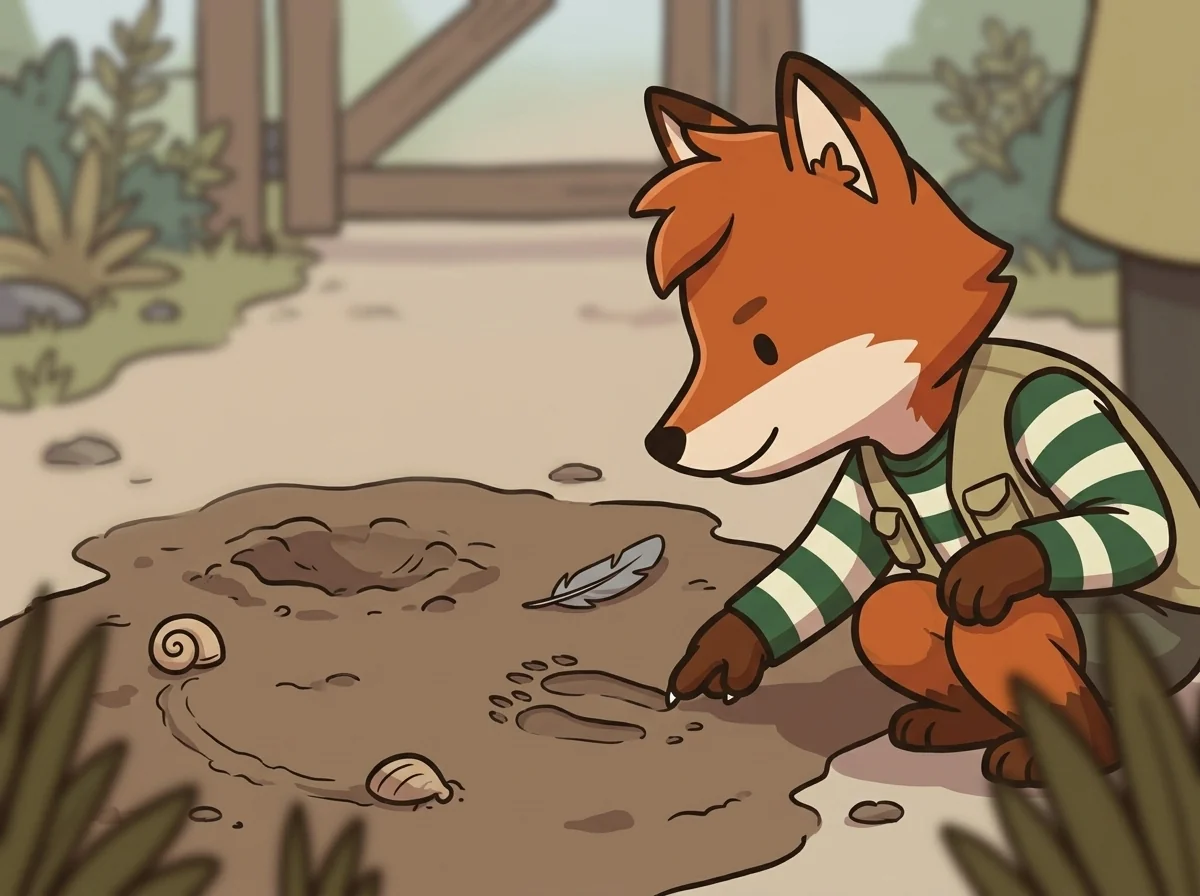
Scout, the mentor, met her at the gate and asked no hard questions. Scout just pointed at a patch of bare ground by the path. "What's been here?"
Spoor crouched and read it. "A rabbit — these paired prints, big back feet landing ahead of the small front ones, that's a hopper. And a bird dust-bathed there; see the little hollow and the loose feather. And something dragged a shell across, right to left." She looked up. "Nobody's HERE now. But four different animals passed through since the last rain."
Scout's eyebrows rose. "Most people only count what they can see."
"Most of nature doesn't wait to be seen," Spoor said. "But it always leaves a note."
Scout looked at the busy little patch of ground, then at Spoor, and nodded. "You belong here."
One afternoon a kid slumped into Spoor's corner of the field station, empty observation sheet in hand.
"I sat by the pond for an hour," the kid said, "and NOTHING came. Not one animal. I'm no good at this — everyone else sees stuff and I see nothing."
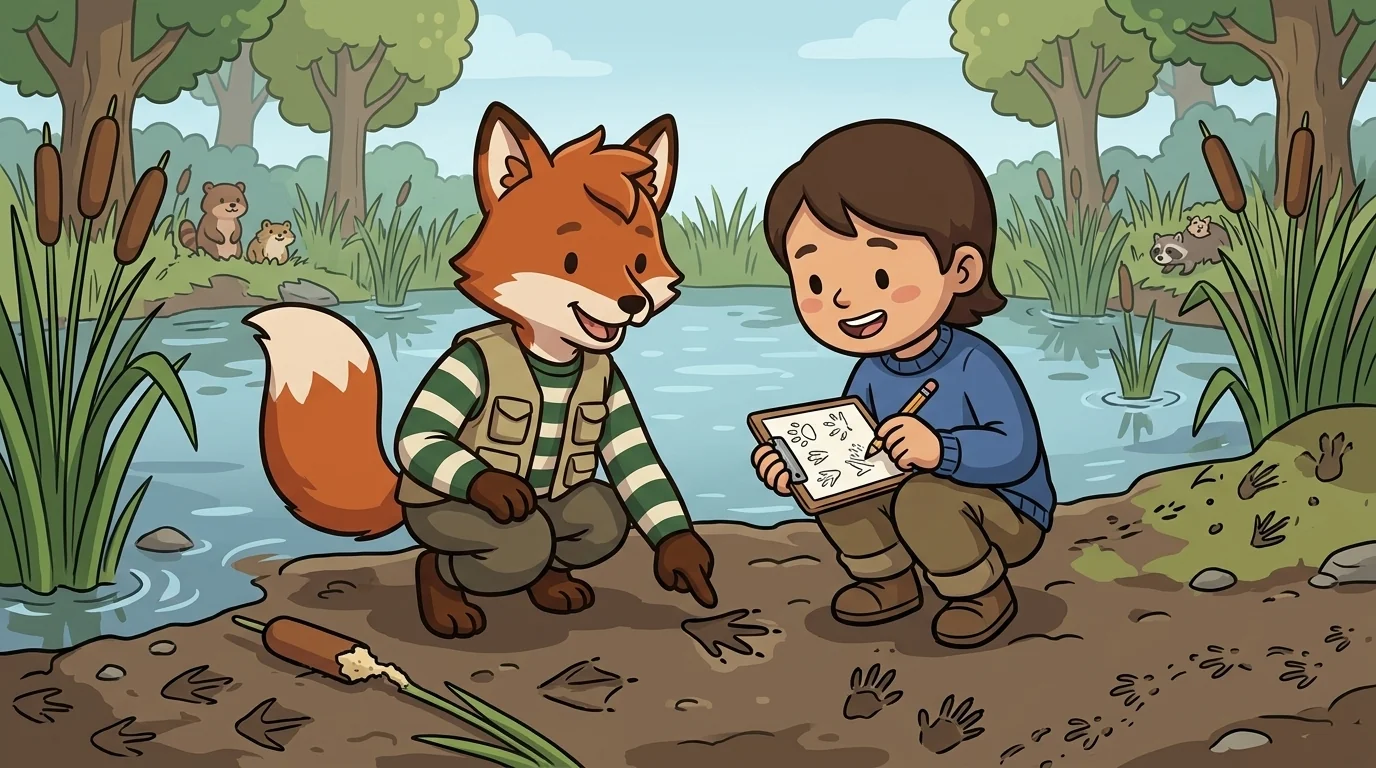
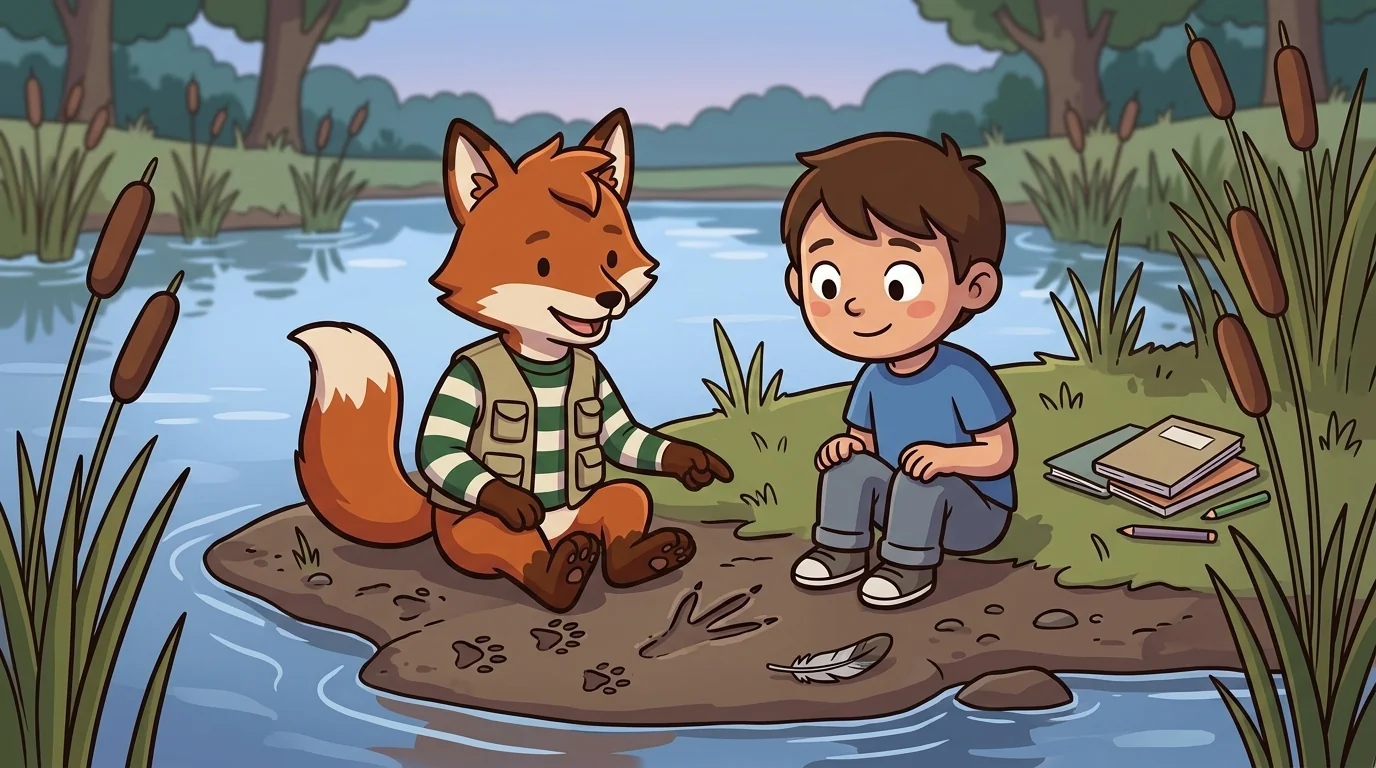
Spoor didn't argue. She walked the kid back to the pond and crouched at the muddy edge. "You were watching the water, waiting for something to appear," she said. "Watch the MUD instead." She pointed. "What's that?"
The kid looked. "...A footprint?"
"Read it. Whose?" Together they worked it out — webbed, three toes forward: a duck. Then a set of tiny hand-prints: a raccoon. Then a smooth belly-drag: a frog or a turtle. The kid's pencil started moving, the sheet filling with animals they'd never seen. "They were all HERE," the kid said, amazed. "I just missed them because I was waiting to see them."
"That's the whole craft," Spoor said, crouching to the kid's level. "You didn't fail to find animals. You found their notes, which is even better — one muddy bank told you about a whole night of visitors. Your looking counts. A real scientist tracking which animals use this pond could use exactly what you just read."
The kid stared at the full sheet, delighted.
Later, when the pond had gone silver with evening, the kid came back, thoughtful.
"When I thought the pond was empty," the kid said, "it was actually full of animals I'd just missed. That's kind of wonderful and kind of spooky."
Spoor sat down beside the kid in the reeds.
"It's wonderful," she said. "Every place you've ever thought was empty was crowded with lives, leaving notes you hadn't learned to read yet. That's not something to be sad about — it's the best news there is. The world is fuller than it looks, always." She traced a fresh print in the mud. "And here's the part that matters: you reading these notes, writing down who passed by — that helps. Scientists can't sit by every pond. But lots of us, reading the mud and sharing what we find, can watch over the whole living world together. Your notes join everyone else's."
The kid nodded, and Spoor watched that same bright wonder open up in them that had opened in her by the woods long ago — the woods filling up, the world getting fuller and more alive. She breathed it in, warm and glad. The animals were always here. You just had to learn to read the notes they left.
The TerraWatch ensemble
Spoor is one of the friends in TerraWatch. Each friend shows you one idea by how they act; meet them all and you have the whole subject.
-
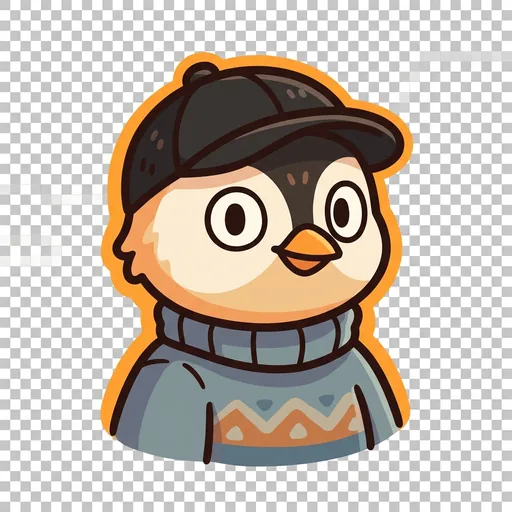
Spot
Observation + noticing — the chickadee perched on a branch who teaches slow-noticing as the first scientific skill ('look once, then look again, slower; the second look usually finds more')
-

Note
Structured recording — the beaver in notebook-pocket vest who teaches fact-vs-inference discipline ('write what you saw; then write what you think it means; don't mix them')
-
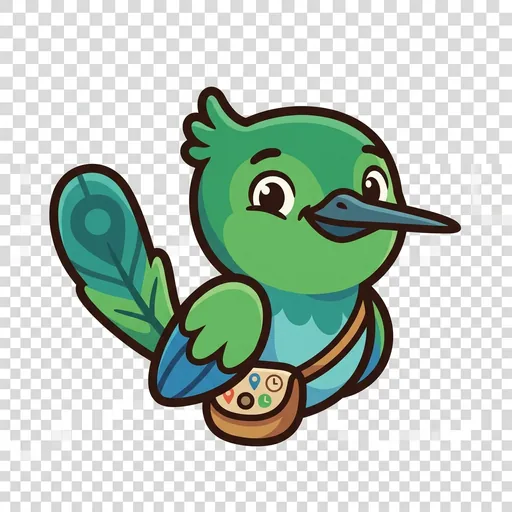
Pin
Geolocation + spatial-data discipline — the hummingbird with pin-tail-feather who teaches that location-stamps + time-stamps make observations useful to other scientists ('where matters; when matters; the same plant in two places is two stories')
-

Census
Biodiversity counting + sampling — the raccoon with tally-pattern vest who treats unglamorous repeated counting as the actual magic of science ('one bird seen is a moment; ten birds seen over ten days is a pattern; counting is the magic')
-
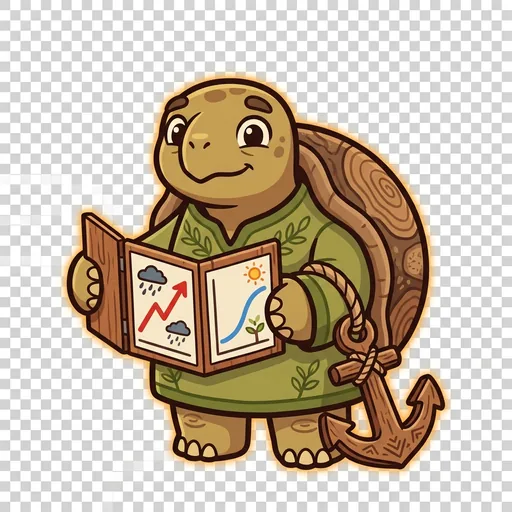
Trend
Change-over-time + agency-positive climate framing — the old tortoise with tree-ring shell and folding-graph showing both worrying AND hopeful trends ('today is one dot; many dots make a line; lines can bend; your dot helps the line')
-
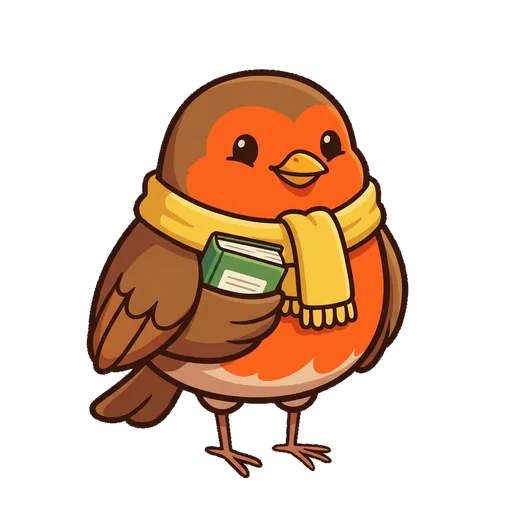
Almanac
Phenology / the timing of natural events
-
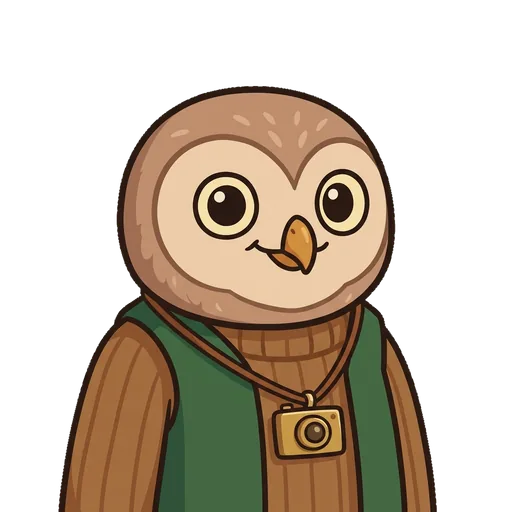
Attest
Evidence and verification
-
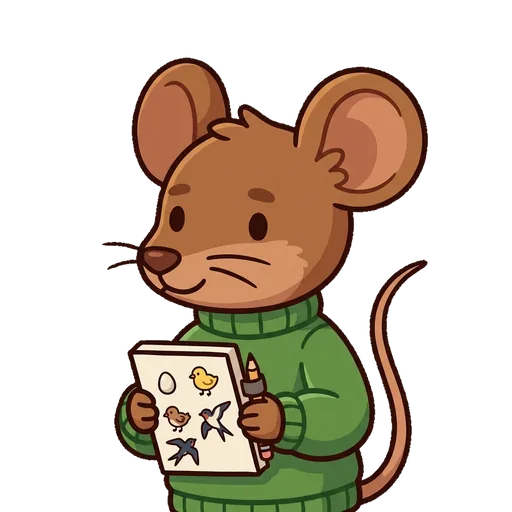
Fledge
Life stages / recording what stage of life something is in
-
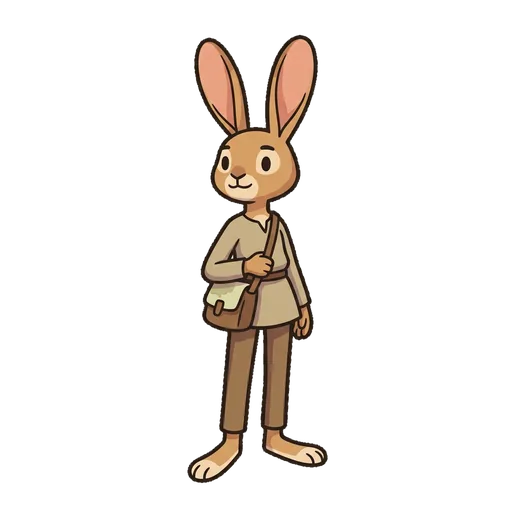
Verge
Range and distribution / where a species lives and where its edges are