
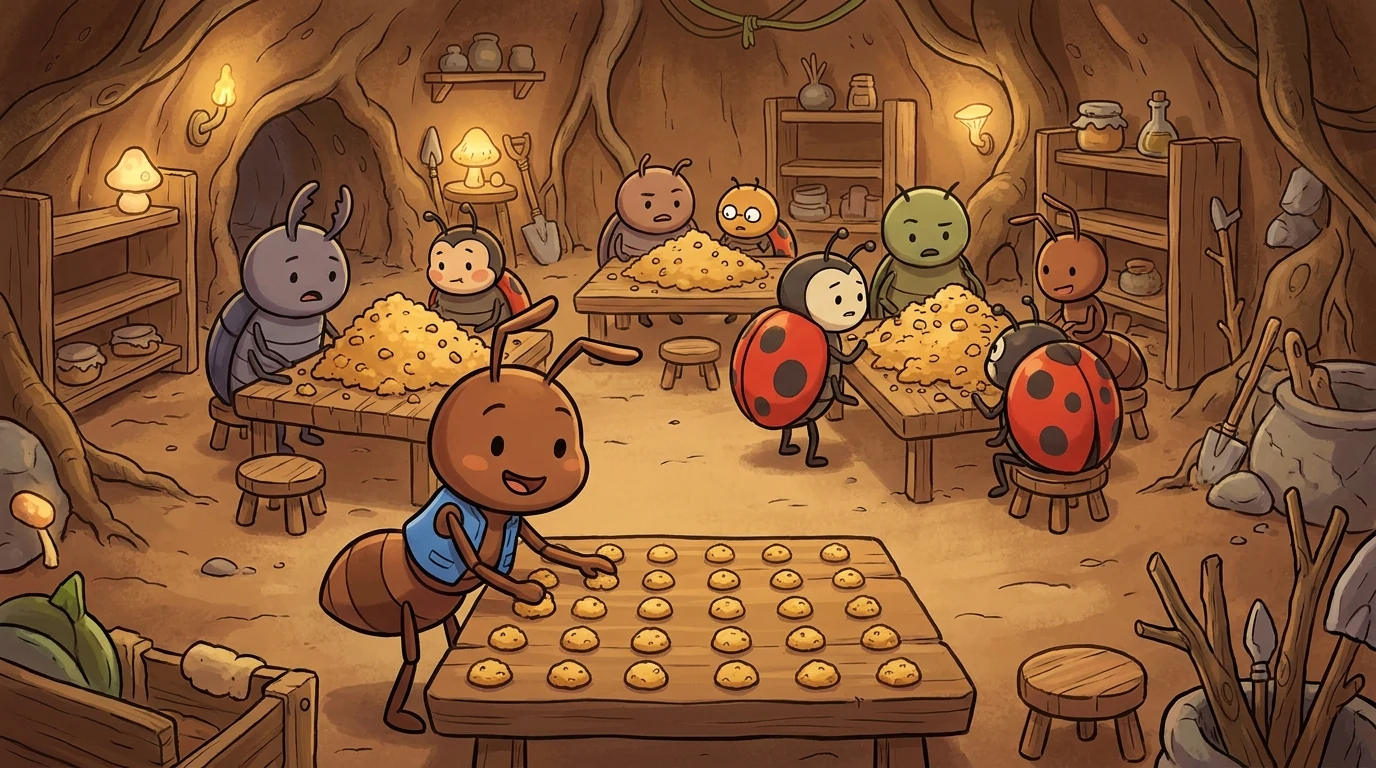
Arlo
ARLO — *equal rows, all the same. That's what times means.*
Listen along — Arlo
Loading audio…
Press play to listen along. The line being read lights up as you go.
Show full transcript
Loading transcript…
Arlo was an ant, and ants are famous for one thing: they line up.
In the Times Workshop, when the little bugs needed to count a big pile of crumbs, they did it the hard way — one, two, three, four, all jumbled, losing their place, starting over. It took forever and they never trusted the answer. Arlo would watch them, twitch his antennae, and smile. “You don’t have to count the mess,” he’d say. “Line it up first. Equal rows. Then it counts itself.”
And he’d march the crumbs into rows — the same number in each row — until the messy pile became a neat little rectangle. An array, he called it. Suddenly the count was easy: just the number of rows, and how many were in each row.
The little bugs didn’t get it. Counting was counting. Why would lining things up make it faster?
Arlo remembered being a tiny ant who counted everything one at a time. One afternoon his job was to count 24 seeds, and he kept losing track — 15, 16, was that 16 already? — and starting over, and over, until he wanted to give up.
An old worker ant named Nona watched him struggle. “Stop counting the pile,” she said. “Make rows. Put the same number in each.” So Arlo made rows of 6. When he finished, he had 4 neat rows of 6 seeds each. “Now,” said Nona, “you don’t count 24 things. You count 4 rows of 6. That’s four sixes. Six, twelve, eighteen, twenty-four.”
Arlo’s antennae shot straight up. He hadn’t counted one by one at all. He’d counted by rows — equal groups — and it was so much faster and he was sure it was right. That was the day he fell in love with the array.
Now a flustered ladybug named Bea had a bakery tray with cookies she needed to count, and she was poking at them one at a time, muttering, losing her place.
“Bea,” Arlo said kindly, “look at the tray. The cookies are already in rows. How many rows?”
Bea counted the rows. “Three.”
“And how many cookies in each row?”
“Five,” Bea said. “Every row has five.”
“So you don’t count fifteen cookies the slow way,” Arlo said. “You count three rows of five. Three fives. Say it with me: five, ten, fifteen.” Bea said it, and her eyes went round. “Fifteen! And I didn’t even lose my place!”
“That’s multiplication,” Arlo said, tidying an imaginary row with his front legs. “Three rows of five is three times five. The array shows you why it works — every row is exactly the same, so you just add that row over and over.” Then he showed her a trick: he turned the tray a quarter-turn. Now it was five rows of three. “Still fifteen! You can spin an array and the answer doesn’t change.”
Bea tried a bigger tray and skip-counted a little wrong. She sighed. “I lost the count again.”
“So point to each row as you count it,” Arlo said, with no fuss at all. “Losing the count isn’t a mistake — it just means the rows moved faster than your voice. Touch each row.” Bea touched each row as she counted, landed it, and Arlo treated the whole thing as the most normal thing in the world.
By the end, Bea could turn any messy pile into neat equal rows and count it by the row — fast, and sure.
“How’s it feel?” Arlo asked, antennae bright.
Bea thought about it. There was a calm, satisfied feeling, like when you finally straighten a crooked picture on the wall. “Neat,” she said. “Everything used to be a jumble I couldn’t trust. Now I line it up and it just… makes sense. And I know the answer’s right.”
Arlo did a happy little ant-dance. That was the feeling he loved most — not the speed, exactly, but the calm certainty of a count you can trust. “That’s the whole gift of the array,” he said. “You never have to count a mess again. Line it up into equal rows, and multiplication does the rest.”
Bea marched home arranging everything she passed into neat little rows — pebbles, leaves, her afternoon snack — counting each one by the row, tidy and sure.
The TimesQuest ensemble
Arlo is part of TimesQuest's distributed-narrative cast. Each character embodies a different curricular primitive; together they teach the full subject.
-

Divi
Division — a fair-minded otter who deals a pile out into equal groups; division is the array shared back out, and the inverse of a times fact (CCSS 3.OA)
-

Parti
Distributive / break-apart → fluency — a beaver who splits a hard fact into two easy known ones (7×8 = 7×5 + 7×3) and adds the parts (CCSS 3.OA.B.5)
-

Una
Unit fractions on the number line — a green inchworm who cuts a whole into exactly equal steps and stands on the line; 1/4 is a number, a place (CCSS 3.NF)
-

Mosa
Area & the array–area link — a slow, sure tortoise who tiles a rectangle with unit squares; area IS rows × columns, and the edge is perimeter (CCSS 3.MD)
-

Zola
Fact fluency (anti-shame) — a quick roadrunner who practices a fact till it pops; speed is a gift of kind practice, never a timed test, never a race lost (CCSS 3.OA.C.7)
-

Marlo
Mentor — a big-eared fennec fox who keeps the Times Workshop; meets every wrong answer with 'show me your thinking', never a sting; a mistake is a map, not a verdict