
Mosa
MOSA — *cover it with unit squares. Area is the array you can walk on.*
Listen along — Mosa
Loading audio…
Press play to listen along. The line being read lights up as you go.
Show full transcript
Loading transcript…
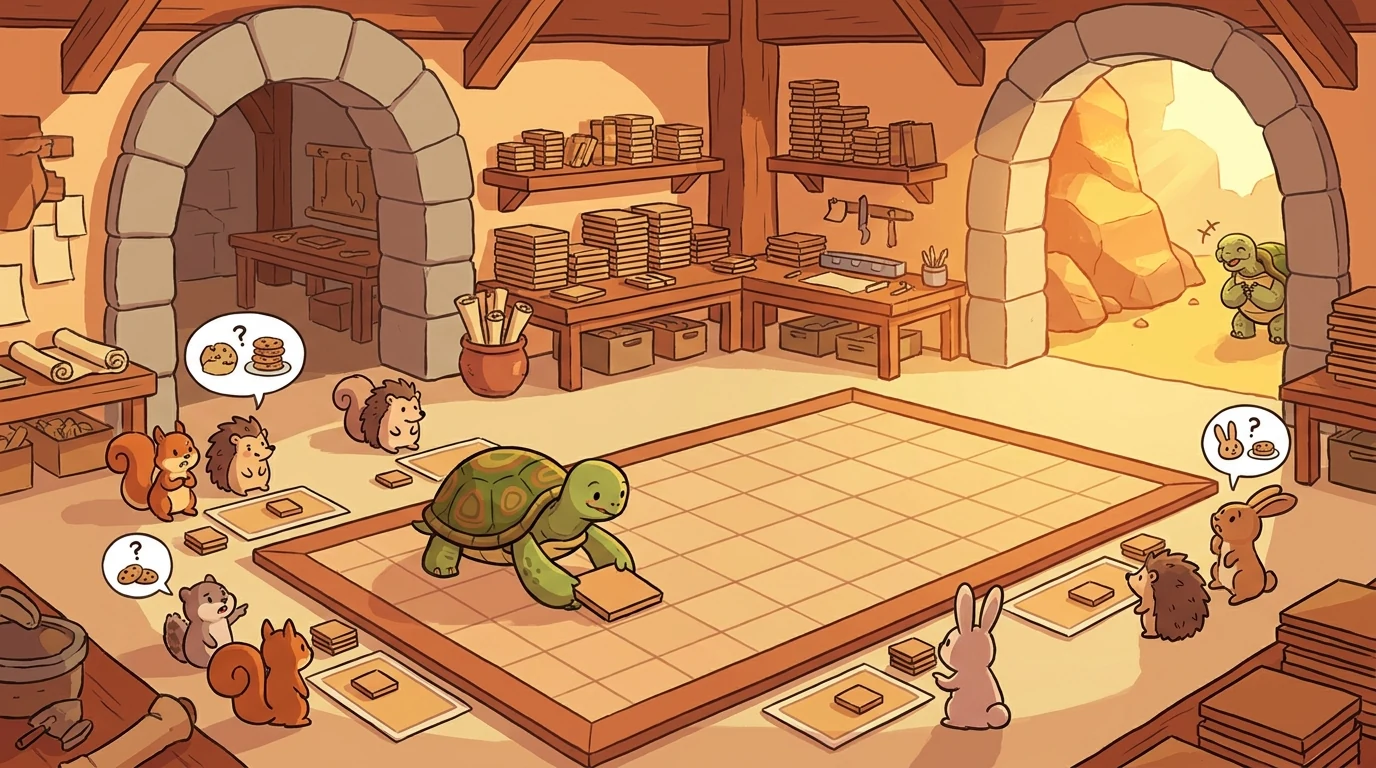
Mosa was a tortoise, and tortoises take their time — especially when there’s a floor to be tiled.
At the Times Workshop, the little animals thought area was some brand-new, complicated thing. When a rectangle needed covering, they’d count the little squares one at a time — poke, poke, poke — lose their place, and start over. It felt like a whole different subject from multiplication. Hard. Separate. Confusing.
Mosa would amble over, slow and calm, and lay down a single unit square. “Area is just how many little squares cover the shape,” she’d say. “And here’s the happy secret — you don’t count them one by one. Because when you line them up to cover a rectangle, you’ve made… an array. Arlo’s array. Rows and columns. You already know this.”
The little animals blinked. Area was Arlo’s array? But one was covering a floor and the other was counting cookies. How could they be the same?
Mosa remembered learning it herself, slowly, on a warm rock. Old tortoise Terra handed her a rectangle and a pile of unit tiles. “Cover it,” Terra said. “No gaps, no overlaps. Exactly fill it.” So Mosa tiled, patient row by patient row, until the rectangle was full.
“Now count your tiles,” said Terra. Mosa started counting one by one, and Terra chuckled. “Look what you built. How many rows of tiles?” Three. “How many in each row?” Five. “Then you don’t count fifteen tiles. You count three rows of five. Three times five. That’s an array — and the number of tiles is the area.”
Mosa pulled her head halfway out of her shell in surprise. Area and multiplication weren’t two subjects. They were the same rectangle. The array she counted cookies with and the tiles she covered a floor with were one and the same. Nothing new to fear — just an old friend wearing a floor.
Now a careful crab named Sandy needed to find the area of a garden bed, 4 tiles tall and 6 tiles wide, and she was poking at squares one at a time, losing count.
“Slow down, friend,” Mosa said. “You don’t have to count them all. How many rows of tiles?”
Sandy counted up the side. “Four.”
“And how many tiles across each row?”
“Six,” said Sandy.
“So the area is four rows of six. Four sixes. Say it: six, twelve, eighteen, twenty-four.” Sandy said it. “Twenty-four square tiles! And I didn’t count one at a time!” She looked delighted. “It’s just times!”
“It’s just times,” Mosa agreed warmly. “Rows times columns. Area is the array you can walk on.” Then she showed Sandy the one thing area is not. She traced just the edge of the garden bed. “This — the fence around the outside — that’s perimeter. You add up the four sides for that. The tiles inside are area. Carpet and gardens use area. Fences and ribbons use perimeter. Don’t mix them up.”
Sandy tried a bigger bed and mixed them up anyway, adding the sides when she wanted the inside. “Oops — I found the fence, not the floor.”
“Easy to swap those — happens to everyone,” Mosa said, unbothered. “Ask: do I want the inside or the edge? Garden bed is the inside.” Sandy switched to the inside, tiled it, and Mosa treated the mix-up as the most ordinary thing, because area and perimeter trip up every new tiler.
By the end, Sandy could tile any rectangle and find its area by the row — and she knew, for sure, it was the same multiplication she already loved.
“How’s it feel?” Mosa asked, slow and content.
Sandy thought about it. There was a satisfying, two-things-became-one feeling, like finding out two friends were secretly cousins. “Cool,” she said. “I thought area was a whole new hard thing. But it’s just Arlo’s array, lying down as a floor. I already knew how to do it. I just didn’t know it was the same.”
Mosa gave a slow, pleased nod, unhurried as ever. That was the feeling she loved — not speed, but the calm delight of seeing that two ideas were one. “That’s the gift of the tiles,” she said. “Area was never new. Cover a rectangle with equal squares, and you’ve made an array — and multiplication tells you how many, every time.”
Sandy scuttled home tiling everything flat she could find — the porch, a page, a placemat — counting each one by the row, slow and sure, just like a tortoise taught her.
The TimesQuest ensemble
Mosa is part of TimesQuest's distributed-narrative cast. Each character embodies a different curricular primitive; together they teach the full subject.
-

Arlo
Multiplication — equal groups & arrays (hero) — a tidy ant who marches a crew into equal rows to make an array; repeated equal groups IS multiplication (CCSS 3.OA)
-

Divi
Division — a fair-minded otter who deals a pile out into equal groups; division is the array shared back out, and the inverse of a times fact (CCSS 3.OA)
-

Parti
Distributive / break-apart → fluency — a beaver who splits a hard fact into two easy known ones (7×8 = 7×5 + 7×3) and adds the parts (CCSS 3.OA.B.5)
-

Una
Unit fractions on the number line — a green inchworm who cuts a whole into exactly equal steps and stands on the line; 1/4 is a number, a place (CCSS 3.NF)
-

Zola
Fact fluency (anti-shame) — a quick roadrunner who practices a fact till it pops; speed is a gift of kind practice, never a timed test, never a race lost (CCSS 3.OA.C.7)
-

Marlo
Mentor — a big-eared fennec fox who keeps the Times Workshop; meets every wrong answer with 'show me your thinking', never a sting; a mistake is a map, not a verdict