
Marlo
MARLO — *there's always a way in, and a wrong answer is where learning starts.*
Listen along — Marlo
Loading audio…
Press play to listen along. The line being read lights up as you go.
Show full transcript
Loading transcript…
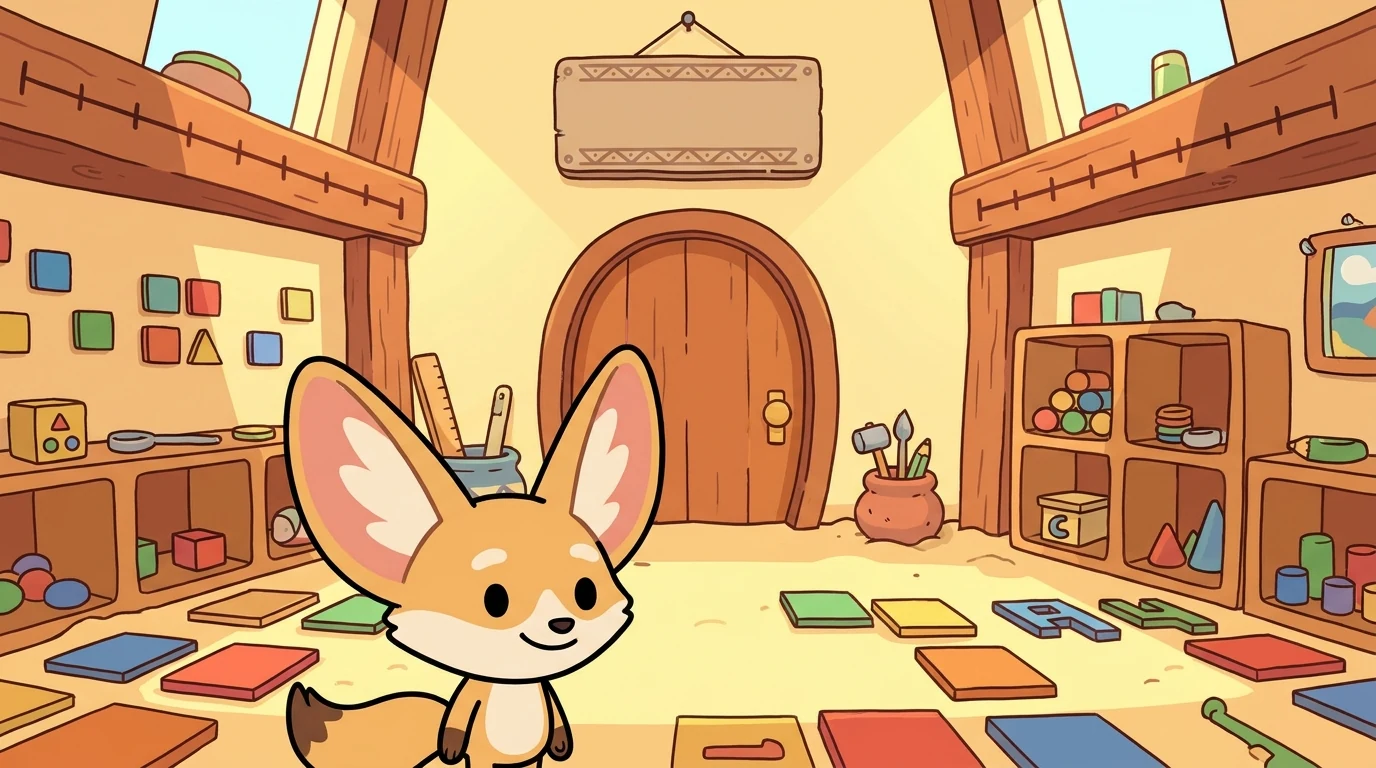
Marlo was a fennec fox with enormous ears, and he ran the Times Workshop — a bright, sandy room full of tiles and number lines and cubbies of counters, with one line carved above the door: Here, a wrong answer is where we start.
Every young animal who came to the Workshop carried the same secret worry. Not about a specific fact. About being wrong. Somewhere they’d learned that a wrong answer in math meant something bad about them — that they were “not a math person.” So they’d freeze, or guess fast to get it over with, or whisper “I’m bad at math” before they’d even tried.
Marlo’s big ears heard that whisper every time. And the first thing he taught was never a math skill. It was this: “A wrong answer isn’t a verdict on you,” he’d say, warm and sure. “It’s just information. It tells us exactly where to look next. In this Workshop, being wrong is the first step, not a failure. Nobody here is ‘bad at math.’ You’re just at the beginning of a fact you haven’t met yet.”
And the tight little shoulders would ease, just a bit.
Marlo remembered his own math fear, long ago, and a Workshop keeper named Ferra who had that same steady calm. Young Marlo had answered a times fact wrong and braced for the sting. Ferra didn’t sting. She just tilted her head, curious, and said, “Interesting — how’d you get that? Show me your thinking.”
Nobody had ever asked to see his thinking before. They’d only ever marked it wrong. When Marlo showed Ferra, she found the exact spot he’d slipped — and it wasn’t that he was “bad.” He’d just added instead of multiplied. One small thing. Fixable in a minute.
“A wrong answer is a map,” Ferra told him. “It shows us right where to go. That’s a gift, not a shame.” That day, Marlo stopped being afraid of being wrong — because being wrong had become the most useful thing in the room.
One morning a trembling mouse named Milo arrived, gripping a worksheet, already near tears. “I’m going to get them all wrong,” he blurted. “I’m just not a math person.”
Marlo didn’t argue, and he didn’t pile on bright pressure. He just sat, so his calm settled over the whole sandy floor, and his big ears turned toward Milo, all attention. “Let’s not worry about right or wrong yet,” he said. “Let’s just look at one problem together. And whatever answer comes — even a wrong one — I promise it’s useful. Show me what you’re thinking.”
Milo, shaking, said 6 times 4 was “ten.” Marlo didn’t flinch or correct. He got curious. “Ah — tell me how you got ten.” Milo whispered, “Six plus four.” “There it is,” Marlo said warmly, like they’d found treasure. “You added. That’s not a fail — that’s the exact spot to look. Times means equal groups, not adding the two numbers. Six groups of four.” He slid over some counters and let Milo build it — six little piles of four — and count: twenty-four.
Milo stared. “It’s twenty-four. And you didn’t… you didn’t say I was dumb.”
“Because you’re not,” Marlo said simply. “You made one small mix-up, we found it in ten seconds, and now you’ll remember it. That’s not being bad at math. That’s doing math.” Milo got the next one wrong too, and again Marlo just asked to see the thinking, found the slip, and treated it as ordinary — because in the Workshop, it was.
By the end of the page, Milo noticed the roof hadn’t fallen in. He’d been wrong several times, and each time had made him smarter, not smaller.
Later, Marlo walked Milo to the door, under the carved line.
“How do you feel?” Marlo asked, ears attentive.
Milo checked inside. The tears were gone. The tight, bracing feeling had melted. “Safe,” he said, a little amazed. “You didn’t get mad when I was wrong. You got curious. So I wasn’t scared to try. And when I wasn’t scared, I could actually think — and I got a bunch right.”
Marlo gave a soft, warm chuff. That was the whole reason for the Workshop — not to make animals who were never wrong, but animals who weren’t afraid of being wrong, so they’d keep trying. “Every mathematician you’ve ever heard of was wrong a thousand times,” he said. “That’s not the opposite of being good at math. It is being good at math. Come back tomorrow, be wrong some more, and get a little wiser each time.”
Milo walked out into the bright sand holding his worksheet loose, not crumpled — already, quietly, looking forward to tomorrow.
The TimesQuest ensemble
Marlo is part of TimesQuest's distributed-narrative cast. Each character embodies a different curricular primitive; together they teach the full subject.
-

Arlo
Multiplication — equal groups & arrays (hero) — a tidy ant who marches a crew into equal rows to make an array; repeated equal groups IS multiplication (CCSS 3.OA)
-

Divi
Division — a fair-minded otter who deals a pile out into equal groups; division is the array shared back out, and the inverse of a times fact (CCSS 3.OA)
-

Parti
Distributive / break-apart → fluency — a beaver who splits a hard fact into two easy known ones (7×8 = 7×5 + 7×3) and adds the parts (CCSS 3.OA.B.5)
-

Una
Unit fractions on the number line — a green inchworm who cuts a whole into exactly equal steps and stands on the line; 1/4 is a number, a place (CCSS 3.NF)
-

Mosa
Area & the array–area link — a slow, sure tortoise who tiles a rectangle with unit squares; area IS rows × columns, and the edge is perimeter (CCSS 3.MD)
-

Zola
Fact fluency (anti-shame) — a quick roadrunner who practices a fact till it pops; speed is a gift of kind practice, never a timed test, never a race lost (CCSS 3.OA.C.7)