
Brake
NEGATIVE FEEDBACK - *runaway growth needs something pushing BACK, or it explodes to nonsense; the rising cost of each next upgrade is a BALANCING loop - the more you grow, the harder the next step becomes - and that push-back is what keeps a system steady instead of spiralling out of control.*
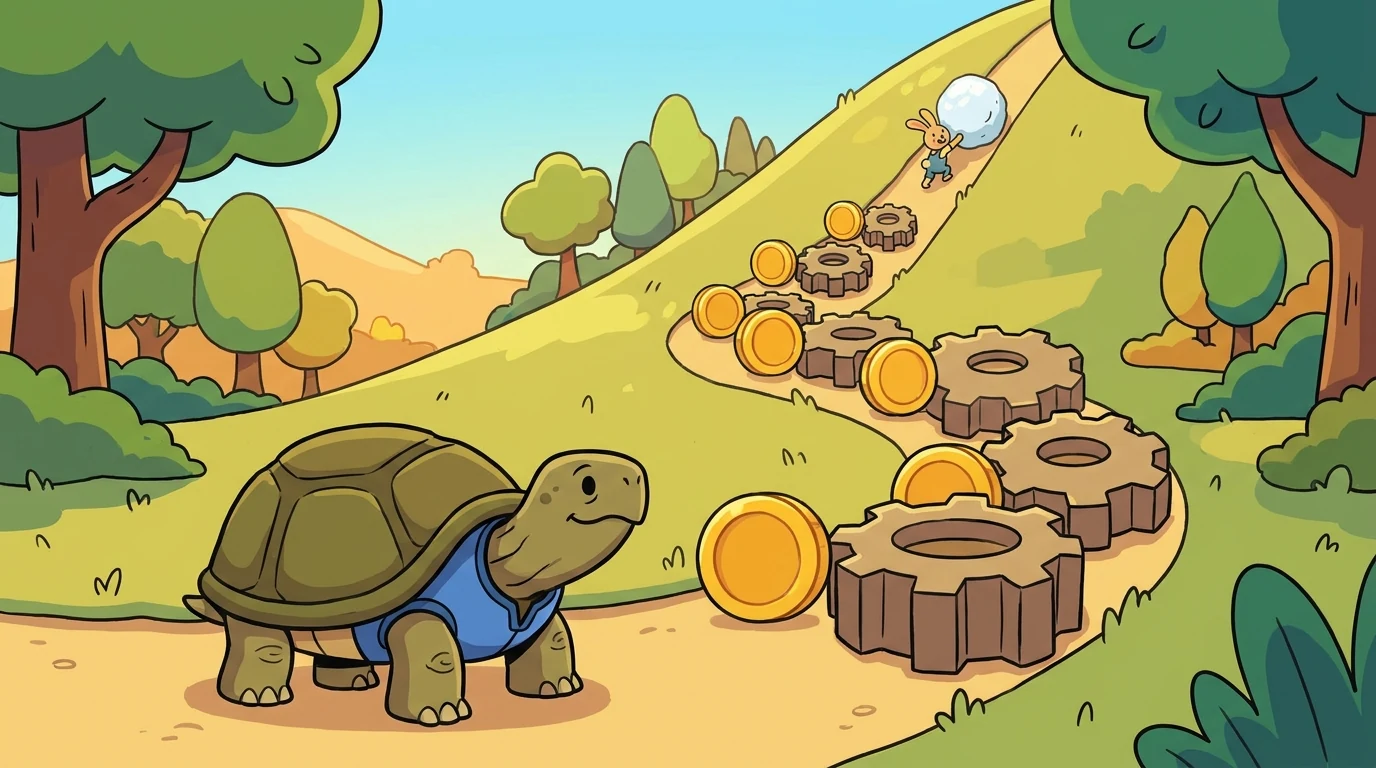
Brake the Tortoise Holds the Line
Brake is a solid, unhurried, deep-voiced tortoise, and Brake has a job that sounds unglamorous but is quietly essential: Brake keeps things from running away. Multi the rabbit loves to make the machine grow faster and faster - and Multi is right to. But left completely unchecked, faster-and-faster has a problem. It doesn’t stop. It races off to numbers so huge they stop meaning anything, and the game turns into a boring straight line to infinity. Something has to push back. That something is Brake.
“Notice what happens each time you buy an upgrade,” Brake says, in no hurry at all. “The next upgrade costs more than the one before. And the one after that costs more still. The price climbs, step by step, the further you go.” That rising cost isn’t the game being stingy - it’s Brake, doing his job. The more the machine grows, the more it costs to grow it further. Growth makes its own next step harder.
This is called a balancing loop, or negative feedback, and it’s the opposite of Multi’s snowball. Multi’s loop reinforces - more leads to more leads to more. Brake’s loop balances - more leads to harder, which slows the more. And here’s the thing: a healthy system usually needs both. Multi’s push forward, and Brake’s push back. One without the other breaks.
“Think of it like a thermostat,” Brake says, slow and sure. “The colder it gets, the harder the heater works to warm things up - the system pushes back against the change and settles at a steady temperature. Or your own body: run hard, and you get tired, which makes you slow down before you hurt yourself. Tiredness is a brake. It pushes back. That push-back is what keeps you steady instead of spinning out.”
And a game especially needs Brake. Without a rising cost, you’d buy every upgrade in seconds and the fun would evaporate - there’d be no reason to keep playing, no next goal just out of reach. Brake is what makes each new upgrade feel earned. The pull-forward of Multi and the push-back of Brake, in tension, is exactly what makes the climb interesting. “A game with no limit isn’t a game,” Brake rumbles. “It’s just a number going up. My job is to keep it a game.”
That is Brake’s steady, essential idea.
Every next step costs more than the last. That rising cost is the balancing push-back that keeps a system steady instead of spiralling away.
A grown-up can play too! Hunt for “brakes” - forces that push back harder the faster things go. A car speeds up until air resistance balances the engine and it hits a steady top speed. A crowded room gets loud until people can’t hear and quiet down. Each is a balancing loop: growth that creates its own resistance. That push-back, holding a system steady, is exactly what Brake does.
When Multi tries to send the machine rocketing off the top of the chart and Brake’s rising costs quietly rein it back to a steady, satisfying climb, Brake gives a slow, contented nod. “Fast is fine,” he says. “Fast forever is nonsense. Somebody has to hold the line - and I don’t mind being slow. Slow is rather the point.”
Push back, hold steady, keep it a game. That’s Brake.
The tycoonforge ensemble
Brake is part of tycoonforge's distributed-narrative cast. Each character embodies a different curricular primitive; together they teach the full subject.