
Multi
COMPOUNDING - *there are two ways to grow: ADDING the same amount each time (steady, straight-line) or MULTIPLYING - where each gain makes the NEXT gain bigger; multiplying feeds on itself, starts slow, then snowballs, and it is the secret behind savings, interest, and every idle game.*
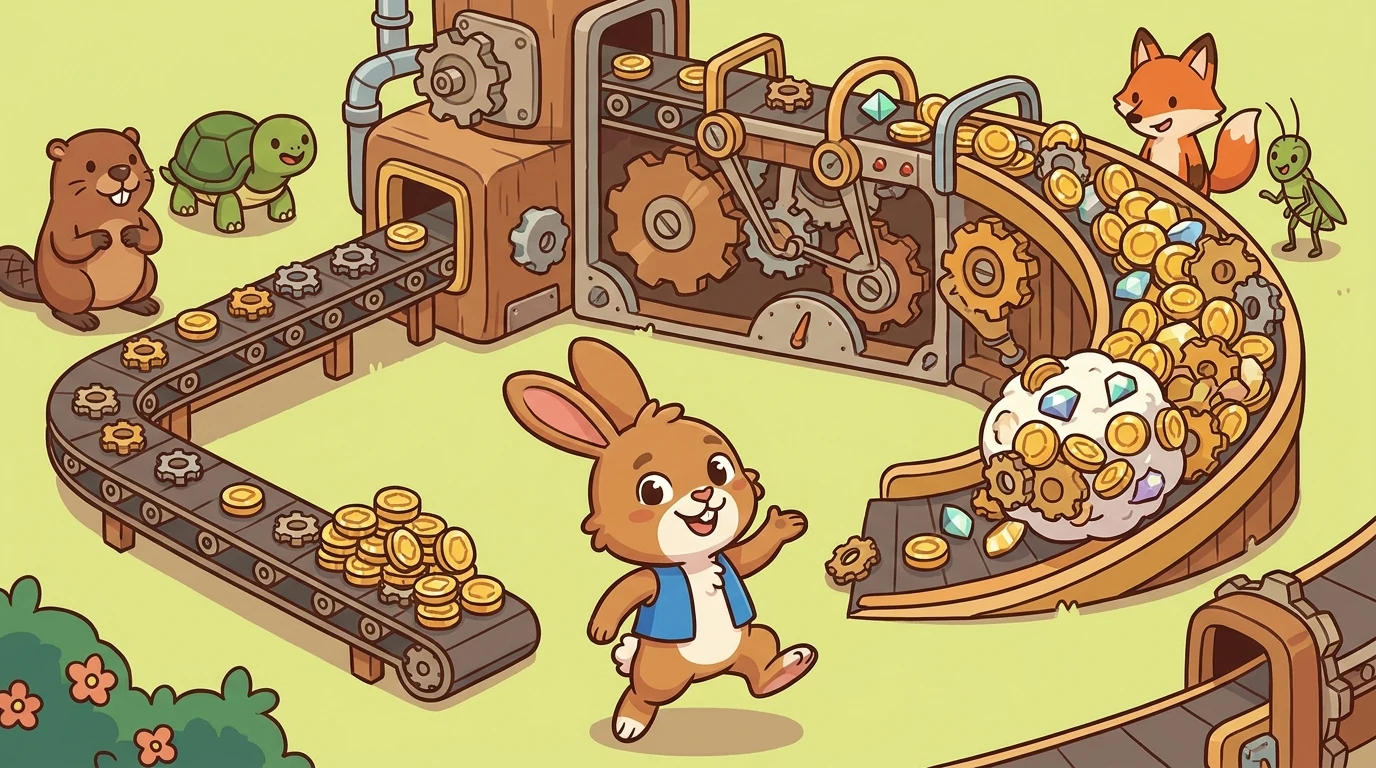
Multi the Rabbit and the Snowball
Multi is a quick, bright-eyed rabbit with a grin that says just you wait, and Multi understands the single most surprising idea in all of money - one that fools almost everybody the first time they meet it. It’s the difference between adding and multiplying.
“Most people,” Multi says, “grow things by adding. Save a coin a day, and after ten days you have ten coins. After a hundred days, a hundred coins. Steady. Straight. Predictable. And…” - Multi wrinkles its nose - “…a bit slow. Nice, but slow.”
“But watch what happens,” Multi goes on, ears perking, “when each step doesn’t just add to the pile - it multiplies it.” In the tycoon machine, every upgrade you buy doesn’t hand you a fixed number of extra coins. It boosts your rate - it makes the machine earn more per tick than before. So the next upgrade builds on a bigger machine, which earns even more, which buys the next upgrade sooner, which makes the machine bigger still. Each gain makes the next gain bigger. That’s compounding, and it’s why Multi grins.
The strange, beautiful, tricky thing about compounding is its shape. It starts out looking almost disappointing - slow, flat, barely moving, so slow that plenty of players quit in boredom, sure it’ll never amount to anything. And then, if you’re patient… it takes off. The curve bends upward and keeps bending, slow-slow-slow-then-whoosh, like a snowball rolling downhill that’s tiny at the top and enormous at the bottom. “The growth grows the growth,” Multi says, hopping in a happy circle. “That’s the whole secret. That’s the snowball.”
This isn’t just a game trick - it’s real, and it’s everywhere. It’s how savings grow when the interest earns its own interest. It’s how a skill builds when each thing you learn makes the next thing easier to learn. It’s the engine under every idle game ever made, and under a great deal of real-world wealth. Understanding the difference between adding and multiplying is genuinely one of the most useful things a person can learn about money.
But Multi is honest about the catch. “Compounding tests your patience,” it admits, ears drooping a little. “At the start it feels like nothing’s happening. That’s exactly when most give up - right before the snowball would have started to roll. The people it rewards are the ones who wait through the boring beginning.”
That is Multi’s patient, surprising idea.
Adding grows you a little; multiplying grows the growth itself. Stick with it through the slow start, and it snowballs.
A grown-up can play too! Try the classic puzzle together: would you rather have a jar with $100 added to it every day for a month, or a single penny that DOUBLES every day for a month? It feels obvious - until you work out the doubling. (The penny wins, enormously, by the end - that’s compounding, and almost nobody guesses it the first time.)
When the tycoon machine finally hits the steep part of the curve and the coins start pouring faster than the eye can follow, Multi throws both paws in the air. “There it is! The whoosh!” it cheers. “Slow, slow, slow - and then all at once. I told you to wait.”
Multiply, be patient, snowball. That’s Multi.
The tycoonforge ensemble
Multi is part of tycoonforge's distributed-narrative cast. Each character embodies a different curricular primitive; together they teach the full subject.