Fan
A wave doesn't march in a straight line past an edge
Loading audio…
Press play to listen along. The line being read lights up as you go.
Show full transcript
Loading transcript…

In the courtyard behind WaveForge, a young moth fluttered near a doorway and pointed out something everyone experiences but few understand: you can hear a voice around a corner you can't see around.
Fan was soft and dusty-winged, with delicate feathered antennae that spread wide to catch the faintest signal. A young hedgehog stood puzzled by a wall. "I can hear the others talking on the far side," he said, "but I can't SEE them at all. How does their voice get around the wall if I can't?"
"Because sound doesn't march in a straight line like you do," Fan said, spreading her wings. "When a wave passes an edge — like the corner of that wall, or the gap of the doorway — it doesn't stay in a narrow beam. It SPREADS. It fans out around the edge and into the space beyond." She swept a wing in a fanning arc past the wall's corner. "Light does it too, but only a tiny bit, so you can't see around the corner. Sound spreads a LOT, so you CAN hear around it." She fluttered. "A wave doesn't march in a straight line past an edge. It spreads and fans out around it. That's why you can hear around a corner."
The hedgehog blinked. "So the sound... bends around the wall's edge?"
"Spreads around it," Fan said. "It's not magic, and the wall isn't leaky. It's just what waves DO at an edge or a gap — they fan out. The narrower the gap or the sharper the edge, the more dramatically they spread. That's why sound leaks around corners, and light through a tiny slit spreads into a pattern, and water waves curl around the end of a jetty."

Fan had learned about spreading waves as a caterpillar-turned-moth.
The first time she tried to fly straight to a lamp behind a leaf, she was baffled — she could sense the light spilling AROUND the leaf's edge, faint and spread, and it confused her sense of where the lamp really was. She fluttered in circles, sure her senses were broken, that she was a hopeless navigator.
An old moth with wide soft antennae drifted beside her. "Your senses aren't broken," she said. "You're picking up the light that SPREAD around the leaf's edge — real light, just fanned out." She fanned her own wings past an edge. "Waves don't stop dead at an edge and leave a sharp shadow. They curl and spread around it a little, filling in the space behind. That spread is why the shadow's edge is soft, not razor-sharp." She touched the young Fan's antenna. "Once you know waves fan around edges, the spread stops confusing you and starts INFORMING you — it tells you something's just around the corner, even when you can't see it straight-on."
Fan learned to read the fanned-out signal — the light and sound that spread around edges — instead of being confused by it. And the world opened up: she could sense what was around corners, behind leaves, through gaps. The broken-senses feeling turned into a keen, capable wonder. Her senses were fine. She just hadn't known that waves fan around edges, filling the spaces straight lines can't reach.
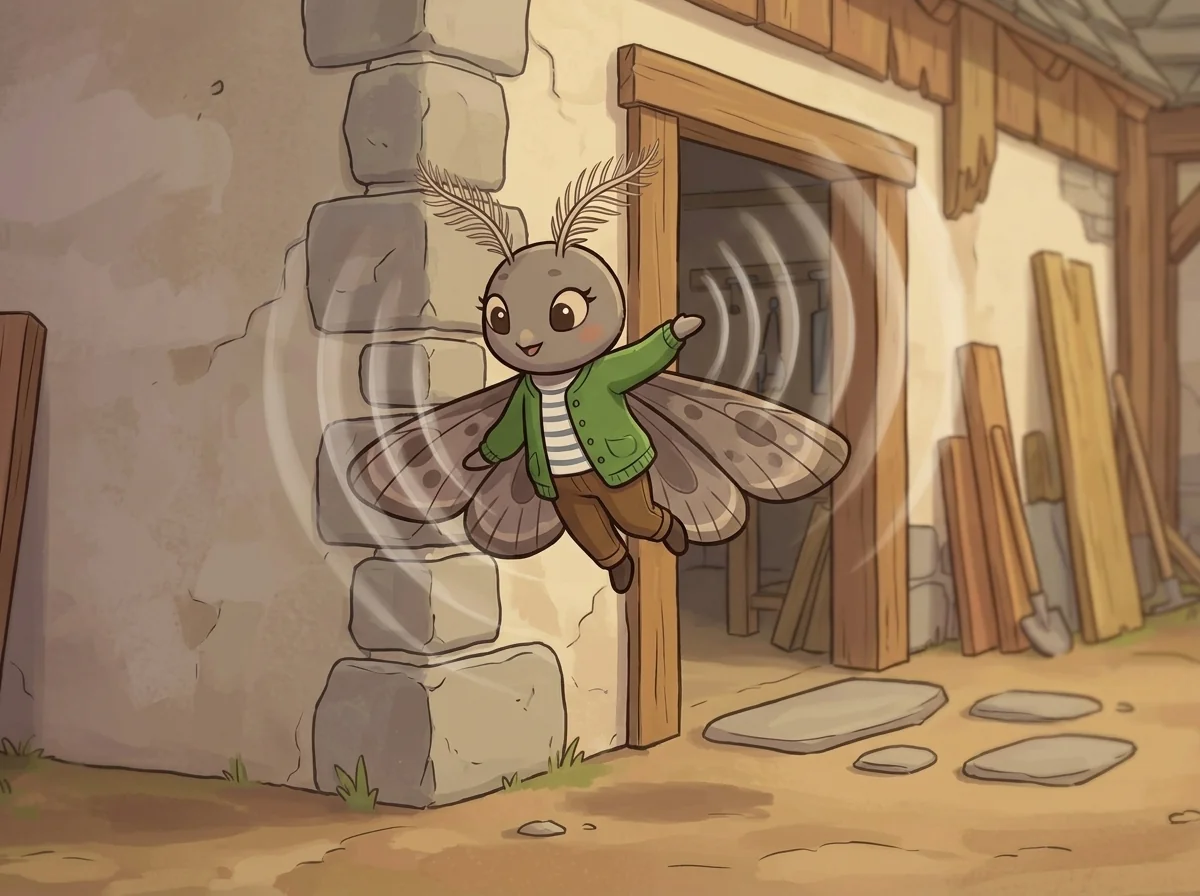
When she was twelve, Fan fluttered to WaveForge, where Sonic, her mentor, asked, "What does a wave do when it passes an edge or a narrow gap?"
Fan didn't answer with a speech. She fluttered past the courtyard doorway and spread her wings. "It fans out — it diffracts," she said. "It doesn't stay a straight beam; it spreads around the edge into the space beyond. That's why you can hear around corners, why light through a pinhole spreads into a pattern, why ocean waves curl around a barrier." She spread wide. "The narrower the gap, the wider the fan. It's the same spreading, everywhere."
Sonic's eyes crinkled warmly. "Some think waves cast sharp shadows and never bend around things," Sonic said.
"They always spread a little at an edge," Fan said. "That's why shadows are soft. Physics, not magic." Sonic smiled. "Then come in," Sonic said. "WaveForge needs someone who knows how waves reach around corners."
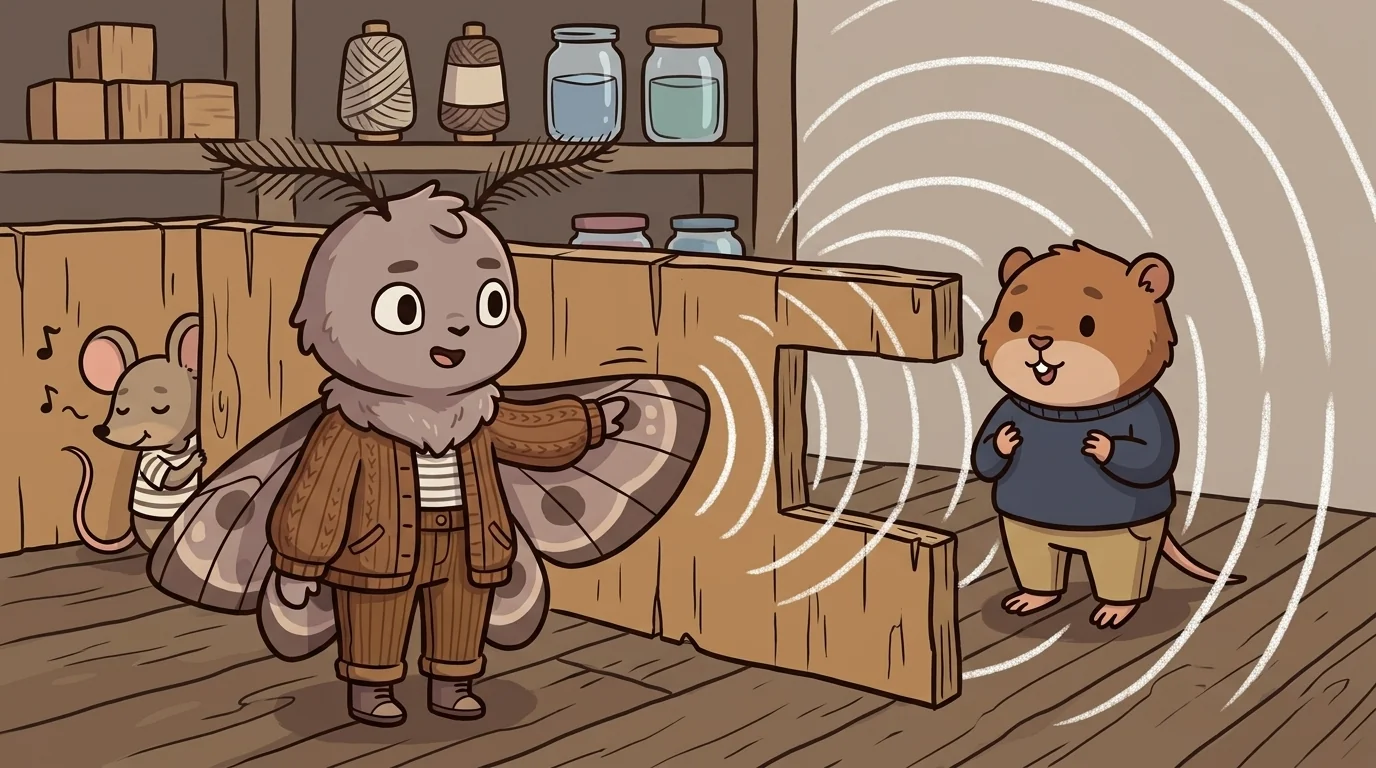
In her workshop one afternoon, a stubborn young vole insisted waves only went straight.
"Sound goes in straight lines," the vole declared. "So if there's a wall between me and someone, I shouldn't hear them AT ALL. But I do, and it makes no sense, so I think the wall's just thin or something."
"The wall's solid — let's prove it and then explain it," Fan said gently. She set the vole behind a solid barrier with a small gap, and had a friend hum on the far side. The vole heard the hum clearly, spread all around, even though no straight line connected them through the solid wall — only through and around the gap. "See? No straight line reaches your ears through that wall. Yet you hear the hum, coming from the GAP and the EDGES, spread out." She fanned a wing. "That's because the sound wave, hitting the gap, fans out from it in all directions — like water spraying through a nozzle. It doesn't need a straight line. It spreads."
The vole listened, astonished. "So sound really doesn't just go straight. It spreads out from every edge and gap, and fills in behind the wall."
"That's the whole craft," Fan said. "Waves fan around edges and out of gaps. It's why you hear around corners, why a whisper leaks under a door, why light through the tiniest slit blooms into a spread pattern. Not a leaky wall — just a wave, doing what waves do at every edge."

Later, as the courtyard quieted, the vole came back, humming around a corner and listening to it spread, grinning.
"It's kind of wonderful," the vole said, "that sound reaches me around corners just by spreading. I was so sure waves only went straight."
Fan settled beside him, wings soft.
"Almost everyone assumes waves go straight and stop dead at edges," she said, "casting razor shadows." She fanned a wing past an edge. "But real waves always spread a little around every edge and out of every gap — that's why shadows have soft edges, why you hear around corners, why a wave curls around a rock." She fluttered. "There's a keen, opening-up feeling in learning that — the moment you realize the world isn't made of sharp straight lines and hard shadows, but of waves gently fanning around every edge, reaching into every space." She spread her dusty wings. "Not magic, not a leaky wall — just a wave, spreading around the corner, the same way, everywhere."
The vole nodded, humming around the corner, and Fan watched the waves-only-go-straight stubbornness ease into that keen, capable wonder she'd found as a young moth reading spread-out light — the warm gladness of a young learner who's discovered that waves don't march in straight lines at all, but fan gently around every edge, reaching the places a straight line never could.
The WaveForge ensemble
Fan is one of the friends in WaveForge. Each friend shows you one idea by how they act; meet them all and you have the whole subject.
-

Pulse
Wave basics (frequency + amplitude + wavelength)
-

Meet
Interference (constructive + destructive)
-

Ring
Resonance (natural frequency response)
-

Drift
Doppler / wave-source motion
-

Loop
Standing waves + harmonics
-

Muffle
Damping / absorption of wave energy
-

Rebound
Reflection / echoes
-

Refract
Refraction / waves bending at a speed change
-

Wane
Spreading / weakening with distance


