Meet
INTERFERENCE — *when waves meet, they add. peaks-meet-peaks = bigger. peaks-meet-troughs = silence.*
Loading audio…
Press play to listen along. The line being read lights up as you go.
Show full transcript
Loading transcript…
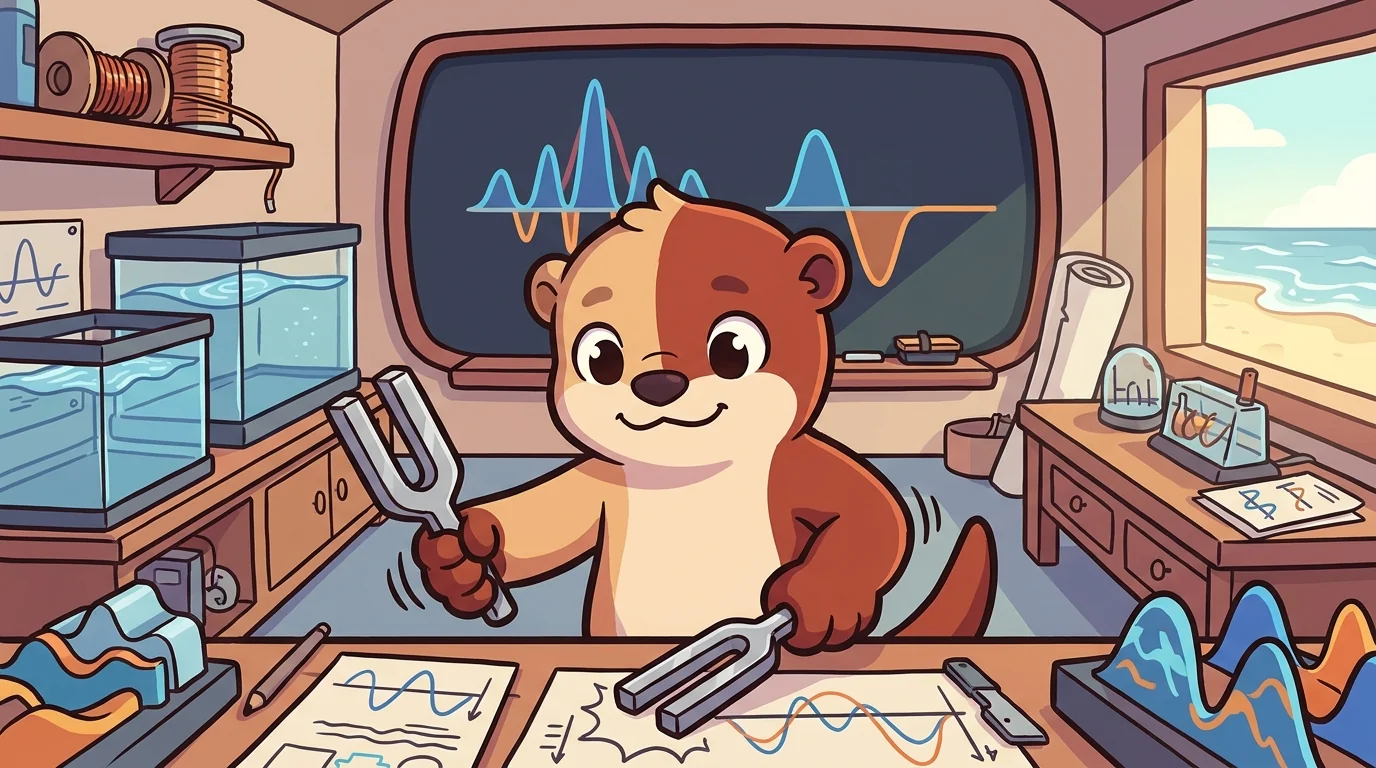
Meet is a small otter-tween split right down the middle in two colors — light tan on one side, dark russet on the other — with chunky paws, a tuning fork held in each.
Meet loves watching things overlap. "When waves meet, they add," he says. That's his whole craft: interference. Strike his two forks — tuned a hair apart — at once, hold them by your ear, and you hear a strange thing — loud, then quiet, then loud again. Most kids think waves just stack up and always get louder, but Meet knows the truth: waves can add AND subtract. When two peaks meet, they build a bigger wave (constructive — louder, brighter); when a peak meets a trough, they cancel (destructive — silence, a flat spot). "It's not magic," Meet says, tapping his bench. "It's just addition. Plus-three and plus-three makes six; plus-three and minus-three makes zero. Same math, all the way down."
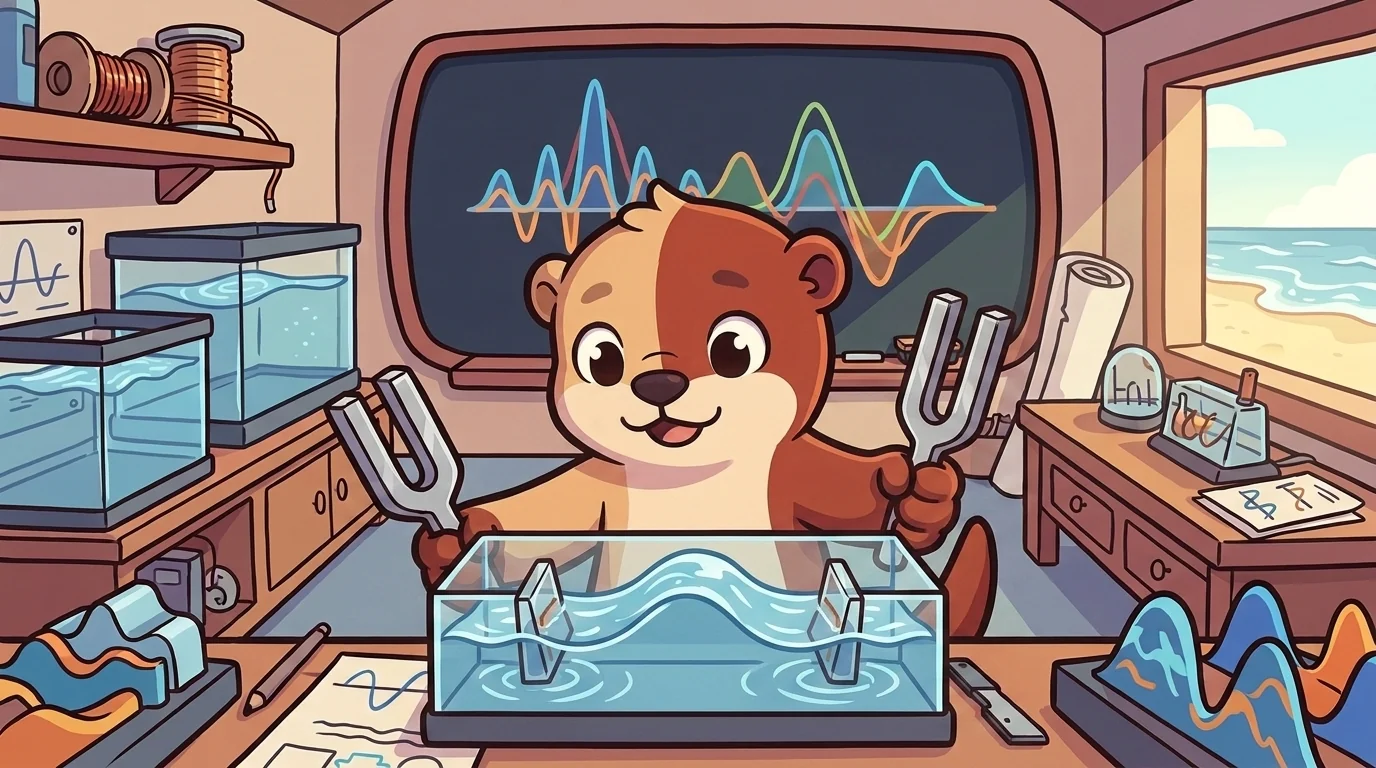
The whole idea, Meet explains, is superposition — a big word for a simple move.
"When two waves cross paths, you just add their heights at every single point," he says. "Like drawing two wiggly lines on top of each other — the new line is wherever both of them add up to." He shows it in a little water tank: two ripples whose high parts line up make one super-high ripple; two ripples where a high part meets a low part go flat — "poof, they cancel."
And it depends on phase — how they line up. "Line up perfectly, they're in-phase and they build up. Totally opposite, they're out-of-phase and they cancel. A little off, and they only partly add." Noise-canceling headphones, he loves to point out, make a wave that's the exact opposite of the noise around you, so the two meet and cancel — poof, quiet.

Meet learned all this by a river, where his family were the village ripple-watchers.
"We'd toss two stones in the water," Meet says, "and sometimes the ripples met and made a huge splash, and sometimes they just... disappeared. My family figured out the secret: it's all about how the crests line up." He carried that secret with him.
When he was twelve he walked to WaveForge, and Sonic, his mentor, asked, "What is interference?" Meet stood tall. "When waves meet, they add — peaks meet peaks and it gets bigger, peaks meet troughs and it goes silent. It's just addition, not magic. Watch two ripples on a pond: sometimes a bigger ripple, sometimes a flat spot. Same math." Sonic smiled. "You are appointed."

In his workshop, Meet struck both tuning forks — but this time they were a tiny bit different — and held them near your ear. "Listen." The sound pulsed: loud, soft, loud, soft. "That's interference — the forks are almost the same, but not quite. When their high points line up, you hear loud; when they don't, you hear soft. That pulsing pattern is called beats." Then he taught it as one habit: waves add point by point (superposition); peaks-meet-peaks build up (constructive), peaks-meet-troughs cancel (destructive); it all depends on phase; and you can see it (ripples in a tank) and hear it (beats, noise-canceling headphones, dead-spots in a concert hall). "Don't be surprised," he said gently, "when two sounds together are quieter than one — that's not your ears playing tricks. The waves really did cancel. It's physics, not magic."
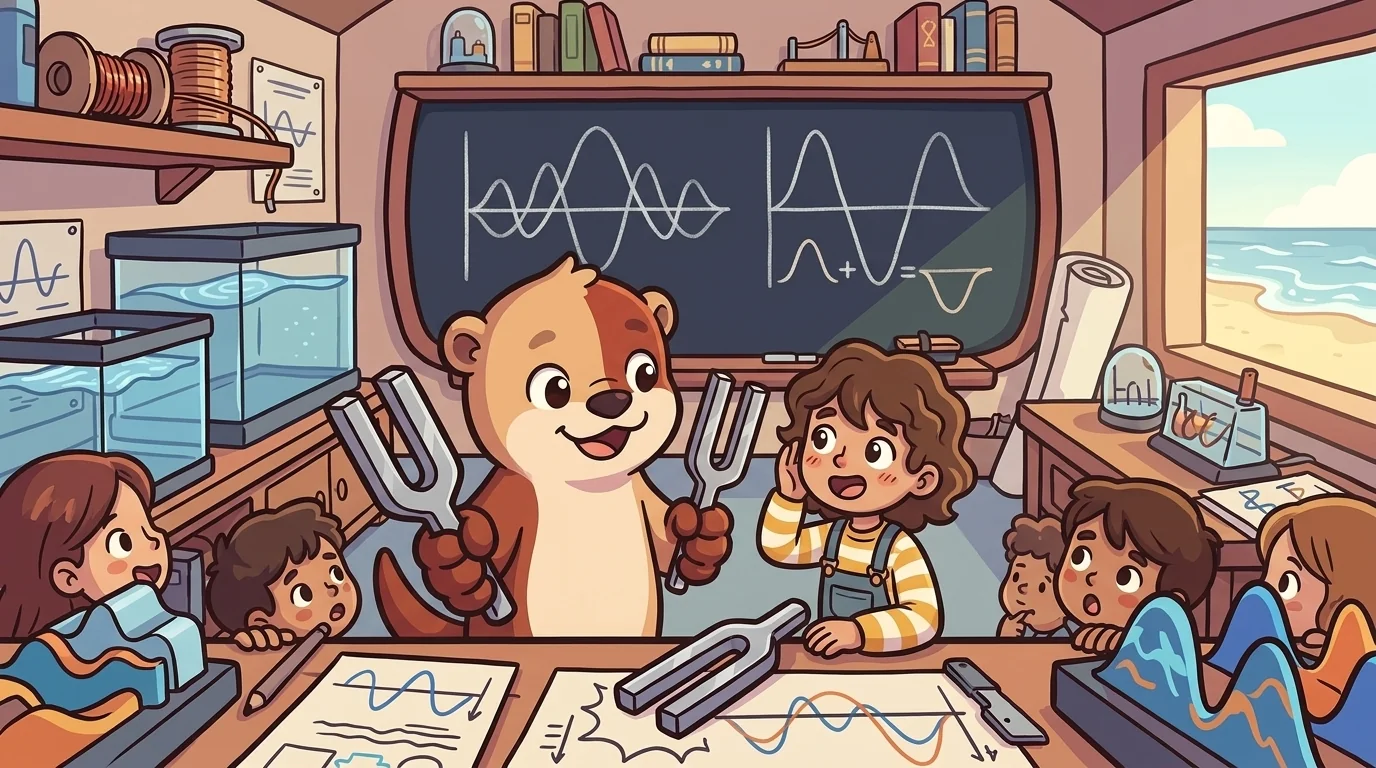
"So two loud sounds can actually make... less sound?" a kid asked, startled.
"Really less," Meet said, grinning. And the kid felt the little jolt of surprise settle into delight — the fun, tickled, no-way-that's-so-cool feeling of a rule that seems backwards until suddenly it clicks and makes perfect sense. Meet knew that feeling well; he remembered his own early days fumbling the demo, striking the forks a beat apart, getting the wrong sound — and then the moment he struck them at the exact same instant and it worked perfectly, that bright little click of a thing you practiced finally landing. That surprised-then-delighted, backwards-until-it-clicks, so-cool feeling — the joy of physics turning out stranger and simpler than you guessed — was, to Meet, the whole reason he loved holding two forks up to a curious ear.
The WaveForge ensemble
Meet is part of WaveForge's distributed-narrative cast. Each character embodies a different curricular primitive; together they teach the full subject.