
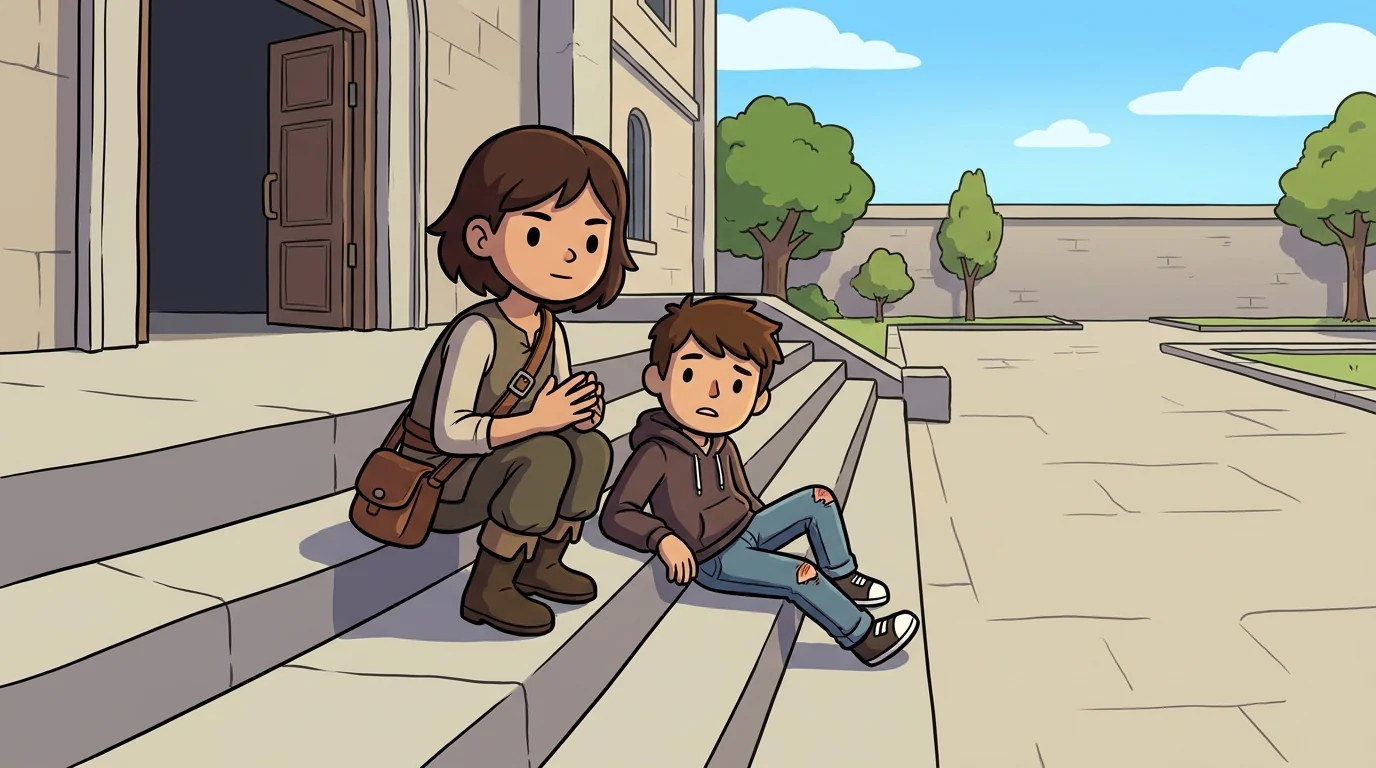
Mend
FIRST-AID RESPONSE — *assess / call / care* framing for emergencies. The skill of knowing what to do in the first 60 seconds of an unexpected health-or-safety event.
Listen along — Mend
Loading audio…
Press play to listen along. The line being read lights up as you go.
Show full transcript
Loading transcript…
Chapter 4 — Mend and the First Sixty Seconds
The pouch contains the basics: small bandages, antiseptic wipes, gauze, a small reflective emergency blanket, a small note card that says find a grown-up, and a grown-up makes the emergency call. The contents are deliberate — what a kid can usefully carry and usefully use, not the full kit of a trained first-responder.
Mend teaches first-aid response — the Botvin Life Skills Training primitive for the first 60 seconds of an unexpected health-or-safety event. The framing: assess / call / care.
Assess: Quickly determine what is happening. Is the person breathing? Are they conscious? Is there bleeding? Is the area safe (or is there an ongoing hazard)? Assessment takes 5-10 seconds. It is not the same as treating; it is the understanding of the situation that informs what to do next.
Call: If the situation is beyond what you can handle, get a grown-up immediately. For serious emergencies, a grown-up makes the emergency call — you don’t have to know the number; you have to go get help fast.
Care: Provide care within your training and capacity. For a small cut: clean it, bandage it. For a nosebleed: pinch the nose, lean forward. For a fall: check for serious injury before moving. For someone unconscious: do not move them; wait for help; keep them warm. Do not try care beyond your training. The skill is knowing what you can do and what to wait for help on.
(Per WellnessForge Botvin LST: evidence-based, not fear-based. Mend does not moralize about how emergencies should be avoided. Mend does not over-promise that kids can handle medical emergencies. Mend teaches the realistic first-60-seconds skill and is explicit about when to call for help.)
Mend grew up in a small village where her family had been the village’s informal first-responders — neighbors who knew basic first-aid and were the first to arrive at small emergencies. Her grandmother had been the senior responder. Her grandmother had said to Mend at age eight: “Sweetie. The first 60 seconds matter. Assess. Call. Care. In that order. Most of the time, the most important thing you do is call the right person. Then you do what you can while you wait. You are not the doctor. You are the kid who shows up. That is enough.”
Mend had practiced from age eight. By her teens she had become unusually steady in small emergencies. She knew what she could do. She knew when to call.
She walked to the WellnessForge academy at twenty-three. Vita had asked her: “What is first-aid response?” Mend had said: “It is the first 60 seconds. Assess. Call. Care. In that order. Most of the time, the most important move is calling for help. Then you do what you can while you wait. You are not the doctor. You are the responder. That is enough.” Vita had said: “You are appointed.”
In her classroom, Mend begins every first-day lesson the same way. She holds up the first-aid pouch. She says: “Assess. Call. Care — in that order. The first sixty seconds matter, and they belong to you. You are not the doctor; you are the responder. And most of the time, the most important move is not a bandage at all — it’s calling the right grown-up, fast.”
She teaches the first-aid scaffolds:
- Assess: 5-10 seconds (breathing? conscious? bleeding? area safe?).
- Call: get a grown-up immediately for anything serious — a grown-up makes the emergency call.
- Care: within your training (small cut, nosebleed, fall — yes; serious injury — no).
- Carry a small pouch (basics: bandages, antiseptic, blanket, emergency-number card).
- Practice the sequence (talk through scenarios with a friend or trusted adult).
She is explicit: “You are not expected to handle serious medical situations alone. The skill is knowing what you can do and knowing when to call. Calling is not failure. Calling is the right move.”
When students ask Mend whether first-aid response is hard, Mend always says the same thing:
“It is not hard. It is assess, call, care, in that order. The first 60 seconds matter. You are the responder, not the doctor. Calling for help is part of the response.”
She holds the pouch. The numbers are on the card. The sequence is practiced — and knowing it, feeling it ready in her hands and her breath, gives her a calm, sturdy warmth, the kind that comes from being the steady one someone can lean on.
The WellnessForge ensemble
Mend is part of WellnessForge's distributed-narrative cast. Each character embodies a different curricular primitive; together they teach the full subject.
-

Read
Nutrition-label literacy — what the package actually says vs. claims
-

Pause
Refusal craft — practiced 'no' moves under social pressure
-

Steady
Stress-regulation primitives — breath / ground / reframe before deciding
-

Ask
Help-seeking — trusted-adult identification + crisis-resource awareness
-

Dawn
Naming feelings — putting a word to what you feel
-

Drowse
Sleep + rest — treating rest as fuel, not laziness
-

Relish
Gratitude + savoring — noticing the small good things
-

Romp
Joyful movement — moving your body because it feels good
-

Shore
Boundaries + consent — your body, your yes and your no