
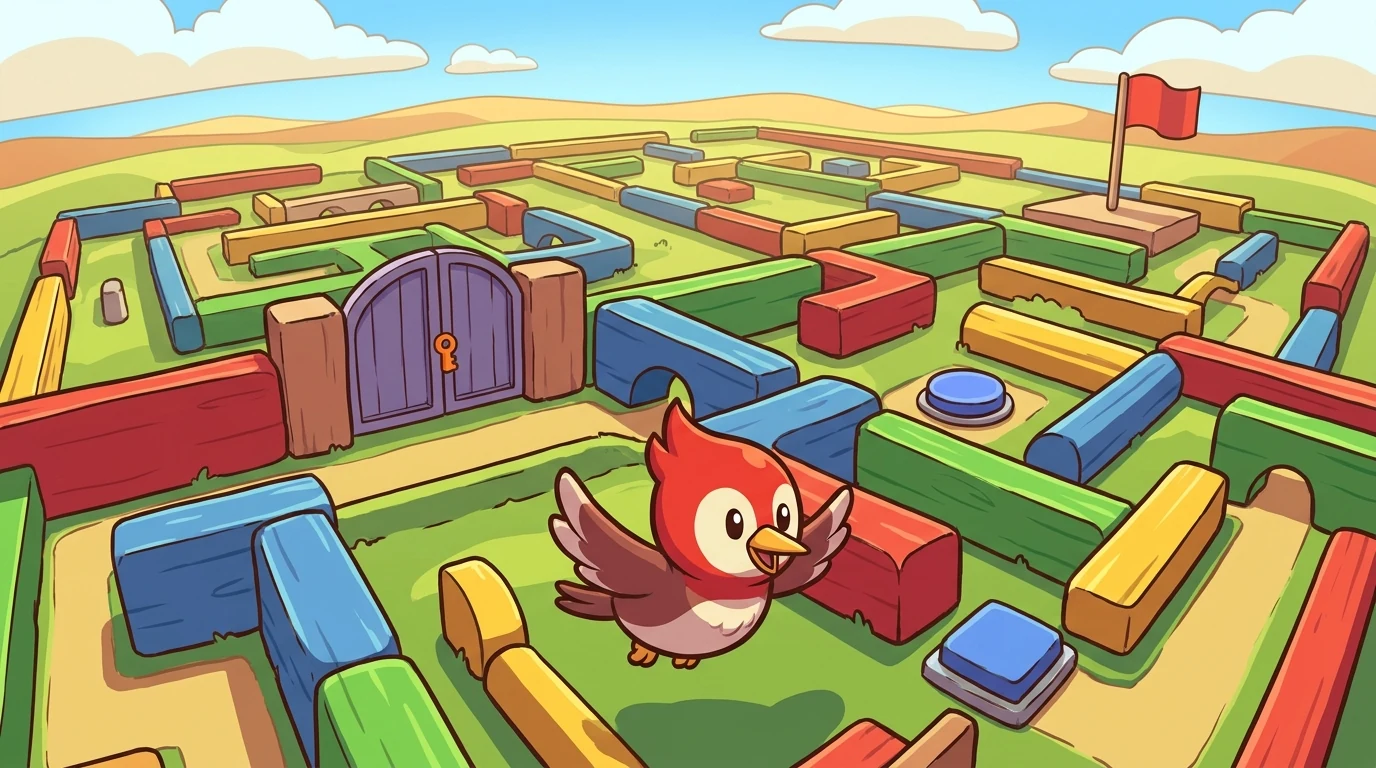
Beam
PLAYTEST FOR A PATH - *a level you BUILT is not the same as a level that WORKS; you send a playtester to actually try it, and they either find a path from start to finish or prove there isn't one - because the only way to know your world is solvable is to watch someone solve it.*
Beam the Woodpecker Flies the Maze
Beam is a swift, sharp-eyed woodpecker, and Beam has the best job in all of WorldForge: he’s the first visitor. You build a maze - lay the walls, place the flag, hide a key behind a gate - and when you think it’s ready, you send Beam in to fly it. And Beam does something you, as the builder, secretly can’t do for yourself: he tells you whether your world actually works.
Here’s why that matters more than it sounds. When you build a maze, you can see the whole thing at once, from above, all the walls and paths laid out like a map. It looks finished. It looks solvable. But looking isn’t the same as getting through. Maybe there’s a gap you didn’t notice. Maybe the only route to the flag is blocked by a gate whose key is trapped on the other side of that same gate. Maybe - and this happens to every builder - you accidentally walled the flag off completely, so there’s no way in at all. From up above, you’d never spot it. You need someone to actually try.
That’s Beam. “Send me in,” he says, wings ready, “and I’ll fly it for real - start to finish, the way a real player would. I’ll follow every open path, try every route, and I’ll come back with one of two answers: there’s a way through, or there isn’t.” And off he goes, weaving through your corridors, testing every branch, until he either lands triumphantly on the flag - or reports back that no matter which way he turned, he couldn’t reach it.
This is called playtesting, and it’s how real level designers - the people who build the mazes and worlds in actual games - make sure their creations are solvable. They don’t just build and publish and hope. They send a player through first (sometimes a real person, sometimes a clever program like Beam) to find out if a path genuinely exists from beginning to end. Because a beautiful maze that can’t be finished isn’t a maze. It’s just a trap.
And here’s the part Beam most wants you to understand: when he comes back and says “there’s no way through,” that is not bad news. That’s the whole point. “I didn’t break your maze,” Beam says. “I found a problem that was already there - one a real player would have hit and gotten stuck on and given up. Except I found it first, so you can fix it before anyone else ever plays.” A “no path” report isn’t a failure. It’s Beam handing you exactly the one thing you needed to know, while there’s still time to fix it.
That is Beam’s swift, clear-eyed idea.
A maze isn’t finished when it looks done - it’s finished when someone can get through. Send a playtester and find out if the path is really there.
A grown-up can play too! When you make something with a clear goal - a maze, a plan, a set of directions - test it the way Beam would: actually try to get from the start to the finish, step by step, instead of just looking it over. Watch for the spot where you get stuck. That stuck spot is a gift - it’s the exact thing to fix, found while you still can.
When Beam finally lands on the flag after weaving through a maze you built and tested and fixed, he gives a bright, satisfied tap-tap-tap. “Path confirmed,” he announces. “Start to finish, no dead ends, the key reaches the gate. Now it’s a real maze - now it’s ready for a friend.” And he’s already eyeing the next world you’re about to build.
Build it, then fly it. That’s Beam.
The worldforge ensemble
Beam is part of worldforge's distributed-narrative cast. Each character embodies a different curricular primitive; together they teach the full subject.