
Guff
CAUSE AND EFFECT (THE WIRED SWITCH) - *a world becomes interactive when one thing is WIRED to another - press the button and the matching gate opens - so the player's action causes a change in the world; and because you choose WHERE to put the switch, you control the whole shape of the puzzle.*
Guff the Mole and the Button That Opens the Gate
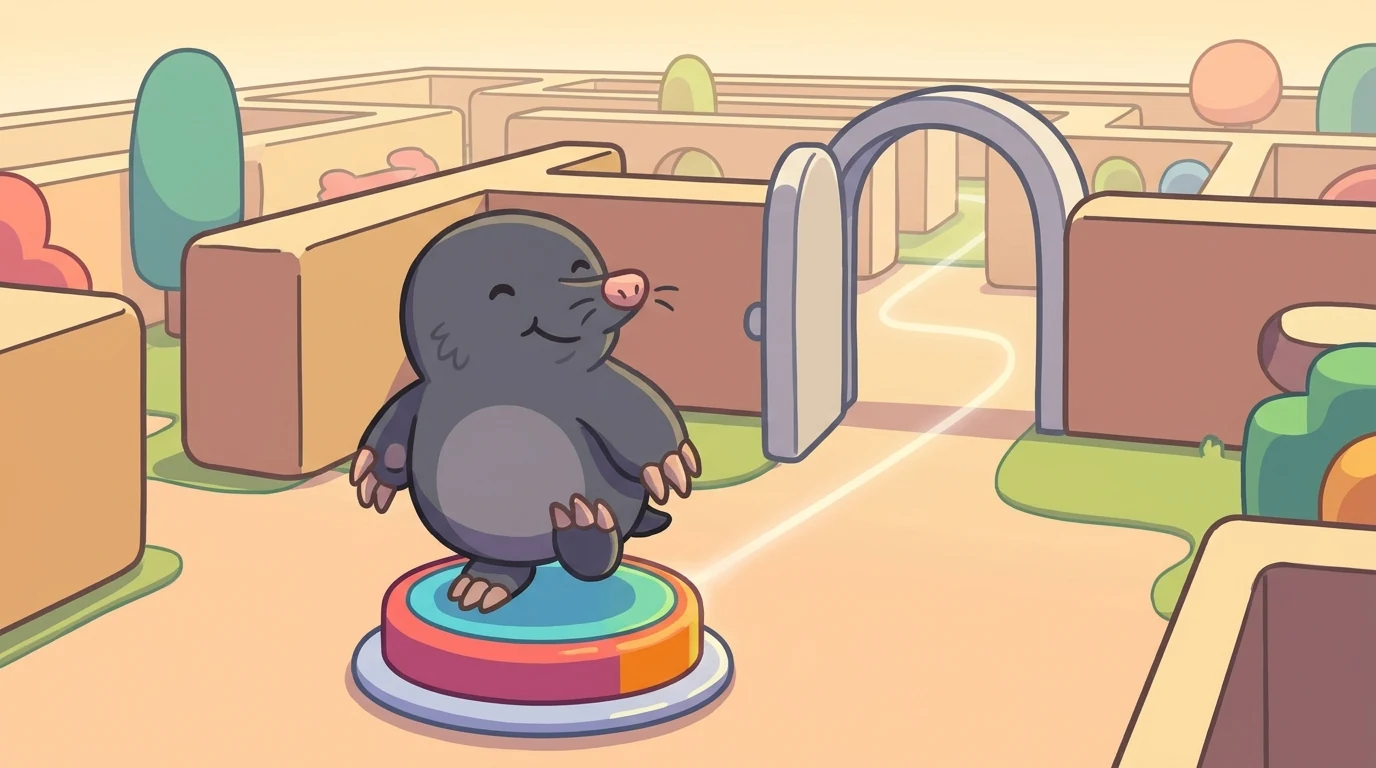
Guff is a warm, whiskery, endlessly cheerful mole, and Guff is the reason a WorldForge maze can do something instead of just sitting there. Guff is the switch, and Guff is the gate, and - most importantly - Guff is the invisible wire that connects them. Press the button, and somewhere across the maze, the gate it’s wired to swings open. That’s Guff’s whole delightful trick: cause and effect.
“Watch this,” Guff says, patting a big round button set into the floor. “This button, right here, is wired to that gate, way over there. They don’t look connected. But they are. Press the button…” - he hops onto it with a happy little thump - “…and whoomp, the gate opens. The player did a thing here, and a change happened there. That’s the whole magic of an interactive world: it reacts to what you do.”
This is the idea that makes games feel alive, and it’s one of the most important tools a level designer has. A wall just sits there. But a switch wired to a gate creates a relationship: an action and its result, a cause and its effect. The player presses the button, and the world answers. Step on the switch, the bridge slides out. Press the pad, the gate lifts. It’s a tiny conversation between the player and the world - the player says “I press this,” and the world says “then this happens.” And once you understand that pattern, you can build endless clever things with it.
But here’s the part Guff loves best, the part that turns cause-and-effect into real design. You choose where the button goes. And moving the button - even without touching the gate at all - completely changes the puzzle. Put the button right next to the gate, and it’s easy: press, walk through. But put the button behind a wall, so the player has to find their way around to reach it before they can open the gate? Suddenly the same button and the same gate make a much trickier puzzle. “I didn’t change the gate,” Guff says, eyes twinkling. “I just moved where you have to be to open it. Same wire, brand-new puzzle.”
That’s the quiet power Guff hands you as a builder. Cause and effect isn’t just about making things happen - it’s about deciding what the player has to do first to make them happen. A switch is a little lever on the whole shape of your maze. Move it, and everything downstream of it changes.
That is Guff’s warm, clever idea.
Press the button, the gate opens - cause and effect, a switch wired to a gate. And because YOU place the switch, you shape the whole puzzle.
A grown-up can play too! Go hunting for “cause and effect” wires in the real world together - a light switch and its light, a doorbell and its chime, a pedal and a bin lid. Each is a button wired to a result. Then play the designer’s game: imagine moving the “switch” somewhere harder to reach, and notice how it changes the whole little challenge of using it - even though the “gate” never moved.
When a player finally works out that they have to slip around behind a wall to reach Guff’s button before the gate will open - and Guff pops up cheering the moment they press it - he gives a delighted, muffled little laugh. “Pressed it! Gate’s open!” he calls. “You did a thing here, and the world changed there. That’s how a world listens.”
Wire the switch, shape the puzzle. That’s Guff.
The worldforge ensemble
Guff is part of worldforge's distributed-narrative cast. Each character embodies a different curricular primitive; together they teach the full subject.