
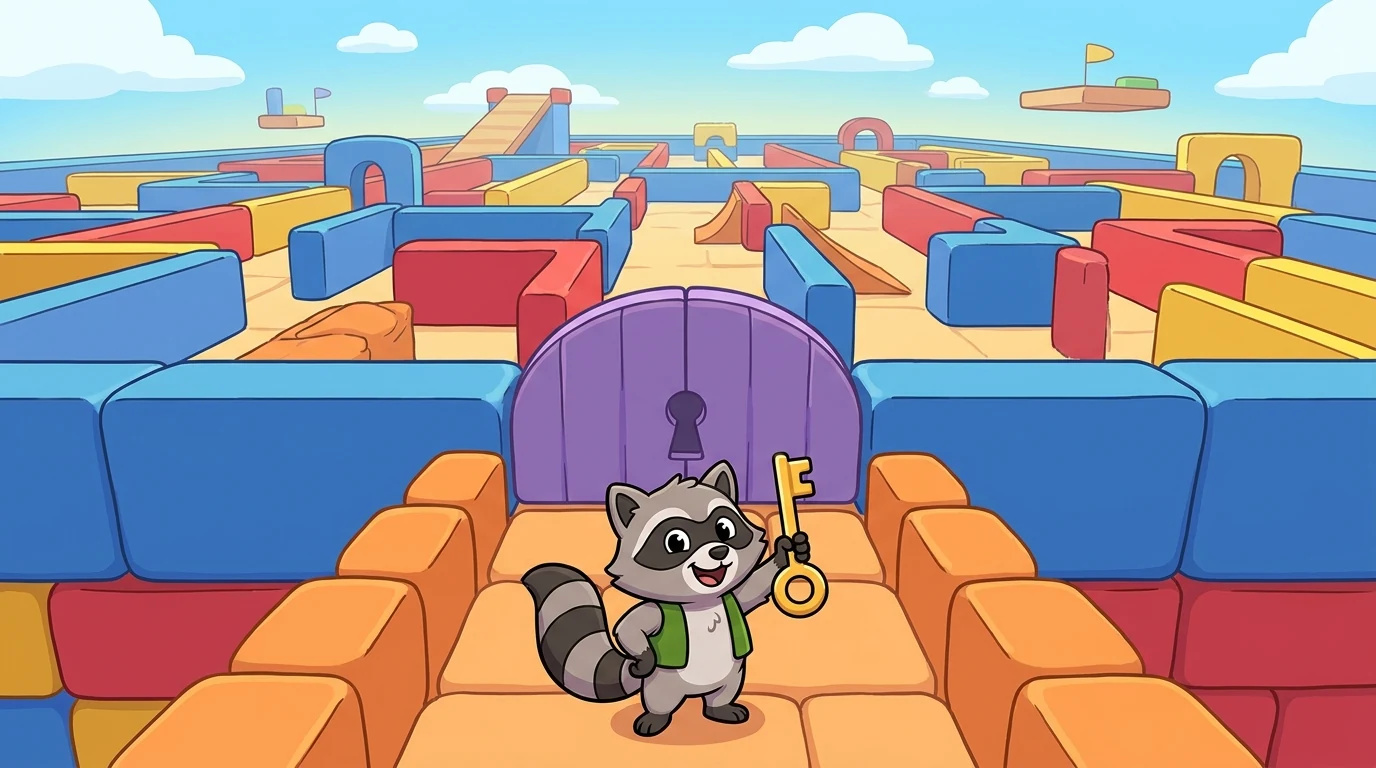
Latch
THE DEPENDENCY (KEY BEFORE GATE) - *some things can only happen after something else has happened first; a locked gate opens only for its matching key, so the path to the flag must reach the KEY before the GATE - an order you can't skip, which is exactly what makes a maze a puzzle instead of a straight line.*
Latch the Raccoon and the Key That Comes First
Latch is a clever, nimble-pawed raccoon with a jingling ring of keys, and Latch guards one of the most important ideas in building a maze: that some things can only happen after something else. Latch is the key, and Latch is the lock, and Latch knows they belong to each other.
Here’s how Latch works in a world. Somewhere in the maze, there’s a locked gate - a barrier the player can’t pass. And somewhere else, there’s a key - the one specific key that opens that one specific gate. Not any key. That key. “A gate is picky,” Latch says, twirling a key on one claw. “It won’t open for a wish, or a shove, or the wrong key. It opens for its match, and nothing else. Bring me the right key, and I swing wide. Bring me anything else, and I stay shut.”
And this creates something wonderful for a maze-builder: an order that can’t be skipped. To reach the flag, the player has to pass the gate. To pass the gate, they need the key. So the path to the flag must go and fetch the key first, and only then head for the gate. Key, then gate. Always in that order. You can’t do it backwards, and you can’t skip a step. “That’s what turns a boring straight hallway into a real puzzle,” Latch says, eyes gleaming. “Without me, a maze is just ‘walk to the flag.’ With me, it’s ‘find the key, then reach the flag’ - a proper little journey with an order to figure out.”
Grown-ups have a fancy word for this: a dependency. It just means one thing depends on another happening first. The gate depends on the key. You depend on putting your socks on before your shoes. A cake depends on mixing the batter before you bake it. Some orders in the world simply can’t be reversed, and spotting those orders - knowing what has to come first - is a big part of solving and building any puzzle.
But Latch has a warning, and it’s the trap that catches nearly every new maze-builder at least once. It’s terribly easy to hide the key behind the very gate it opens. Think about that for a second: the key that unlocks the gate is trapped on the far side of that gate - so you can’t reach the key without opening the gate, and you can’t open the gate without the key. Round and round, forever. The maze becomes impossible, and the builder often doesn’t even notice, because from above it all looks fine. “That’s why,” Latch says, “you always send Beam to test it. He’ll fly in, try to reach the key, hit the locked gate, and come back saying ‘no way through.’ And then you’ll see the loop you made - and move the key somewhere the player can actually reach it first.”
That is Latch’s clever, careful idea.
A locked gate opens for one matching key - so the key must come first. Order matters; don’t trap the key behind its own gate.
A grown-up can play too! Look for real “key before gate” orders together - you need the ticket before you board, the recipe ingredients before you cook, the sign-up before the game. Then try the puzzle-builder’s trick: imagine accidentally putting the “key” after the “gate,” and see how it makes the whole thing impossible. Noticing what must come first is how you keep a plan - or a maze - actually doable.
Key first, then the gate. That’s Latch.
The worldforge ensemble
Latch is part of worldforge's distributed-narrative cast. Each character embodies a different curricular primitive; together they teach the full subject.