The Gallery of Faces
-
1698 · Charles Le Brun
The passions, drawn to a system
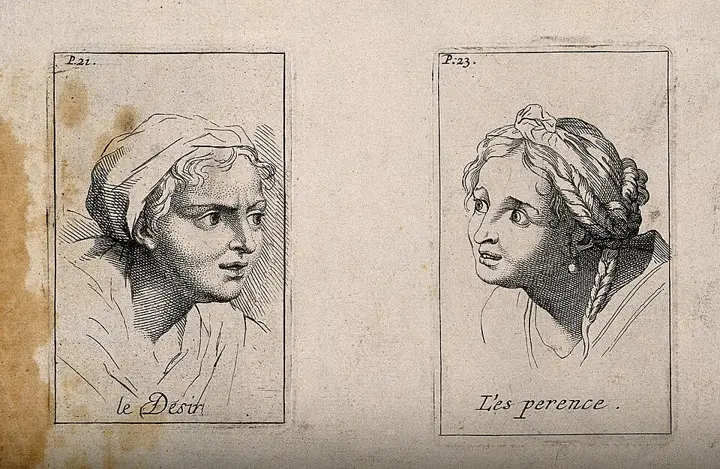
✎ Imagined · a drawing to show the idea Two heads from Le Brun’s method for drawing the passions, published in 1698, here in an etching by Bernard Picart (1713): “desire” on the left and “hope” on the right.
Le Brun taught painters one correct face for each passion. Cover the labels: can you tell which one is desire and which is hope? A drawn face is a rule about faces, not a person feeling something.
-
1862 · Guillaume Duchenne de Boulogne
A face moved by electric current
In Mécanisme de la physionomie humaine (1862) Duchenne touched single face muscles with a mild electric current and photographed what each muscle did. (The photographs are not shown here.)
He believed a real smile always moves the muscles around the eyes. Later scientists found people can make that smile on purpose too (Krumhuber and Manstead, 2009). And a face moved by a current shows a muscle, not a feeling: the man in his photographs felt nothing of the sort.
-
1872 · Charles Darwin
Posed photographs
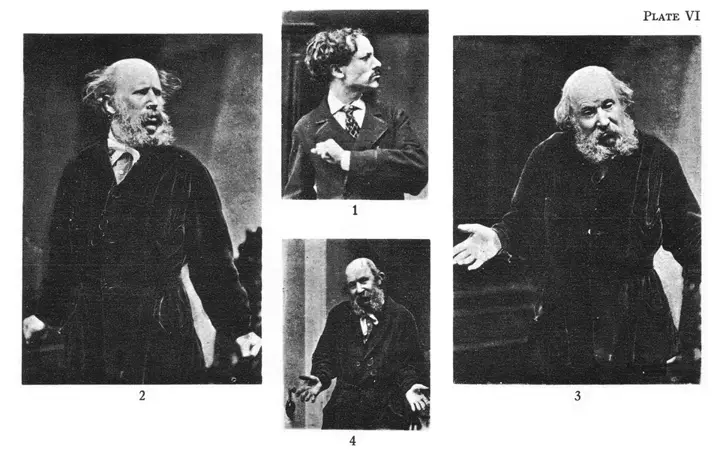
✓ Seen · a record of the real thing Plate VI, “Anger and Indignation”, of Darwin’s The Expression of the Emotions in Man and Animals (1872): figures 1 and 2 are men acting indignation; figures 3 and 4 are the photographer Oscar Rejlander acting a helpless shrug.
Darwin sent questions to observers in many countries about how people there showed their feelings, and used posed photographs to show what he meant. A posed face is an actor’s answer to “show me indignation”, which is not how a face looks in the middle of a real day.
So what can a face tell you?
Scientists who reviewed a thousand studies found that the same face can mean many different feelings, and that people read faces through the body, the voice and what just happened (Barrett et al., 2019; Aviezer’s experiments). The best clue is still the one at the top of CueLab’s ladder: ask.
What Do You Do with the Mad That You Feel? Fred Rogers first sang it on his programme in 1968, and spoke it to a United States Senate subcommittee in 1969. Its title is the question this room leaves you with.