← The Game Nobody Could Finish
The Fair on the Green · Reader · ages 6-8
Listen along
Loading audio…
Read by an AI-generated voice. The words on this page are the transcript.
1. Two Things in a Pocket
The hammer rang once. A spark jumped off the anvil and did not go out. It waited. They followed.
It was the third weekend of the fair. The Green was full of bunting again, and the oak tree by the cake stall was dropping acorns on everybody who queued for a lemon bun. The hoopla man had new rings. The games tent had a new tent pole, because the old one had blown down in the rain.
Lan had two things in her pocket now. One was a plain wooden die, from the first weekend. One was a small cloth flag, from the second. She held them both in her fist as she ran after the spark, so they would not knock together and get lost.
"You're squashing the flag," said Inkling, running beside her.
"I'm keeping it safe," said Lan. "I promise it's fine."
All week Lan had been playing the flag game at home. She had played it with Inkling at break time, drawing the track in chalk on the playground. She had played it with Tí on the kitchen floor, using a spoon for a flag because Tí would not give the real one back. Every time it ended, somebody said "Again," and they played again, and every time it ended again. Lan had started to think that the only trouble with good games was that they finished. If only a good game could go on and on, she thought, you would never have to stop and put it away and go to bed.
By Friday she had decided exactly what she was going to wish for. She had told nobody, not even Inkling. She had only smiled to herself on the walk to the Green, the smile of someone keeping the best secret in the world.
The spark went the way it always went. Past the cakes, past the hoopla, past the big white games tent, all the way to the very end of the row, where the bunting ran out and the striped red-and-white booth stood waiting.
ANY GAME YOU WISH, WHILE YOU WAIT.
They ducked inside.
The booth's striped curtain swung shut behind them, and the noise of the fair went soft. The glass of the lamp had cracked once and been glued, and next to the crack was a tiny scratched hammer.
Trial was on her stool. The round little capybara looked up from her box of wooden parts and blinked slowly, the way she always did, as if the light were a little too bright for her.
"Third weekend," she said. "I'll build it exactly as you wish. The fair packs up on Sunday night."
"It's my turn," said Lan. "Inkling had last time. I've got the best wish ever. I've been saving it."
Inkling sat down on the floor with her knees up. "Go on, then."
2. A Game That Never Ends
Lan stood in the middle of the booth.
"You know when you're playing a really good game," she said, "and it's so much fun, and then somebody wins, and it's over? And you're sad because it's over?"
"Yes," said Inkling.
"Well, I wish for a game that never ends," said Lan. "So the fun never has to stop. Not ever. That's my wish." She looked at Trial. "I promise it will be the best game you've ever built."
Trial did not say that was a strange wish. She did not say anything at all for a moment. Then she nodded, slowly, and reached into her box.
Out came a track, and this time it was not a straight line. It was a ring. Twenty spaces, all joined up, with no first space and no last space, except for one with a little star painted on it.
"This is the start," said Trial, tapping the star. She set two pieces on it, one red and one blue. "Go round the loop. Every time you get all the way round, back to the star, that's one home. Then you keep going." She held up one claw. "And if you land on someone else's space, they go back to the star and start again."
"Exactly as I wished?" said Lan.
"Exactly," said Trial. "There is nothing in it that ends."
They rolled to see who would go first, and Lan rolled a five, and went first, as she nearly always did. She moved five. Inkling rolled a three and moved three. Lan rolled a two and landed right on Inkling.
"Back you go!" said Lan.
Inkling went back to the star. She rolled a six, and then a four, and landed on Lan.
"Back YOU go," said Inkling.
It was exciting. It was very exciting. Every roll, you might send somebody back, or be sent back yourself. They shouted and groaned and laughed, and the hoopla man's voice outside went far away.
They played for an hour.
3. The Church Clock
After an hour, it was still exciting, but it was a different sort of exciting. It was the sort of exciting that makes your arms tired.
Lan had got all the way round the loop once. She had been sent back twice when she was almost home. Inkling had been sent back so many times she had stopped counting. Every time somebody got close to the star, the other one landed on them. Every time anybody was winning, they stopped winning.
"Who's ahead?" said Inkling.
Lan looked at the board. "I don't know. I think I am. No. Maybe you are."
It was hard to tell. You could be ahead on one roll and back at the star on the next. Being ahead did not seem to mean anything.
Then, from outside, the church clock on the Green began to strike. One, two, three, four, five, six.
"Tea," said Inkling. "I've got to go."
"But we haven't finished," said Lan.
"We can't finish," said Inkling. "There isn't a finish."
They had to stop. Nobody had won. Nobody could have won, not if they had played all night. Lan put the pieces down on the loop, and they walked home across the Green in the evening light, and they did not talk very much, because they were both cross, and they did not know who they were cross with.
That night, in bed, Lan thought about the loop. She had played the most exciting game in the world for an hour. So why did she feel as if she had been cheated?
Across the room, her little brother Tí was asleep with his thumb in his mouth. He had a favourite game too, a game where you rolled a ball to the end of the hall and back. Lan had played it with him a hundred times. It always ended when the ball came back to your feet. Then you started again, because you wanted to, not because you had to.
She lay and listened to the wind in the oak tree on the Green. She thought about the red piece and the blue piece going round and round the loop, all night, in the dark, with nobody there to move them. It made her feel strange, as if a song had got stuck on one note.
She fell asleep before she worked it out.
4. Whoever Is Ahead
Next morning, Saturday, Lan was at the booth before Inkling had even finished her breakfast. When Inkling came in, Lan was already setting up the pieces.
"I know what that means," said Lan. "I've worked it out. The game's fine. It just needs stopping. So here's the rule. We play until the tea bell. When the church clock strikes, whoever is ahead wins. Simple!"
She turned to Trial. "Can you add that? I promise it'll work."
Trial did not argue. She did not say yes and she did not say no.
"Let's see how they play it," said Trial.
So they played. They played all morning, and it began well. The first hour was every bit as exciting as Friday. Lan sent Inkling back twice and Inkling sent Lan back three times, and the hoopla man put his head round the curtain to ask what all the shrieking was about. But by the second hour, something had changed. The game felt heavier. They knew that whatever happened, it would not matter until six o'clock. A good roll at ten in the morning did not count for anything. A bad roll at noon did not count for anything either. Only the last roll before the bell would count.
They played and all through lunch, which was a bun each on the floor of the booth, and all through the afternoon. They sent each other back to the star. They got nearly home and were sent back. The clock on the Green struck four, and then five.
Just before six, Lan was one space ahead.
Lan saw it, and stopped playing properly. She did not want to land on anybody any more. She did not want to move at all. She just wanted the clock to strike. She rolled the die as slowly as she could and moved her piece as slowly as she could, and kept looking at the curtain.
Inkling, one space behind, rolled and moved and rolled, trying to catch up. She was so close.
The clock struck six.
"I won!" said Lan. "I'm ahead! I won!"
Inkling did not say anything. She looked at her blue piece, one space behind Lan's red one, and her face fell all the way down, the way a sandcastle falls when the sea comes in.
"I was about to catch up," she said. "I was going to land on you next go."
"But the bell rang," said Lan.
Trial was watching, still as a stone.
"Look at her face, not the board," said Trial quietly.
Lan looked. Inkling was not crying, but she was very close to it. And Lan found, to her surprise, that she did not feel as if she had won anything at all. Being ahead when a bell rings was not the same as winning. It was just being lucky about the time.
"Calling it doesn't end the game," said Trial gently. "It only stops it."
5. Sixty Turns
Trial opened her little notebook. She turned past the race-track page and the everything-game page until she came to the page that said THE LOOP.
"I counted," she said. "On Friday, in one hour, you took sixty turns between you. In those sixty turns, somebody was sent back to the star twenty times."
"Twenty!" said Inkling.
"Sixty turns, twenty times," said Trial. "So about every three turns, somebody went back to the start."
Lan worked it out on her fingers. Three, six, nine. It came out the same.
"Were we getting nearer the end, at least?" said Lan.
Trial closed the notebook.
"There isn't an end," she said. "After sixty turns, you were exactly where you were after one. Going round. That's what you wished for." She rubbed her eyes. "A game that never ends doesn't keep the fun going. It keeps the middle going."
Lan thought about that. The middle of a game was the exciting part. But the middle was only exciting because it was going somewhere.
"Can you write down how many times people won?" said Inkling.
"I did," said Trial. She opened the notebook again and showed them. At the bottom of THE LOOP page there was a single word, and next to it a number. The word was WINS. The number was nought.
"Last weekend," said Trial, "you played three games of the flag game in under an hour. Three wins. This weekend, the whole of Friday and the whole of Saturday. No wins at all." She turned to the first page. "The race on the first weekend had four wins in twenty minutes. Too many, and all the same person's. Your loop has the other trouble. Not enough."
Lan looked at the nought for a long time. She had always thought winning was the thing that stopped the fun. Now it looked as if winning was the thing that made you want to start.
6. One Less Every Time
They went to the games tent to think. The ladybird was there with her dice garden, and the duck was there at her ONE BREATH table, saying "Roll, move, first one home wins" to a family in raincoats. But there was a new table near the new tent pole, and it was very quiet.
A curly-haired child sat behind it, in a striped jumper. In front of them was a wooden board shaped like a triangle, with fifteen little holes in it. Fourteen of the holes had a coloured peg in them. One, in the very top corner, was empty.
"Fourteen pegs, fifteen holes," said Vault, without looking up. "Want a go?"
Lan sat down. "What do I do?"
"Jump one peg over another, into an empty hole," said Vault. "Then take the one you jumped away. Every jump takes one away."
Lan jumped. A peg came off the board and went into a little dish. She jumped again. Another peg went into the dish. She jumped again, and again, and the board grew emptier, and the dish grew fuller, and there were fewer and fewer jumps she could make.
"Does it ever stop?" said Lan.
Vault smiled for the first time. "It can only go one way," they said. "One less every time. You start with fourteen pegs. Every jump takes one. So even if you're perfect, and get down to the very last peg, that's only thirteen jumps. Then it has to end."
"Has to?" said Inkling.
"When the pegs run out, it's over," said Vault. "Nobody can make it go on. That's the good bit. You always know it's getting somewhere."
Lan finished with three pegs left on the board.
They sat there, far apart, with no jumps between them. The game was over. She had not won, exactly, but she did not feel cheated either. She wanted to try again, to see if she could get down to two.
"Count what's left," said Vault. "That's your score."
"Again?" said Vault.
This time it was Inkling's turn. She did not jump straight away. She looked at the whole board first, counting holes and pegs, the way she was learning to do. She found that if she jumped from the middle first, she trapped pegs in the corners, and if she jumped from the edges first, the middle stayed open.
"I noticed something," she said. "The corners are the hard part. If you leave a corner peg alone too long, nothing can ever jump it."
"That's right," said Vault, looking pleased. "Most people only notice that after ten tries."
Inkling finished with two pegs. She looked at them, two lonely pegs on opposite sides of the board, and laughed.
"It's over," she said. "And I want to do it again."
"That's how you know it's a good one," said Vault. "Count what's left. Then try to leave less."
Lan watched Inkling's face. It was not cross at all. It was the face of somebody who had played a whole game, from beginning to end, and wanted another one. Lan had not seen that face on Friday, or on Saturday at six o'clock.
7. Sunday Evening
On Sunday it was cold and bright. The oak tree by the cake stall dropped acorns in the wind, and children collected them in their pockets. Lan collected some too, without really thinking.
On Sunday evening, the hoopla came down. The spark was waiting, and they went into the booth.
The loop game was still on the bench. The two pieces stood exactly where they had stopped at six o'clock on Saturday, one space apart.
Lan sat on the stool. She looked at the loop for a long time.
"I thought a game that never ends would be the best game," she said. "But it's not. It's the worst. Because nobody wants to start a game they can't finish. And nobody feels good when it just stops." She pushed her red piece round the loop with one finger, all the way round and back to where it started. "It doesn't go anywhere."
Inkling sat beside her. "You could just make the loop longer," she said. "Then it would take longer to get sent back."
Lan shook her head. "That would only make the middle longer. The middle isn't the problem."
She put her hand in her pocket.
Trial was sitting very still, watching her. She did not say anything. She never told anybody what was wrong with a game. Lan was beginning to understand why. If Trial had told her, on Friday, that a game that never ends is a bad game, Lan would not have believed her. She would have said she promised it would be fun. She had needed to play it for an hour, and then all of Saturday, and then see Inkling's face at six o'clock, before she knew it for herself.
"What would Vault say?" said Inkling.
"One less every time," said Lan. "But there's nothing in the loop that gets less. Nothing runs out. The pieces just go round." There was the die, and the flag, and something else, small and hard and round. She took it out. It was an acorn.
8. The Acorn Basket
Lan looked at the acorn. Then she looked at the triangle of pegs in her head, getting emptier and emptier. One less every time.
"Wait there," she said, and ran out of the booth.
She came back with her hands and both pockets full of acorns from under the oak tree. Trial watched her count them out on the bench. One, two, three, all the way to ten. She found a little basket in Trial's box and put the ten acorns in it, and she put the basket in the middle of the loop.
"The chase stays," said Lan. "Sending people back stays. But now, every turn, you take one acorn out of the basket. Ten acorns, two of us. Five turns each. When the basket is empty, the game is over. And whoever got home the most times wins."
Inkling looked at the basket. "It can only go one way," she said, grinning. "One less every time."
"Exactly," said Lan.
They played a game. It was quick, because ten acorns did not last long. Lan got home once and Inkling got home not at all, and when the last acorn came out of the basket, Lan had won.
Inkling's face started to fall again.
Lan saw it. And that was when she thought of something nobody had shown her. Not Trial. Not Vault. Not the duck or the ladybird or the fox. Nobody.
"Wait," said Lan. "One more rule. The last acorn is worth two."
"Two homes?" said Inkling.
"Whoever takes the last acorn gets two homes," said Lan. "So the one who's behind can still win, right at the very end. So it's not over until it's really over."
They played again.
This time, nobody stopped trying near the end. Nobody wanted the bell. Everybody wanted the last acorn. Inkling was behind the whole game, two homes behind, and on the very last turn she took the very last acorn out of the basket, and it was worth two, and she won.
Inkling shrieked. Lan shrieked too, even though she had lost. They played a third game straight away, and that one Lan won by a single home, on the last acorn. They finished three whole games before the church clock struck six, and nobody walked home cross.
9. The Third Piece
Trial had watched all three games. She had watched the basket empty three times, one acorn at a time. She had watched both faces at the end, not the board.
She did not write anything down. She only sat very still, and smiled.
When the third game was over, she reached into the empty basket. There was nothing left in it, of course. But she turned it over, and one acorn that had got stuck in the weave fell out, polished and brown and shining.
"For you," she said, and gave it to Lan.
Lan put it in her pocket, beside the die and the flag. That was the third piece.
"Every jump takes one away," said Inkling quietly, to nobody in particular, and Lan knew she was thinking about Vault.
Lan took everything out of her pocket and looked at it in her hand. A die, for chance. A flag, for leaving things out. An acorn, for ending. Three plain things that did not look like much. But each one had a whole weekend inside it.
"One more weekend," said Trial, watching her. "Then the fair goes."
"What will we wish for?" said Inkling.
Lan closed her hand around the three pieces. She did not answer. For once in her life, she did not want to say the first thing that came into her head. She wanted to think about it first.
The curtain swung open, and the Green was full of fair again. The wind was blowing acorns off the oak tree, and the hoopla man was singing as he packed his pegs.
The spark dimmed to a warm dot and settled back on the anvil. The Green was just the Green again.
Back on the Green
At bedtime, Lan's little brother Tí wanted one more game. Then one more. Then one more. Lan gave him five buttons from the button tin.
"Every game, you give me one button," she said. "When they're gone, it's sleep."
Tí played four games. Then he looked at his very last button for a long time, and gave it to her himself, and went to bed.
Tell the story back to someone. Why could nobody finish Lan's first game? What did the acorns do, and why was the last one worth two?
Saved. The next chapter will be here whenever you come back.
Who you met
-
 Trial Watch what players do, not what they say from TableForge
-
 Lan a child of the Green Goes first; makes a friend in a minute
-
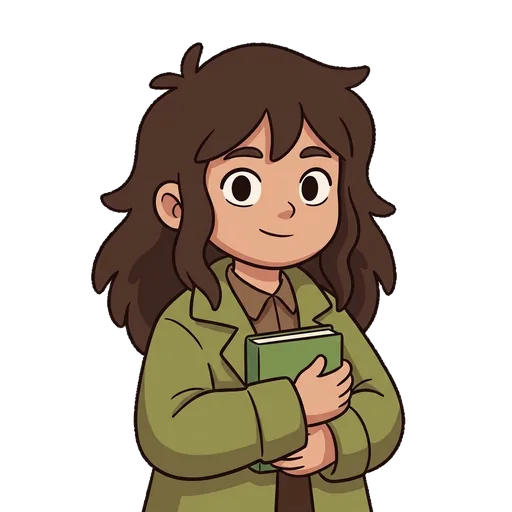 Inkling a child of the Green Names what she notices
-
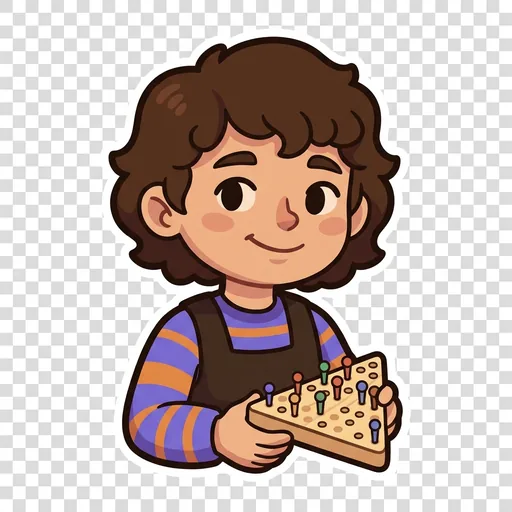 Vault If every move takes something away, the game has to end from PuzzleForge
Every recurring character has a short tune, so you can tell who is on stage before a word is said. The tunes play only when you tap, and the Reading Access sound switch turns them off.
The Honest Page
Which parts of this story are true, stretched or made up?
True
- In the triangle peg game every jump takes one peg off the board, so fourteen pegs can make at most thirteen jumps. The game always ends.
- A peg solitaire board shaped like a triangle with fifteen holes is a real, old puzzle. You start with one hole empty. Source
Stretched
- Calling the game when the bell rings does not end it. It only stops it. What we simplified: Plenty of real games do end on a clock, and that works when the players agree to it before they start. The point is that the ending should be part of the game, not a surprise.
Made up
- The wishing booth, the loop game, the acorn basket and the fair's stall-keepers are made up.