
The Mark for Nothing
The idea: a mark that means none lets a count say an empty place.
Read it
One story, three ways: Sprout for a new reader, Grower in short chapters, Reader as a full chapter book. Same plot, same ending.
Who is in this book
-
 Lan a child of the Green Goes first; makes a friend in a minute
 -
 Inkling a child of the Green Names what she notices
Every recurring character has a short tune, so you can tell who is on stage before a word is said. The tunes play only when you tap, and the Reading Access sound switch turns them off.
The Honest Page
Which parts are true, stretched or made up — and what does nobody know?
True
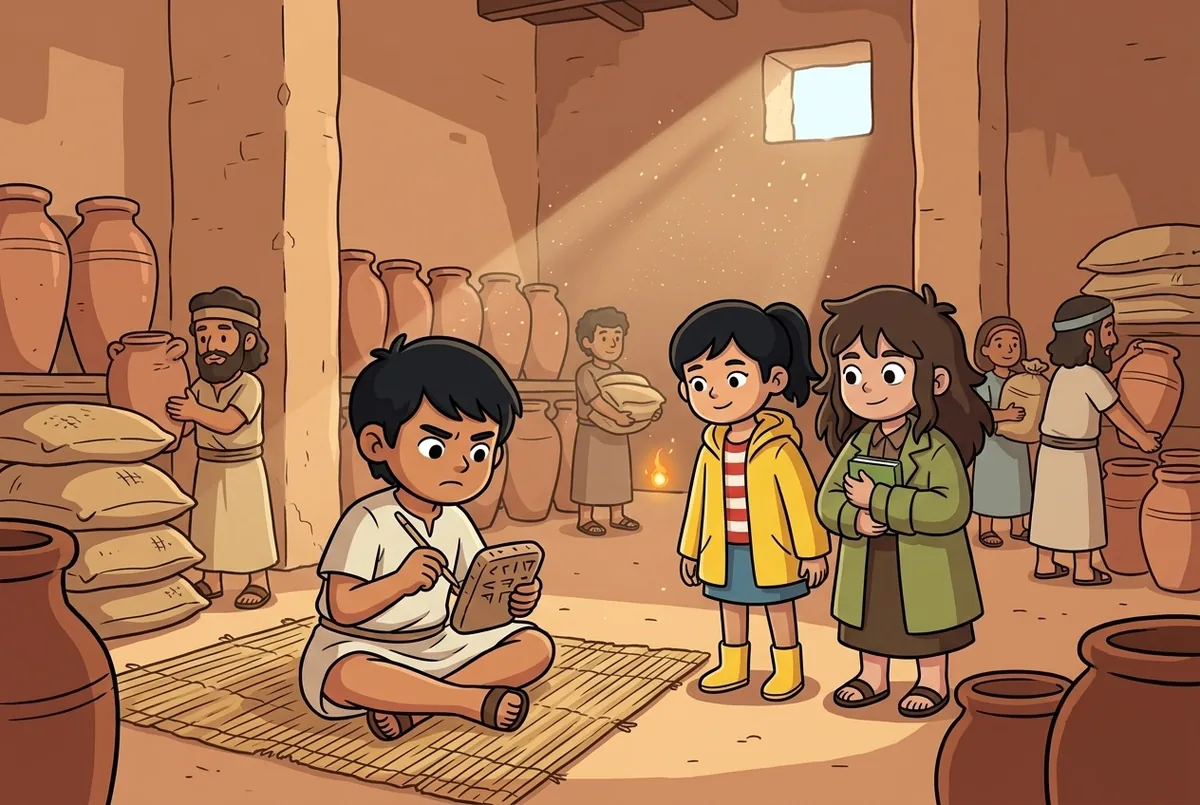
- In Babylon, in Mesopotamia (now Iraq), scribes wrote numbers by pressing a reed into soft clay. By about 300 BC they had started using a mark of two slanted wedges to show an empty place in a number. Source
- That Babylonian mark held a place, but it was not yet thought of as a number of its own, and it was not written at the end of a number. The Maya, far away in Central America, had their own sign for zero, shaped like a shell. Source
- Two hundreds, no tens and five ones make two hundred and five. Without a mark in the empty tens place, the same marks can be read as twenty-five.
Stretched
- In the story the boy counts in hundreds, tens and ones. What we simplified: The Babylonians counted in sixties, not tens: their places stood for ones, sixties and sixty sixties. The idea of an empty place works the same way.
Made up
- Lan and Inkling, the spark, the buzzing word, the boy, his teacher, the steward and the two hundred and five sacks are made up.
Nobody knows
- Nobody knows who first pressed a mark for an empty place into clay, or who first thought of nothing as a number. It seems to have been worked out more than once, by different people, in different places. Source
Tell it back
Tell the story in your own words: who was there, what went wrong, and what they found out. Then the letter N, the last of the second word under DOOR goes on your belt.
On your belt: the letter N, the last of the second word under DOOR.
Your belt lives on this device. Nothing is sent anywhere.
Ring the hammer for someone
Pick this book for someone younger. The link carries only the book, and it will wait for them on the Green.