
The Day Before · Reader · ages 6-8
Listen along
Loading audio…
Read by an AI-generated voice. The words on this page are the transcript.
1. The Storehouse of Barley
The hammer rang once. A spark jumped off the anvil and did not go out. It waited. They followed.
There were seven letters on the anvil now. DOOR across the top, and underneath it O, P and E, with one space left over at the end. Inkling had copied them into her green book and drawn a single dash after the E. She had stopped saying that she had a feeling about the word. Now she only smiled when Lan asked, which was much more annoying.
"You know what it is," said Lan, on Saturday.
"I think I do," said Inkling. "But thinking isn't the same as finding. And it buzzes."
The spark took them to the bench under the big tree on the Green, where the old people sat in the afternoons. Then it simply waited there.
Warm wind blew the Green away, and the ground under their feet was somewhere else, the day before.
The first thing Lan noticed was the smell. It was warm and dusty and sweet, like the inside of a bread bin, like a field in August. The second thing she noticed was that it was cool, much cooler than she had expected, after the hot wind.
They were standing in a long room with thick walls made of mud bricks, the colour of sand. There was no glass in the windows. There was only one window, a little square one high up near the roof, and the sunlight came down through it in a long slanting beam, full of floating dust that turned and glittered. Everywhere else the light was soft and dim.
And the room was full. Sacks were piled up against every wall, sacks made of rough woven stuff, bulging and fat, stacked higher than a grown-up's head. Between them stood tall clay jars with narrow necks, as big as Lan, sealed at the top with lumps of clay. Through a wide doorway at the far end she could see another room, just as full, and through another doorway beyond it, a courtyard full of bright sun and people carrying things on their heads.
"What's in them?" whispered Lan.
"Barley, I think," Inkling whispered back. "It smells like porridge."
A little way along, a boy their age was sitting cross-legged on a reed mat in the shade of the sacks. He had a short linen tunic and bare feet, and his hair was cut very short. On his knee he held a little flat slab of soft grey clay, about the size of a biscuit, and in his other hand a thin pointed reed, like a pen with a sharp, three-sided end. He was frowning at the clay, very hard.
On the wall behind him a crack in the mud bricks had been filled in with fresh mud, smoothed flat. Beside the mend, scratched in with the corner of something sharp, there was a tiny hammer.
Lan touched it. It was the same tiny hammer as all the others. She did not say anything.
The boy looked up and saw them, and his eyes went round at their clothes. Then he looked at the doorway, as if to check that nobody had seen them, and then back at them.
"Are you from the north?" he asked. "My teacher says people in the north dress strangely."
"Further than the north," said Inkling. "What are you writing?"
The boy held up the tablet so they could see. The clay was covered in little marks, tiny wedge shapes, pressed in rows. They were not letters Lan knew, or numbers either. Just neat little dents, like the marks a bird leaves in wet sand.
"I'm learning to be a scribe," said the boy proudly. "A scribe writes things down. Words, and counts. My teacher writes everything that comes in and out of the storehouse. Today he let me do the count for this room on my own. He said it's my first real one."
2. Too Soon
"What did you count?" said Lan.
"Sacks of barley," said the boy. "All of them. It took me all morning." He pointed round the room. "These two big stacks are full rooms, my teacher calls them. Each full room is a hundred sacks. I counted twice to be sure. So that's two hundreds."
"And the rest?" said Inkling.
"Usually there are crates of ten as well," said the boy, "in that corner, ten sacks tied together. But there aren't any today. The bakers took them all yesterday. So there are no tens." He pointed to a little heap of sacks by the door, on their own. "And then there are those. Five loose sacks."
"Two hundred and five," said Inkling.
"Two hundred and five," said the boy, pleased. "Tomorrow morning the steward reads my tablet. Then he sends that many sacks to the bakers in the city. The bakers make the bread for the whole of our street, and the temple, and the market."
Lan knew what this was. She was completely sure.
She had done it at school with counting blocks: the hundreds were big flat squares, the tens were long sticks, the ones were little cubes. You put the hundreds in one column, the tens in the next, the ones in the last. And when you had no tens, you wrote a special thing in the middle, a round thing, a thing so ordinary that she had never thought about it in her life. It was a short word, and it was right there, and Lan always went first.
"I know what that means!" said Lan. "I'll go first. What you need is a..."
She said the word.
Bzzz.
It came out as a buzz, sharp and silly, like a fly in a jam jar.
The boy jumped so much that he nearly dropped his tablet.
Lan went pink from her ears to her chin. She had done it on the island, with the stick map. She had promised herself afterwards that she would go first with a question, the way Inkling had told her. And here she was, going first with the answer again, before she had even looked properly at the tablet.
Inkling did not laugh. She took Lan's hand and squeezed it.
"The door," said Inkling softly. "You can't bring the answer. You can only bring the question."
"I know," said Lan, in a small voice. "First with a question."
"First with a question," said Inkling.
Lan took a deep breath, and turned back to the boy.
"Can we see how you write two hundred and five?" she asked.
It was a question, so it came out as words.
3. A Little Gap
The boy smoothed the clay with the flat of his thumb until it was clean. Then he held the reed very carefully and began.
First he pressed two little wedge marks, side by side, at the left of the tablet. "Two," he said. "That's in the hundreds place. My teacher writes the big ones first."
Then he moved the reed along a little, and stopped.
"Now the tens," he said. "But there are no tens. So I don't write anything there." He moved the reed along a little more, past an empty space. Then he pressed five little marks in a row. "And five. In the ones place."
He held up the tablet. Two marks. A gap. Five marks.
It looked very neat. Lan was impressed.
Just then an older scribe came through the doorway with a basket of tablets on his hip. He was a young man with a short beard, in a hurry, with a reed stuck behind one ear. He glanced down at the boy's tablet as he passed.
"Twenty-five?" he said. "That's not many. I thought this room was full."
"It's two hundred and five," said the boy.
The scribe stopped and looked again. "Is it? It looks like two, then five. Twenty-five." He shrugged. "You'd better check it." And he went on through to the courtyard.
The boy looked down at his tablet.
Lan looked too. The gap between the two marks and the five marks was very small. Just the width of a reed. If you didn't know there was supposed to be something in between, you would never notice it was there at all. Two, then five. It did look like twenty-five.
"But it isn't twenty-five," said the boy. "It's two hundred and five. That's a whole room of sacks different."
"Two hundreds and five," said Inkling slowly, "or two tens and five. The same marks."
"Twenty-five sacks wouldn't even fill one corner," said the boy.
4. A Bigger Gap
"I know," said the boy. "I'll make the gap bigger."
He smoothed the clay again. This time he pressed the two marks right at the left-hand edge. Then he put his finger flat on the clay next to them, the whole width of his finger, and made the five marks on the other side of it. When he took his finger away, there was a wide, empty space in the middle, as wide as a fingertip.
"There," he said. "Nobody could miss that."
A woman came in from the courtyard with a jar on her shoulder. She was the steward's helper, the boy whispered, and she could read counts faster than anybody. She set down the jar and looked at the tablet.
"Two hundreds," she said. "Then nothing. Then five. Two hundred and five." She nodded at him. "Good."
The boy glowed.
It worked. For a while.
Then the older scribe with the short beard came back through the doorway, still in a hurry. "Is that the count for this room?" he said. "I need to copy it for the bakers. They want their own tablet." He took a fresh lump of clay from his basket, slapped it flat on his knee, and copied the boy's count onto it, quickly, without thinking, the way you copy something off the board at school.
He made the two marks. He made the five marks. And because he was in a hurry, and because there was nothing in the middle to copy, he made them close together.
He held the copy up. "Twenty-five," he read. "For the bakers." And he put it in his basket and went out.
"No!" said the boy, jumping up. But the scribe had already gone.
The boy sat down again on his mat.
"It worked when I made it," he said. "And then it didn't work when he copied it. You can't copy a gap. There's nothing there to copy."
5. What Is in the Middle?
They sat on the mat together in the dusty light.
Inkling had not said anything for a long time. She had been looking at the tablet. Now she spoke carefully, so that every word was a question.
"I noticed something," said Inkling. "Can I ask you about the middle place? The place for the tens. What's in it?"
"Nothing," said the boy. "There are no tens today."
"And when you wrote it," said Inkling, "what did you put in that place?"
"Nothing," said the boy. "There wasn't anything to put."
"And can you see a nothing?" said Inkling.
The boy thought about it. He looked at his tablet. "No," he said. "You can only see a gap. And a gap is just a space between things. It isn't a thing. If someone moves the things closer, the gap goes away."
"So the first gap was too small to see," said Inkling, "and the big gap worked, until someone copied it."
"The copy squeezed it shut," said Lan.
Inkling looked at the tablet for a long time. Then she looked at Lan, and Lan could see her trying very hard not to say anything too soon.
"Wait," said Inkling. "I think I can name it now. I looked first."
"Go on," said Lan.
"The empty place has to be shown," said Inkling. "Even though there's nothing in it. Especially because there's nothing in it. If you can't see the empty place, people think it isn't there, and the five slides over next to the two. A gap can shrink. The empty place needs something you can see."
It came out as words. Not a buzz at all.
"Something you can see," said the boy, slowly. "For nothing."
6. Orange Light
But the sun had moved.
The long beam of light from the high window had crept across the floor and up the sacks on the far wall, and it had gone from white to gold, and now it was turning orange. Out in the courtyard the people were packing up. Somebody was sweeping. The carts for the morning were being lined up by the gate, one behind another, empty.
The boy picked up the bakers' copy, which the scribe had dropped back on the mat on his way out with a note to check it. Twenty-five, it said, as plain as anything. He rubbed it out with his thumb, very slowly, until it was smooth grey clay again.
"Tomorrow the steward will read whichever tablet he finds first," he said. "And if it says twenty-five, he'll send twenty-five sacks. Not two hundred and five. The bakers will run out of flour by the middle of the morning. The street won't have bread. The temple won't have bread." His voice wobbled. "And it was my first real count. And it will be my fault."
Lan sat down next to him. She did not know what to say.
She looked round the storeroom, at the sacks and the jars, at the high window and the orange light. Then she looked at the shelf on the wall behind the boy, where his teacher kept a row of finished tablets, dry and hard and pale, each one stood up on its edge like a book on a bookshelf. They were covered in rows of the little wedge marks.
And between some of the rows, here and there, there was a different mark. Two little wedges, pressed in at a slant, side by side, like two small ticks. They were not part of the words, Lan thought. They were between the words.
She looked at them for a long moment.
7. A Mark for None
"Can I ask something?" said Lan.
The boy looked up.
"Those little slanted marks," said Lan, pointing at the shelf. "Between the rows. What are they?"
The boy turned and looked. "Oh, those," he said. "My teacher puts those in to show where one thing ends and the next thing starts. So you don't read two sentences as one. They don't say anything themselves. They just keep things apart."
Lan thought about that.
"The gap didn't work," she said slowly, feeling her way, the way you feel your way across a dark room. "Because a gap isn't a thing, and you can't copy it. But that mark is a thing. You press it in, like the others. It stays. You can copy it." She took a breath. "Could there be a mark that means none? Not a gap. A real mark, that you press in like all the others, that says nothing is here?"
It came out as words, every one.
The boy stared at the shelf.
Then he jumped up and took down one of his teacher's tablets, very carefully, the way you hold something that does not belong to you, and looked at the two slanted wedges. Then at his own smooth clay. Then at the two slanted wedges again.
"They don't say anything," he said. "They just keep things apart. They keep a place."
He put the teacher's tablet back exactly where it had been.
8. The Middle Place
"Can I ask one more thing?" said Lan. "What if you put that mark right in the empty middle place? Where the tens go, when there aren't any tens?"
The boy sat down on the mat. He smoothed the clay one last time, until it was perfectly flat.
He pressed two little marks at the left. "Two," he said, under his breath. "Two hundreds."
Then, in the middle place, where there was nothing, he turned the reed and pressed the corner of it into the clay, at a slant, once, and then again beside it. Two small slanted wedges, like two ticks.
"None," he said. "No tens."
Then five marks at the right. "Five."
He held it up to the orange light. Two marks. The mark for none. Five marks. There was no gap anywhere now. Every place had something in it, even the empty one.
"Two hundred and five," said Inkling.
"Two hundred and five," said Lan.
Just then the older scribe with the short beard came back through the doorway, more slowly this time, with his basket empty. "Did you check it?" he said. "The bakers' one? Only I've been thinking about it, and I'm not sure it was right."
"I made a new one," said the boy, and held it out. "Can you copy it again?"
The scribe sat down on the edge of the mat, took a fresh lump of clay, and copied the count, quickly, the way he always did. Two marks. Then he stopped, with the reed in the air.
"What's this in the middle?" he said.
"It means none," said the boy. "No tens. It's keeping the place."
The scribe looked at it for a long moment. Then he pressed two slanted wedges into the middle of his copy, exactly the same. Then five marks.
He held it up next to the boy's. They were the same. Two, none, five.
"Two hundred and five," he read. He looked at the boy with his eyebrows up. "Well, look at that. You can't get that wrong, can you? Even in a hurry." He laughed. "Especially in a hurry."
"You can't squeeze it shut," said the boy. "Because it isn't a gap. It's a mark."
The scribe went out to the courtyard with the copy in his basket, and Lan heard him say to someone outside, "Come and look at what the boy's done."
9. Two Hundred and Five
The next morning, very early, before it was hot, the steward came into the storeroom. He was a big, slow man with a stick, and he read every tablet in the storehouse every morning before the carts went out.
He picked up the boy's tablet and read it. Two hundreds. The mark for none. Five.
He did not frown. He did not ask. He simply nodded and called out to the men in the courtyard. "Two hundred and five for the bakers!"
The men started carrying sacks out to the carts, one after another. Lan and Inkling helped count them as they went past. One, two, three, all the way up. Two whole stacks went out, one hundred and then another hundred. Then the five loose sacks by the door. The carts creaked off through the gate, one behind another, heavy and low, towards the city.
That afternoon a baker's boy came to the storehouse gate with a basket of round flat loaves, still warm, as a thank-you from his master, and the boy's teacher came out to see what all the fuss was about. The older scribe showed him the tablet with the two slanted wedges in the middle.
The teacher looked at it for a long time without saying anything. Then he put his hand on the boy's head, and kept it there.
"I use that mark to keep sentences apart," he said at last. "I never thought of using it to keep a place."
"I didn't either," said the boy. "Not until somebody asked."
They all ate the warm bread sitting on the reed mat in the storeroom, in the dusty light, and it was the best bread Lan had ever tasted.
Nobody would write down the boy's name, or his teacher's.
When the beam of light from the high window had turned orange again, the spark rose up out of the dust and waited.
Lan and Inkling said goodbye. The boy gave each of them a little lump of clay, rolled into a ball, with two slanted wedges pressed into it.
Warm wind blew the day before away, and the grass under their feet was the Green.
The bench was there, and the big tree, and the anvil, glowing faintly in the dusk.
Lan ran straight to it. Inkling ran too, for once, and got there at exactly the same moment.
Under the word DOOR, after the O and the P and the E, in the last space, there was a new letter. It had two straight sides and a line going slantwise between them, scratched in neatly, like all the others.
"N," said Lan.
Inkling wrote it in her green book, in the last dash. Then she held the book up so they could both see it.
"O, P, E, N," she read. "OPEN."
"DOOR," said Lan, touching the top line on the anvil. Then the bottom line. "OPEN."
They looked at each other.
"Door open," said Lan slowly. "Is that what you thought it would say?"
"Yes," said Inkling. "But I didn't say it. So now it's found, not guessed." She shut the book. "I wonder what it opens."
The spark dimmed to a warm dot and settled back on the anvil. The Green was just the Green again.
Back on the Green
On Monday Lan had to write her address on a card for the new postman, because the old one had retired. She lived at number 106.
She very nearly wrote 16. Her pen was already moving. Then she thought of the boy with the clay, and the five sliding over next to the two. She put the 0 in the middle, where the tens would be, and pressed it on very firmly, so that nobody could ever squeeze it out.
Tell the story back to someone. Why did the gap not work, even when it was big? Why did the boy need a mark for nothing?
Saved. The next chapter will be here whenever you come back.
Who you met
-
 Lan a child of the Green Goes first; makes a friend in a minute
 -
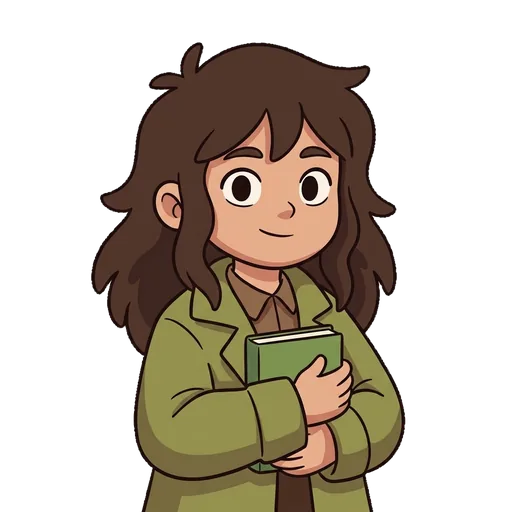 Inkling a child of the Green Names what she notices
Every recurring character has a short tune, so you can tell who is on stage before a word is said. The tunes play only when you tap, and the Reading Access sound switch turns them off.
The Honest Page
Which parts are true, stretched or made up — and what does nobody know?
True
- In Babylon, in Mesopotamia (now Iraq), scribes wrote numbers by pressing a reed into soft clay. By about 300 BC they had started using a mark of two slanted wedges to show an empty place in a number. Source
- That Babylonian mark held a place, but it was not yet thought of as a number of its own, and it was not written at the end of a number. The Maya, far away in Central America, had their own sign for zero, shaped like a shell. Source
- Two hundreds, no tens and five ones make two hundred and five. Without a mark in the empty tens place, the same marks can be read as twenty-five.
Stretched
- In the story the boy counts in hundreds, tens and ones. What we simplified: The Babylonians counted in sixties, not tens: their places stood for ones, sixties and sixty sixties. The idea of an empty place works the same way.
Made up
- Lan and Inkling, the spark, the buzzing word, the boy, his teacher, the steward and the two hundred and five sacks are made up.
Nobody knows
- Nobody knows who first pressed a mark for an empty place into clay, or who first thought of nothing as a number. It seems to have been worked out more than once, by different people, in different places. Source