
The Day Before · Grower · ages 6-8
Listen along
Loading audio…
Read by an AI-generated voice. The words on this page are the transcript.
1. The Storeroom
The hammer rang once. A spark jumped off the anvil and did not go out. It waited. They followed.
The spark led them to the bench under the big tree on the Green. Then it simply waited there.
Warm wind blew the Green away, and the ground under their feet was somewhere else, the day before.
They were standing in a cool, shady room with walls made of mud bricks. Sacks of barley were piled in rows, higher than their heads. Tall clay jars stood in the corners. Sunlight came down from a little window near the roof, full of floating dust.
A boy their age was sitting on a reed mat with a soft clay tablet in one hand and a pointed reed in the other. On the wall behind him, a crack in the bricks had been mended with fresh mud, and beside the mend somebody had scratched a tiny hammer.
"I'm learning to write counts," said the boy, when he saw them. "I counted all the sacks. Two hundred and five."
"How do you know?" asked Inkling.
"Two whole rooms of a hundred," said the boy. "No crates of ten left over. And five loose sacks, there." He pointed. "Tomorrow the steward reads my tablet and sends that many sacks to the bakers in the city."
2. Bzzz
Lan knew what the boy needed. She had learned it at school, with counting blocks.
"I know what that means!" said Lan. "I'll go first. What you need is a..."
She said the word before she had looked.
Bzzz.
Lan went pink. Inkling squeezed her hand.
"The door," said Inkling kindly. "Only the question."
3. A Little Gap
The boy pressed the reed into the clay. He made two marks for the hundreds. He left a little space for the tens, because there were no tens. Then he made five marks for the ones.
An older scribe walked past and glanced at the tablet.
"Twenty-five?" said the scribe. "That's not many. Are you sure?"
The boy looked at the tablet. Two marks, a tiny gap, five marks. It did look like twenty-five.
4. A Bigger Gap
The boy smoothed the clay flat with his thumb and wrote it again. This time he left a big, wide gap in the middle, as wide as his finger.
The steward's helper read it. "Two hundreds, nothing, five," she said. "Two hundred and five."
It worked. For a while.
Then the older scribe copied the count onto a second tablet, for the bakers. He was in a hurry. He made the marks close together. The gap in the middle squeezed shut.
The copy said twenty-five again.
5. What Is in the Middle?
Inkling did not name anything this time. She asked questions instead.
"I noticed something," said Inkling. "What is in the middle place?"
"Nothing," said the boy. "There are no tens."
"Can you see a nothing?"
"No," said the boy. "You only see a gap."
"And a gap can shrink," said Inkling. "Wait, I can name it. An empty place has to be shown. If you can't see it, it disappears."
6. Orange Light
The light in the high window turned orange. The boy rubbed out the copy with his thumb.
"Tomorrow the steward will send twenty-five sacks," he said. "Not two hundred and five. The bakers will have no flour. And it will be my fault."
7. A Mark for None
Lan looked at the tablets on the shelf. Some had little slanted marks between the words, like tiny ticks.
"Could there be a mark that means none?" said Lan. "Not a gap. A real mark, pressed in like the others, that says nothing is here?"
The boy looked at her. Then he looked at the shelf.
"My teacher uses two slanted wedges to show where a sentence ends," he said slowly. "Like this." He pressed the corner of the reed into the clay twice, at a slant.
8. The Middle Place
"Can I ask one more thing?" said Lan. "What if you put that mark right in the empty middle place?"
The boy smoothed the clay again. He pressed two marks for the hundreds. In the middle place he pressed the two slanted wedges. Then five marks for the ones.
Two hundreds, none, five.
The older scribe copied it in a hurry, close together. But this time the mark for none was there in the middle, and he copied that too.
"Two hundred and five," he read. "Well, look at that."
9. The Bakers
In the morning the steward read the tablet. Two hundreds, none, five. He sent two hundred and five sacks of barley to the bakers in the city, on a long line of carts.
Nobody would write down the boy's name, or his teacher's.
Warm wind blew the day before away, and the grass under their feet was the Green.
On the side of the anvil, under the word DOOR, after the O and the P and the E, there was a new letter. An N.
"O, P, E, N," said Inkling. "OPEN."
"DOOR," said Lan. "OPEN."
The spark dimmed to a warm dot and settled back on the anvil. The Green was just the Green again.
Back on the Green
Lan wrote her house number on a card for the postman: 106. She very nearly wrote 16. Then she remembered the boy, and put the 0 in the middle, where the tens would be.
Tell the story back to someone. Why did the gap not work? Why did the boy need a mark for nothing?
Saved. The next chapter will be here whenever you come back.
Who you met
-
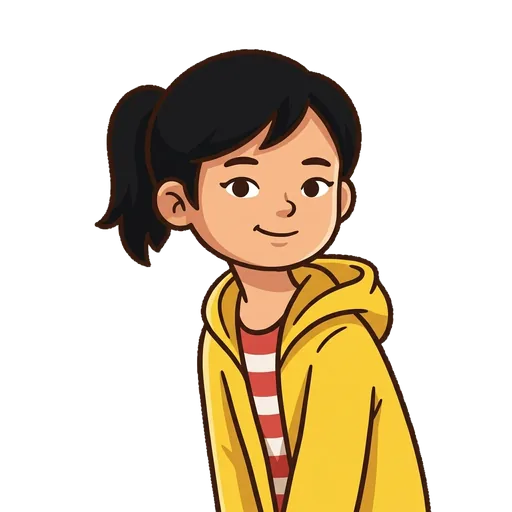 Lan a child of the Green Goes first; makes a friend in a minute
 -
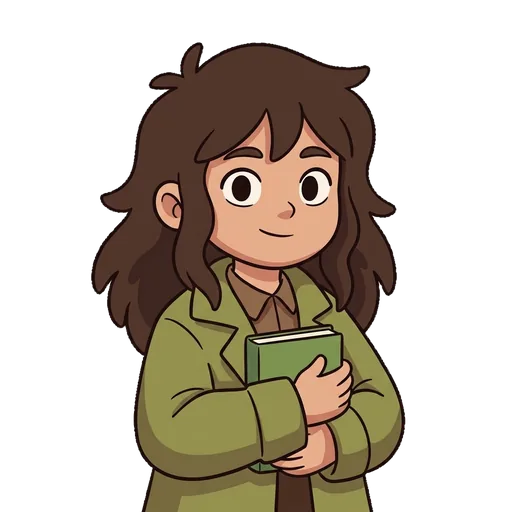 Inkling a child of the Green Names what she notices
Every recurring character has a short tune, so you can tell who is on stage before a word is said. The tunes play only when you tap, and the Reading Access sound switch turns them off.
The Honest Page
Which parts are true, stretched or made up — and what does nobody know?
True
- In Babylon, in Mesopotamia (now Iraq), scribes wrote numbers by pressing a reed into soft clay. By about 300 BC they had started using a mark of two slanted wedges to show an empty place in a number. Source
- That Babylonian mark held a place, but it was not yet thought of as a number of its own, and it was not written at the end of a number. The Maya, far away in Central America, had their own sign for zero, shaped like a shell. Source
- Two hundreds, no tens and five ones make two hundred and five. Without a mark in the empty tens place, the same marks can be read as twenty-five.
Stretched
- In the story the boy counts in hundreds, tens and ones. What we simplified: The Babylonians counted in sixties, not tens: their places stood for ones, sixties and sixty sixties. The idea of an empty place works the same way.
Made up
- Lan and Inkling, the spark, the buzzing word, the boy, his teacher, the steward and the two hundred and five sacks are made up.
Nobody knows
- Nobody knows who first pressed a mark for an empty place into clay, or who first thought of nothing as a number. It seems to have been worked out more than once, by different people, in different places. Source