The Paper Door · Reader · ages 6-8
Listen along
Loading audio…
Read by an AI-generated voice. The words on this page are the transcript.
1. A Spark and a Little Cover
The hammer rang once. A spark jumped off the anvil and did not go out. It waited. They followed.
It was a warm, still morning on the Green. The grass was dry, the bees were busy in the clover, and the only sound was a lawnmower somewhere far away. Lan ran after the spark with her yellow raincoat flapping open, even though it was much too warm for a raincoat. Inkling walked behind, watching where the spark went instead of just chasing it.
The spark went where it always went. Past the mending shed. Past the little museum with the loan desk. Up to the door of the print shop, where it hovered, glowing orange, until they opened the door and let it in.
Inside, the print shop was cool and quiet. The big presses stood still. Someone had left a pile of folded leaflets on the side table, and the room smelled of ink and dust and warm paper. The spark crossed the long table and settled beside a square of paper, orange on one side and cream on the other.
The square sat up.
"Fold me, I won't mind," said Kami.
"Somewhere with books," said Inkling at once. "Old books. Really old ones."
"Lots of them," said Lan. "And somewhere sunny."
"Then fold me in half," said Kami, "and in half again, like the cover of a little book."
Inkling folded Kami in half, edge to edge, and ran her thumb along the crease. Then she folded it in half again. Kami was a small, thick square now, with a spine on one side, like the cover of a book with nothing inside it yet.
"It's a book," said Lan.
"It's a cover," said Inkling. "There aren't any pages."
"Not yet," said Kami.
The last crease went flat, and the paper opened like a door.
2. The House on the Canal
The little cover opened wider and wider, until the inside of it was full of bright, rippling light.
Lan stepped through first, as usual. Inkling came after her, holding Kami carefully by one corner.
The light was rippling because it was bouncing off water. They were standing in a long, high room with a tiled floor and a tall window, and outside the window there was no street at all. There was a canal, green and slow, and a narrow black boat sliding past with a man standing at the back, pushing it along with a long pole.
"Where's the road?" whispered Lan.
"There isn't one," said Kami. "Not here. This is Venice, in Italy. The streets are water. The year is 1501."
The room was full of work. In the middle stood a big wooden press, taller than a man, with a heavy screw and a long wooden bar. Two men were working it. One dabbed ink onto rows of tiny metal letters with a pair of round leather pads, like fat mushrooms on sticks. The other laid a big sheet of paper on top, pulled the bar, and the press groaned and pushed down. When he lifted the sheet, it was covered in neat black lines of writing.
Along one wall, great stacks of printed sheets waited to be folded. Along another wall, on a long bench, lay finished books. Most of them were enormous. Some were as big as tea trays, with thick boards for covers and brass corners.
But at one end of the bench lay a small pile of very different books. They were no bigger than a hand. Their covers were soft brown leather, and they were thin enough to slide into a coat.
A girl was standing by the little books, looking at them very hard. She had dark curls tucked under a white cap and a blue apron with one big pocket on the front. She was about the same age as Inkling.
When she saw them, she jumped.
"Where did you come from?" she said. Then she looked at the paper door behind them, which was folded like a little book, and her eyes went very round. "Oh," she said. "From a book."
"Sort of," said Inkling. "I'm Inkling. This is Lan. And this is Kami."
"Hello," said Kami.
The girl did not seem surprised that the paper could talk. Perhaps, in a house full of books, it was not so strange.
"I'm Bettina," she said. "My father is a binder. He sews the books together and puts the covers on. This is Master Aldus's house. He is the printer."
3. Books You Can Carry
Bettina picked up one of the little brown books very carefully, with two hands, the way you hold a bird.
"Do you see these?" she said. "They are new. This week. Master Aldus says that books should not only live in libraries, chained to desks. He says people should be able to carry them about, in a pocket or a sleeve, and read them anywhere. On a boat. In a garden."
She opened it. The letters inside were small and neat and leaned a little to one side, like grass in the wind.
"The letters are slanting," said Lan.
"That is new too," said Bettina proudly. "A man called Francesco made them, from Bologna. He cut every letter by hand. The slanting ones fit more words on a small page. This is a poem by Virgil. They are printing a thousand of them. A thousand! Usually it is two or three hundred."
"Can you read it?" asked Inkling.
Bettina shook her head and laughed. "It's in Latin. I can read a little Italian. But I like how it looks."
She put the book back on the pile, very gently, and lined it up with the others.
"They are not for me," she said. "They are for scholars and rich men. My father says a girl does not need a Virgil." She pulled a face. "But I would like a book of my own. A small one. For my pocket."
"What would you put in it?" asked Lan.
"My grandmother's stories," said Bettina at once. "She tells the best stories in Venice. About the sea, and the islands, and a cat who rode on a gondola. But she is getting old, and she forgets bits. I want to write them down before they are lost. And then I want to carry them with me, so I can read them to her when she forgets."
She put her hand into her apron pocket and pulled out a single sheet of paper. It had been folded into quarters to fit.
She unfolded it. One side was printed with lines of slanting letters, but a big black smudge of ink ran right across the middle, like a puddle.
"This one is spoiled," said Bettina. "The pressman dropped the ink pad on it. I am allowed to keep it. The back is blank." She turned it over. It was. "But it is only one sheet. A book is lots of pages, sewn together. My father would need thread and boards and glue. And I would need lots of sheets."
"Could you write the stories on the sheet as it is?" asked Lan. "Just on the back?"
Bettina shook her head. "Then it is a page, not a book. It would get crumpled in my pocket, and the words would rub out. And I could not turn it. A book you can turn, one page after another, like walking along a street. Nonna's stories go one bit after another too. First the cat is on the steps, then it is on the boat, then it is out at sea. They need pages."
"It's only one sheet," said Lan.
Inkling looked at the sheet for a long time. Then she looked at Kami.
"One sheet can be a whole book," said Kami quietly. "If you fold it the right way. Every fold makes me something new."
4. Read the Drawing First
A small, careful figure with a pencil behind one ear had been sitting on the windowsill all this time, watching the press. It hopped down.
"Before anybody folds anything," said Mark, "read the drawing before your hands move."
"There isn't a drawing," said Lan.
"Then make one," said Mark.
Inkling borrowed a pencil from the pressman's bench. She laid the spoiled sheet on the table, blank side up, and began to draw very lightly, so the lines would hardly show.
"A one-sheet book has eight boxes," said Inkling slowly, remembering. "Two rows of four."
She drew them. Two long rows, four boxes in each.
"Every fold is dashes," said Mark. "Dashes mean fold."
Inkling went over the lines between the boxes with little dashes. Down the middle the long way. Across, between each box and the next.
"And one cut," said Inkling. "Just one. In the very middle."
She drew one short solid line. It ran along the long middle fold, but only between the two middle boxes. It did not go out to the edges. It stopped.
"A solid line means cut," said Mark. "Look where the line stops."
Bettina leaned over the drawing. "Only that little bit?"
"Only that little bit," said Mark. "Every line on the drawing has a job."
5. In Half, in Half, in Half Again
A neat, cheerful figure with very tidy hands had appeared at the end of the table. Cornelia never seemed to arrive. She was just there when somebody needed a fold made properly.
"Now the folds," said Cornelia. "Make the edges meet exactly."
Bettina held the sheet. She brought the short edges together, edge to edge, and held them still while she pressed the fold.
"In half," said Cornelia. "Now in half again."
Bettina folded it again. The paper was getting thick.
"And in half once more," said Cornelia.
It was harder this time. The paper fought back a little. But Bettina lined the edges up, held them, and pressed.
"Open it," said Cornelia.
Bettina unfolded the sheet. The creases had made eight neat boxes, two rows of four, exactly where Inkling had drawn them.
"Three folds in half," said Inkling. "Eight boxes. Each box is an eighth of the sheet."
"Like the big sheets," said Bettina suddenly. "The ones by the wall. My father folds them three times too, before he sews them. That is how the little books are made. He calls them eights."
"So the little Virgil is a big sheet folded small," said Lan.
"Lots of big sheets," said Bettina. "Sewn together. But yes."
Just then a tall man with a leather apron and a needle tucked into his sleeve came over from the binding bench. He had the same dark curls as Bettina, with a little grey in them.
"Papà," said Bettina, "these are my friends. They are making me a book."
Her father raised his eyebrows at the eight boxes on the table, but he did not laugh. He fetched one of the big printed sheets from the stack by the wall. It was enormous, almost as wide as Lan's arms could stretch.
"Watch," he said.
He laid it on the bench, printed side up, and folded it in half, so smoothly it hardly made a sound. Then in half again. Then once more. Now it was a thick little block of paper, no bigger than his hand.
"Eight leaves," he said. "Sixteen pages, front and back. But the edges are joined. So." He took a long, thin knife and slit the folded edges along the top, one by one, so they opened like the pages of a book. "Now they turn."
"That's what you do for the little Virgils," said Inkling.
"That is what I do," he said. "Fold, cut the edges, sew many of these together, put on a cover. Master Aldus prints the sheet so that when it is folded three times, every page lands the right way up, in the right place. It is like a puzzle. The printer solves it before the paper is even printed."
Lan stared at the big sheet. "So the pages are in the wrong order when it's flat?"
"All over the place," said Bettina's father. "Some upside down. And after three folds, every one is right." He smiled at the spoiled sheet on the table. "Yours is a smaller puzzle. One sheet, one book. Go on, then. Show me."
He went back to his bench, but Lan noticed that he kept glancing over to watch.
6. All the Way Through
"Now the cut," said Inkling. "We fold it in half the long way, and cut along the middle of the fold."
"I'll do it!" said Lan. "I promise. I'm good at cutting."
She was. She had cut out a whole paper chain of elephants last week without breaking a single trunk. She grabbed the scissors from the bench, folded the sheet the long way, and put the blades at the folded edge.
Then she began to cut along the fold. Snip. Snip. She was going fast. She was going to cut it all the way, from one end to the other.
"Look where the line stops," said Mark sharply.
Lan froze, with the blades open.
"Not all the way through, please!" said Kami. "Leave me a bridge."
Lan looked at the drawing. The solid line stopped at the middle boxes. She had already cut almost as far as it went. If she had kept going, the sheet would have fallen into two long, loose strips. Two strips are not a book. You can't fold two strips into pages that stay together.
She put the scissors down on the table, very carefully.
"Sorry," she said. "I was going too fast."
"You stopped," said Mark. "That's the important bit. Reading a drawing doesn't only mean looking at it once. It means looking again while your hands move."
Lan held the scissors out to Bettina. "You finish it," she said. "It's your book. Just to where the line stops."
Bettina took them. She made one tiny snip more, to the very end of the solid line, and no further.
7. The Crease Remembers
"Now the magic part," said Inkling. "Open it out, fold it the long way again, and push the two ends together. The middle should open up into a cross."
Inkling held the two short ends and pushed them gently towards each other.
Nothing opened. The middle of the sheet bulged and puffed up, like a cushion somebody had sat on. It wobbled. The cut in the middle stayed shut.
"It won't open," said Inkling. She pushed a little harder. The paper bulged worse.
"Don't push harder," said a cheerful voice. Crinkle had come out from under the bench, brushing off dust. "Smooth it out and try again."
"But we did it all right," said Inkling. "Every fold."
"You did every fold," said Crinkle. "But they're soft. Look." She ran her finger along one of the creases. It was there, but only just, like a line drawn in sand. "Paper does what its creases tell it. If the creases are soft, it doesn't know which way to go. The crease remembers, but only if you make it remember."
They opened the sheet flat on the table. They folded every line again, one at a time. In half. In half again. In half once more. The long way. After every fold, Bettina ran her thumbnail along the crease, hard, from one end to the other.
"Crooked is just a first go," said Crinkle. "This is your second go. Try now."
Inkling folded the sheet the long way and held the ends. She pushed them gently together.
This time the paper knew what to do. The cut in the middle opened like a mouth, and the sheet folded itself into a shape like a little plus sign, a cross with four arms.
"There," said Crinkle. "We can fix this one. We just did."
8. Press It Flat
A big, calm figure leaned over the table. Presso always moved slowly, and always got there in time.
"Now fold the cross round," said Presso. "So the arms lie on top of each other, like pages."
Bettina folded the arms of the cross round, one behind the other, until they lay in a neat stack. The smudged printed side was hidden on the inside. Only the blank boxes showed, one after another.
"Hold it still," said Presso. "Now press it flat."
Bettina held the little stack in one hand and ran her thumbnail down the spine.
"Press slowly," said Presso. "Press firmly. A fold you press is a fold that stays."
When she let go, the stack did not spring open. It stayed shut. It had a spine. It had a front cover and a back cover. When she opened it, the pages turned.
It was a book.
"From one sheet," whispered Bettina.
"I'm still one piece of paper," said Kami, from Inkling's hand. "Eight pages, and still one sheet."
9. The Two Tests
"A pocket book has to pass two tests," said Kami. "First, its pages have to turn in order. A book with pages in the wrong order is just a muddle."
Bettina took the pencil. In the bottom corner of each page she wrote a small number. One on the front. Two on the next. All the way to eight on the back cover.
Then she turned the pages, slowly, one at a time.
"One," she said. "Two. Three. Four. Five. Six. Seven. Eight."
They were in order. Every one.
"How?" said Lan. "We didn't put them in order. We just folded."
"The fold put them in order," said Kami. "That is the clever part. The person who first worked out this fold must have tried it many times, until the boxes came round in the right order. Every fold makes me something new."
"And the second test?" asked Bettina.
"It has to fit a pocket," said Kami. "Otherwise it's just a small book. A pocket book has to go in a pocket."
Bettina looked at Inkling. "You do it," she said. "You drew the plan."
Inkling took the little book. She folded it shut, pressed the spine one last time, and slipped it into the pocket of Bettina's blue apron.
It fit. It sat there, flat and snug, with just the top corner peeping out.
Bettina put her hand over the pocket and held it there, as if the book might fly away.
"Now I need eight stories," she said. "Or one story on eight pages. My grandmother's cat on the gondola. That one first."
Down the room, the big press groaned and thumped again. Another sheet of slanting letters came off it, for another little Virgil. Bettina looked at it, and then at her pocket, and smiled.
Lan thought about the thousand little Virgils, all the same, all with the same slanting letters in the same places. Then she thought about Bettina's book, with its smudge hidden on the inside and its eight blank pages waiting. There was only one of it in the whole world.
"Theirs is a thousand books," said Bettina. "Mine is one. But mine has my grandmother in it."
She ran to the door, which opened onto a narrow stone walkway beside the canal, and the children followed her as far as the step.
A little way along, on a bench in the sun, an old woman in a black shawl sat feeding crumbs to the pigeons. Bettina sat down beside her and took out the little book.
"Nonna," she said. "Tell me the cat on the gondola. I'm going to write it down."
Her grandmother laughed. "That old story? Again?"
"Again," said Bettina. "Slowly. So I can write."
Her grandmother began. Once there was a cat who belonged to nobody, who lived on the steps of a church, and who wanted more than anything to see the sea. Bettina wrote with the pencil, very small, so that the beginning fitted on the first page. When the first page was full, she turned to the second, and her grandmother waited for her, smiling.
"There," said Bettina, when the cat had found its gondola. "Now you can't forget it. It's in my pocket."
She looked up and waved to the step where the children stood.
"Thank you, paper door," she called.
Lan found a plain square in her raincoat pocket. They unfolded it flat, and the door closed behind them.
The spark dimmed to a warm dot and settled back on the anvil. The Green was just the Green again.
Back on the Green
At the print shop, Lan found an old drawing in the scrap box. She folded it in half three times, edge to edge, and opened it out. Eight boxes.
She folded it the long way. She picked up the scissors and cut along the middle of the fold. Then she looked at the line she had drawn, and stopped exactly where it stopped.
She pushed the ends together. The middle opened into a cross. She folded it round and pressed the spine.
"What's it about?" asked Inkling.
"A girl in Venice," said Lan, "who carried her grandmother's stories in her pocket." She drew Bettina on the first page and a cat on a boat on the second.
Tell the story back to someone. Why did Lan stop cutting? And why did the soft folds make the paper bulge?
Saved. The next chapter will be here whenever you come back.
Who you met
-
 Kami Paper becomes a new shape with every fold, and it only cuts where it is told from CreaseTots
-
 Mark The lines tell you what to do — dashes fold, solid lines cut from CreasePals
-
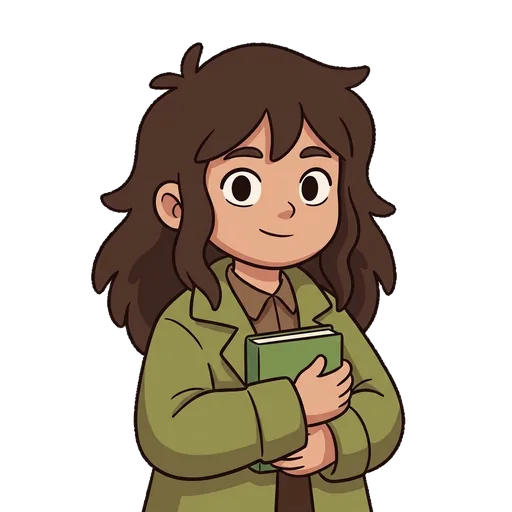 Inkling a child of the Green Names what she notices
-
 Cornelia Bring one corner to meet the other corner, exactly from CreaseTots
-
 Lan a child of the Green Goes first; makes a friend in a minute
-
 Crinkle Smooth a crooked fold out and try again; the crease remembers from CreaseTots
-
 Presso Hold the paper still and press the fold flat so it stays from CreaseTots
Every recurring character has a short tune, so you can tell who is on stage before a word is said. The tunes play only when you tap, and the Reading Access sound switch turns them off.
The Honest Page
Which parts of this story are true, stretched or made up?
True
- Aldus Manutius ran a printing house in Venice from 1494. He made 'portable small books', which people could carry about, a little like today's paperbacks. Source
- His small Virgil came out in April 1501. It was the first book printed in italic, a slanting type cut by Francesco Griffo, and he printed a thousand copies, many more than usual. Source
- Printers made small books by folding one big printed sheet several times. A sheet folded three times gives eight leaves, a size called octavo. Source
- Three folds in half make eight boxes, two rows of four, and the one-sheet book turns those eight boxes into eight pages.
Stretched
- Bettina folds a book like Aldus's small books. What we simplified: Aldus's books were folded from big printed sheets, sewn and bound with covers. Bettina's one-sheet book is a simpler fold with one cut that children make today; it works the same way, one sheet becoming many pages.
Made up
- Bettina, her family and the paper door are made up. Kami, Mark, Cornelia, Presso and Crinkle are our own characters.