The Paper Door · Reader · ages 6-8
Listen along
Loading audio…
Read by an AI-generated voice. The words on this page are the transcript.
1. A Spark and a Puppy Face
The hammer rang once. A spark jumped off the anvil and did not go out. It waited. They followed.
It was a grey, windy morning on the Green, the kind where the leaves blow round in circles and nobody can keep a hat on. Lan ran after the spark with her yellow hood flapping. Inkling walked behind her, holding her coat shut with one hand, watching where the spark went instead of just chasing it.
The spark went where it always went. Past the mending shed. Past the bench with the loose plank. Right up to the door of the print shop, where it hung in the air, glowing orange, until they pushed the door open and let it in.
The print shop was warm and smelled of ink and old paper. Long sheets hung drying on a line above the presses. The spark crossed the long table and settled next to a square of paper, orange on one side and cream on the other.
The square sat up.
"Fold me, I won't mind," said Kami.
"Somewhere with snow," said Lan at once. "Real snow. Proper deep snow you can fall over in. I've never seen it."
"I can't promise deep," said Kami. "Every fold makes me something new, but I don't choose the weather. Start with something you know. Start with a puppy."
Inkling knew the puppy. She turned Kami so a corner pointed up, like a diamond. She folded the top corner down to the bottom corner, and there was a triangle with its point at the bottom. She folded the left corner down beside the face for one ear, and the right corner down for the other. Then she folded the bottom tip up a little, for a nose.
It was a puppy face, with two floppy ears, looking up at them from the table.
"It needs eyes," said Lan.
"It needs pressing," said Inkling, and ran her thumb along the folds.
The last crease went flat, and the paper opened like a door.
2. A Cold Little House
The puppy face opened wider and wider, until the inside of it was full of white light.
Lan stepped through first, of course. Inkling stepped through behind her, holding Kami by one corner.
It was cold. That was the first thing, before anything else. Not wet cold, like the Green, but dry, sharp cold that pinched their noses. Their breath came out in little clouds.
"Snow!" said Lan.
She was right. Outside a window, a thin layer of snow lay along a wooden fence and on the roof of the house next door. It was not deep enough to fall over in. But it was real.
They were standing inside a small wooden house. The floor was covered in pale straw mats, soft and springy under their feet. The walls were not walls exactly. They were sliding screens, made of thin white paper stretched on wooden frames, and the winter sun came through them in a soft glow. In one corner, a small iron stove ticked and hissed, and a kettle sat on top of it, steaming.
"We should take our shoes off," said Inkling, looking at the mats. "I think you're meant to."
They left their shoes by the step.
"Where are we?" asked Lan.
Kami crackled. "Japan," said Kami. "A big city called Tokyo. The year is 1954."
"Japan again," said Inkling. "Like the temple with the cranes."
"A long time after the cranes," said Kami. "More than a hundred and fifty years. Every door opens somewhere. This one opened here."
3. Hana's Problem
There was a low wooden table in the middle of the room, so low that you had to kneel to use it. A girl was kneeling at it.
She was about eight, with short black hair, a thick knitted cardigan and a long wool skirt. In front of her lay a brown envelope, a pencil, and one sheet of writing paper. The sheet was completely blank. She was staring at it as if it had done something wrong.
Lan, who was never shy for long, knelt down on the other side of the table.
"Hello," she said. "I'm Lan. This is Inkling. That's Kami."
The girl looked at Kami, who waved one corner. She blinked, and decided not to ask.
"I'm Hana," she said. "I'm trying to write a letter. But I don't know how."
"I'm good at letters," said Lan. "Who's it for?"
"My cousin Yuki," said Hana. "She turns five next week. She lives far away, up in the mountains, in a village with one shop. I can't go to her party. So I want to send her a present."
"What present?" asked Inkling.
Hana took a small square of paper out of her cardigan pocket and folded it, quickly, without looking. A triangle. Two ears. A nose. She held up a little paper puppy face.
"This," she said. "But not the puppy. I want to send her the way to fold it. Then she can make as many as she likes. She loves dogs, and her family can't have one."
"That's a good present," said Lan.
"It is," said Hana. "But there's a problem." She put the puppy down. "Yuki can't read yet. She's only just learning her letters. And nobody at her house knows how to fold a puppy. Her mother never learned. Her grandmother's hands are too stiff."
They all looked at the blank sheet of writing paper.
"So I have to send her instructions," said Hana. "To someone who can't read."
4. Words, Words, Words
Lan had an idea. Her ideas came out of her mouth before they had finished arriving.
"I'll do it!" said Lan. "I promise. You don't have to worry. I'll write it all down really clearly, and someone can read it to her."
She picked up the pencil and pulled the sheet towards her.
"Take the top corner," she said as she wrote, "down to the bottom corner, so it makes a triangle with the point at the bottom. Then take the left corner, but not all the way across, just down, sort of beside the face, so it hangs like an ear, not too far, and..."
The words ran on. They filled one line, then two, then five. Lan wrote smaller to fit them in. The sheet was half full, and they had only done the first fold and a bit of the second.
"Yuki can't read words," said someone behind her.
Lan turned round. In the doorway stood Mark, who drew every fold line in the world and liked nothing better than a good drawing. He had a pencil behind one ear, as usual, and he was looking at Lan's page with his head on one side.
"Someone can read it to her," said Lan.
"Who?" asked Mark. "Hana said her mother can't fold. Her mother will read the words and still not know what 'not too far' means. 'Sort of beside the face' could be anywhere."
Lan looked at the page. Mark was right. It said "sort of." It said "not too far." It said "just down, beside." To someone who had never seen a paper puppy, the words would not make a picture at all.
"Lines don't lie, but long letters lose people," said Mark. "Read the drawing first."
Lan put the pencil down. Her ears went hot.
"I promised before I checked," she said quietly. "Sorry, Hana. I filled up your paper."
"I have more paper," said Hana. "That's the one thing I do have."
She turned the sheet over, so the words were face down, and slid a fresh one across.
Inkling noticed that Lan sat on her hands for a while after that, as if she did not quite trust them.
5. The Man in the Next Room
"Mark," said Inkling. "What drawing? There isn't one."
Mark nodded towards the back of the room. One of the paper screens was slid open a little way. Through the gap, they could see into the next room.
A man sat there at another low table. He wore a plain dark jacket, and his sleeves were pushed back. He was drawing with a brush, very slowly, dipping it into a little dish of ink and lifting it again. Around him on the mat lay sheets of paper, drying. On the table beside him stood folded paper animals: a crane with its wings spread, a frog that looked ready to jump, a small dog that looked so alive Lan almost expected it to wag its tail.
The man did not look up. He did not explain. He just drew.
"That's our neighbour," whispered Hana. "He folds all day. Mother says he's making a book."
Mark tiptoed to the gap in the screen. He did not go in. He just looked at the drawings drying on the mat, the way you look at a map.
After a while he came back and knelt at their table.
"Read the drawing before your hands move," said Mark. "He draws every fold as a picture. And every picture uses the same few marks. Look." He took Hana's pencil and drew on the fresh sheet.
He drew a line made of short dashes. "A dashed line means fold here, towards you. The paper comes up and over, and you can see the fold like a little valley."
He drew another line, this time made of dashes with dots between them. "Dashes and dots mean fold it behind. The paper goes away from you, and the fold is like the top of a mountain."
Then he drew a curved arrow, starting at one point and landing on another. "And the arrow shows which way the paper moves. Where it starts, and where it lands."
Hana stared at the three marks.
"There are no words," she said slowly.
"Every line on the drawing has a job," said Mark. "None of them is a word. You don't need to read to understand them. You only need to look."
Inkling looked at the drying sheets through the gap. She could see dashed lines and arrows on all of them, picture after picture, like a strip of film.
"It's a language," she said. "A language for folds."
This time, nobody told her she had named it too soon.
6. The First Picture
"Corner to corner," said a cheerful voice. "Corners first, always."
It was Cornelia, who could make any two corners meet as if they had been made for each other. She took a fresh square and turned it so one corner pointed up, like a diamond.
"Make the corners meet exactly," said Cornelia. "Point to point, then hold."
She brought the top corner down onto the bottom corner. They met perfectly. She held them, and pressed the middle, and there was a triangle with its point at the bottom.
"Now draw it," said Mark.
Hana picked up the pencil. She thought hard. Then she drew a square, standing on its point like a diamond. Across the middle, from the left corner to the right corner, she drew a dashed line. Then she drew a curved arrow, starting at the top corner and swooping down to land on the bottom corner.
They all looked at it.
"That says: fold the top down to the bottom," said Inkling. "Along the middle. Towards you."
"Yuki could understand that," said Hana. Her face had changed. She looked like someone who had found the end of a tangled string.
Below the first picture, Hana drew a second small one: the triangle, the way it looked after the fold. "So she can check," said Hana. "If her paper looks like this, she did it right."
"That's what the man does too," said Mark, pleased. "A picture before, and a picture after."
7. The Cat's Ear
The next fold was the first ear.
"I'll draw that one," said Inkling. "Wait, I can name it. It's an ear arrow."
She took the pencil. She drew the triangle, and a short dashed line near the left corner, slanting down. Then she drew the arrow, curving from the left corner. She drew it curving up.
"I'll go first," said Lan, who had been sitting on her hands for a long time. "I'll fold exactly what it says. Not what I know. What it says."
She took the triangle. She looked at Inkling's picture. She folded along the dashed line, and she moved the corner the way the arrow showed: up.
The ear stuck straight up from the top of the head, sharp and pointy.
Hana burst out laughing. "That's not a puppy," she said. "That's a cat!"
Inkling went pink to the tips of her ears. She had named it too soon. She had drawn the arrow before she had really looked at where the ear went.
"I drew it wrong," she said. "Yuki would make a cat. She'd be so confused."
"Crooked is just a first go," said a gentle voice.
It was Crinkle, who was never upset by a mistake and only ever looked interested in them.
"Smooth it out and try again," said Crinkle. "The crease remembers."
Lan opened the cat's ear gently. A faint line stayed in the paper where the fold had been. That line was in the right place. Only the direction had been wrong.
"See?" said Crinkle. "The fold line was right. The arrow told it the wrong way. Fix the arrow, not the fold."
Inkling rubbed out the arrow. She drew it again, curving from the left corner down, so it landed beside the face, below the fold.
Lan folded again, following the new arrow. This time the ear flopped down beside the face, soft and floppy, like a puppy's.
"Puppy," said Hana, nodding firmly.
They drew the right ear the same way. Inkling checked the arrow three times before she let anyone fold it.
8. Pressed and Drawn
The paper was getting soft at the corners from all the folding and unfolding.
"Hold it still," said a slow, calm voice. "Now press it flat."
It was Presso, who never hurried and whose folds never came undone.
"If the paper moves while you draw it," said Presso, "the picture is a picture of nothing. Hold it still. Press slowly, press firmly. A fold you press is a fold that stays."
Presso held each test fold flat on the table while Hana drew it. First the triangle. Then the triangle with one ear. Then the triangle with two ears.
There was one fold left. The bottom tip of the face folded up a little way, just the top layer, to make a nose. Presso pressed it, and Hana drew it: a dashed line across the tip, and a small arrow curving up.
Then Hana laid all the pictures out in a row along the low table.
The plain square, standing on its point. The square with the dashed line across the middle and the big arrow. The triangle with the first ear arrow. The second ear. The nose.
"How many?" asked Lan.
Inkling counted carefully, pointing at each one. This time she did not say a number until she had touched every picture.
"Four folds," she said. "And the plain square before them. Five pictures."
This time she was right, and she knew it.
9. The Test
"Every fold makes me something new," said Kami, who had been watching from the edge of the table. "But a picture is only good if it teaches. Now you have to test it."
"How?" asked Hana.
"Someone who has never seen the puppy must fold it," said Kami. "From the pictures alone. Nobody helps. Nobody points. Nobody says a word."
"That's hard," said Lan. "I always want to help."
"That's why you sit on your hands," said Kami.
Hana went to the window. In the little garden next door, a small girl in a red hat was making footprints in the thin snow. Round and round in circles.
"That's Mio," said Hana. "She's four. She can't read either."
Hana slid the door open and called her. Mio came in, stamping snow off her boots, with very pink cheeks.
"I'll do the test," said Lan. She gave Mio a square of paper and the row of five pictures. Then she sat back and sat on both hands, and she did not say one word, not even when Mio turned the paper round and round.
Mio looked at the first picture for a long time. She looked at the paper. She turned the paper round until it stood on its point, like the picture. Then she looked at the arrow, and she folded the top corner down to the bottom one.
She looked at the second picture. She checked her paper against it. It matched. She smiled a small, private smile.
The third picture. The ear arrow, curving down. Mio folded the corner down beside the face. The fourth picture. The other ear. The fifth picture. The little nose.
She held it up.
It was a puppy. A small, slightly crooked puppy with two floppy ears and a little nose.
Nobody had said a single word.
"Puppy," said Mio, very pleased, and she barked at it.
Hana laughed out loud. She took the pencil and drew two dots for eyes on Mio's puppy, and then she hugged Mio, who did not mind at all.
10. A Letter with No Words
Hana gathered up the five pictures. She stacked them in order and slid them into the brown envelope. Then she took the blank sheet of writing paper, the fresh one, and folded it in with them, so Yuki would have paper to practise on.
"Aren't you going to write anything?" asked Lan. "Not even happy birthday?"
Hana thought about it. Then she picked up the pencil and wrote one word on the front of the envelope, big and clear. Yuki had just learned to read her own name.
YUKI.
"She'll know it's for her," said Hana. "And she'll know what to do inside. She can look."
Through the gap in the screen, the man in the next room was still drawing, slowly, with his brush. He had not looked up once. A small dog stood on the table beside him, folded so well that it seemed about to bark.
"Will he finish his book?" whispered Inkling.
"I think he will," said Kami. "Lots of people will fold from his pictures. People all over the world, who can't read a word of each other's languages."
11. The Red Post Box
"Can we post it now?" asked Hana. "Before it gets dark?"
"I'll go first!" said Lan, already at the step.
They put their shoes back on by the step. Hana wrapped a long scarf round her neck twice and tucked the envelope inside her cardigan, where it would stay dry.
Outside, the cold pinched harder. The thin snow squeaked under their shoes. The street was narrow, with wooden houses close together on both sides, and every roof had a white line along its edge. A man on a bicycle went past, wobbling, with a tray of tofu balanced on the back. A woman was sweeping snow off her step with a broom made of twigs.
At the corner of the street stood a post box. It was round and red, as tall as Lan, with a little roof on top like a hat. Snow had settled on the roof.
Hana took the envelope out of her cardigan and looked at it one more time.
"What if she can't do it?" she said. "What if she gets stuck on the ears, like Inkling?"
"I noticed something," said Inkling. "The arrow is right now. I checked it three times, so she won't get stuck there."
"Come on, quick!" said Lan. "Mio did it, and Mio is only four. Yuki is nearly five. That's a whole extra year of being good at things."
Hana laughed. She stood on tiptoe and pushed the envelope into the slot. They heard it drop inside with a soft pat.
"It will go on a train," said Hana. "Up into the mountains. Then a man with a bag will walk it to Yuki's house. It might take three days."
"And then she'll open it," said Lan, "and there won't be any words, and she'll know exactly what to do."
On the way back, Lan found a patch of snow by the fence that was a little deeper than the rest. Not deep enough to fall over in, really. She fell over in it anyway, on purpose, and lay on her back looking up at the white sky.
"It's real," she said. "It's really real snow."
"It's very thin," said Inkling.
"It's the best snow I've ever seen," said Lan, "because it's the only snow I've ever seen."
Mio came running out of her garden and fell over next to her, giggling, holding her paper puppy up so it would not get wet.
Back in the little house, the kettle was still steaming on the stove.
Lan found a plain square in her pocket. She looked at it, and then at Kami.
"Fold me, I won't mind," said Kami. "Or rather, unfold me."
They unfolded the paper flat, and the door closed behind them.
The spark dimmed to a warm dot and settled back on the anvil. The Green was just the Green again.
Back on the Green
That afternoon, Lan's baby brother wanted a paper boat, and he wanted it right now, and Lan had to go to the shop.
She did not write a note for her mum. She did not write a single word. She took a square of paper and drew it: a dashed line across the middle, and one curved arrow. Then another picture, and another.
When she came back, her brother had folded his own boat. It was crooked. It floated anyway.
Tell the story back to someone. What did the dashed line say, and what did the arrow say?
Saved. The next chapter will be here whenever you come back.
Who you met
-
 Kami Paper becomes a new shape with every fold, and it only cuts where it is told from CreaseTots
-
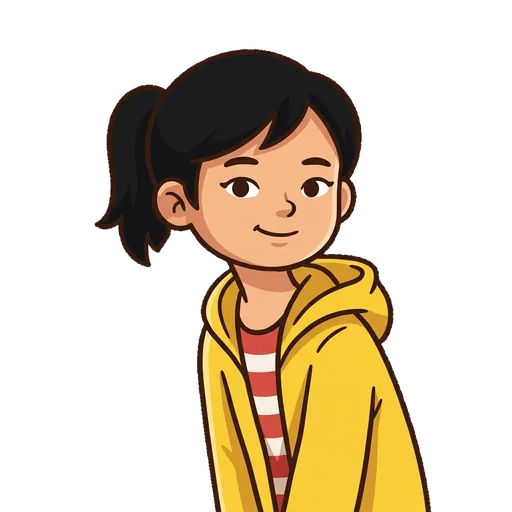 Lan a child of the Green Goes first; makes a friend in a minute
-
 Mark The lines tell you what to do — dashes fold, solid lines cut from CreasePals
-
 Cornelia Bring one corner to meet the other corner, exactly from CreaseTots
-
 Crinkle Smooth a crooked fold out and try again; the crease remembers from CreaseTots
-
 Presso Hold the paper still and press the fold flat so it stays from CreaseTots
-
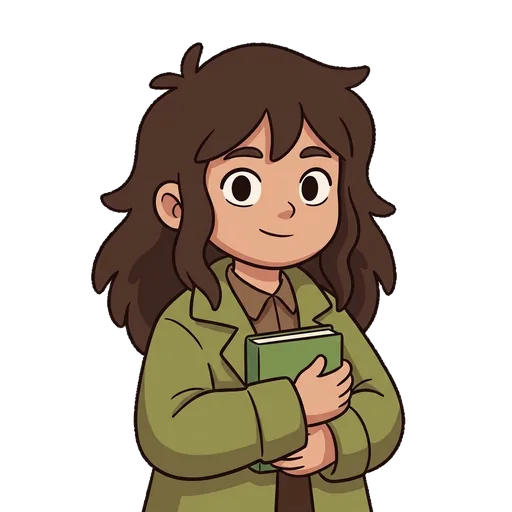 Inkling a child of the Green Names what she notices
Every recurring character has a short tune, so you can tell who is on stage before a word is said. The tunes play only when you tap, and the Reading Access sound switch turns them off.
The Honest Page
Which parts of this story are true, stretched or made up?
True
- In 1954 Akira Yoshizawa, a Japanese paper folder, published his first book, New Origami Art. In it he used a drawing language for folds. Source
- In that language a dashed line means fold the paper in front of itself, and a line of dashes and dots means fold it behind. Arrows show which way the paper moves. Source
- Yoshizawa did not invent every mark. The first book of folding, printed in 1797, already had drawings, but they were hard to follow. Later Samuel Randlett and Robert Harbin added a few marks, and folders all over the world now use the system. Source
- The paper puppy takes four folds. With a picture of the square before the first fold, that makes five pictures.
Stretched
- The man drawing in the next room in our story never says his name. What we simplified: We kept the real Akira Yoshizawa in the background so the children and the cast solve the problem themselves; we do not know which room he drew in, or that he lived next door to anyone called Hana.
- In our story his drying drawings show the dashed line and the arrow. What we simplified: We drew our own simple pictures, not his pages, and the brush he holds is a guess.
Made up
- Hana, her cousin Yuki, the little neighbour and the paper door are made up. Kami, Mark, Cornelia, Presso and Crinkle are our own characters.