The Paper Door · Reader · ages 6-8
Listen along
Loading audio…
Read by an AI-generated voice. The words on this page are the transcript.
1. A Spark and a Paper Cup
The hammer rang once. A spark jumped off the anvil and did not go out. It waited. They followed.
It was a soft, rainy afternoon on the Green. The rain was the fine kind that you do not really feel, only see, hanging in the air like dust. Lan ran after the spark with her yellow hood up. Inkling walked behind her, watching where the spark went instead of just chasing it.
The spark went where it always went. Past the mending shed. Past the bench with the loose plank. Up to the door of the print shop, where it waited, glowing orange, until they let it in.
Inside, the print shop smelled of ink and warm paper. The presses were quiet. Long sheets hung drying on a line. The spark crossed the long table and settled next to a square of paper, orange on one side and cream on the other.
The square sat up.
"Fold me, I won't mind," said Kami.
"Somewhere with lots of people," said Lan at once. "I like a crowd. Everybody talking, everybody busy."
"Then fold me into a cup," said Kami. "A cup is for sharing. You pour, I hold, somebody drinks."
Inkling knew the cup, or most of it. She turned Kami so a corner pointed down, like a diamond. She folded the bottom corner up to meet the top corner, and there was a triangle. She folded the left corner across until it touched the far edge, and the right corner across the same way. Two little flaps stood up at the top.
"One in front," said Kami. "One behind. Don't forget."
Inkling folded one flap down in front and turned Kami over to fold the other down behind. She opened the top with her finger. It was a little paper cup.
"It needs a drink," said Lan.
"It needs pressing," said Inkling, and ran her thumb along every fold.
The last crease went flat, and the paper opened like a door.
2. The Room Full of Folders
The cup opened wider and wider, until the inside of it was full of white light.
Lan stepped through first, of course. Inkling came behind her, holding Kami by one corner.
The first thing was the sound. It was a busy sound, like bees, made of lots of people talking quietly at once, and under that a soft crackle, crackle, crackle that Lan could not place.
Then she saw. They were in a big bright room with tall windows. The windows went nearly up to the ceiling, and autumn sun came through them in long yellow stripes across the wooden floor. Rows of long tables filled the room. At every table people sat on folding chairs, and every single one of them was folding paper. That was the crackle. Dozens of squares of paper, being folded all at once.
"A crowd," said Lan happily. "I said a crowd."
"You did," said Kami. "America. New York. The sixth of October, 1958."
Most of the folders were grown-ups. There were ladies in hats and men in jackets and one very old man with a magnifying glass. But there were a few children too, sitting beside their parents, with their tongues stuck out in concentration.
Far away at the front of the room, a grey-haired woman in a dark dress stood beside a blackboard. She held up a little paper bird. Everyone leaned forward to see it, and a sound went round the room, a soft "ooh".
"Who is she?" whispered Lan.
"The teacher," said Kami. "This is her first lesson here. She wants everyone in the city to know how to fold."
"Everyone?" said Inkling. "That's a lot of people."
"She has to start somewhere," said Kami. "She started with this room."
The woman did not look over at them. She was busy. She was showing a man near the front how to turn his bird over, and then a lady, and then somebody else.
Lan walked slowly along the nearest table, looking. Some people were good at it already. Their birds had sharp points and neat wings. Some people were not good at it at all. One lady had a square that had been folded and unfolded so many times it had gone soft, like cloth. A man was holding his paper up to the light, trying to see where the creases went.
"Nobody here is in a hurry," said Inkling. "Have you noticed? Nobody's cross."
It was true. When somebody got muddled, the person next to them leaned over and showed them. When somebody got it right, the people near them clapped, very quietly, with the tips of their fingers. The old man with the magnifying glass had folded a frog, and the lady beside him was asking him how.
"It's like a print shop," said Lan, "but with no presses. Just hands."
"Paper goes from hand to hand," said Kami. "That's how it travels. It always has. Somebody shows somebody, and they show somebody else."
3. Ruth and Leo
At the nearest table sat a girl about Inkling's age. She had brown plaits and a green pinafore dress, and in front of her lay a square of blue paper, not folded at all. She was holding it with both hands and looking at it the way you look at a hard sum.
Lan, who was never shy for long, pulled out the chair next to her.
"Hello," she said. "I'm Lan. This is Inkling. That's Kami."
Kami waved one corner. The girl stared, and then she smiled a little. In a room full of folded paper, a square that waved did not seem so strange.
"I'm Ruth," she said.
"Why aren't you folding?" asked Inkling. "Everyone else is."
Ruth looked down at her blue square. "It's not for me," she said. "It's for my brother Leo. He's six. He fell off the wall in our street and broke his leg, and now it's in a big white cast and he has to stay in bed for weeks and weeks."
"Poor Leo," said Lan.
"He's so bored," said Ruth. "Our flat is on the fourth floor, and his bed is by the window. All day he watches the street. He watches the milk truck, and the man with the newspapers, and the boys playing ball on the corner. He used to be one of the boys playing ball."
Lan was quiet for a moment. She did not like the idea of watching other people play.
"He tried drawing," said Ruth, "but he says his drawings look like potatoes. He tried a jigsaw, but half the pieces fell under the bed and nobody can reach them. He's read all his comics twice. My grandma saw a notice about this lesson, and she said, Ruth, go and learn something you can take home to him. So here I am."
"That's easy," said Lan. "Just ask the teacher."
Ruth shook her head and pointed at the front. The teacher was still helping one person after another. A queue of people stood waiting with their half-folded birds.
"There are twenty-five people here," said Ruth. "She showed the bird once, at the start, very fast. I didn't get it. And even if I did, she can't come home with me. Leo can't come here. He can't even get down the stairs."
"So what do you want?" asked Inkling.
Ruth thought about it carefully. "I want Leo to fold something himself," she said. "With his own hands. Something good. Something he can do in bed."
"Every fold makes me something new," said Kami gently. "But whatever you fold here has to get from this room to Leo's bed."
4. A Cup in a Pocket
"I'll do it!" said Lan. "I promise. That's easy. Watch."
She took a square from the pile in the middle of the table. She folded it as fast as she could, corner to corner, corners across, flaps down. It was a bit lopsided, but it was a cup.
She pushed it into the pocket of Ruth's pinafore so that it stuck out at the top.
"There," said Lan. "Take that to Leo. Done."
"A finished cup can't show anyone the steps," said Mark.
Lan jumped. Mark had come up beside her without a sound, the way he always did, with his pencil behind his ear.
"Leo wants to fold, not just hold one," said Mark. "He'll look at it for a minute, and then he'll put it down, and then he'll be bored again. Read the drawing first."
Lan looked at the lopsided cup sticking out of Ruth's pocket. She imagined Leo in bed, turning it over and over, looking for the way in. You could not see the folds from the outside. You could only see the cup.
"Oh," said Lan. She took the cup back out of the pocket. "I promised before I checked. Sorry, Ruth."
"It's a nice cup," said Ruth kindly.
"It's a lopsided cup," said Lan. "And it can't teach anybody anything."
"So Ruth has to learn it," said Inkling. "Properly. Well enough to show Leo."
"But how?" said Ruth. "The teacher's too busy."
"Look where the line stops," said Mark, and pointed at the front of the room.
5. Chalk on the Board
Behind the teacher stood a big blackboard. It was covered in chalk pictures. There were no words on it at all, only drawings: squares standing on their points, triangles, little dashed lines and arrows.
Mark led Ruth up the side of the room, round the backs of the chairs, so they would not get in anybody's way. Lan and Inkling followed with Kami.
The teacher was showing someone the bird again. She did not turn round. She did not explain. She just kept folding, very calmly, for whoever was in front of her.
"Read the drawing before your hands move," said Mark. "Every line on the drawing has a job."
Ruth looked. At the bottom corner of the board was a small row of pictures, all in chalk.
"That one's a square on its point," she said. "Like a diamond."
"Good," said Mark. "And the dashed line across the middle?"
"Fold there?"
"Dashes mean fold," said Mark. "And look. The arrow goes from the bottom corner to the top corner."
"So the bottom corner goes up to the top," said Ruth. "That makes a triangle."
They went along the row together. The next picture had a dashed line from one side, and a little dot on the far edge.
"That dot is where the corner lands," said Mark. "Not in the middle. All the way over, on the other edge."
The last pictures showed two flaps at the top. One had an arrow going down in front. The other had an arrow going round the back.
"It's the cup," said Ruth slowly. "Diamond. Fold in half. Corners across. Then the flaps."
"You read it," said Mark, pleased. "Every line, in order."
Ruth said it again under her breath, so she would remember. "Diamond. In half. Corners. Flaps."
6. Corner to Corner
Back at the table, Cornelia was already waiting beside Ruth's blue square. She sat very straight, the way she always did, as if she were about to measure something.
"Corner to corner," said Cornelia. "Make the corners meet exactly."
Ruth turned the square into a diamond. She took the bottom corner and lifted it up to the top corner. She was careful. She looked at the two points until they sat exactly on top of each other, and then she pressed.
"Point to point, then hold," said Cornelia. "Yes. That's a triangle."
"Now the corners," said Ruth. "Across to the far edge."
"Bring it all the way over," said Cornelia. "Not near. All the way."
Ruth took the left corner of the triangle and folded it across. It touched the far edge, right where the chalk dot had been. Then she took the right corner and folded it across the same way, over the top of the first.
"Three folds," said Inkling, counting.
Ruth looked at it. Two flaps stood up at the top, like two little ears.
"It's nearly a cup," she said.
"Corners first, always," said Cornelia. "You did the corners right. The rest will follow."
Ruth held the folded triangle up to the window. The light came through the blue paper and made her fingers look blue too. Through the paper she could see the shadow of the corners, lying neatly on top of each other.
"I can see where it goes," she said. "If you hold it up, you can see inside."
"Corner to corner, exactly," said Cornelia. "That's why you can see them lined up. If the corners meet, the shadows meet."
Across the table, a man in a brown jacket was watching them. He looked at Ruth's triangle, and then at his own, which was very crumpled. He smoothed his out and started again.
7. Glued Shut
There were two flaps left. Ruth was getting quicker now, and happier. She took both flaps together, between her finger and thumb, and folded them down in one go.
She pressed. She lifted the cup. She tried to open the top.
It would not open.
She tried again, with her fingernail. There was no gap at all. The two flaps had folded down together and closed the cup up like a mouth that would not talk.
Ruth's face went red. "It's broken," she said. "I broke it. I'll never be able to show Leo."
"Crooked is just a first go," said Crinkle.
Crinkle was a small, crumpled square who had been sitting in the pile of paper the whole time. Crinkle was always cheerful about mistakes. Crinkle had made lots of them.
"Open it up gently," said Crinkle. "Smooth it out and try again. The crease remembers."
Ruth unfolded the two flaps. The paper had a line across it where they had been folded down, a soft crease.
"See?" said Crinkle. "The crease remembers where you were. Now it's even easier to find."
"But what did I do wrong?" asked Ruth.
Inkling looked at the chalk picture again in her mind. "The board had two arrows," she said. "One flap went down in front. The other went round the back."
"One in front," said Kami. "One behind. I told Inkling that at the start."
Ruth folded the front flap down in front. Then she turned the cup round and folded the other flap down behind. She lifted it and pushed her finger into the top.
It opened. There was a little gap, and inside the gap, a little pocket.
"We can fix this one," said Crinkle happily. "We did."
8. Water in a Paper Cup
"Hold it still," said Presso.
Presso was big and slow and calm. Presso put a corner on the cup to keep it from sliding about.
"Now press it flat," said Presso. "Run your thumbnail along the fold."
Ruth ran her thumbnail along every fold, slowly. Along the triangle. Along each corner. Along the front flap and the back flap.
"Press slowly, press firmly," said Presso. "A fold you press is a fold that stays."
Inkling counted on her fingers. "One fold in half. Two corners. Two flaps. Five folds."
There was a glass jug of water on the table, for people who got thirsty. Lan picked it up.
"Can I?" she said.
Ruth held out the cup. Lan poured, a very little bit. The water ran into the paper cup and stopped there. It did not leak. It did not go soggy. It just sat in the cup and shone in the window light.
Ruth laughed out loud. Two ladies at the next table looked up and smiled.
"It's a real cup," said Ruth.
"It's a real cup for a little while," said Kami. "Paper only holds water so long. Drink it quickly."
Ruth drank it. It tasted of water and, very faintly, of paper.
The man in the brown jacket across the table had been watching the whole time. He held up his own cup. It was crumpled, but it was a cup. "I copied you," he said to Ruth, a little shyly. "I hope you don't mind."
"I don't mind," said Ruth. She sounded surprised. Nobody had ever copied her before.
"That's how it works," said Kami. "You learn it, and then it isn't only yours any more."
Ruth looked at the empty cup in her hand, very seriously.
"I can fold it," she said. "I can really fold it now. But can I show Leo? When I'm at home, and there's no blackboard, and no Cornelia?"
9. Joe
"Every fold makes me something new," said Kami. "But here is the real test. Can you pass me on?"
At the next table sat a boy of about seven, with big glasses and a green square. He had been turning the square round and round for ages. His mother was busy with her own bird, and nobody was helping him.
"His name's Joe," said Lan, who had already found out. "He's never folded a cup."
"Then he's like Leo," said Inkling. "He's never seen it before."
Ruth took a deep breath and sat down next to Joe.
"Do you want to make a cup?" she said. "One that really holds water?"
Joe nodded.
"There's one rule," said Mark quietly behind her. "Don't touch his paper. If you fold it for him, he hasn't learned it. Show him on yours."
So Ruth took a new square, and she folded it slowly while Joe watched, and she told him every step.
"Turn it into a diamond. Bring the bottom corner up to the top corner. Make them meet exactly."
Joe did.
"Now fold this corner all the way across, to touch the other side. And the other corner too."
Joe did. His second corner was a bit short. Ruth did not fix it. "Bring it all the way over," she said, just like Cornelia. Joe pulled it the rest of the way.
"Now there are two flaps. One goes down in front. One goes down behind. Not both together, or it gets stuck."
Joe folded one flap down in front. He turned the cup round and folded the other down behind. He pressed it flat with his thumb.
Lan poured. The water went into Joe's cup and stayed there.
Joe looked at it for a long time. Then he turned to his mother and said, "Look! I made a cup! She showed me!"
His mother looked, and smiled, and said, "Show me how."
And Joe began to show her.
10. Two Squares
Ruth sat back and watched. Joe was teaching his mother. His mother would show somebody else. That somebody would show somebody else.
"It's going round the room," said Inkling. "Like a spark."
At the front, the grey-haired teacher looked up for a moment. Her eyes went over the room, over all the folders and their birds and their cups, and she nodded to herself. Then she went back to her queue.
Ruth took two blue squares from the pile and folded them carefully into her pocket, flat.
"One for me," she said. "And one for Leo. I'll fold mine, and he'll fold his, and I won't touch it once."
"Will you remember?" asked Lan.
Ruth said it under her breath. "Diamond. In half. Corners across. One flap in front, one flap behind." She grinned. "I'll remember."
"What will Leo fold next?" asked Lan. "After the cup?"
Ruth thought. "A bird," she said. "Like the teacher's. I'll come back next month and learn the bird. Then I'll go home and teach it to him, the same way. No touching his paper."
"And then Leo can teach somebody," said Inkling. "When his leg's better. Maybe one of his friends from the street."
"And then they'll teach somebody," said Lan. She counted on her fingers and ran out of fingers. "It never stops."
"That's the idea," said Kami. "One teacher in one room. She can't fold for a whole city. But if everybody she shows shows somebody else, the folds go out of the door, and down the street, and into every house."
Lan looked at the teacher at the front, still patiently folding for the person in front of her, one at a time.
"She's very calm," said Lan, "for somebody trying to teach a whole city."
"She knows the secret," said Inkling. "She doesn't have to do it all herself."
"I'm still one piece of paper," said Kami. "But now I'm in your head too. Every fold makes me something new."
Lan found a plain square in her raincoat pocket. They unfolded it flat, and the door closed behind them.
The spark dimmed to a warm dot and settled back on the anvil. The Green was just the Green again.
Back on the Green
At the print shop, Inkling taught Lan the cup. She kept her hands in her lap the whole time and only used words. Lan's cup held water on the very first try.
"Now you teach someone," said Inkling.
"Who?" said Lan.
"Anyone who's never folded one," said Inkling. "That's the rule."
Tell the story back to someone. Why didn't Ruth just take a cup home for Leo? And why did she keep her hands off Joe's paper?
Saved. The next chapter will be here whenever you come back.
Who you met
-
 Kami Paper becomes a new shape with every fold, and it only cuts where it is told from CreaseTots
-
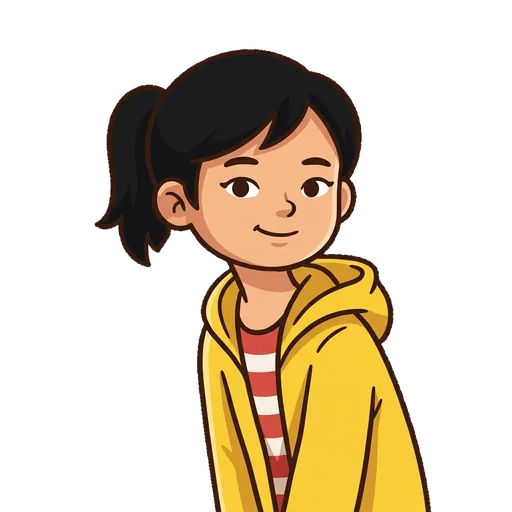 Lan a child of the Green Goes first; makes a friend in a minute
-
 Mark The lines tell you what to do — dashes fold, solid lines cut from CreasePals
-
 Cornelia Bring one corner to meet the other corner, exactly from CreaseTots
-
 Crinkle Smooth a crooked fold out and try again; the crease remembers from CreaseTots
-
 Presso Hold the paper still and press the fold flat so it stays from CreaseTots
-
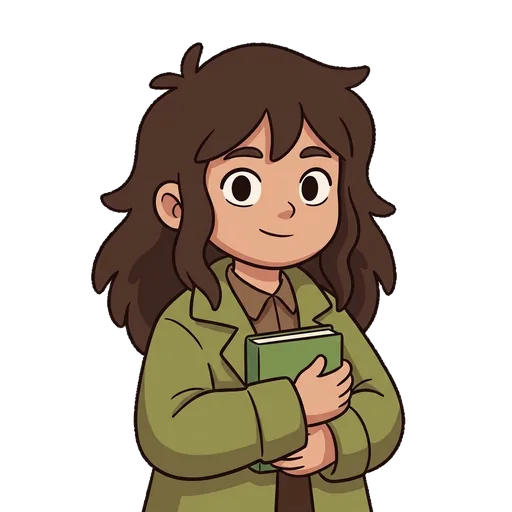 Inkling a child of the Green Names what she notices
Every recurring character has a short tune, so you can tell who is on stage before a word is said. The tunes play only when you tap, and the Reading Access sound switch turns them off.
The Honest Page
Which parts of this story are true, stretched or made up?
True
- On 6 October 1958 Lillian Oppenheimer started a monthly folding lesson in New York, at the Japan Society in Manhattan. Twenty-five people came to the first one. Source
- Her group became the Origami Center. She taught Scouts, Red Cross groups, people in nursing homes and patients in a New York hospital, and she wrote letters to folders all over the world. Source
- She chose the Japanese word origami instead of paper folding, and it became the word most English speakers use. Source
- The paper cup takes five folds: one in half, two corners across, and two flaps down, one in front and one behind.
Stretched
- In our story the woman at the front holds up a paper bird and never comes over to help. What we simplified: We kept the real Lillian Oppenheimer in the background, so Ruth and the cast solve the problem themselves. We do not know what she folded at that first lesson.
- In our story the blackboard shows the steps of the cup. What we simplified: We do not know what was on the walls that day, so we drew our own simple chalk pictures.
Made up
- Ruth, her brother Leo, Joe and the paper door are made up. Kami, Mark, Cornelia, Presso and Crinkle are our own characters.