The Paper Door · Reader · ages 6-8
Listen along
Loading audio…
Read by an AI-generated voice. The words on this page are the transcript.
1. A Spark and a Paper Roof
The hammer rang once. A spark jumped off the anvil and did not go out. It waited. They followed.
It was a bright, gusty morning on the Green. Clouds raced across the sky, and every few minutes the sun came out and went in again, as if somebody were playing with a switch. Lan ran after the spark with her yellow hood bouncing. Inkling walked behind, watching where the spark went instead of just chasing it.
The spark went where it always went. Past the mending shed. Past the bench with the loose plank. Up to the door of the print shop, where it waited, glowing orange, until they let it in.
Inside, the print shop was busy with quiet. The presses stood still. A stack of fresh posters sat drying on the side table, and the room smelled of ink and warm paper. The spark crossed the long table and settled beside a square of paper, orange on one side and cream on the other.
The square sat up.
"Fold me, I won't mind," said Kami.
"Somewhere with a big machine," said Lan. "A really noisy one. With handles and wheels and clanking."
"Then fold me in half," said Kami, "and fold two corners down into a roof."
Inkling folded Kami in half, top edge to bottom edge, so the fold ran along the top. Then she took the top left corner and folded it down towards the middle. She took the top right corner and folded it down to meet it.
There was a little pointed roof, like the roof of a house in a picture book.
"It's a house," said Lan.
"It's the top of something," said Inkling. "I'm not sure what yet."
"Then don't name it too soon," said Kami, and Inkling laughed, because that was exactly the sort of thing she did. She ran her thumb along the folds instead.
The last crease went flat, and the paper opened like a door.
2. The Printing Room
The little roof opened wider and wider, until the inside of it was full of white light.
Lan stepped through first, of course. Inkling came behind her, holding Kami by one corner.
The first thing was the smell. It was ink, but not the clean ink of the print shop on the Green. It was thick, oily ink, mixed with the smell of sawdust and coal smoke and damp stone.
The second thing was the noise. Clunk. Then a long creak. Then clunk again.
They were in a dusty room with one grey window. The light that came through it was thin and cloudy, as if the sky outside had not been washed for a while. In the middle of the room stood a huge black iron press. It was taller than a man and wider than a door, with a long iron handle sticking out of one side. A man in shirt sleeves and a waistcoat was pulling the handle, slowly, with both hands.
Clunk. Creak.
"A big machine," said Lan happily. "With a handle. I said a handle."
"You did," said Kami. "England. London. The year is 1871."
Around the walls stood shelves of paper in tall stacks. On a long wooden bench lay small blocks of wood, each about the size of a book. Inkling went over to look. Every block had a picture cut into its smooth top, with tiny careful lines. But the pictures were all back to front.
"Wait, I can name it," said Inkling, and then stopped herself. She looked properly first. "They're printing blocks," she said. "Somebody draws on the wood. Somebody else cuts away everything that isn't the drawing. Then you put ink on it and press it on paper, and the picture comes out the right way round."
"Very good," said Kami. "Everything in that sentence is true."
Through a half-open door they could see into the next room. It was quieter in there. Five or six men sat at high wooden desks by a long window, each bent over a little block of wood. Each one held a tiny tool, like a very sharp pencil, and moved it so slowly that you could hardly see it move. Every now and then one of them blew on his block, and a puff of wood dust floated up into the light.
"The engravers," said Kami softly. "They cut the pictures. It can take a whole week to cut one little block."
"A whole week?" said Lan. "For one picture?"
"One line wrong," said Kami, "and the whole picture is wrong. So they go slowly."
Lan looked at the men in the next room, and then at the big clanking press, and decided she liked the press better. It was quicker.
On the wall above the bench hung a printed picture, in black and white. It showed a large walrus with a moustache, walking along a beach beside a man. The man wore a square folded paper hat.
3. Nell
A girl about Inkling's age stood by the press. She wore a plain brown dress and a white apron, and she had a smudge of ink on one cheek. She was holding a big sheet of newspaper out in front of her with both hands, frowning at it.
Lan, who was never shy for long, went straight up to her.
"Hello," she said. "I'm Lan. This is Inkling. That's Kami."
Kami waved one corner. The girl did not even blink. In a printing room, odd bits of paper moved about all day.
"I'm Nell," she said. "That's my dad." She nodded at the man at the press.
"What does he do?" asked Inkling.
"He prints proofs," said Nell proudly. "When the engravers finish cutting a block, Dad prints it once, on good paper. Then they can see if every line came out right. If one line is wrong, they cut it again." She lowered her voice. "Tomorrow is the big day. All the pictures for a new book get printed. A storybook. With that walrus in it."
The man at the press straightened up and wiped his forehead. Then he turned round, and they saw his hair.
It was dark brown hair, but it was covered in little black spots, as if he had stood out in a rain of ink.
"Oh," said Lan.
"The ink flies off the rollers," said Nell. "Little drops, everywhere. It takes Mum ages to wash it out. That's why he always wears a paper cap at the press. Everybody does, at the printing works. Look at the picture." She pointed at the man in the folded hat on the wall. "Like that."
"Doesn't he mind?" asked Lan.
"He minds when Mum scrubs it," said Nell. "Last time she used the hard brush, and he said it felt like a hedgehog walking on his head. And on Sundays, at church, people look. One old lady asked him if he had been out in a storm of tadpoles."
Lan giggled before she could stop herself. Nell giggled too, and then the man at the press looked round, and they both pretended to be very busy looking at the wooden blocks.
"So where's his cap?" asked Lan.
"He left it at home on the kitchen table," said Nell. "And it's a long walk, and he can't stop the press. And tomorrow he'll have to print all day, the most important day of the year, and he'll get ink in his hair a hundred times."
"Then make him a new one," said Lan.
Nell held up the newspaper and shook it. It rustled.
"That's the problem," she said. "This is the only paper I'm allowed to use. Yesterday's newspaper. All the good paper is for printing, and Dad counts every sheet. And look at it. It's long. It's not a square."
It was true. The sheet was much longer than it was wide, like a door instead of a window.
"Every fold Kami does starts with a square," said Lan slowly.
"Not every fold," said Kami. "Every fold makes me something new. But not every new thing starts with me."
4. The Scissors
Lan did not quite hear what Kami said, because she had seen the scissors.
They lay on the bench beside the wooden blocks: big, heavy iron scissors, the kind for cutting stacks of paper.
"I'll do it!" said Lan. "I promise. Easy. I'll just cut it square, like Kami, and then we can fold anything we like."
She picked up the scissors with both hands and opened them wide over the end of the newspaper.
"Look where the line stops," said Mark.
Lan froze, with the scissors open.
Mark had appeared beside the bench without a sound, the way he always did, with his pencil behind his ear. He was not looking at Lan. He was looking at the picture on the wall.
"That hat has no cut in it anywhere," said Mark. "No solid line. No stitches. No tape. It's folded all the way. Read the drawing first."
Lan looked at the picture. Then she looked at the newspaper under her scissors. If she cut it, there would be a square on one side and a long, thin, useless strip on the other. And the square would be smaller than the sheet. A much smaller hat.
She closed the scissors very slowly and put them back on the bench.
"I promised before I checked," she said. "Sorry, Nell. I nearly ruined your only paper."
"You didn't, though," said Nell.
"Not all the way through, please," said Kami, who looked quite pale at the thought. "That's my rule. And it's a good rule for newspapers too."
5. Reading the Picture
Mark stood in front of the print of the walrus and the man in the hat. He looked at it for a long time, the way he looked at everything, as if each line were saying something.
"Read the drawing before your hands move," said Mark.
"It's just a picture of a hat," said Lan.
"It's a picture of how a hat is made," said Mark. "Every line on the drawing has a job. Look at the top."
They looked. The top of the hat came up to a point, like a roof.
"That point is made of two corners," said Mark. "Folded down, so they meet in the middle. You can see the line where each one lies."
"Like Kami's roof!" said Lan. "The one we folded to get here."
"Exactly like it," said Mark. "And look at the bottom. There's a band all the way round. A brim, folded up."
Inkling was staring at the picture very hard. She wanted very much to say something clever. But she waited until she was sure.
"If the roof is two corners," she said slowly, "and there's still paper left underneath for a brim, then the sheet has to be longer than it is wide. Folded in half, with the fold at the top."
"That's right," said Mark, pleased.
Nell looked down at the long sheet of newspaper in her hands, as if she had never seen it before.
"So it's the right shape," she said. "It was the right shape all along."
"It's the right shape for a hat," said Kami. "A square makes a cup, or a bird, or a fortune teller. A long sheet makes a hat. Not every fold starts with a square."
6. Edge to Edge
Nell spread the newspaper on the bench, on a clean bit with no ink. Cornelia was already there, sitting very straight, the way she always did.
"Corners first, always," said Cornelia. "But first, edges. Bring the top edge down to the bottom edge. Make them meet exactly."
Nell took the top edge and brought it all the way down. The newspaper was big and floppy, and the edges kept wanting to slide. She held them with her fingertips until they sat exactly on top of each other, the whole way along.
"Point to point, then hold," said Cornelia. "Edges too. Now press."
Nell pressed. The fold ran along the top.
"One fold," said Inkling.
The folded newspaper was still enormous. Nell had to kneel up on the bench to reach the far end of it. A line of tiny print ran across the top, all about the price of coal, and a picture of a horse, upside down.
"It's a big hat," said Lan.
"Newspapers are big," said Nell. "Dad says a printer's newspaper has to be big. One sheet, one hat. If the paper were any smaller, you'd need two."
"Now the top left corner," said Cornelia. "Down to the middle line."
"What middle line?" asked Nell. "There isn't one."
Lan thought about it. Then she folded the sheet in half again from side to side, very lightly, just enough to make a soft mark, and opened it again. There was a faint line down the middle.
"Now there is," said Lan.
"Good," said Cornelia, and Lan glowed.
Nell took the top left corner and folded it down until its edge lay along the middle line. Then she took the top right corner and folded it down to meet the first.
"Three folds," said Inkling.
7. The Leaning Roof
But something was wrong.
The second corner had gone too far. It had slid right over the middle line and on past it, so that it lay on top of the first corner instead of beside it. The point at the top was not in the middle any more. The whole roof leaned over to one side, like a chimney about to fall off a house.
"It looks like it's had too much cake," said Lan.
Nell did not laugh. Her cheeks went pink. "Dad needs it tomorrow," she said. "And I've only got this one sheet. I can't get another."
"Crooked is just a first go," said Crinkle.
Crinkle had been lying in a crumpled heap at the end of the bench, among the scraps, and nobody had noticed. Crinkle was always cheerful about mistakes. Crinkle had made more of them than anybody.
"Open it up gently," said Crinkle. "Smooth it out and try again. The crease remembers."
Nell lifted the second corner back up. Where it had been, there was a crease, a soft line pressed into the newspaper.
"See?" said Crinkle. "That's a crease where you went too far. Now you know exactly how far too far is."
Nell folded the corner down again, slowly this time. She stopped when its edge just touched the middle line, and the two corners sat side by side, meeting in the middle with no gap and no overlap.
The roof stood up straight and sharp.
"We can fix this one," said Crinkle happily. "We did."
8. The Brims
At the bottom of the hat, below the two corners, two long strips of newspaper still stuck out, one in front and one behind.
"Hold it still," said Presso.
Presso was big and slow and calm, and Presso put a corner on the newspaper to keep it from sliding off the bench.
"Now press it flat," said Presso.
Nell took the front strip and folded it up, over the bottoms of the two corners, so it made a band across the front. She ran her thumbnail along it.
"Press slowly, press firmly," said Presso. "Now turn it over."
Nell turned the hat round. She folded the back strip up behind, the same way, and pressed that too.
"A fold you press is a fold that stays," said Presso.
Inkling counted on her fingers. "One fold in half. Two corners. Two brims. Five folds."
"Now open it," said Kami.
Nell put her fingers into the bottom of the hat, between the two brims, and opened it out.
It was a hat. A real paper hat, pointed on top, with a brim all the way round. A little piece of yesterday's news ran across the front, upside down.
Nell held it up to the grey window and turned it round slowly. From the front it was a hat. From the side it was a hat. Even from underneath, looking up into it, it was a hat, a neat little paper tent with a doorway at the bottom for a head.
"I made that," she said quietly, as if she did not quite believe it. "From yesterday's newspaper."
Lan put it on her own head to try it. It came right down over her eyes.
"It's a dad-sized hat," said Inkling.
"Good," said Nell, and took it back.
9. All Afternoon at the Press
"Every fold makes me something new," said Kami. "But a hat has one real test. It isn't enough to look like a hat. It has to stay on while you work."
Nell carried the hat across the room to her father. He was bending over the press, inking the rollers again.
"Dad," she said. "Here."
He looked at the hat. Then he looked at Nell. Then he laughed, a big surprised laugh, and bent his head so she could put it on him.
"Well," he said. "That's a better cap than my old one."
Then he went back to work.
The children sat on a pile of flattened boxes in the corner and watched. All afternoon Nell's father worked the press. He rolled ink onto the block, and tiny black drops flew up. He laid a sheet of paper over it. He pulled the long handle, clunk, creak. He bent right down to look at every proof, so close that his nose nearly touched the paper.
Every time he bent down, Lan held her breath.
The hat did not fall off. Not once. The brim held it tight round his head, and the pointed roof stood up straight, like a little paper tent.
By the time the grey light in the window had turned orange, he had printed a whole stack of proofs. Every one of them had the walrus in it, or the Carpenter, or a girl with long hair looking into a mirror.
Once a boy came in from the engravers' room with a fresh block wrapped in a cloth. Nell's father inked it, printed it, and held the proof up to the window. The boy looked at it carefully, line by line, and nodded, and took the block away again. Nobody said anything about the hat. In the printing room, a paper hat was the most ordinary thing in the world.
Nell kept glancing at her father, just to check. Every time, the hat was still there.
"It's working," she whispered to Inkling. "It's really working."
"Don't name it too soon," said Inkling, smiling. "Wait until he takes it off."
At last he straightened up and took the hat off. Inkling stepped close and looked at his hair before anybody said a word.
The brim was speckled all over with tiny black spots of ink. So was the roof. His hair underneath was clean.
"Now you can name it," said Inkling. "It's a hat that works."
"Look at that," he said, turning the hat round in his inky fingers. "Every drop on the paper, not on me."
10. A Hat on a Nail
Nell's father did not throw the hat away. He hung it on a nail by the press, carefully, by its point.
"For tomorrow," he said. "The big day."
"Will it last?" asked Nell.
"It'll last a day or two," he said. "Then it'll be so inky I'll fold a new one. That's the good thing about paper hats. There's always another newspaper." He winked at her. "Now you know how, you can fold me one every week."
Nell beamed.
Lan looked up at the hat on its nail, and then at the picture of the Carpenter on the wall above it. The two hats were not exactly the same. The Carpenter's hat had a square top, like a box.
"His is different," she said. "It's flat on top."
"That's the same hat, with a few more folds," said Kami. "It starts just like yours. You fold the newspaper hat first, and then you fold the corners in and the point down, and it turns into a box. Every fold makes me something new."
"So the newspaper hat is the start of lots of hats," said Inkling.
"Lots of people's hats," said Kami. "Printers and carpenters and painters. For a hundred years, anybody who got messy at work folded one from the morning paper. I'm still one piece of paper, even when I'm not a square."
Nell took a scrap of newspaper from the bench and began to fold, very small, edge to edge, corners to the middle, brims up. It was a tiny hat, no bigger than a thimble. She put it on the walrus in the picture, right over his head, and they all laughed.
Lan found a plain square in her raincoat pocket. They unfolded it flat, and the door closed behind them.
The spark dimmed to a warm dot and settled back on the anvil. The Green was just the Green again.
Back on the Green
At the print shop, Lan found a long sheet of old paper in the scrap box. She folded a hat from it, edge to edge, corners to the middle, brims up, without cutting a single thing.
She wore it while she inked the rollers. At the end of the day, the brim was spotted with ink, and her hair was clean.
"Now fold one from a square," said Inkling.
"Kami makes cups," said Lan. "Hats come from long sheets. I checked."
Tell the story back to someone. Why didn't Nell cut the newspaper square? And why did the second corner have to stop at the middle line?
Saved. The next chapter will be here whenever you come back.
Who you met
-
 Kami Paper becomes a new shape with every fold, and it only cuts where it is told from CreaseTots
-
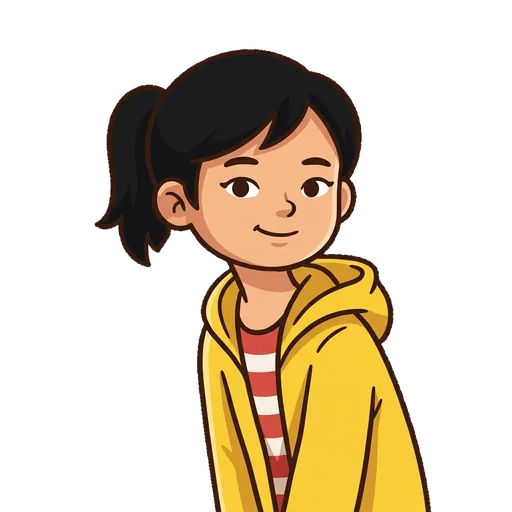 Lan a child of the Green Goes first; makes a friend in a minute
-
 Mark The lines tell you what to do — dashes fold, solid lines cut from CreasePals
-
 Cornelia Bring one corner to meet the other corner, exactly from CreaseTots
-
 Crinkle Smooth a crooked fold out and try again; the crease remembers from CreaseTots
-
 Presso Hold the paper still and press the fold flat so it stays from CreaseTots
-
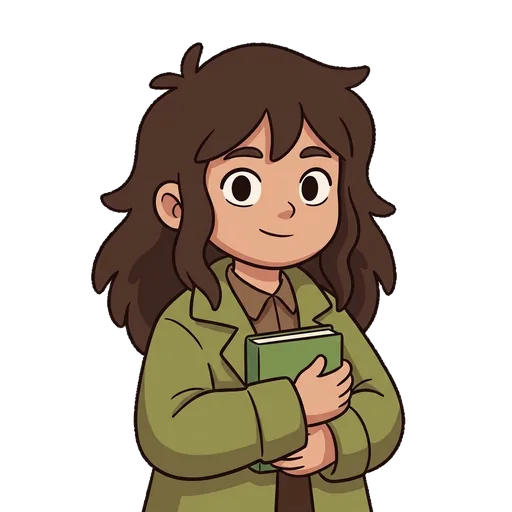 Inkling a child of the Green Names what she notices
Every recurring character has a short tune, so you can tell who is on stage before a word is said. The tunes play only when you tap, and the Reading Access sound switch turns them off.
The Honest Page
Which parts of this story are true, stretched or made up?
True
- In Lewis Carroll's book Through the Looking-Glass, which came out in London at the end of 1871, John Tenniel's picture shows the Carpenter wearing a folded paper hat. Source
- Printers, carpenters, masons and painters wore folded paper hats. Printers wore them to keep ink out of their hair, and could fold a new one when a hat got inky. Source
- The box-shaped printer's hat starts as the simple pointed newspaper hat, folded a few more times. Some workmen's hats were folded from a square, and some from a longer sheet. Source
- Tenniel's pictures were drawn on wood and cut by engravers, the Dalziel brothers, so they could be printed in the book. Source
- The paper hat takes five folds: one in half, two corners down to the middle, and two brims up, one in front and one behind.
Stretched
- In our story the picture of the Carpenter hangs on the wall of a printing room the day before the big printing. What we simplified: We do not know which room printed the proofs, or on which day. Mr Tenniel himself never comes into our story.
- In our story the carpenter's hat is a simple pointed hat. What we simplified: The hat in Tenniel's picture is the box-shaped kind. We kept the simple first part, the newspaper hat, which is where the box hat starts.
Made up
- Nell, her father and the paper door are made up. Kami, Mark, Cornelia, Presso and Crinkle are our own characters.