
Rungo
Graduated sanctions: fair consequences begin gentle and escalate only for repeated or serious rule-breaking
Rungo and the Ladder of Consequences
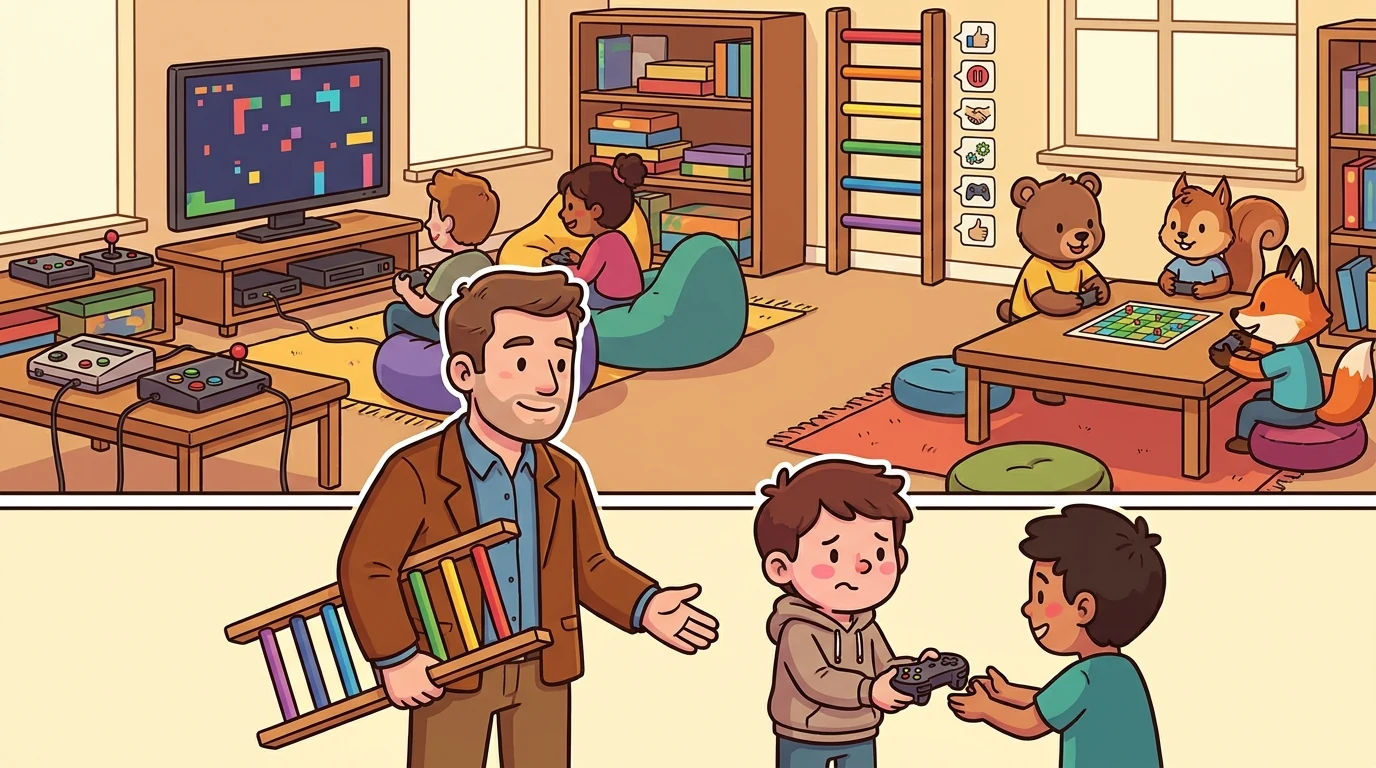
Rungo kept a little painted ladder on the wall of the games club, and he said it was the fairest thing in the room.
The ladder had rungs, bottom to top, and each rung was a consequence — the bottom ones gentle, the top ones serious. When somebody broke a club rule, Rungo did not leap to the top rung. He started at the bottom.
The first time a kid hogged the good controller past their turn, Rungo didn’t ban them or shout. Bottom rung: a friendly reminder. “Hey — your turn’s up, pass it on.” Most of the time, that was the whole story. The kid went pink, passed the controller, and never did it again. One gentle rung, problem solved.
“That’s too soft!” complained a kid who liked harsh punishments. “You should ban rule-breakers on the spot.”
“Ban them for a first, small slip?” Rungo shook his head. “Think about what that teaches. If the tiniest mistake gets the harshest punishment, people get terrified of ever putting a foot wrong — and worse, they stop owning up, because owning up costs the same as a big crime. A gentle first rung says: everyone slips, here’s your chance to fix it, no hard feelings. Most people take that chance. You solve the problem AND you keep the friend.”
But then Rungo pointed higher up the ladder, because there was a second half to being fair. “The ladder has to actually climb, though. If someone hogs the controller once, gentle reminder. Twice, we have a proper chat. Again and again, on purpose? Then we step up — a turn skipped, a cooling-off. A consequence that stays gentle forever, no matter how many times someone tramples the rules, isn’t kind — it’s useless. People learn there’s no real edge, and the rule quietly dies. Fair means the response fits: small for small, and firmer, step by step, for stubborn or serious trouble.”
The club came to love the ladder. First slips felt survivable, so people fixed them and moved on. Repeat trouble met a firmer, but never cruel, step. Nobody got flattened for one bad afternoon, and nobody got away with wrecking things again and again either.
Rungo tapped the bottom rung of his painted ladder, the gentle one, the one he used most. “Start on the bottom rung,” he said. “A small consequence first, a bigger one only if it keeps happening.”
The charterforge ensemble
Rungo is part of charterforge's distributed-narrative cast. Each character embodies a different curricular primitive; together they teach the full subject.