Crux and Ladle
FAIR COMPARISON — comparing two places honestly takes two moves at once: Crux finds where each crowd truly sits (so one giant value can't fake a high average), and Ladle divides by the crowd's size (so a big place doesn't win just for being big). The typical value AND the per-something rate, together, are what make a comparison fair.
Loading audio…
Press play to listen along. The line being read lights up as you go.
Show full transcript
Loading transcript…
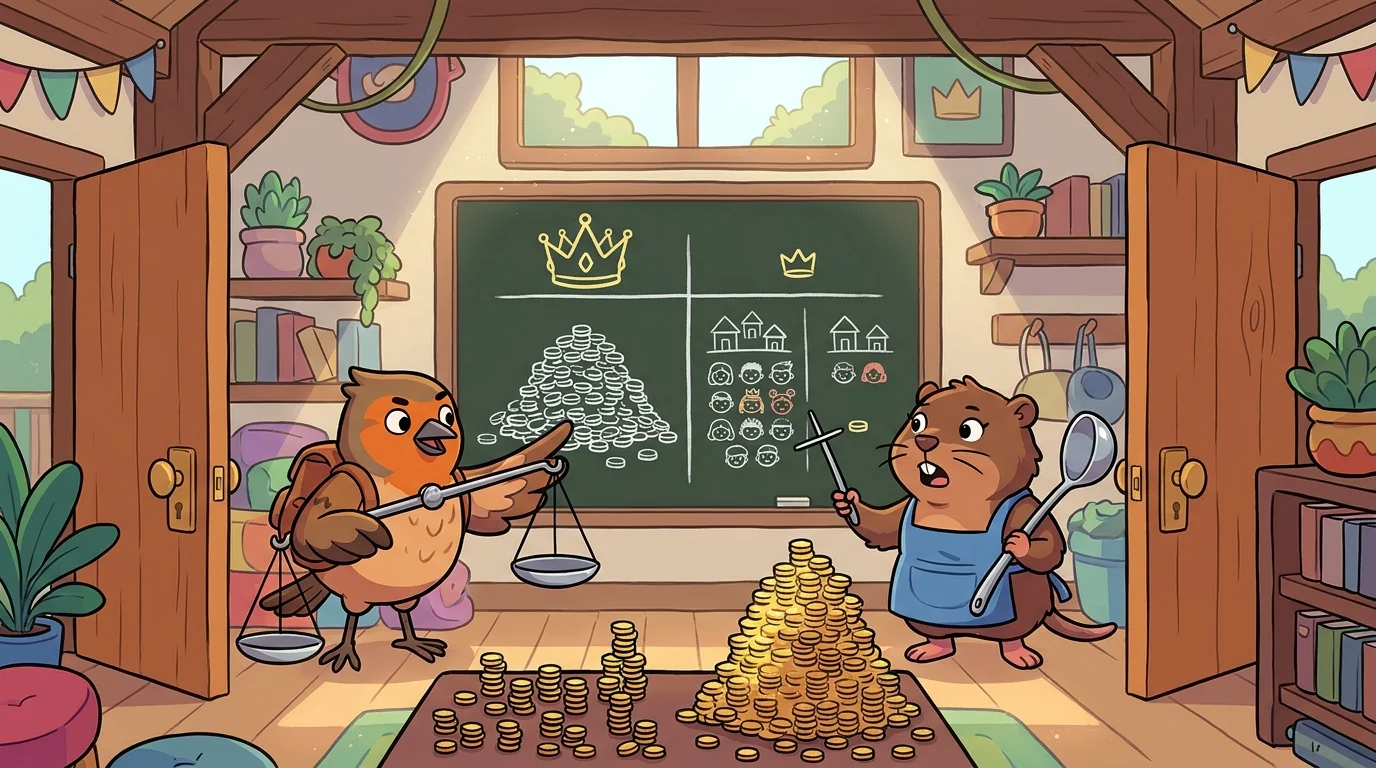
The day the club crowned a town, Crux and Ladle arrived at the same moment from opposite doors, each certain the crown had been handed out wrong.
Crux the chaffinch came in with his balance-beam. Ladle the water vole came in with her ladle. On the board hung the club's verdict: Goldhaven is the most generous town in the valley — it gave nine thousand coins to the harvest fund. Little Brook gave only four hundred. Goldhaven wins.
"That's a lopsided pile," said Crux, laying out Goldhaven's donations in heaps. Almost every heap was tiny — a coin, two coins — except one, from a single wealthy manor, of eight thousand.
"That's an unfair race," said Ladle, chalking each town's size on the board. Goldhaven: ten thousand folk. Little Brook: four hundred.
They looked at each other, then at the board, then at each other again — and each realized their own objection was only half of the problem.
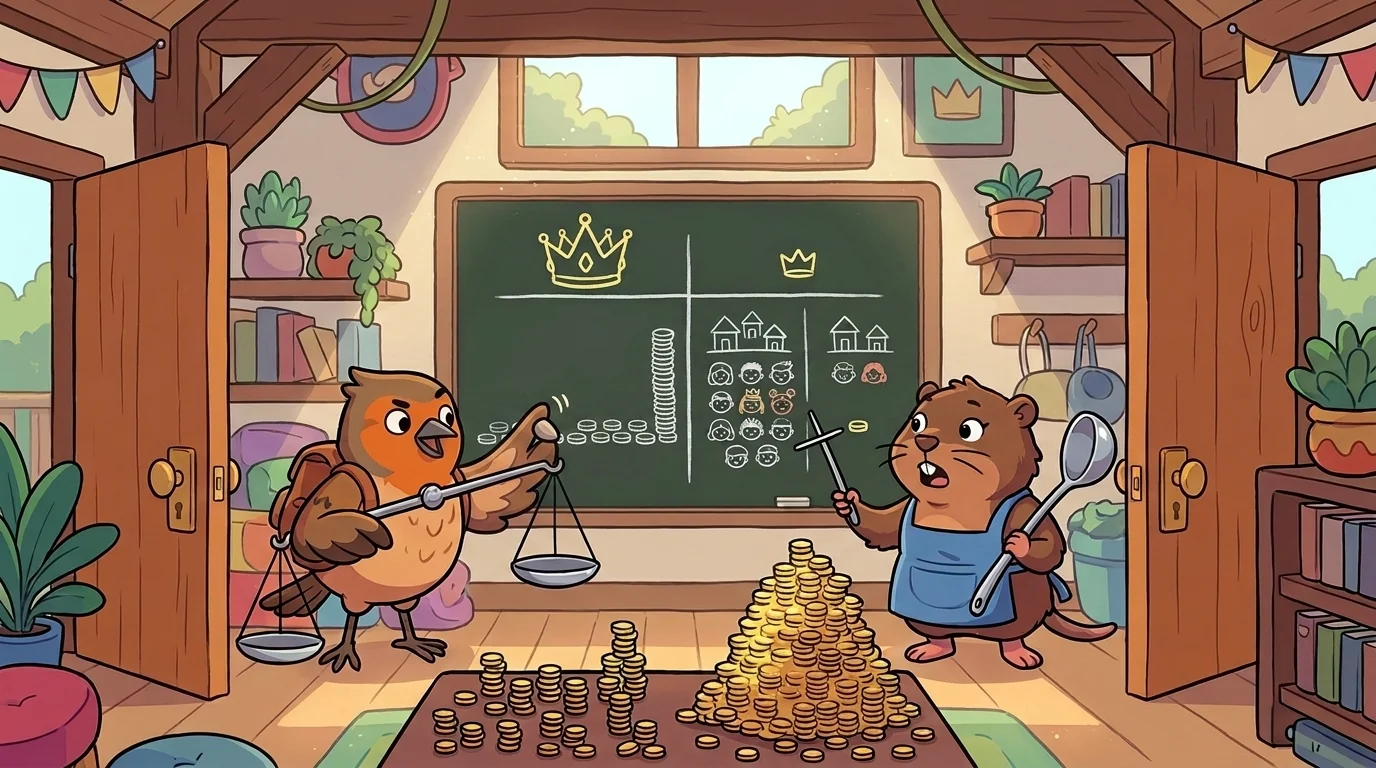
Crux stepped to the board first. "Look at where the giving actually sits in Goldhaven," he said, sweeping a wing down the long row of tiny heaps. "Nine thousand coins, yes — but eight thousand of them came from one manor. The other ten thousand families gave a coin or two apiece. So when the club says 'Goldhaven gave nine thousand,' they make it sound like the whole town opened its heart." He set a pebble at the crowded cluster of little heaps. "The typical Goldhaven family gave almost nothing. One rich manor is standing in front of the town, waving its arms, and the club counted the arm-waving as the town."
He tapped the median heap. "If you want to know a town's heart, don't add up everyone and let the one giant speak. Find where the crowd actually gives. In Goldhaven, the crowd gives one coin."
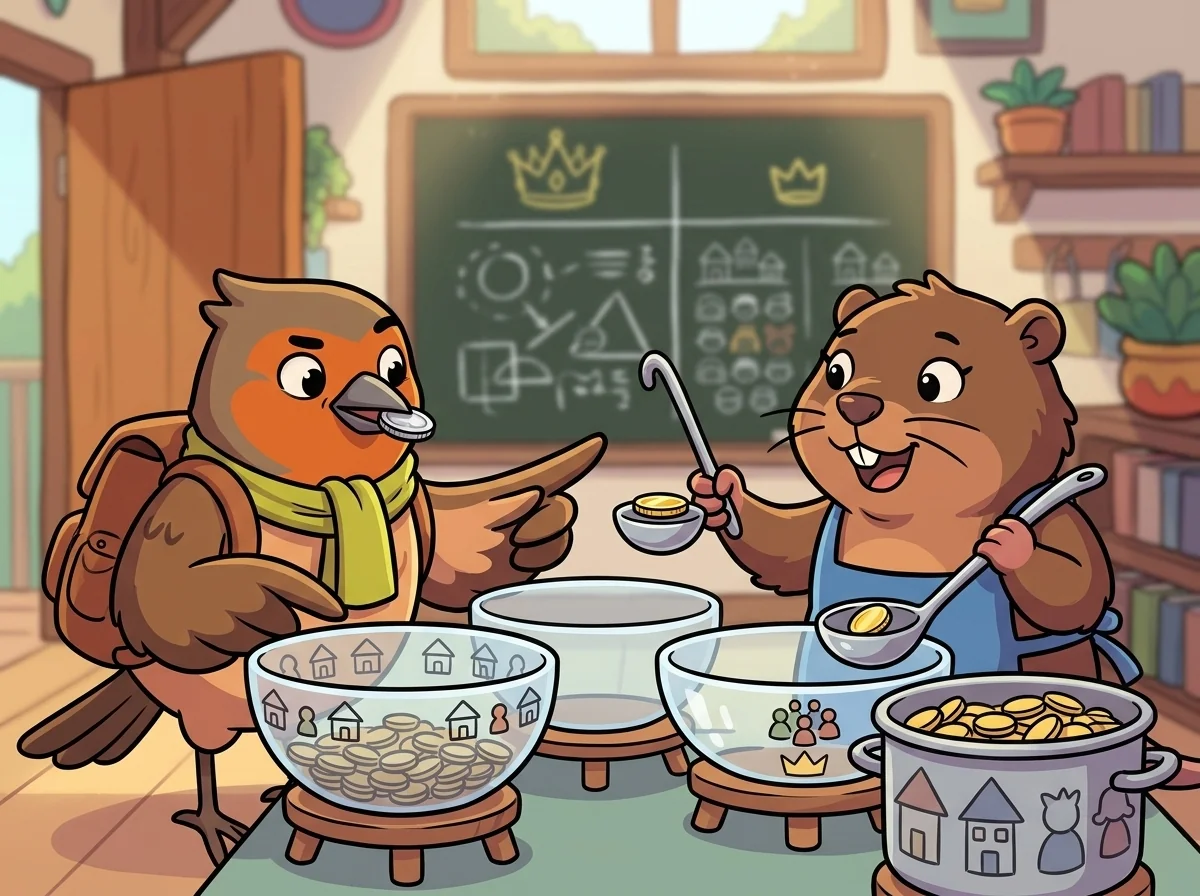
Then Ladle stepped up. "And even that isn't the whole unfairness," she said, filling two bowls of soup, one from a huge pot marked Goldhaven — 10,000 and one from a small pot marked Little Brook — 400. "Goldhaven gave nine thousand coins because Goldhaven has ten thousand people to give them. Little Brook gave four hundred — from only four hundred folk." She ladled each pot into a bowl divided by its own crowd.
"Per person," she said, holding up the two fair bowls, "Goldhaven gave a little under a coin each. And Little Brook gave a whole coin each — every single soul in the village chipped in one." She set the bowls level. "The raw nine thousand is bigger only because the crowd is bigger. Share it out per belly, and Little Brook is the more openhanded town." She looked at the crown on the board. "You didn't measure generosity. You measured how many people Goldhaven has."
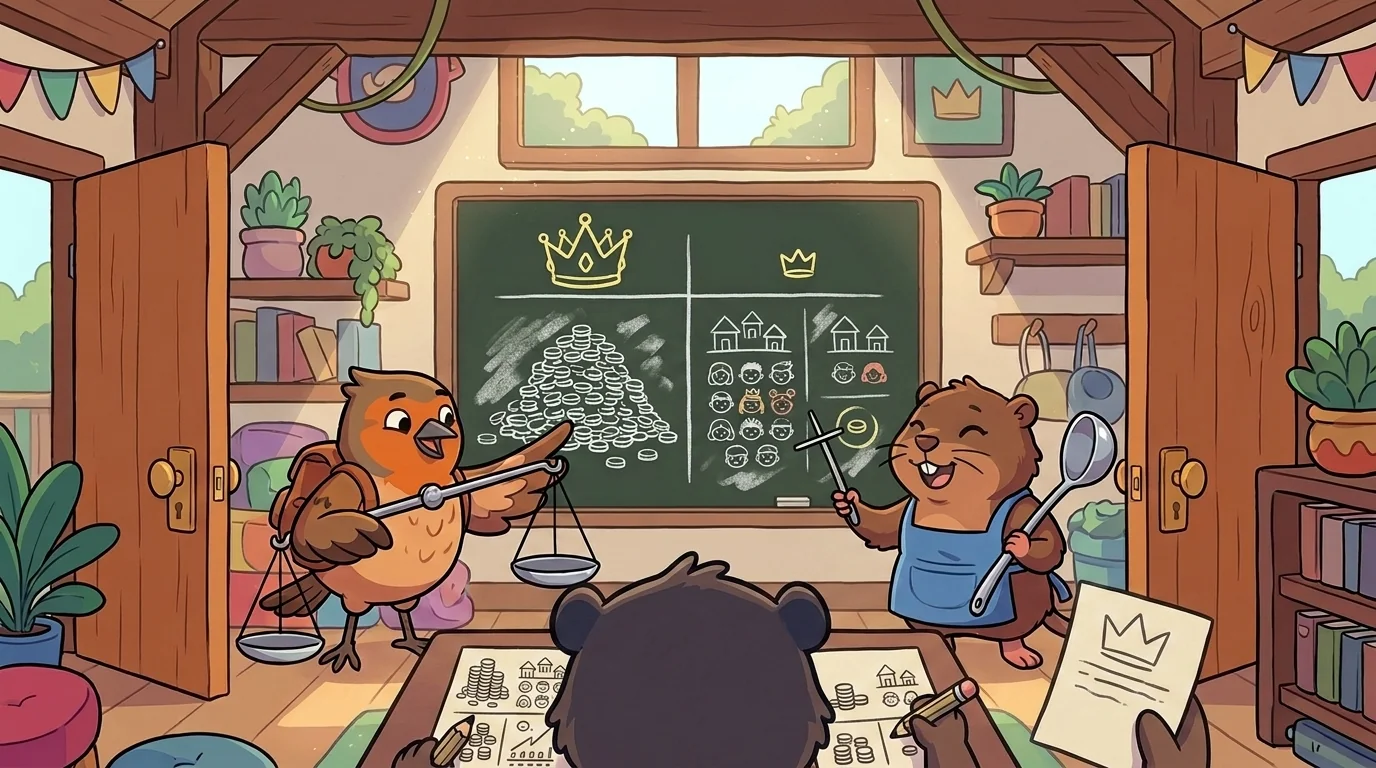
A young otter named Rill had been listening, holding the club's chart and looking worried. "But you two are saying different things," she said. "Crux, you say look at the typical giver. Ladle, you say divide by the town's size. Which one settles it?"
Crux and Ladle looked at each other and, for the first time, smiled the same smile.
"Both," said Crux. "Neither alone."
"Try it," said Ladle, and slid the two towns' full records to Rill. "Do my move first: divide each town's total by its people, so the sizes stop lying. Then do Crux's move: instead of the average giver, find the typical giver — the middle of the pile — so one rich manor can't fake it."
Rill bent to the numbers. First she found the per-person rate: Goldhaven, just under one coin each; Little Brook, one coin each — close, once size was fair. Then she found the typical giver in each: in Little Brook, the middle family had given one coin, same as almost everyone; in Goldhaven, the middle family had given nothing at all — the town's whole nine thousand had come from a handful of manors while the ordinary streets gave little.
Rill sat back, astonished. "So Goldhaven's number is big and lopsided and from a bigger crowd," she said slowly. "Once I fix the size and find the real middle — Little Brook is the town where almost everybody gave. Goldhaven is a town where a few gave a lot and most gave nothing." She looked up. "That's the opposite of what the crown said."
"That's the two moves together," said Crux. "The middle keeps the giants honest."
"And the rate keeps the sizes honest," said Ladle. "One without the other and you'd still be fooled."
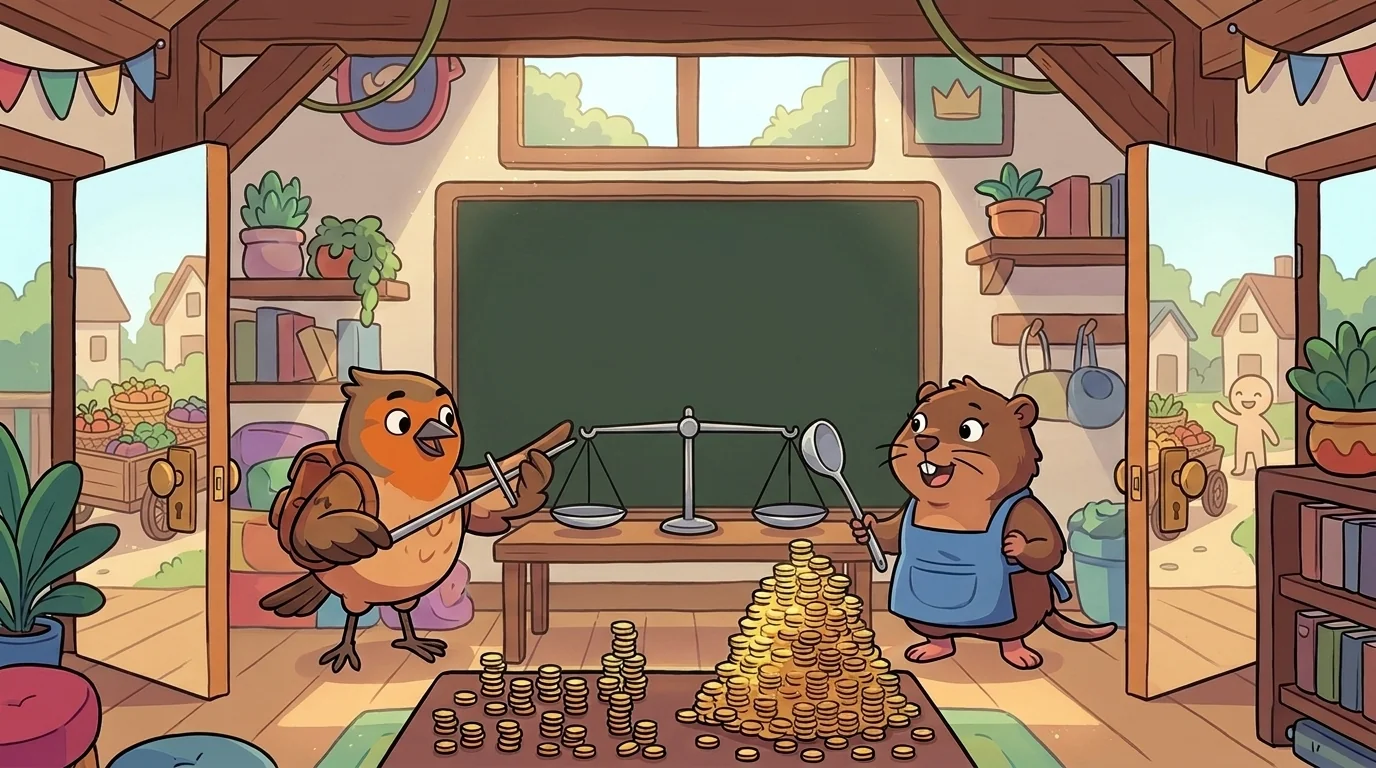
Rill redrew the whole comparison — per person, and by the typical giver, both — and the crown quietly came off Goldhaven and hung, more truthfully, over Little Brook. "It felt so settled before," she said. "One big number, one winner. This took twice the work."
"It took two of us," Crux said, resting his beam beside Ladle's ladle, "because it takes two ideas. A fair comparison is never just the biggest total, and never just the plainest average."
"You almost handed a crown to a town for being large and having a few rich neighbors," Ladle added gently, "and taken it from the town where every soul gave what it had." She nudged the fair bowls toward Rill. "Now nobody who reads this will mistake a big lopsided number for an open heart."
Rill looked at the two towns, seen fairly at last, and felt something settle warm in her chest — not the thrill of crowning a winner, but the steadier gladness of having been fair to a small place that deserved it. Outside, the harvest carts rolled in from both towns together, and Crux and Ladle walked out side by side, the beam and the ladle swinging, each glad the other had come in the opposite door that morning.
The DataForge ensemble
Crux and Ladle is part of DataForge's distributed-narrative cast. Each character embodies a different curricular primitive; together they teach the full subject.
-

Catch
Data collection — who-what-why-when posture (every dataset has a collector + purpose + omissions)
-

Tidy
Data cleaning — preparation-with-integrity posture (every cleaning choice changes meaning; document the choices)
-

Graph
Data visualization — shape-of-the-story posture (which chart tells the truth, not the loudest one)
-

Tell
Interpretation — correlation-not-causation posture (data shows patterns; humans interpret; confidence not certainty)
-

Guard
Data ethics — bias-privacy-harm-consent posture (who benefits, who's harmed, who decided; structurally present in every kit from kit 6)
-

Crux
Summary — honest-middle posture (which middle tells the truth: mean, median, or mode; one giant value drags the average away from where most of the crowd actually sits)
-
Cull
Representative sampling — fair-sample posture (a sample must mirror the whole; who gets left out silently bends the story)
-

Ladle
Rates & fair comparison — like-for-like posture (compare rates and fair portions, not raw totals; a bigger pot isn't a bigger share)
-

Stray
Reading the outlier — the-one-that-doesn't-fit posture (an outlier is a question to ask, not noise to delete; find out why before you drop it)
-

Waver
Uncertainty & margin — confidence-not-certainty posture (every estimate carries a margin of error; show the wobble honestly instead of hiding it)