Stray
OUTLIER — *the odd point is a question, not a mistake* (before you erase the value that doesn't fit, ask whether it's a slip of the pen or a real thing worth chasing). The habit of pausing on the point that stands apart instead of quietly deleting it.
Loading audio…
Press play to listen along. The line being read lights up as you go.
Show full transcript
Loading transcript…
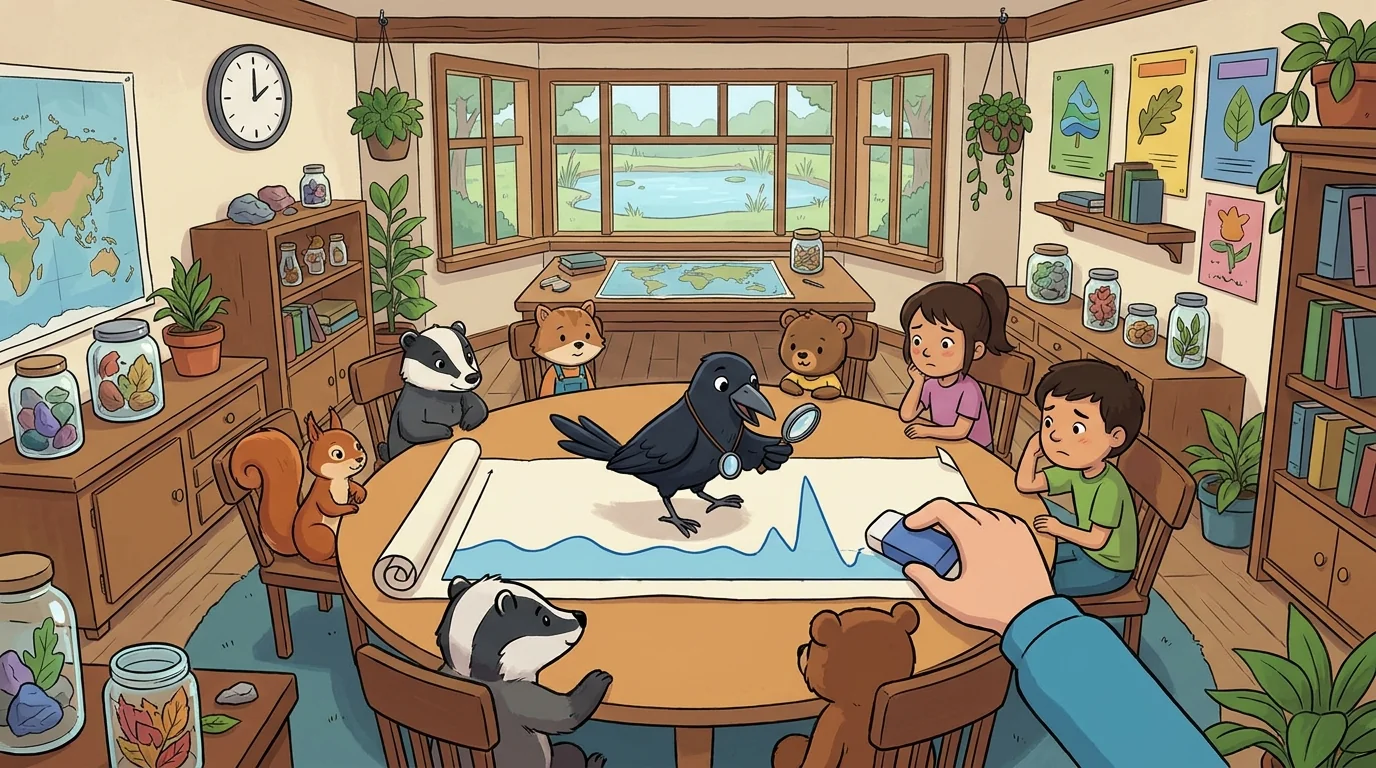
The morning the club smoothed out a bump in their chart, Stray was the only one who flew down to see what the bump had been.
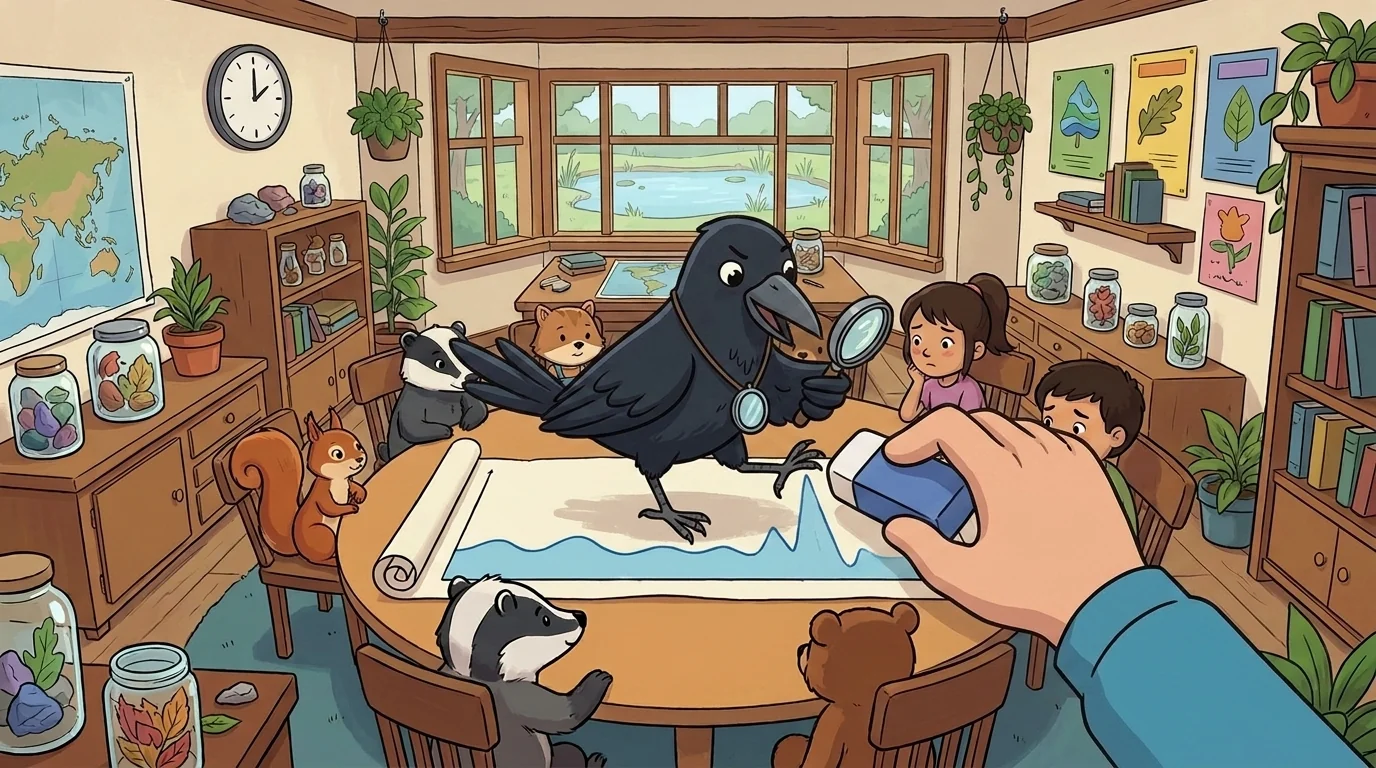
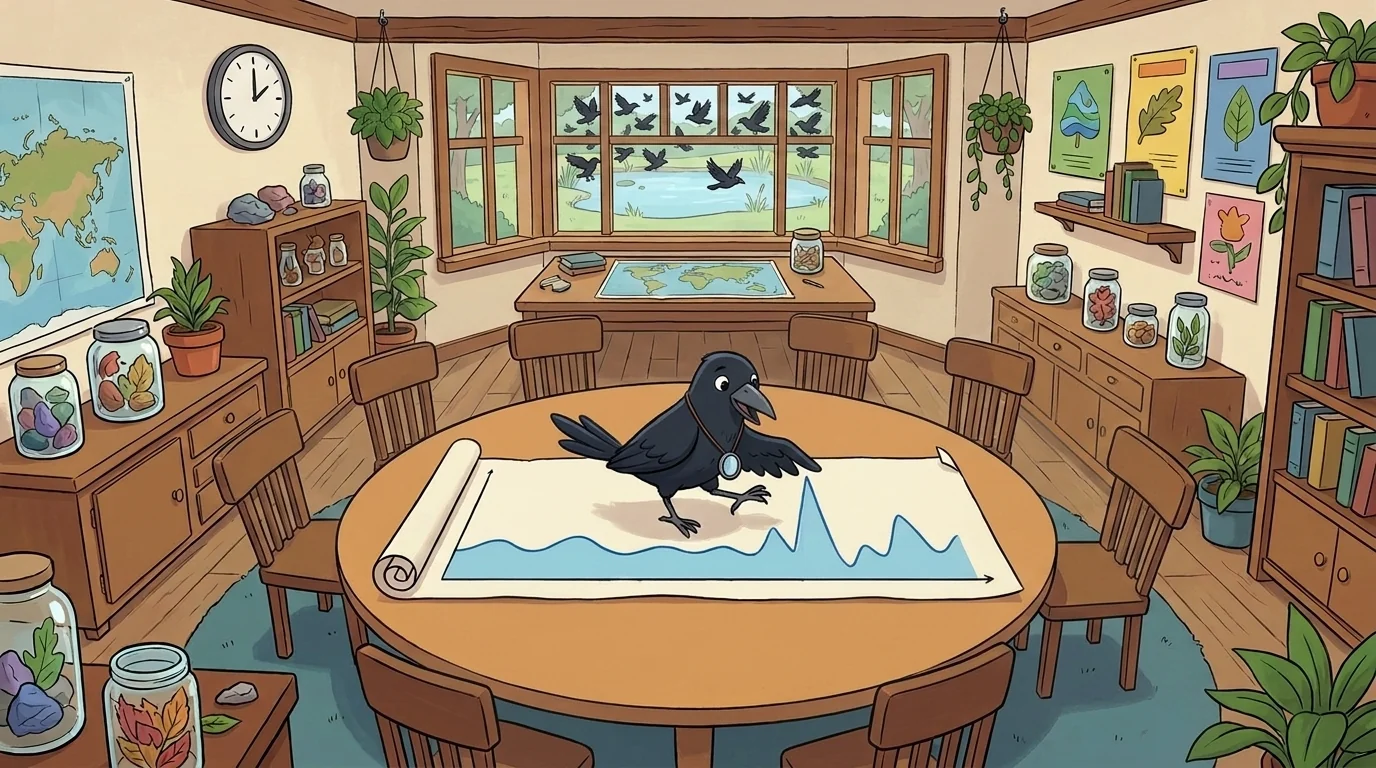
He was a crow, sleek and black with a knowing eye, and he carried a little lens on a cord around his neck. The club had drawn a tidy line of the pond's water level, month by month, and one month poked far above the rest — a sharp spike in a smooth season. "A mistake in the measuring," someone said, and reached to erase it. "Let's just smooth it into the line."
Stray hopped between the pencil and the page. "Wait," he said. "Before you rub it out — what if it isn't a slip? What if the water really did leap that month?" He lowered his lens over the spike. "An odd point is a question first. It might be a mis-copied number, yes. Or it might be the most interesting thing on the whole chart — a storm, a burst dam, something real that everyone would want to know." He tapped the spike gently. "Erase it and you might be tidying away the truth. Chase it, and you find out which it is."
The room hesitated, the eraser hovering. Stray felt the sharp curiosity he always felt when a point stood apart — not annoyance at the mess, but a pull toward the mystery in it.
Stray learned about odd points long before he learned about charts.
He grew up among the rook-parliament in the tall elms, and his mother was the one the flock sent to investigate anything strange — a scarecrow that moved, a field that glittered, a sound no one could place. When Stray was young, he watched her fly toward a distant flash the others were ignoring.
"Everyone else is staying put," he called. "Why go look?"
"Because everyone else decided it was nothing without checking," she called back. "The odd thing is where the news is." When she returned, she'd found a spill of grain from a broken cart — a feast the whole flock had nearly missed by shrugging off the flash. "A crow who ignores what doesn't fit," she told him, "misses every discovery and every danger both. The strange point is the one worth your eye."
But she taught him the other half too. Another day, a "strange" glint turned out to be a shard of broken glass, nothing at all. "Sometimes the odd thing is only odd," she said. "So you look — and then you know. You don't have to keep it or throw it before you've seen what it is."
Stray never forgot either half. Years later, over a chart with a spike in it instead of a field with a flash, he would think: the point that doesn't fit is a question. Go and answer it before you decide.
When he was grown, Stray flew to the DataForge academy, his lens swinging at his chest.
At the door stood Datum, who ran the academy. "Show me what you do with the value that doesn't belong," Datum said.
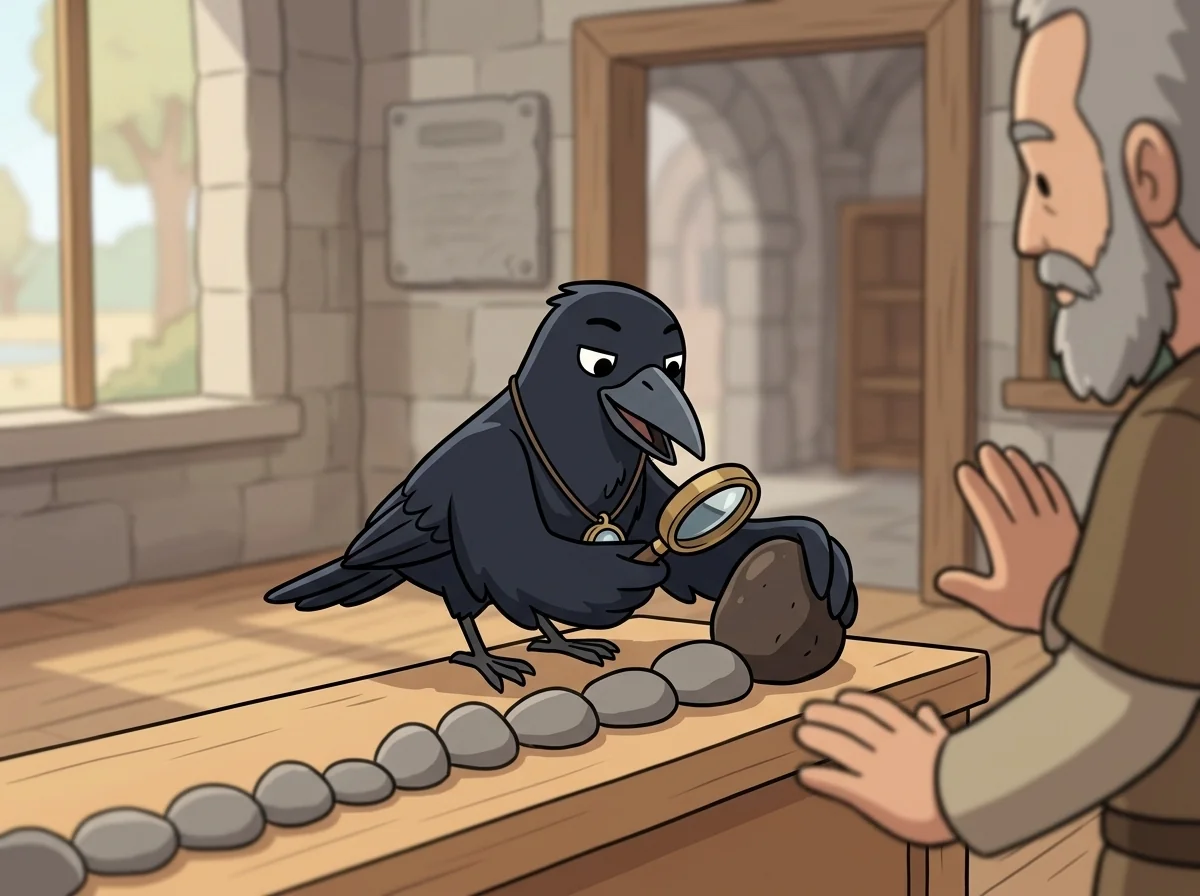
Stray didn't recite. He laid out a neat row of pebbles, evenly sized — and one enormous one at the end. Instead of sweeping the big one away, he raised his lens over it, turned it, examined it, and then set it either back in the row or firmly aside, depending on what he found.
"When a point stands far off from the rest," Stray said, "I don't erase it and I don't trust it — I look at it. Where did it come from? Is it a copying slip, a broken instrument, a decimal in the wrong place? Then it's a mistake to fix. Or is it a real, rare, true thing — a record flood, a prodigy, a genuine surprise? Then it's the most important point on the page." He set the big pebble deliberately. "The one thing I never do is quietly smooth it away. That's how the truth gets tidied out of the picture."
Datum studied the big pebble, set apart but not discarded. "Then always look before you smooth," Datum said, and stepped aside to let him in.
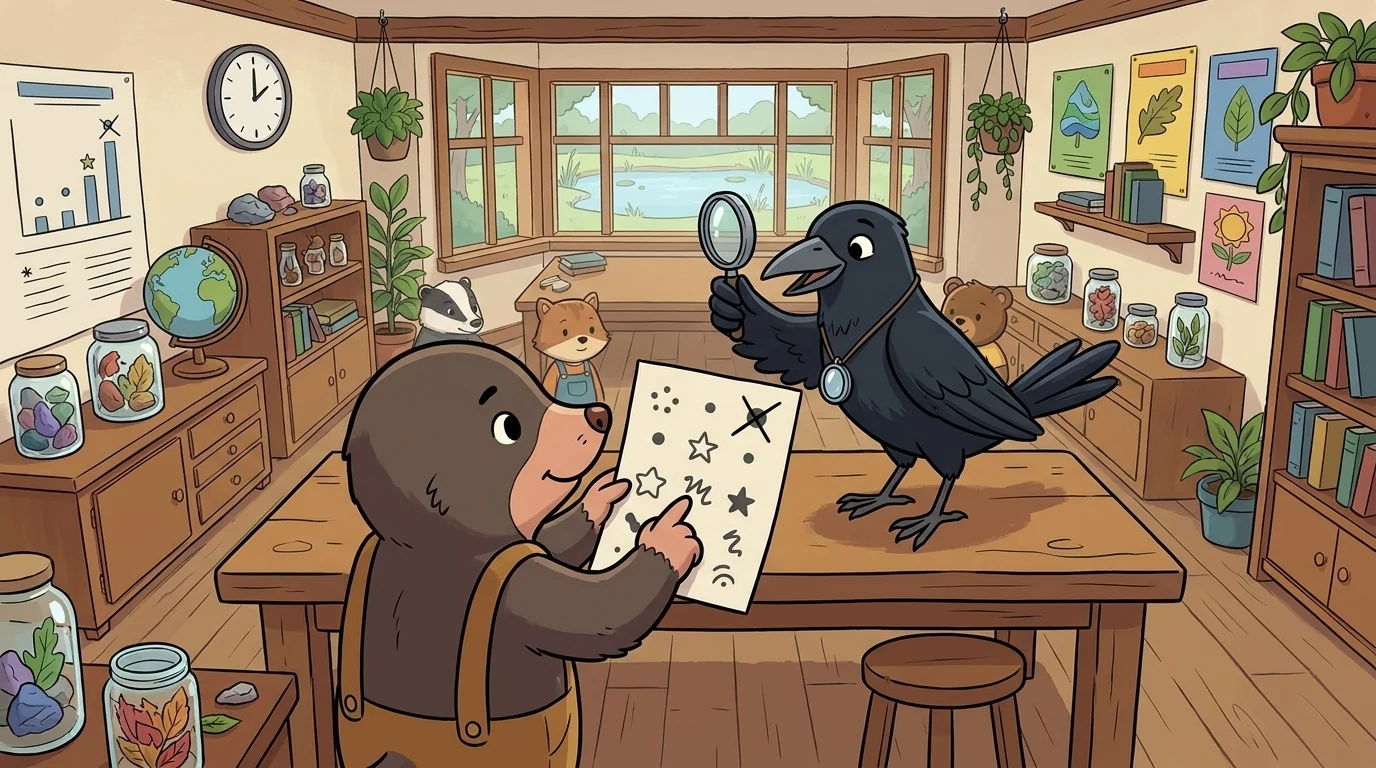
In Stray's workshop, a young mole named Digby brought a chart of test scores. "Everyone got around fifty," he said, "except one score of ninety-eight. I dropped it — it was throwing off my average."
Stray raised his lens. "Dropped it where?"
"Crossed it out. It didn't fit."
Stray's eye went keen. "Before we agree — who got the ninety-eight?"
Digby checked his notes. "A new student. Only joined last week."
"So the odd point is a real creature who really answered," Stray said gently. "Maybe she'd studied this exact thing before. Maybe she's found a way of learning the others could use. Maybe — check this — the paper was marked wrong." He tapped the crossed-out score. "You erased her because she didn't match. But she might be the whole story: how did one new student score so far above the rest?" He nudged the lens toward Digby. "Fix the odd point if it's an error. Chase it if it's real. But never delete it just for standing out. Standing out is a clue, not a crime."
Digby looked at the crossed-out ninety-eight, and slowly rubbed the crossing-out away. "I'll go ask her how she did it," he said.
When Digby came back, he'd found the new student had simply loved this subject for years — a real, honest, fascinating point, not an error at all. "I nearly rubbed out the best thing on the page," he admitted, "just because it made my line untidy."
"That's the danger of tidiness," Stray said. "It's so satisfying that we forget it can hide the truth." He tapped the restored score. "Now nobody who reads this will lose the surprise that made it worth reading."
He let his lens fall back against his chest, and something in him settled — not smooth, exactly, but bright and awake, the pleasure of a mystery met instead of erased. Over the elms the rook-parliament would wheel and call, always sending one of their number toward whatever didn't fit, and Stray felt keen and glad, certain that the point standing apart is the one that most repays a closer look.
The DataForge ensemble
Stray is part of DataForge's distributed-narrative cast. Each character embodies a different curricular primitive; together they teach the full subject.
-

Catch
Data collection — who-what-why-when posture (every dataset has a collector + purpose + omissions)
-

Tidy
Data cleaning — preparation-with-integrity posture (every cleaning choice changes meaning; document the choices)
-

Graph
Data visualization — shape-of-the-story posture (which chart tells the truth, not the loudest one)
-

Tell
Interpretation — correlation-not-causation posture (data shows patterns; humans interpret; confidence not certainty)
-

Guard
Data ethics — bias-privacy-harm-consent posture (who benefits, who's harmed, who decided; structurally present in every kit from kit 6)
-
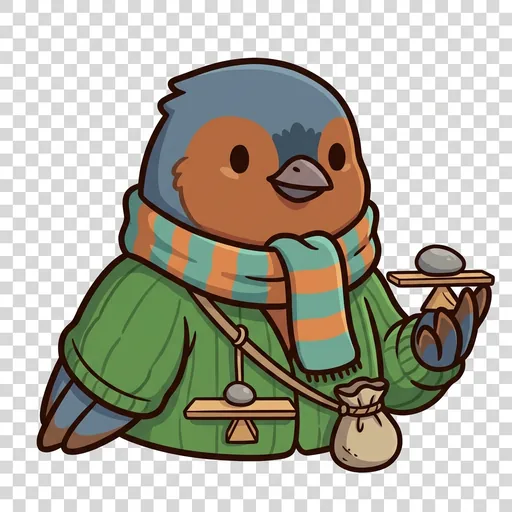
Crux
Summary — honest-middle posture (which middle tells the truth: mean, median, or mode; one giant value drags the average away from where most of the crowd actually sits)
-
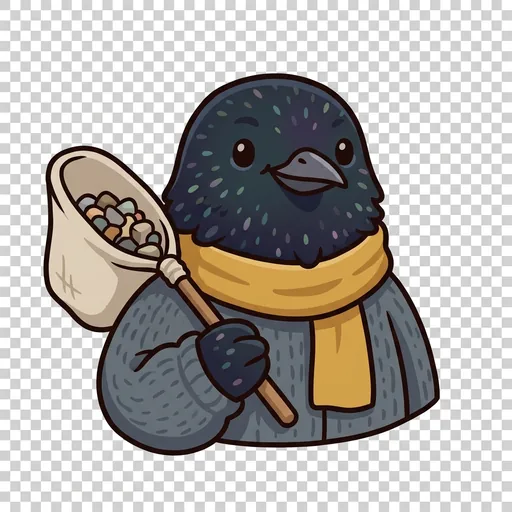
Cull
Representative sampling — fair-sample posture (a sample must mirror the whole; who gets left out silently bends the story)
-

Ladle
Rates & fair comparison — like-for-like posture (compare rates and fair portions, not raw totals; a bigger pot isn't a bigger share)
-
Waver
Uncertainty & margin — confidence-not-certainty posture (every estimate carries a margin of error; show the wobble honestly instead of hiding it)