Ladle
RATE — *out of how many?* (a raw count means little until you divide it by the crowd it came from; a big number from a big place can be a small share). The habit of turning a total into a per-something rate before you compare.
Loading audio…
Press play to listen along. The line being read lights up as you go.
Show full transcript
Loading transcript…
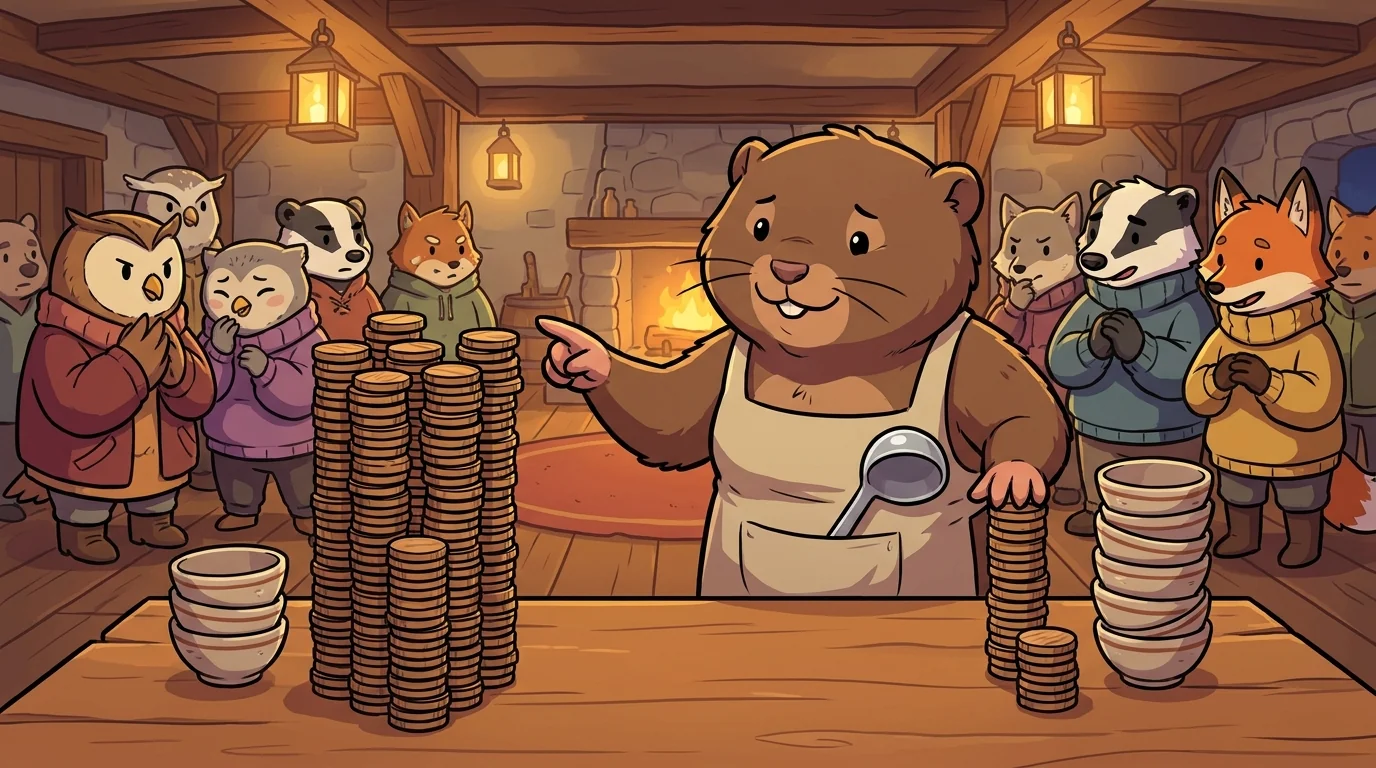
The evening the club declared one town hungrier than another, Ladle was the only one who asked how many mouths each pot had to feed.
She was a water vole, round and sensible, with dense brown fur and neat paws, and she wore an apron with a big ladle tucked in the pocket. The club had counted the free meals given out in two towns and posted the result: Bigby gave out three thousand meals; Little Thorn gave out three hundred. Bigby cares ten times more. Everyone murmured approval of Bigby.
Ladle didn't murmur. She pulled out her ladle and set it on the table beside the two numbers. "Three thousand meals," she said. "Out of how many people?"
Somebody checked. "Bigby has thirty thousand folk. Little Thorn has three hundred."
Ladle nodded slowly and did the sums with her paw. "So Bigby served three thousand meals to thirty thousand people — one meal for every ten. And Little Thorn served three hundred meals to three hundred people — one meal for every single person." She tapped Little Thorn's number. "The raw count is bigger in Bigby because Bigby is bigger. But share it out per mouth, and Little Thorn fed a far larger part of itself." She set the ladle down. "You didn't compare kindness. You compared crowd size, and called the bigger crowd kinder."
The room went still, redoing the division. Ladle felt the steady warmth she always felt when a number had been set beside the crowd it belonged to.
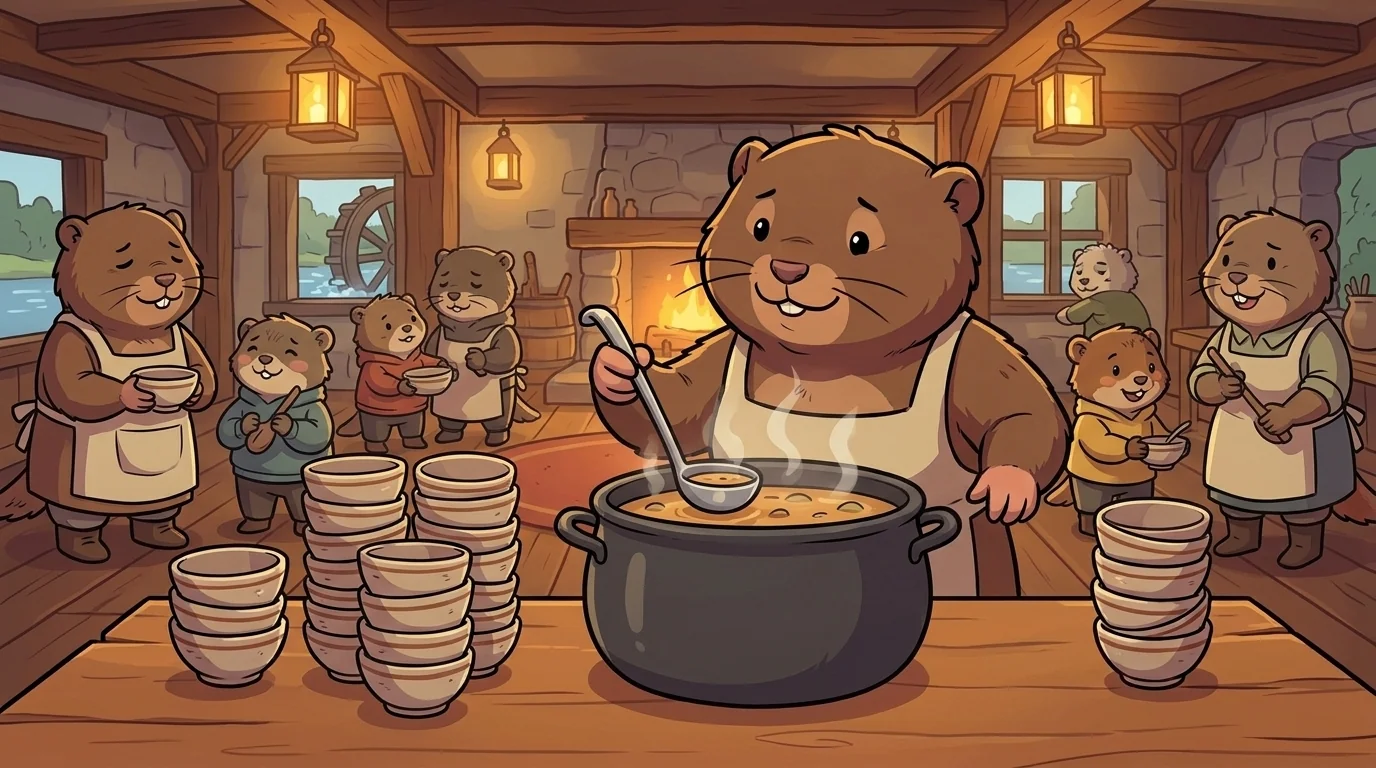
Ladle learned about fair bowls long before she learned about statistics.
Her family ran the harvest kitchen by the millpond, water voles who cooked one great pot of soup for the whole working-party at the end of each day. When she was small, she carried bowls, and one evening she boasted to a tired field-mouse, "Ours is the biggest pot on the river! Look how much soup!"
Her grandmother took her aside. "Big pot," she agreed. "How many bellies is it for?"
"Everyone. The whole party."
"And the little kitchen at Reed Corner — small pot, yes? For how many?"
"Just the six of them."
Her grandmother handed her the ladle. "Then dip our great pot and Reed Corner's little pot, and tell me which feeds each creature more." Ladle did the arithmetic on her fingers and found, to her surprise, that Reed Corner's small pot gave each of its six a deeper bowl than the great pot gave each of its hundred.
"The size of the pot isn't the kindness," her grandmother said. "The size of the bowl each belly gets is the kindness. Always ask how many mouths before you crow about the pot."
Ladle never forgot it. Years later, over a page of totals instead of a pot of soup, she would think: a big number from a big place can still be a thin bowl. Divide it by the mouths.

When she was grown, Ladle walked to the DataForge academy, her ladle in her apron pocket.
At the door stood Datum, who ran the academy. "Show me how you compare two places fairly," Datum said.
Ladle didn't recite. She set out two pots — one huge, one small — and filled each with the same soup. Then, instead of pointing at the bigger pot, she ladled one bowl from each, divided by the number of eaters chalked on each pot's side, and set the two fair bowls next to each other.
"When I compare two places," Ladle said, "I never trust the raw total — the total just tells me which place is bigger. I divide by the crowd: meals per person, cases per hundred, coins per family. Only then are the two bowls the same size and the comparison fair." She held the two bowls level. "A rate turns 'more' into 'more for each,' which is the only 'more' that's fair to compare across a big place and a small one."
Datum looked at the two level bowls. "Then serve them fair," Datum said, and stepped aside to let her in.
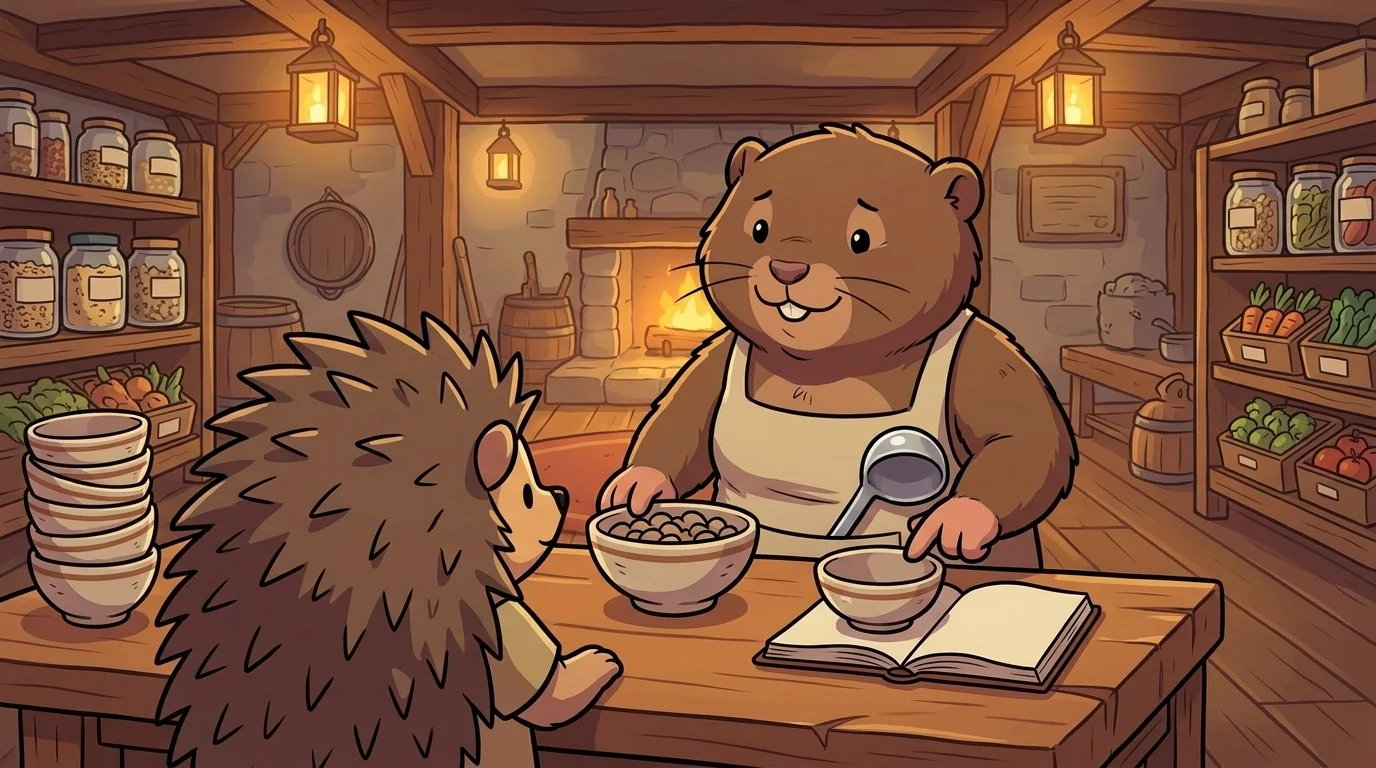
In Ladle's workshop, a young hedgehog named Bramble came in cross. "The city has way more thieving than our village," he said. "A hundred thefts last month! We only had four. Cities are wicked."
"Let's ladle it out," said Ladle kindly. "How big is the city?"
"Huge. A hundred thousand folk, maybe."
"And our village?"
"About two hundred."
Ladle set two bowls on the bench and divided. "A hundred thefts among a hundred thousand people — that's one theft for every thousand. Four thefts among two hundred — that's one for every fifty." She slid the bowls together. "Per person, our village had more thieving than the city, not less. The city's big number is big because the city is big." She tapped his page. "You felt the hundred and stopped. But a hundred out of a hundred thousand is a thin bowl."
Bramble's spines settled. "So the raw counts fooled me."
"They fool everyone," Ladle said. "That's why the first question is never 'how many' — it's 'how many, out of how many.'" She nudged the ladle toward him. "Two places can only be compared once each number has been set beside its own crowd."
Bramble rewrote his note as rates, and the city stopped looking wicked and started looking simply large.

When Bramble was done, he looked at the two fair bowls. "I nearly told the whole village the city was rotten," he admitted. "It felt so obvious."
"The raw count always feels obvious," Ladle said. "That's what makes it dangerous." She tapped the two level bowls. "Now nobody who reads this will fear a place just for being big, or praise one just for being small."
She slid her ladle back into her apron, and something in her chest went round and warm — the settled feeling of two numbers finally standing beside their own crowds, fair at last. The great harvest pot back home would steam over the millpond, one deep bowl for every belly, and Ladle felt easy and content, glad she'd learned young that the pot is never the kindness — the bowl each creature gets is.
The DataForge ensemble
Ladle is part of DataForge's distributed-narrative cast. Each character embodies a different curricular primitive; together they teach the full subject.
-

Catch
Data collection — who-what-why-when posture (every dataset has a collector + purpose + omissions)
-

Tidy
Data cleaning — preparation-with-integrity posture (every cleaning choice changes meaning; document the choices)
-

Graph
Data visualization — shape-of-the-story posture (which chart tells the truth, not the loudest one)
-

Tell
Interpretation — correlation-not-causation posture (data shows patterns; humans interpret; confidence not certainty)
-

Guard
Data ethics — bias-privacy-harm-consent posture (who benefits, who's harmed, who decided; structurally present in every kit from kit 6)
-

Crux
Summary — honest-middle posture (which middle tells the truth: mean, median, or mode; one giant value drags the average away from where most of the crowd actually sits)
-

Cull
Representative sampling — fair-sample posture (a sample must mirror the whole; who gets left out silently bends the story)
-

Stray
Reading the outlier — the-one-that-doesn't-fit posture (an outlier is a question to ask, not noise to delete; find out why before you drop it)
-

Waver
Uncertainty & margin — confidence-not-certainty posture (every estimate carries a margin of error; show the wobble honestly instead of hiding it)