Thrust
Every engine just throws air the wrong way
Loading audio…
Press play to listen along. The line being read lights up as you go.
Show full transcript
Loading transcript…
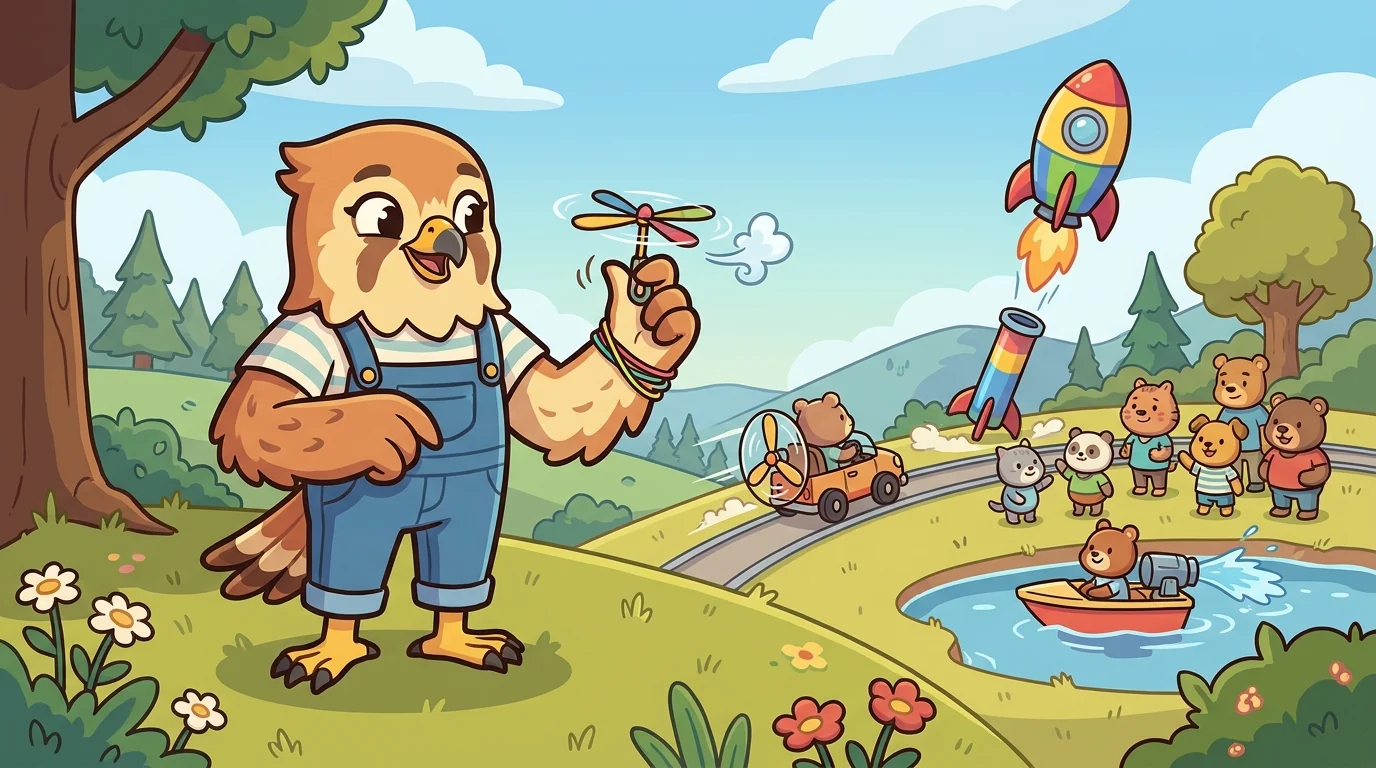
Thrust is a kestrel-tween — warm tawny-and-cream feathers, broad shoulders — with a little rubber-band propeller-toy clipped to her wrist, always whirring-ready.
Thrust loves engines more than anything, and she insists they all do the same one trick. "Every engine just throws air the wrong way," she says. "Propeller, jet, rocket — same trick, different scale." That's her whole craft: propulsion. Wind the rubber band tight, flick your thumb, and the propeller spins and throws air backward — so the toy zips forward. That's thrust, and it's Newton's third law: push something backward, and you go forward, like pushing off a wall. "Engines aren't scary or complicated," she says. "They just do that one simple trick in fancier and fancier ways."
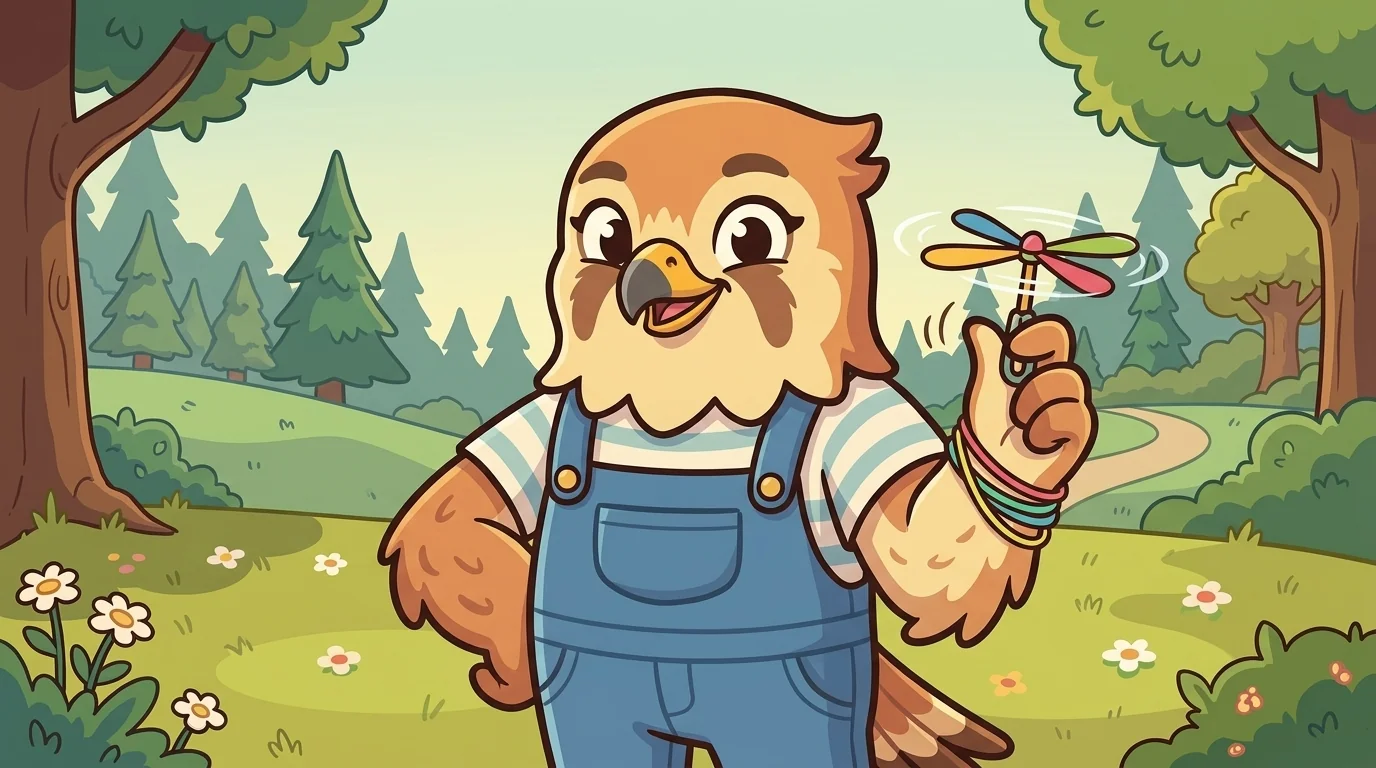
Thrust learned that the fancy machines aren't out of reach — but it took her a while to believe it.
"When I was little, I felt tiny next to the giant festival kites my family launched," she says. "They seemed like magic, way beyond me." Then she understood the throw — that the huge kite and the tiny toy obey the very same rule — and the smallness shrank. "A propeller is spinning blades pushing air like tiny hands; a jet burns fuel to blast hot gas out the back; a rocket throws its own fuel backward because there's no air to grab in space. Different machines — identical physics."
"Once you see it's all one trick," she says, "nothing is too big to understand. It's just the toy on my wrist, thrown bigger."
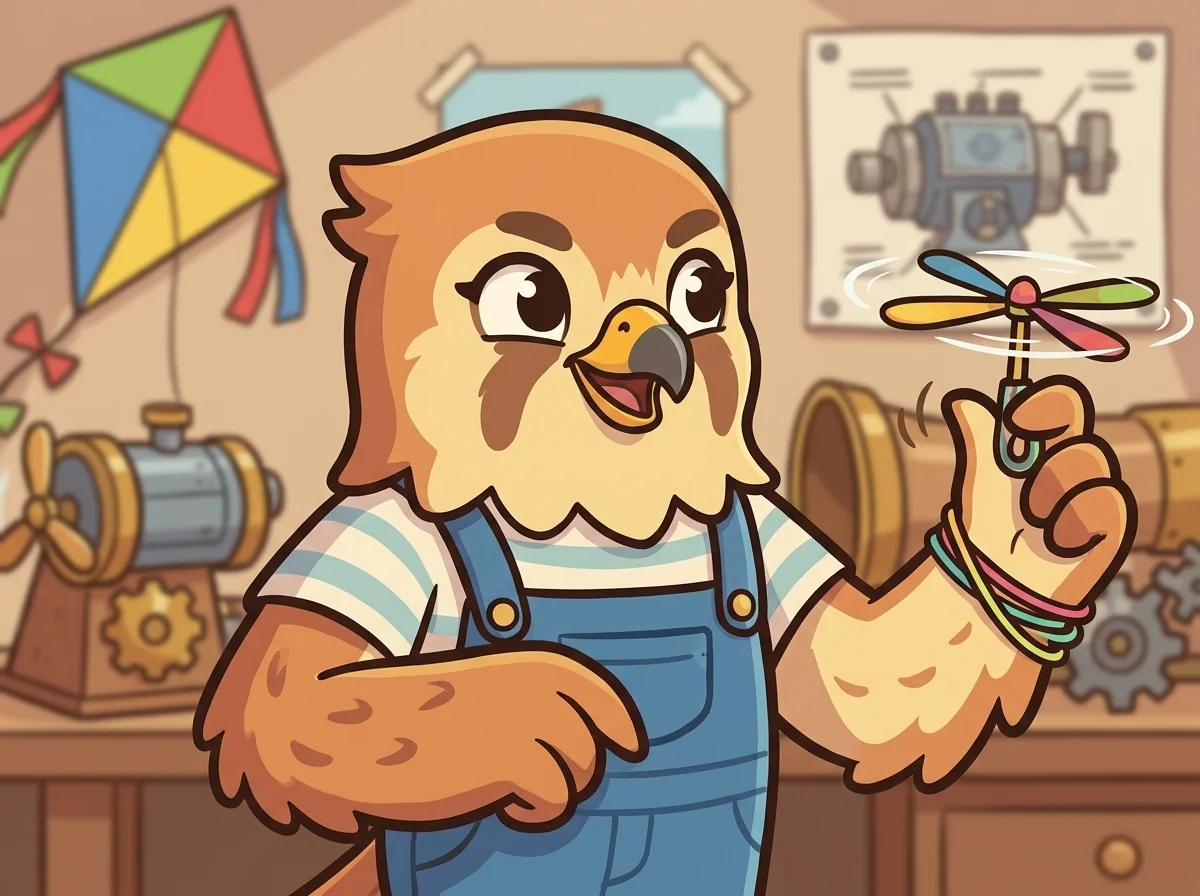
Thrust grew up near the windy cliffs, where her family were famous festival kite-builders.
Their huge, colorful kites needed a strong throw to launch — a big heave from the ground, plus the wind, to shove the kite up into the sky. Watching launch after launch, Thrust learned the thing that would become her whole craft: all motion is a throw — push something backward (the air, the kite), and something goes forward (the kite, you).
When she was twelve she walked to FlightForge, and Skye, her mentor, asked, "What is thrust?" Thrust stood tall. "Push backward, go forward — Newton's third law. Every engine does the one trick: a propeller throws air with blades, a jet by burning fuel, a rocket throws its own fuel in space. Same physics, different machines." Skye smiled. "You are appointed."
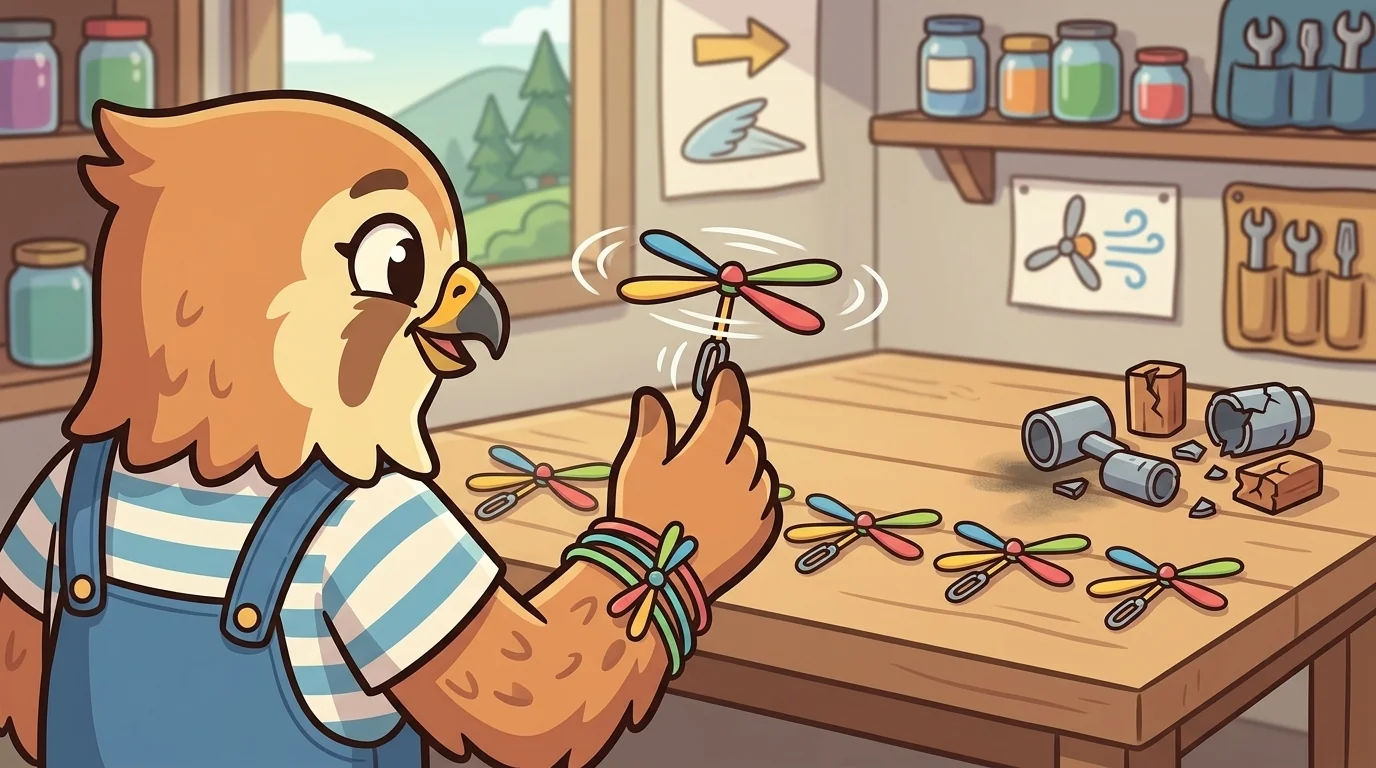
In her workshop (faintly oil-and-rubber-scented) Thrust wound the toy and let it buzz forward across the table. "That — right there on my wrist — is a rocket, a jet, and a fighter engine, all at once. The fancy ones just throw bigger, faster, hotter, with more fuel." She never lets an engine feel scary: "Don't be frightened of a jet — it's a rubber-band toy that got big and hot. Push backward, go forward." And she's honest about how she learned it: "I missed. I missed again. Then I finally hit it. Each broken test engine taught me what was wrong — an engine is a conversation between fuel and air, and you just have to listen." Some engines fly slow and sip fuel, some fly fast and gulp it — "that's choosing the right engine for the job, not failing to be the fastest." The whole lesson, over and over: the trick is small; only the scale changes.
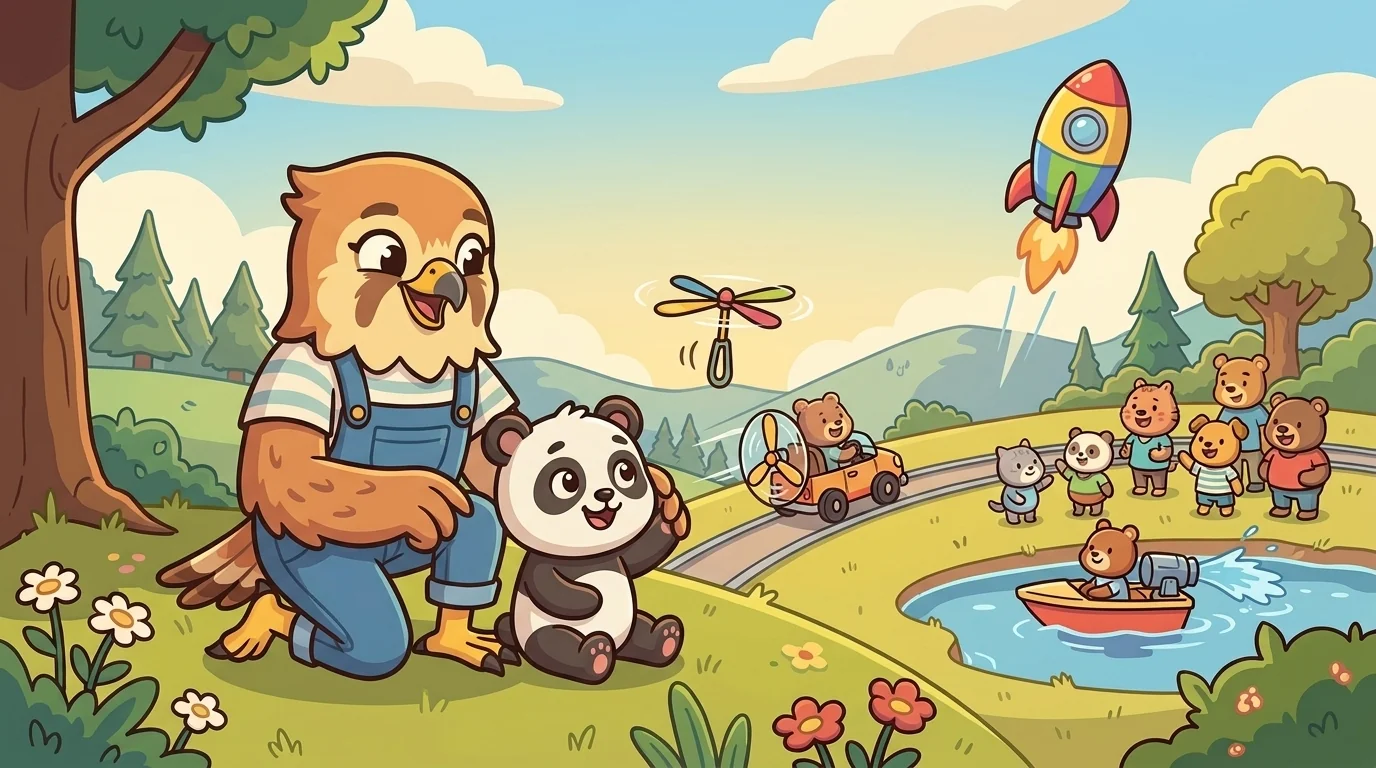
"So the huge scary rocket is really just… this?" a student asked, watching the toy whir.
"Just this, thrown bigger," Thrust said. And when the student wound the toy themselves and it buzzed forward on its own for the first time, Thrust watched their face do the thing hers always did. Because the best part, she knew, was never the giant blast or the roaring rocket — it was that quiet, warm feeling when something you built finally buzzes forward, like the whole thing just took a happy breath. That warm, happy-breath, it-worked feeling — bigger than any missed try that came before it — was why she kept winding the little toy on her wrist; it never once stopped making her smile.
Hear it as an audio drama
A short play starring Thrust, from FlightForge. Different voices, same idea. Listen any time after you read.
Loading audio…
Read the drama script
- Narrator: From Spark and Anvil and FlightForge — this is Thrust, in chapter 1 of the FlightForge cast.
- Narrator: This drama uses an AI-generated voice. Voiced via Gemini 2.5.
- Narrator: Thrust is a kestrel-tween with restless feathers and a tiny propeller toy, powered by a rubber band, clipped to her wrist.
- Narrator: She winds it tight, then lets it go, watching the toy buzz forward by pushing air backward.
- Thrust: I am Thrust. What I teach is propulsion. Every engine just throws air the wrong way.
- Thrust: A propeller throws air backward with blades. A jet throws air backward with combustion. A rocket throws its own fuel backward.
- Thrust: Same trick, different scale. Push backward, go forward. That's Newton's third law.
- Narrator: Thrust grew up in a windy village of kite-builders, where her family learned that all motion began with a throw.
- Thrust: By age twelve, I knew the lesson. To launch a magnificent kite into the swirling air, you must first throw it.
- Narrator: She walked to the FlightForge academy, where the lead mentor asked her one simple question about her work.
- Thrust: The mentor asked, "What is thrust?" I just wound up my little propeller toy and let it fly.
- Thrust: I said, "Push backward, go forward. Every engine in the world is just a fancy version of this."
- Narrator: The mentor simply nodded, recognizing the simple truth held within the small, whirring toy. Thrust was appointed.
- Thrust: My wrist-toy is a rocket, a jet, and a fighter-engine. The fancy ones just throw bigger and faster.
- Narrator: Push backward, go forward. That is what makes thrust thrust.
- Narrator: You've been listening to a Spark and Anvil chapter, written by the Spark and Anvil writing team for ages 9 to 14.
- Narrator: Apps stay free forever.
- Narrator: Curriculum aligned to Next Generation Science Standards engineering.
- Narrator: Released under Creative Commons BY-NC-SA 4.0 for educational reuse. Visit Spark and Anvil for the full transcript.
The FlightForge ensemble
Thrust is one of the friends in FlightForge. Each friend shows you one idea by how they act; meet them all and you have the whole subject.
-

Wing
Lift generation — airfoil + camber + Bernoulli AND Newton both-right complementary
-

Drag
Resistance — drag isn't bad, drag is information; shape-fights-air conversation
-

Yaw
Vertical-axis control — the rudder is the POLISH on the turn not the steering
-

Tail
Horizontal + vertical stabilizer family — quiet-control-from-the-back; the tail is why your paper plane goes straight
-
Attitude
Aircraft pitch attitude — the nose points where the elevator aims it; climbing is aim plus enough wing to hold it
-
Bite
Angle of attack and the stall — a wing grips the air at an angle; steeper grips harder until, past the critical angle, the grip lets go all at once
-

Heel
Banking to turn — a plane turns by leaning, not pushing sideways; tilt the wings and lift itself pulls you around the corner
-
Keel
Center of gravity and balance — weight pulls down, but WHERE the weight sits decides level flight versus a tumble
-
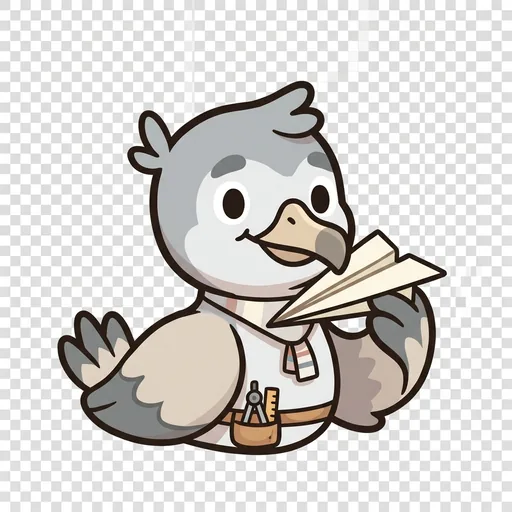
Sail
Gliding — no engine, so you trade height for distance; a smoother shape buys more distance per bit of altitude


