
Charge
CHARGE — every part sips power. know your battery budget, or your robot dies mid-mission.
Loading audio…
Press play to listen along. The line being read lights up as you go.
Show full transcript
Loading transcript…
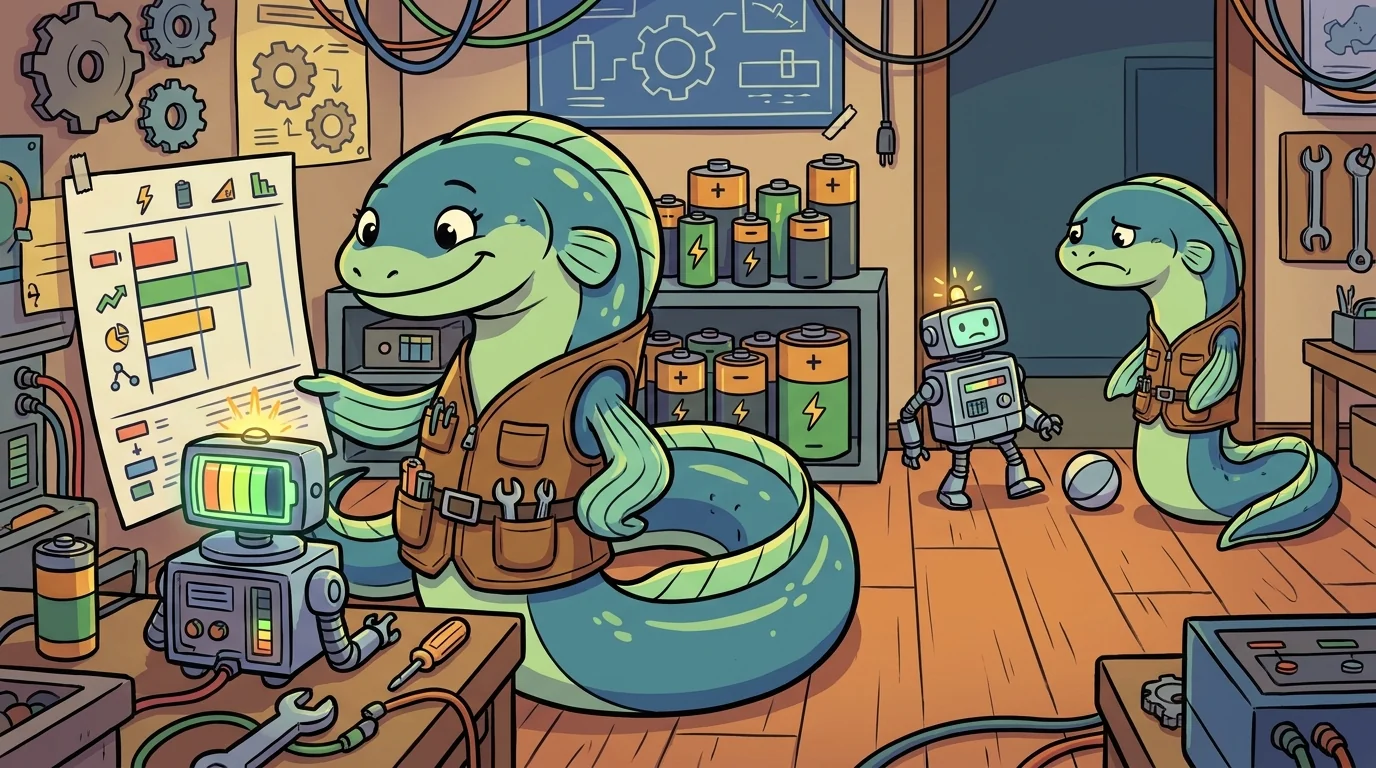
On Charge's workbench sat a little robot with a glowing battery meter, and Charge — a sleek electric eel in a tool-vest, coiled beside a bank of batteries — watched that meter the way a captain watches fuel.
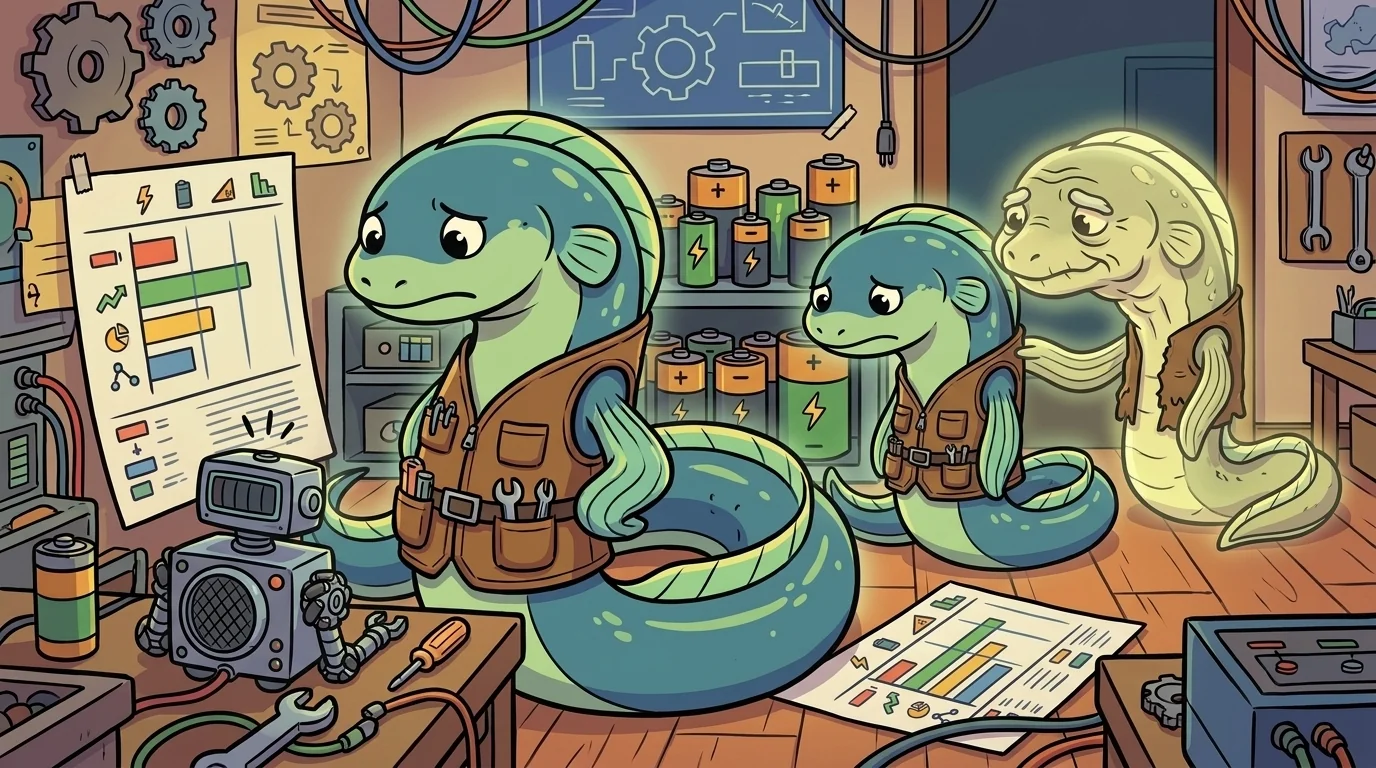
"Everyone plans what their robot will do," she said, "and forgets to plan whether it has the power to do it. That's the whole craft: a power budget." She tapped the meter. "Every part draws current, measured in milliamps. The motors are the thirsty ones — they can pull a hundred times what a sensor sips. The brain, the radio, the gripper, the lights, all drinking from the same battery at once. And a battery isn't bottomless — its capacity is a fixed number of milliamp-hours. Draw more per hour, and it empties sooner. It's simple arithmetic, and skipping the arithmetic is how a robot dies two feet from the finish."
She pointed at a robot stranded mid-floor. "That one had a great plan — cross the room, grab the ball, come back. But nobody added up the draw. So here's how I do it: I list every part, measure its current draw, and multiply by how long each part is actually on — that's the duty cycle. The motors run the whole trip; the gripper only fires once; the lights only need the dark stretch. Sum those, and I get the total energy the mission spends. Then I compare it to the battery's capacity — and I never let the plan use the whole battery."
"Why not all of it?" a young builder asked.
"Reserve margin," Charge said. "I keep maybe twenty percent in the tank, because the real world always costs more than the plan — a longer path, a stuck wheel, a cold battery that gives less than its rating. And there's a nastier failure than simply running flat: brownout. When too many thirsty parts fire at once, the voltage sags below what the brain needs, and the robot doesn't stop cleanly — it resets, or behaves erratically, mid-task. So the motors and the brain can't just share one rail thoughtlessly."
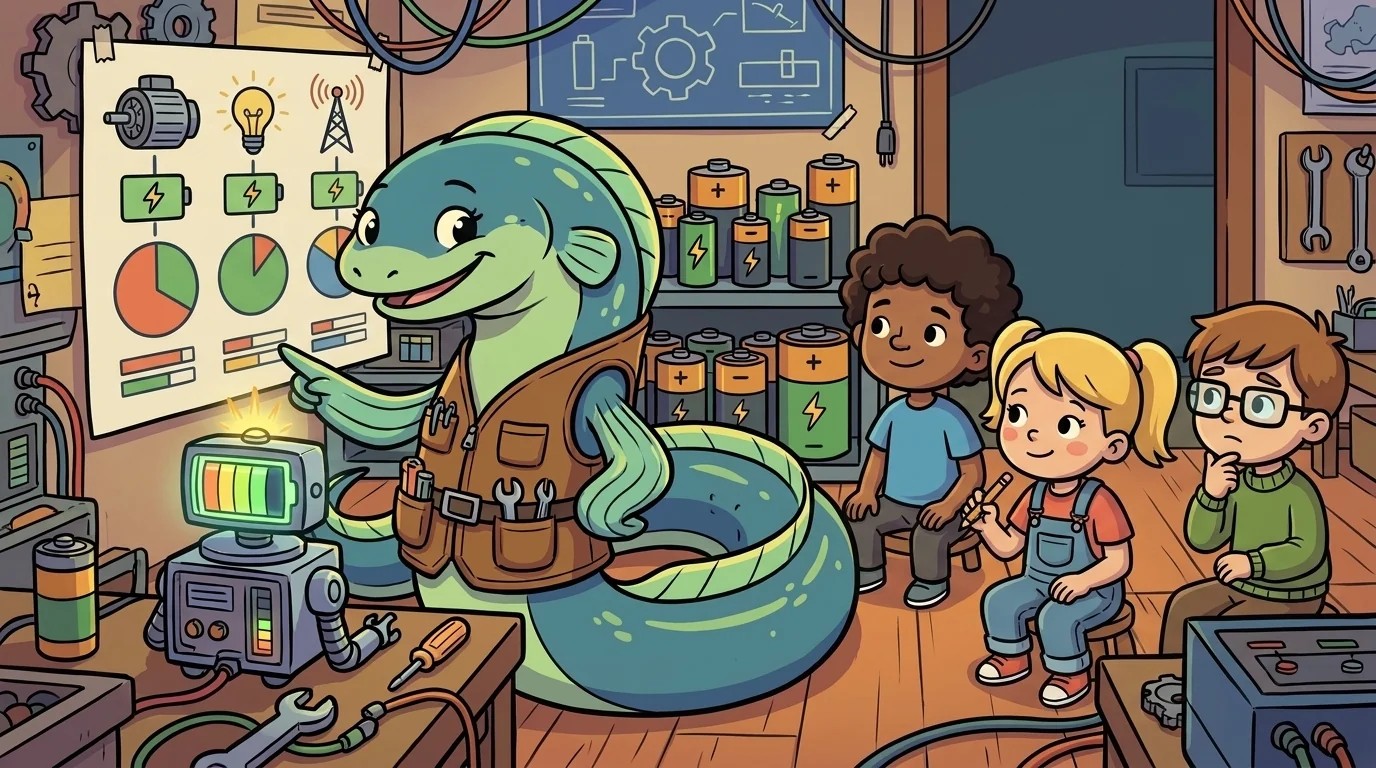
She held up two options. "When the budget doesn't fit, most people reach for a bigger battery. But you can also trim the spending. Dim the lights when it's not dark. Slow the motor on the easy stretch — power rises steeply with speed, so a slightly slower robot lasts far longer. Turn off the radio between messages. Spend where it matters; save where it doesn't."
"So I plan the power, not just the plan," the builder said slowly, "or it quits at the worst moment."
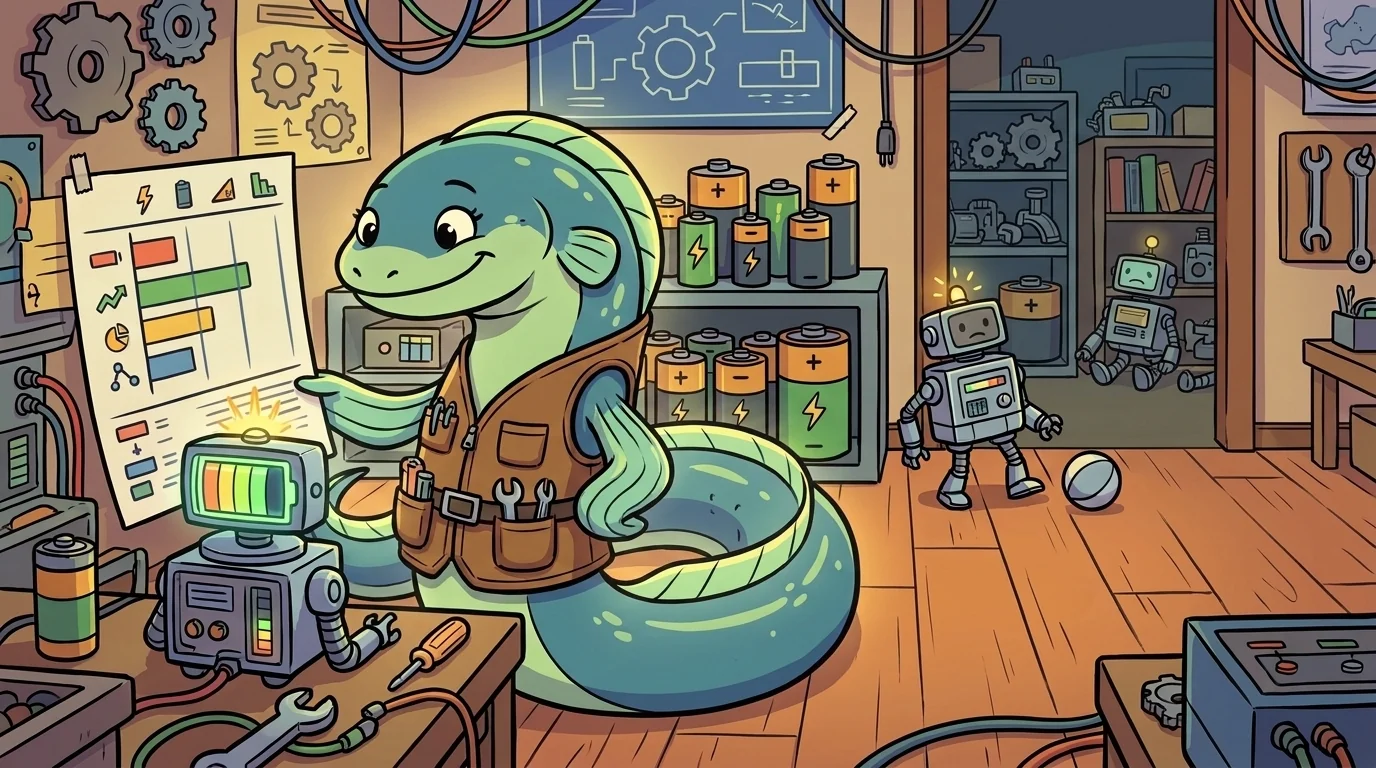
"Plan the power, always," Charge agreed. She coiled beside her fully-charged bank and let her own glow settle to a calm, steady, unhurried light — not blazing, not dimming, but paced to last. A warm, well-provisioned happiness settled in her: the unworried calm of a creature who had learned she didn't have to shine her brightest every second, that knowing her budget was what let her finish everything she started.
Her glow held even. "Know what you have," she said softly, "spend it where it matters, and always keep a little in reserve."
The RoboForge ensemble
Charge is part of RoboForge's distributed-narrative cast. Each character embodies a different curricular primitive; together they teach the full subject.
-

Bolt
Chassis + mechanical structure — 'the frame holds everything; build the chassis like you mean it'
-

Sense
Sensors + perception — 'the robot only knows what it can sense; choose the senses for the job'
-

Drive
Motors + actuators + movement — 'motors turn power into motion; balance speed and control'
-

Loop
Iteration + sensor-driven control loops — 'read. decide. act. repeat. that's the whole robot brain'
-

Tune
Testing + calibration + iteration — 'first run fails. that's information. tune + run again' (closes cast arc)
-

Clamp
Grippers + manipulation — 'grabbing is harder than it looks; hold firm enough not to drop, gentle enough not to crush'
-

Hail
Communication + signals — 'a robot alone knows only its own corner; robots that talk share what they each can see'
-

Halt
Fail-safe + safe failure — 'everything breaks eventually; plan for it — fail safe, not dangerous'
-

Rove
Navigation + pathfinding — 'don't just go toward the goal; find a PATH around what is in the way'