Charge
CHARGE — *every part sips power. know your battery budget, or your robot dies mid-mission.*
Loading audio…
Press play to listen along. The line being read lights up as you go.
Show full transcript
Loading transcript…
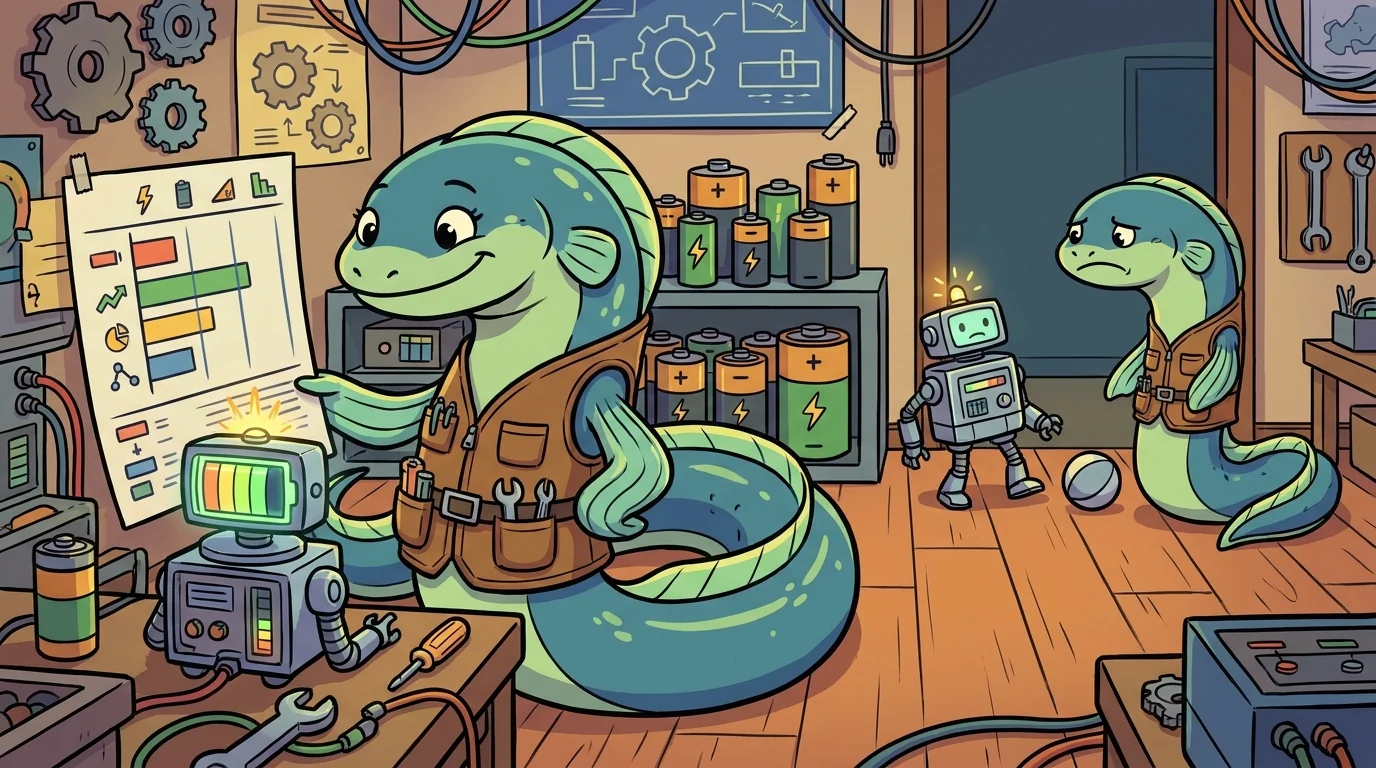
On Charge's workbench sat a little robot with a glowing battery meter, and Charge — a sleek electric eel in a tool-vest, coiled beside a bank of batteries — was watching that meter the way a captain watches fuel.
Her whole craft is power budgeting — making sure the battery lasts the whole mission. "Everybody plans what their robot will do," she said, "and forgets to plan whether it has the power to do it." She tapped the meter. "Every single part sips from the battery. The motors gulp the most — they're thirsty. The sensors sip a little. The brain sips a little. The lights, the gripper, the radio — all of them, drinking from the same battery, all the time." She frowned at a robot that had died halfway across the room. "This one had a great plan. Cross the room, pick up the ball, come back. But nobody added up the power it would take — and it ran dry right in the middle, stranded, with the ball just out of reach." She held up a chart. "So before I build, I make a power budget. How much does each part draw? How long is the mission? Does the battery have enough to finish — with a little to spare, because a robot that dies mid-mission isn't a robot. It's a paperweight in the middle of the floor."
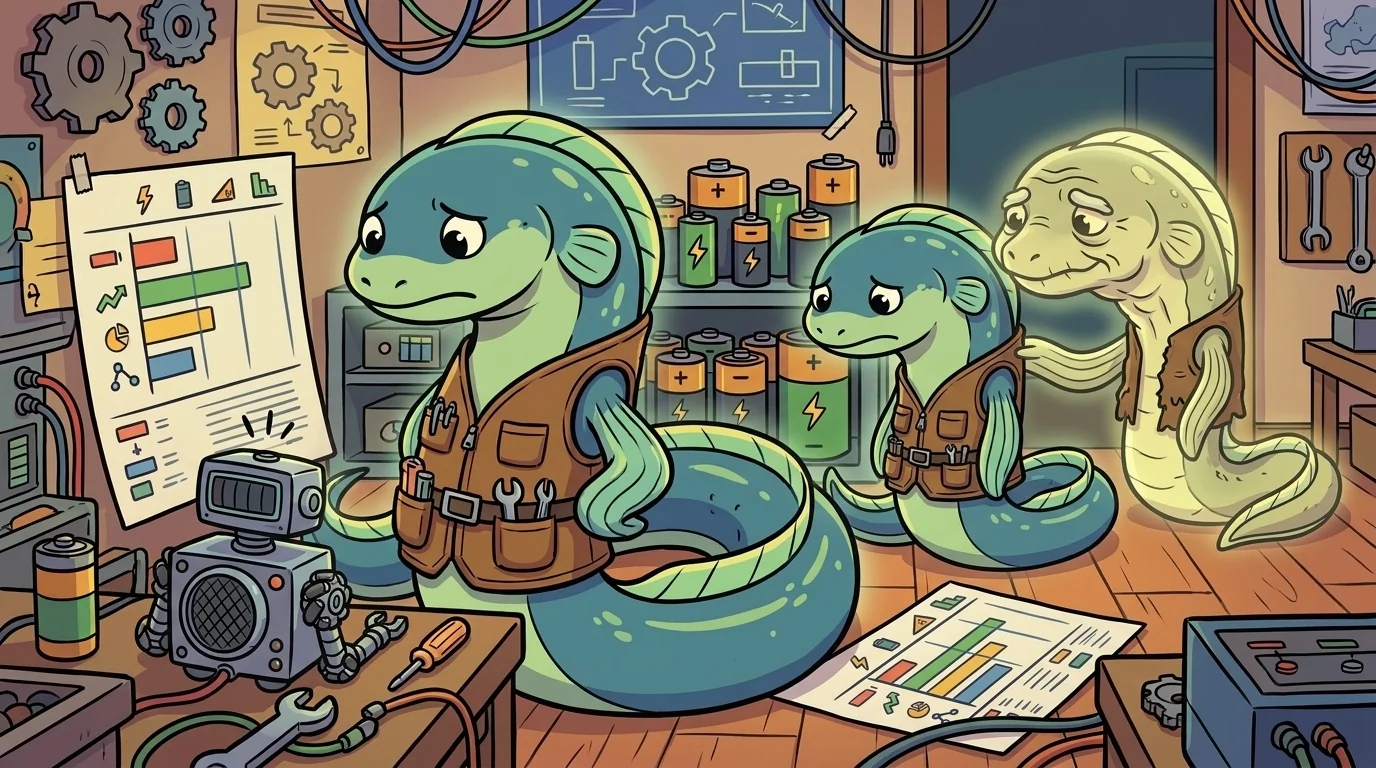
Charge learned to budget power the day her own big project died two feet from the finish.
She was young, and she'd built an ambitious robot with everything — bright lights, a fast motor, a loud speaker, a fancy gripper — and sent it off on its first grand mission. It made it almost all the way. Then, right before the finish, the meter hit zero, and it stopped dead, humiliatingly close.
Her grandfather, an old eel with a dimming glow, coiled beside her.
"It had SO many features," young Charge said, crushed. "Why did it quit?"
"Because every feature cost something, little one, and you never added up the bill," her grandfather said gently. "Bright lights, fast motor, loud speaker — each one delicious, each one thirsty. Together they drained the battery faster than you ever planned. You budgeted the robot's dreams but not its power." He tapped the dead meter. "A battery is like a day's energy — there's only so much, and everything you do spends some. The trick isn't to do less. It's to know your budget: add up what everything draws, measure how long you need, and make sure there's enough — plus a little extra, always, for the unexpected." He smiled. "Turn off the lights when you don't need them. Slow the motor when you can. Spend your power where it matters and save it where it doesn't. A robot that budgets its power finishes its mission. A robot that spends wildly dies two feet from the finish — with the best features in the world, and nothing left to run them."
Young Charge never built without a power budget again. She knew: it's not what your robot can do. It's what it can do before the battery runs out.
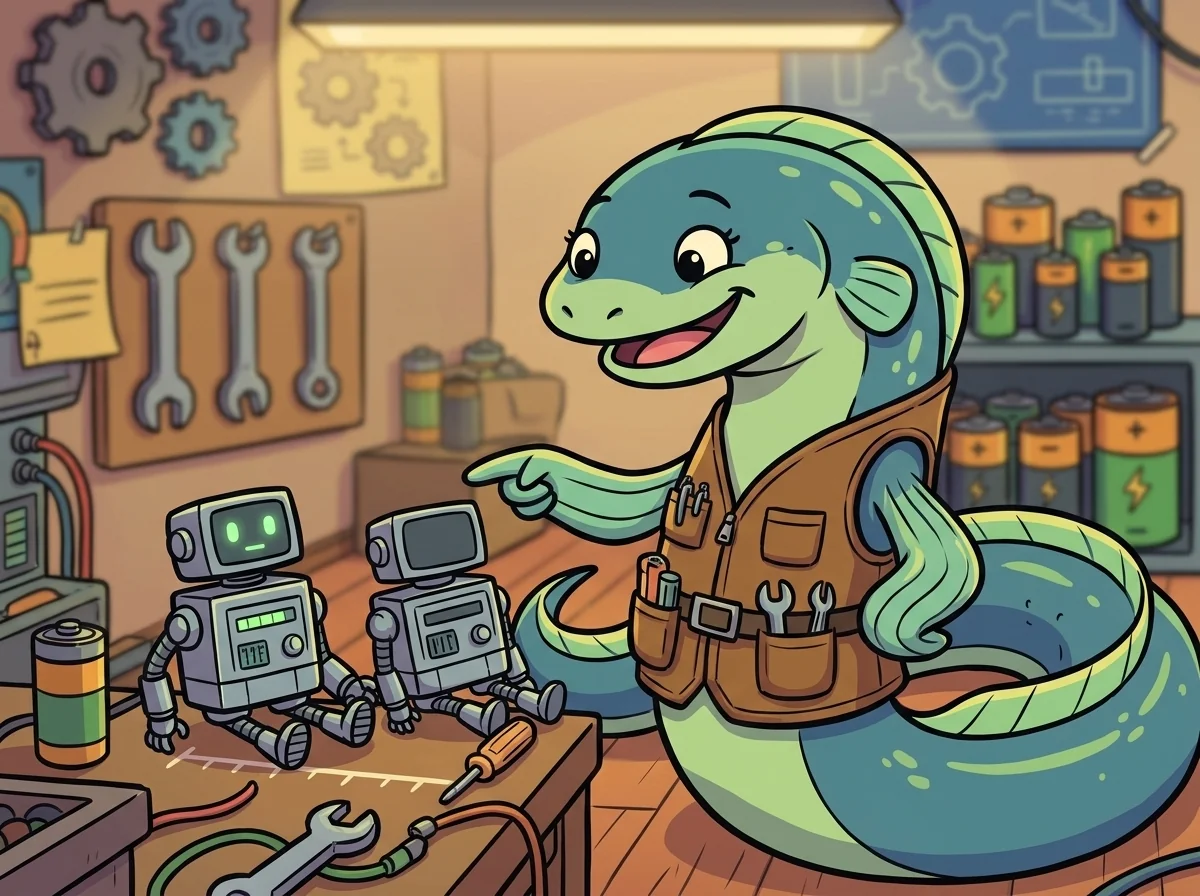
She swam to RoboForge at twelve, because a place that built robots ought to make sure they didn't die mid-mission.
Servo, her mentor, met her at the workbench. "What keeps a robot running to the end?"
Charge didn't answer with a speech. She laid two robots side by side, same battery. The first, she'd loaded with every feature at full blast — it raced off, dazzling, and died halfway. The second, she'd budgeted: dimmed lights, a steady motor, power saved for the return trip — and it finished the whole mission with charge to spare. "Same battery," she said. "The first one spent wildly and stranded itself. The second one knew its budget and made it home. A robot is only as good as the power it saved for the end."
Servo watched the second robot roll home. "You are appointed," she said.

At Charge's workbench, she taught power budgeting with a mission plan. She had the kids list every part their robot would use and how much each drew: "Motors — big gulp. Sensors — small sip. Radio — medium sip." Then she had them add it up across the whole mission time. "Now — does the battery have enough?" It didn't, quite. So instead of a bigger battery, she taught them to trim the budget: "Do you need the lights the whole time, or just at the dark part? Can the motor go slower on the easy stretch?" They trimmed — and now the budget fit, with a reserve. Then she gave the working rules: every part draws power, and motors draw the most, so add up the whole draw before you build, not after it dies; a mission needs enough battery for the whole job plus a reserve for the unexpected (a longer path, a stuck wheel); and when the budget doesn't fit, you can trim the spending (dim lights, slow motors, turn off what you're not using) as well as grow the battery. "A student's robot 'kept dying for no reason,'" Charge said, her glow steady. "But there was always a reason — it was spending more power than it had, every time. We made a budget, trimmed the waste, kept a reserve — and it never died mid-mission again. A robot doesn't run out of power by accident. It runs out because nobody counted."
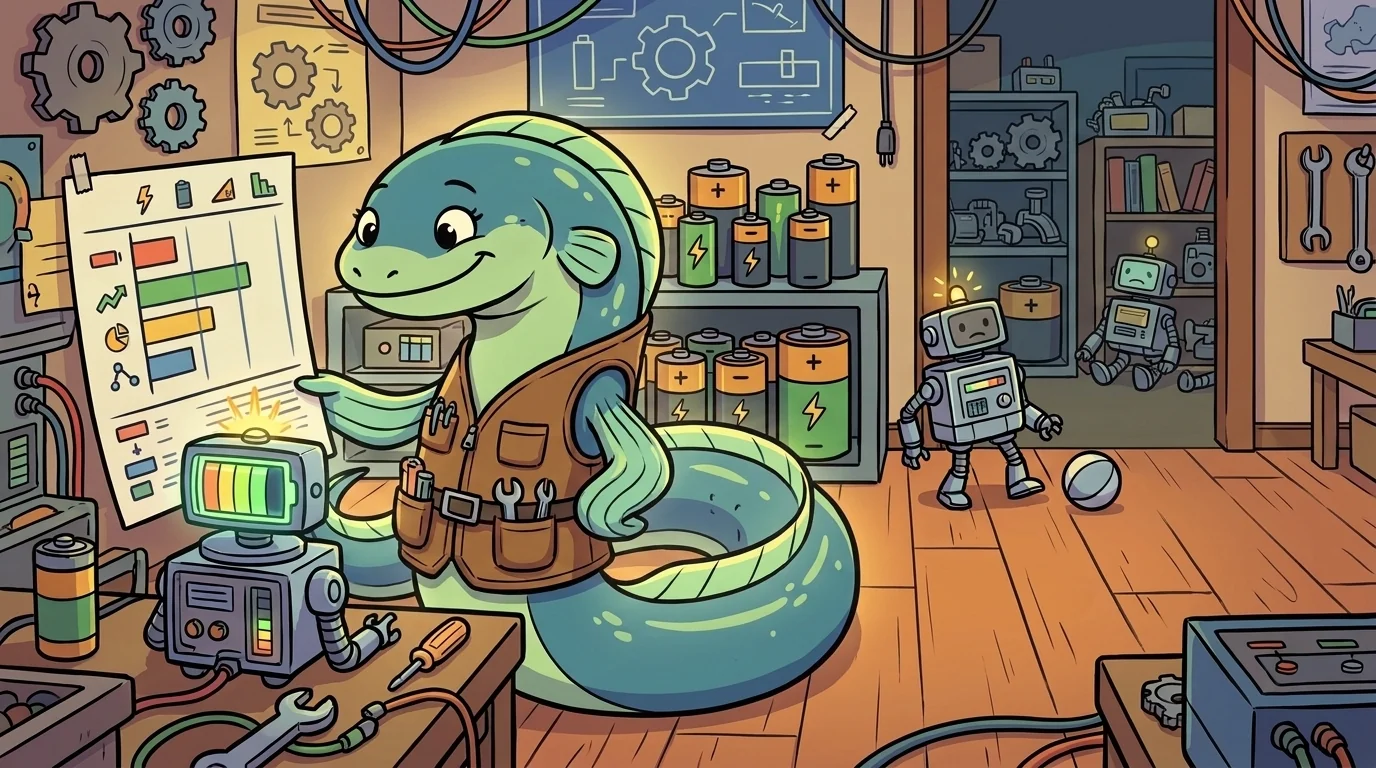
"So I have to plan the power, not just the plan," a student said slowly, "or it'll quit at the worst moment?"
"Plan the power, always," Charge agreed, and she coiled beside her fully-charged battery bank and let her own glow settle to a calm, steady, unhurried light — not blazing, not dimming, but paced to last — content in the knowledge that she had exactly what she needed for the whole long day ahead, with a little in reserve. There was a warm, well-provisioned happiness in it — the deep, unworried calm of an eel who had learned that she didn't have to shine her brightest every second, that knowing her budget and pacing her energy was what let her finish everything she started, and never strand herself two feet from the finish. That well-budgeted, paced-to-last, saved-enough-for-the-end warmth — the settled gladness of a creature who never ran dry at the worst moment — was, to Charge, the quiet confidence hidden inside a power budget. "Know what you have," she said softly, glowing steady, "spend it where it matters, and always, always keep a little in reserve."
The RoboForge ensemble
Charge is part of RoboForge's distributed-narrative cast. Each character embodies a different curricular primitive; together they teach the full subject.
-

Bolt
Chassis + mechanical structure — 'the frame holds everything; build the chassis like you mean it'
-

Sense
Sensors + perception — 'the robot only knows what it can sense; choose the senses for the job'
-

Drive
Motors + actuators + movement — 'motors turn power into motion; balance speed and control'
-

Loop
Iteration + sensor-driven control loops — 'read. decide. act. repeat. that's the whole robot brain'
-

Tune
Testing + calibration + iteration — 'first run fails. that's information. tune + run again' (closes cast arc)
-

Clamp
Grippers + manipulation — 'grabbing is harder than it looks; hold firm enough not to drop, gentle enough not to crush'
-

Hail
Communication + signals — 'a robot alone knows only its own corner; robots that talk share what they each can see'
-

Halt
Fail-safe + safe failure — 'everything breaks eventually; plan for it — fail safe, not dangerous'
-

Rove
Navigation + pathfinding — 'don't just go toward the goal; find a PATH around what is in the way'