Hail
HAIL — *a robot alone knows only its own corner. robots that talk share what they each can see.*
Loading audio…
Press play to listen along. The line being read lights up as you go.
Show full transcript
Loading transcript…
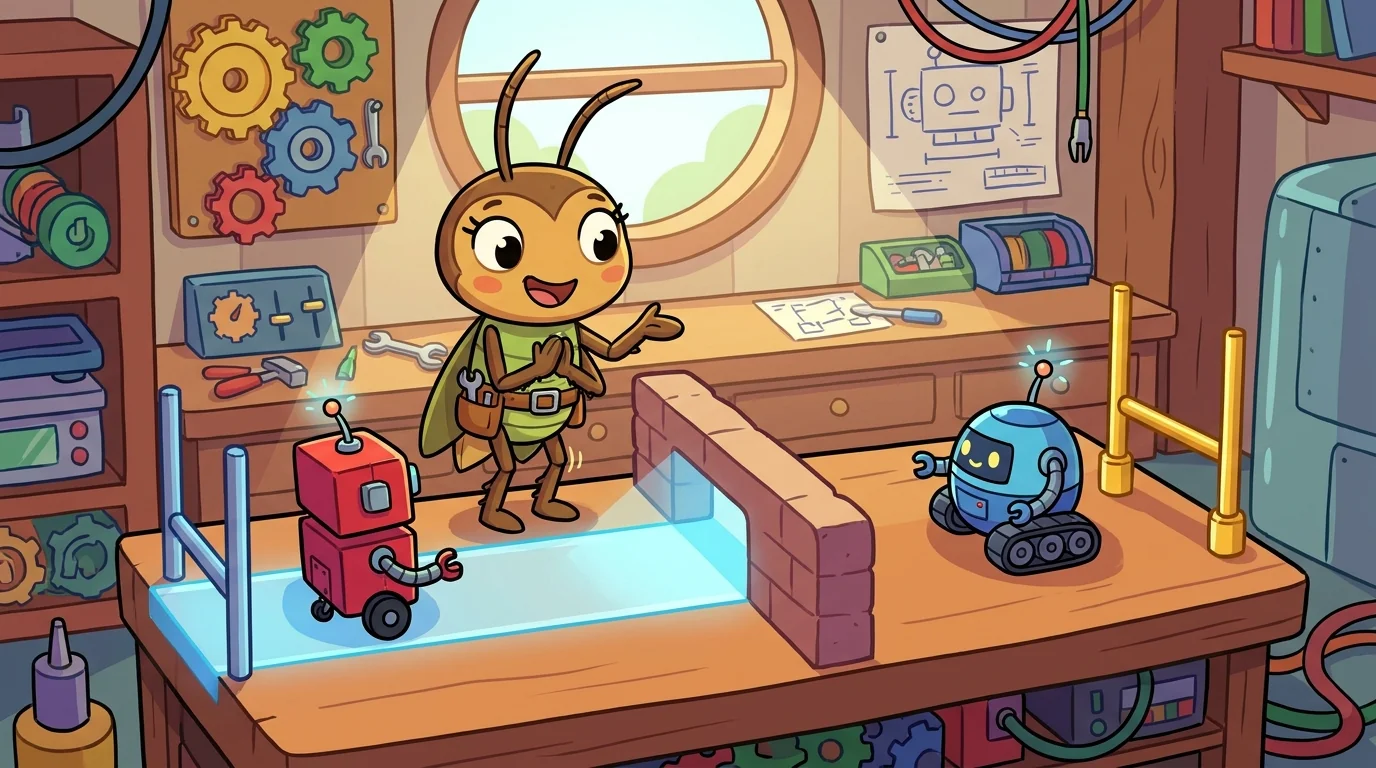
At Hail's workbench, two little robots sat on opposite sides of a wall, each able to see only its own side — and Hail, a cheerful cricket with a tiny antenna-radio, was about to teach them the thing that made them a team.
Her whole craft is communication — how robots send and receive messages. "A robot all alone," she said, rubbing her legs to chirp, "knows only what it can see from its own little corner. This one—" she pointed to the first robot "—sees a clear path on the left. This one—" the second "—sees the goal on the right. Neither can see the other side of the wall." She grinned. "But watch what happens when they can talk." She switched on their radios. The first chirped a message: clear path on the left. The second chirped back: goal is on the right. And suddenly both robots knew the whole map — clear path and goal — though neither could see it alone. "See? Apart, each one knows half. Talking, they each know the whole. That's the magic of communication — robots that share what they see become smarter together than any one of them alone." She tapped her antenna. "But there's a catch. A message only helps if it's clear. A garbled chirp, a vague signal, a robot that shouts nonsense — that's worse than silence. Say exactly what you mean, clearly enough to be understood — because a clear message is a gift, and a muddled one is just noise."
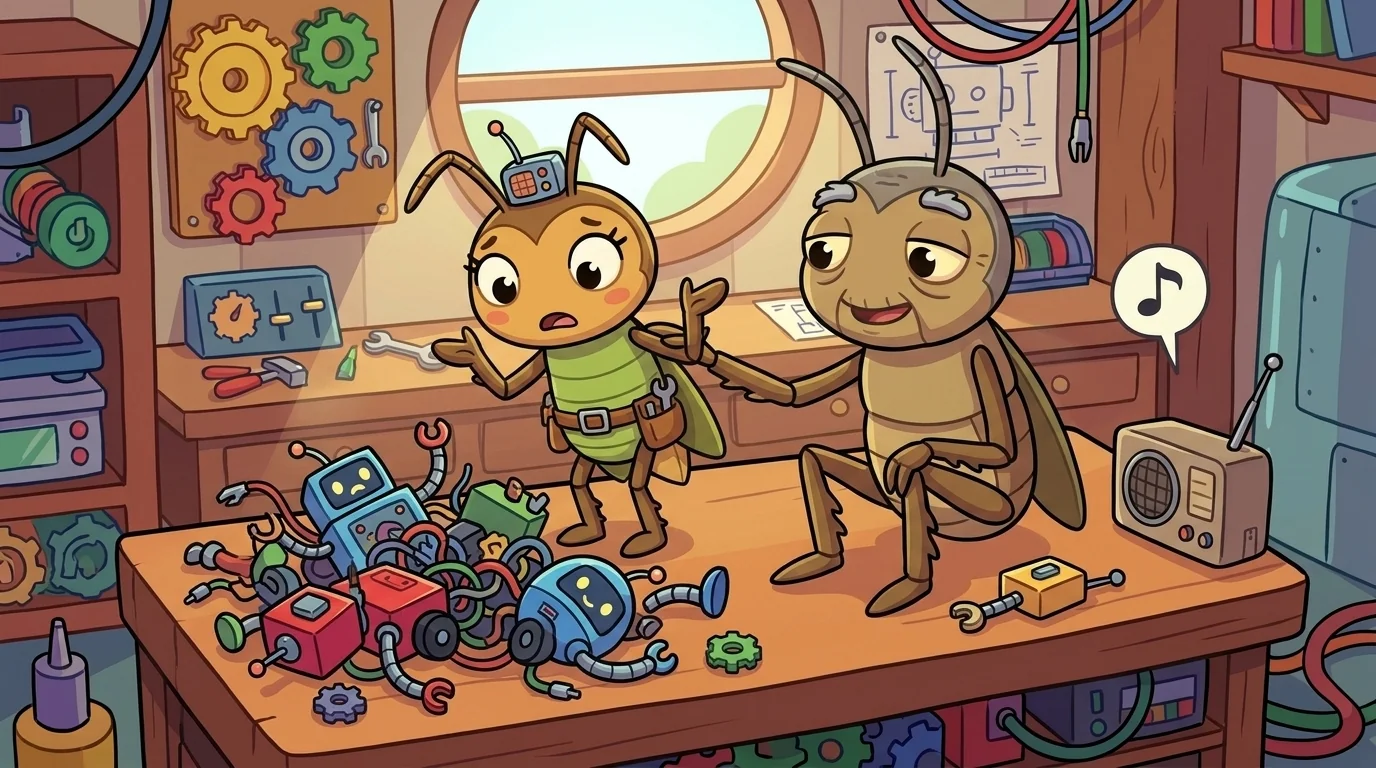
Hail learned the power — and the peril — of a message the day a garbled signal caused a pile-up.
She was young, and she'd built a swarm of little robots that all talked at once — a constant, overlapping chatter of half-signals and vague chirps. She thought more talking meant better teamwork. Instead, the robots, drowning in muddled messages, misunderstood each other and crashed into a heap.
Her grandfather, an old cricket with a slow, clear chirp, sat with her in the wreckage.
"They were talking SO much," young Hail said, bewildered. "Why did they crash?"
"Because talking a lot isn't the same as talking well, little one," her grandfather said gently. "They filled the air with vague, overlapping, half-finished chirps — so much noise that no clear message could get through. A robot that hears ten muddled signals is more confused than one that hears none." He chirped, once, slow and clear: a single, clean note. "The goal isn't more messages. It's clear ones. Each robot should say exactly what it means — 'path clear on my left,' not just a panicked buzz — and listen for the others' clear words, and not talk over them." He smiled. "One clear message that everyone understands is worth a thousand loud confused ones. Communication isn't about volume. It's about being understood." He tapped her antenna. "Say what you mean. Say it clearly. Then listen. That's the whole of it."
Young Hail rebuilt her swarm to chirp clearly — one clean message at a time, each robot saying exactly what it saw and listening for the rest. And they moved like one mind.
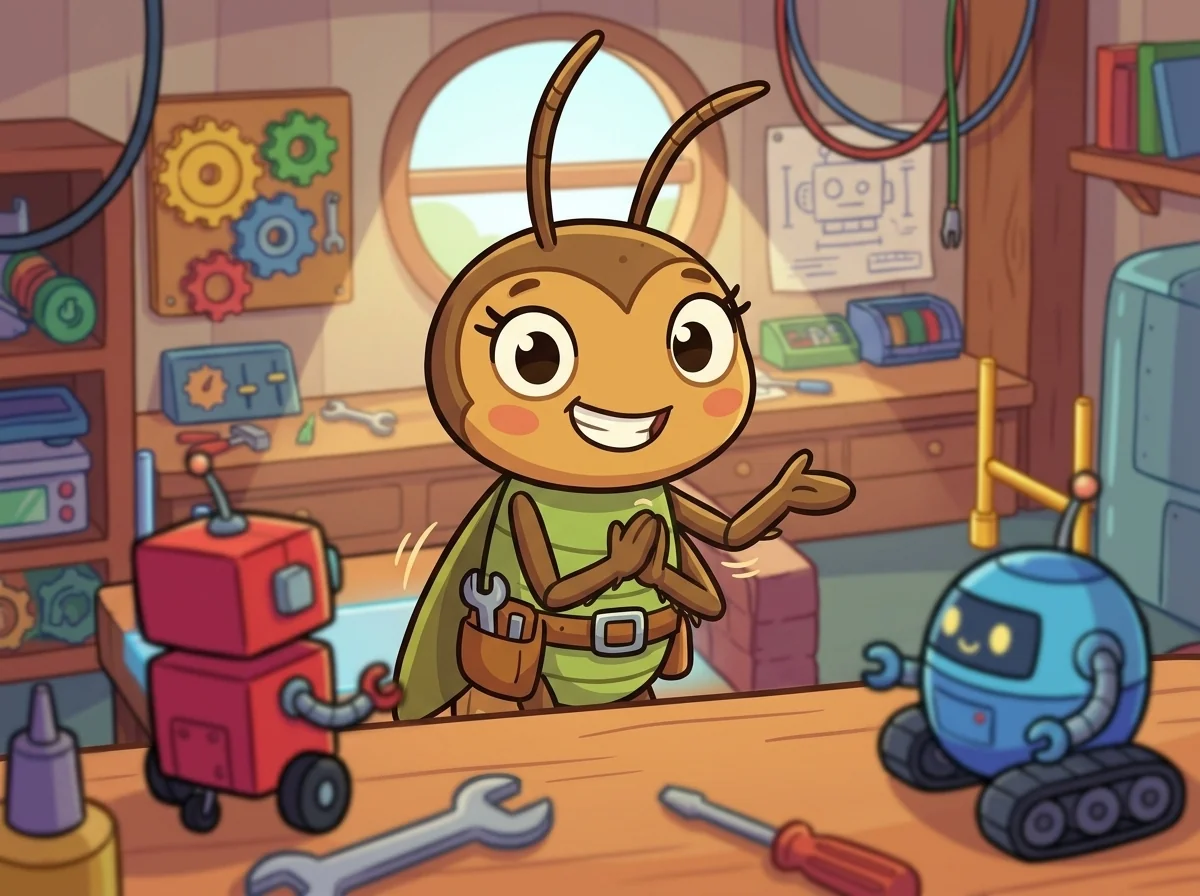
She hopped to RoboForge at twelve, because a place that built robots ought to teach them to work together.
Servo, her mentor, met her at the workbench. "How do robots become a team?"
Hail didn't answer with a speech. She set two robots on opposite sides of a wall — one seeing a hazard, one seeing the goal — and let them talk, clearly: hazard ahead on my side, goal is behind me on mine. Combining their two clear messages, both robots routed safely around the hazard and toward the goal — something neither could have done with only its own half of the picture. "There," Hail said. "Alone, each knew half and would have failed. Talking — clearly — they shared the whole picture and both succeeded. A team is just robots that tell each other the truth, clearly, about what they each can see."
Servo watched the two robots move as one. "You are appointed," she said.
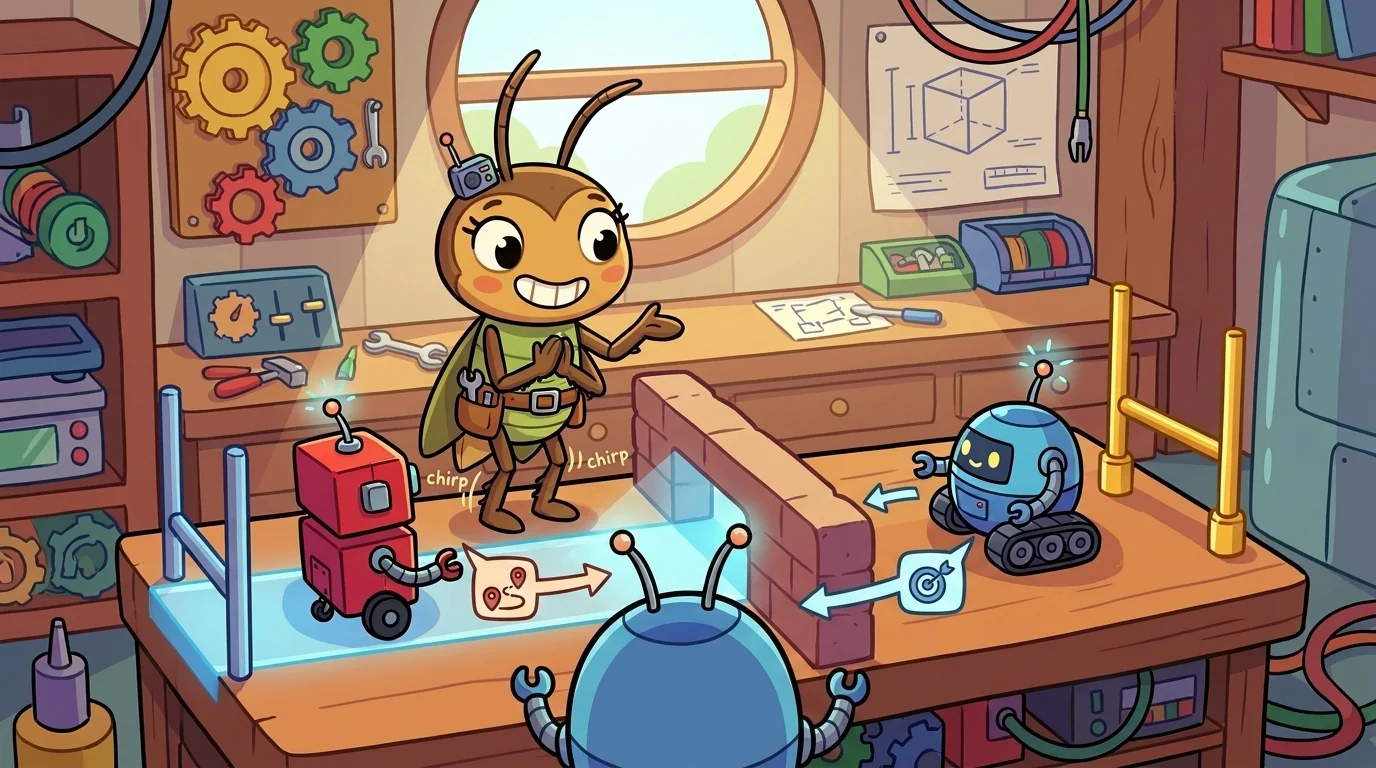
At Hail's workbench, she taught communication with a team task no single robot could do — one robot could see the map, another could reach the goal, a third had the key — and they had to share to win. First she let them work silently: total failure, each stuck with its own fragment. Then she gave them radios — but let them chatter all at once: chaos, crashes, noise. Then she taught them to chirp one clear message at a time and listen: and they solved it easily, pooling their fragments into a whole plan. Then she gave the working rules: a robot alone knows only its own corner, so robots that share what they each perceive become far smarter together than any one alone; a message only helps if it's clear — say exactly what you mean, one clean signal, not a vague or panicked buzz — because muddled messages are worse than silence; and listening matters as much as talking — a team that all shouts at once understands nothing, while a team that takes turns and listens moves as one mind. "A student's robot swarm 'talked constantly but kept crashing,'" Hail chirped. "Because they were loud, not clear. We slowed them to one clean message at a time, each saying exactly what it saw, each listening — and the crashing stopped and the teamwork began. It was never about talking more. It was about being understood."
"So a good message is clear, not loud," a student said slowly, "and I have to listen as much as I talk?"
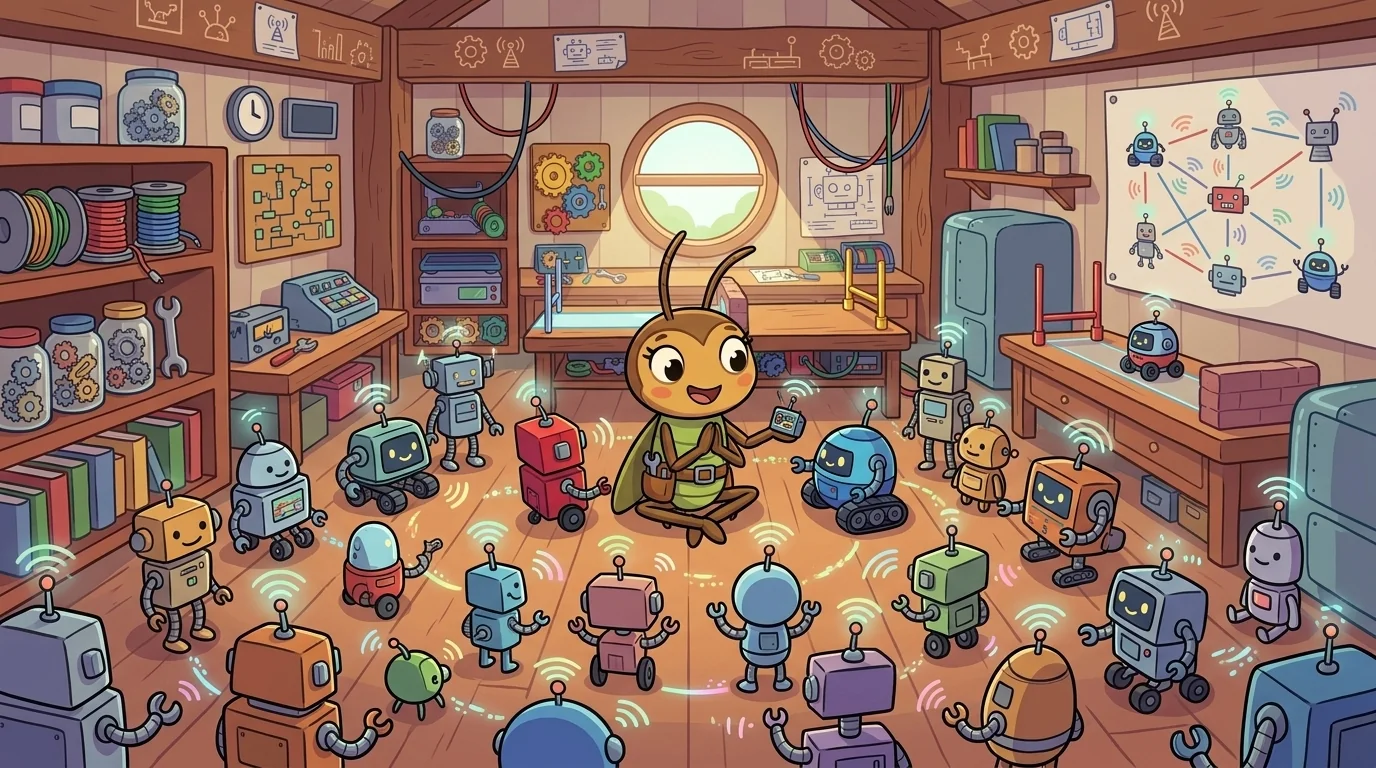
"Clear, and listening — that's the whole of it," Hail agreed, and she settled among her swarm of clearly-chirping robots, listening to them share their little corners of the world one clean note at a time, each one making all the others wiser, and felt a deep, connected gladness at the way a hundred small views became, through clear words, one whole understanding. There was a warm, together happiness in it — the settled contentment of a cricket who had learned that no robot, and no creature, has to face the world with only its own narrow view, that a clear word shared is a gift that makes everyone smarter, and that talking well — not talking much — is what turns a crowd of loners into a single, seeing team. That share-what-you-see, clear-not-loud, listen-as-much-as-you-speak warmth — the connected gladness of a creature who made a team out of loners — was, to Hail, the quiet magic hidden inside a clear message. "Say exactly what you mean," she said softly, among her chirping swarm, "clearly — and then listen — and a hundred half-views become one whole."
The RoboForge ensemble
Hail is part of RoboForge's distributed-narrative cast. Each character embodies a different curricular primitive; together they teach the full subject.
-

Bolt
Chassis + mechanical structure — 'the frame holds everything; build the chassis like you mean it'
-

Sense
Sensors + perception — 'the robot only knows what it can sense; choose the senses for the job'
-

Drive
Motors + actuators + movement — 'motors turn power into motion; balance speed and control'
-

Loop
Iteration + sensor-driven control loops — 'read. decide. act. repeat. that's the whole robot brain'
-

Tune
Testing + calibration + iteration — 'first run fails. that's information. tune + run again' (closes cast arc)
-
Charge
Power budget + energy management — 'every part sips power; know your battery budget or your robot dies mid-mission'
-

Clamp
Grippers + manipulation — 'grabbing is harder than it looks; hold firm enough not to drop, gentle enough not to crush'
-

Halt
Fail-safe + safe failure — 'everything breaks eventually; plan for it — fail safe, not dangerous'
-

Rove
Navigation + pathfinding — 'don't just go toward the goal; find a PATH around what is in the way'