Halt
HALT — *everything breaks eventually. plan what your robot does when it does — fail safe, not dangerous.*
Loading audio…
Press play to listen along. The line being read lights up as you go.
Show full transcript
Loading transcript…
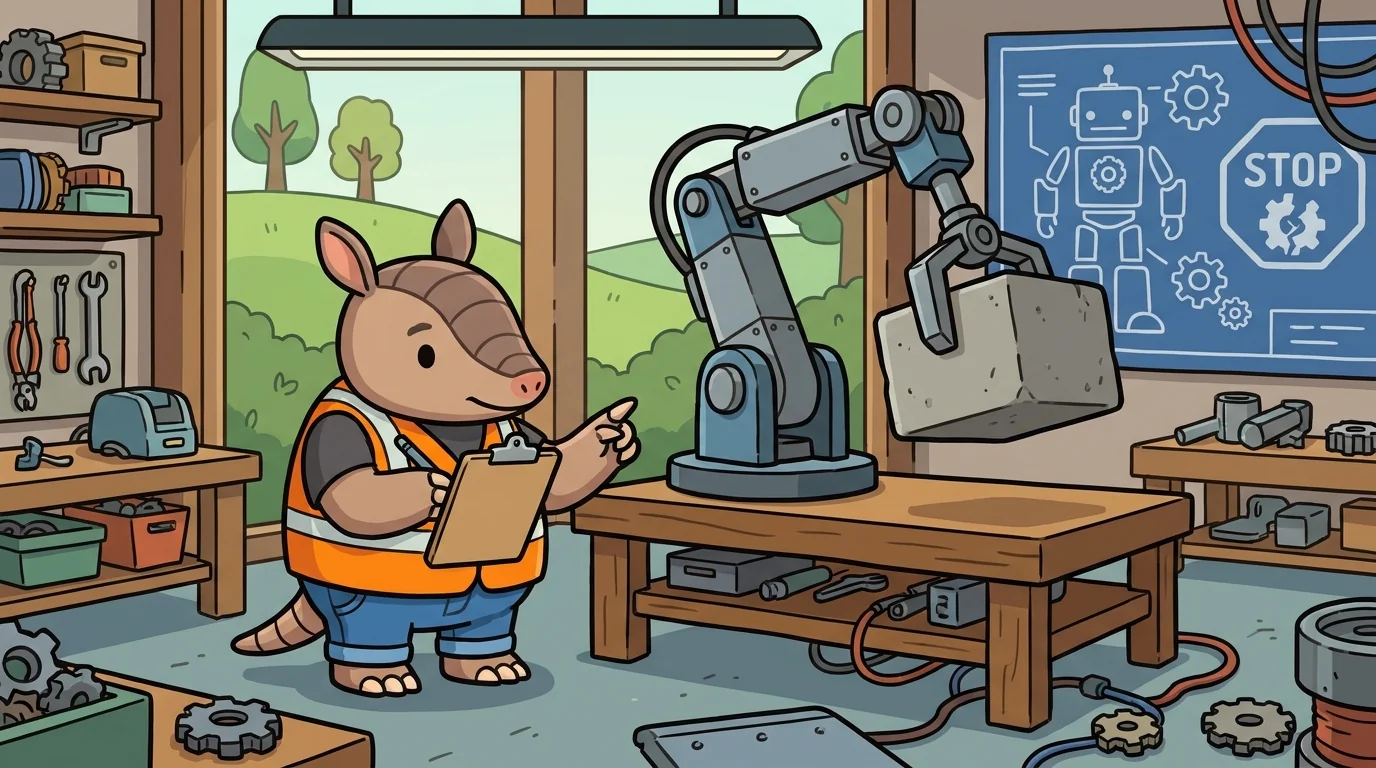
On Halt's workbench, a robot arm was lifting a heavy block — and Halt, a calm armadillo in a safety-vest, was watching not the success, but the one question nobody else asked: what happens if this breaks?
His whole craft is fail-safe design — deciding what a robot does when something goes wrong. "Everybody plans for the robot working," he said, tapping his clipboard. "Almost nobody plans for it breaking. But here's the truth: everything breaks, eventually. A motor jams. A wire comes loose. The battery dies. A wheel slips. The question isn't if — it's what does the robot do when it does?" He pointed at the lifting arm. "Say this arm's motor jams while it's holding this heavy block. A badly-designed robot keeps forcing it — grinding, overheating, maybe dropping the block on someone's foot, maybe catching fire. A fail-safe robot notices something's wrong and stops — gently sets the block down, or freezes in place, powered-down and harmless." He curled a protective paw. "That's fail-safe. When it breaks — and it will — it breaks safely. It stops. It doesn't grind, doesn't force, doesn't hurt anyone. A robot's most important behavior isn't what it does when everything's working. It's what it does when everything's wrong."
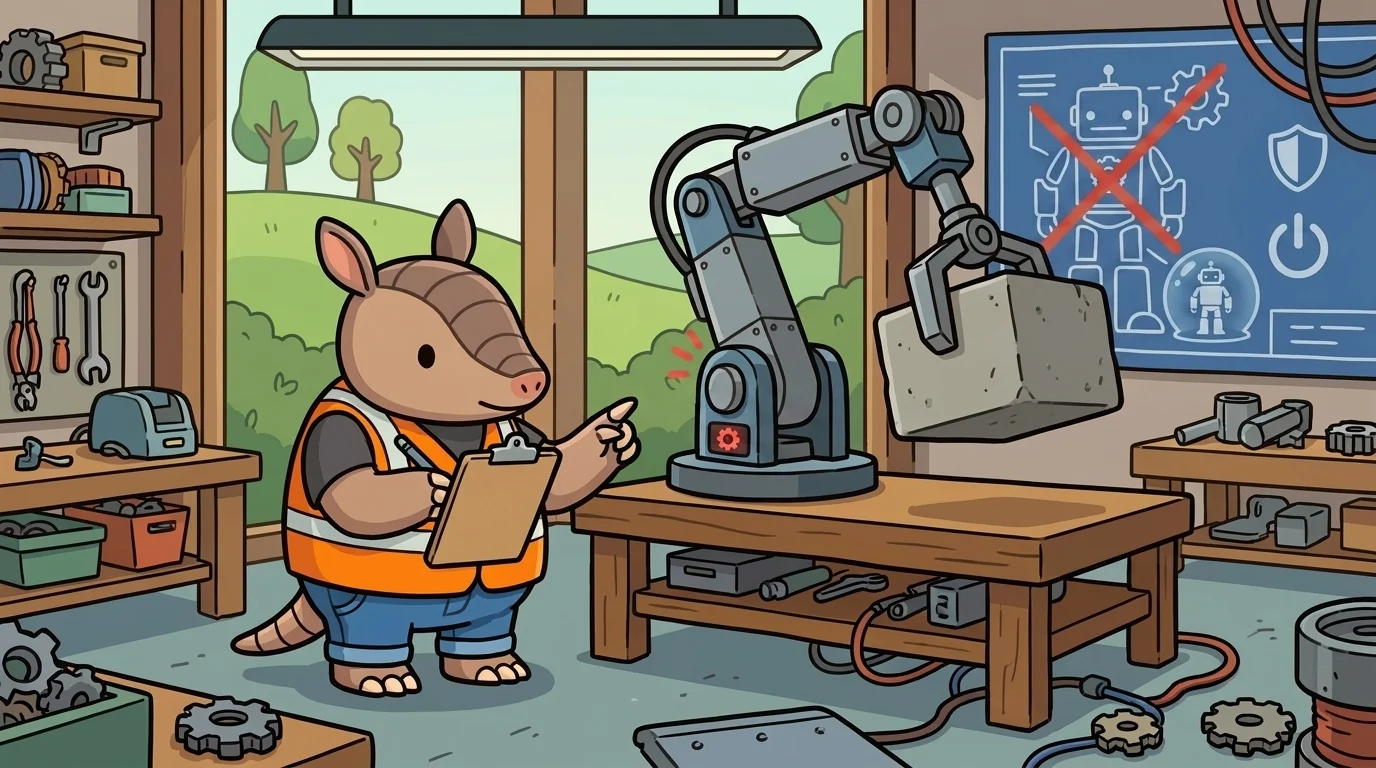
Halt learned to plan for failure the day a robot that couldn't fail safely scared everyone.
He was young, and he'd built a fast little robot with no plan for trouble at all. When its steering broke mid-run, it didn't stop — it just kept going, full speed, blind, careening around the room until it crashed into a shelf. Nobody was hurt, but everyone had scrambled out of its way, hearts pounding.
His grandmother, an old armadillo with a scarred, sturdy shell, sat with him.
"The steering broke," young Halt said, shaken. "That wasn't my fault!"
"The breaking wasn't your fault, little one," his grandmother said gently. "Things break; that's the world. But what it did when it broke — kept racing, blind and dangerous — that was a choice you didn't make. You never told it what to do when things went wrong, so it did the worst possible thing: nothing but keep going." She tapped his shell. "A good builder assumes everything will fail, and plans the failure gently. If the steering breaks — stop. If the battery's low — return, or park safely. If a sensor goes dark — slow down, don't guess. If anything's wrong at all — fail toward safe, never toward danger." She smiled. "And here's the beautiful part: once your robot always fails safely, you can be braver. You can try wild, fast, ambitious things — because you know that if it breaks, it'll stop gently, not hurt anyone. Fail-safe design isn't gloomy. It's what makes bold building possible."
Young Halt never built a robot without a failure plan again. He knew: you can't stop things from breaking. But you can always decide how they break.
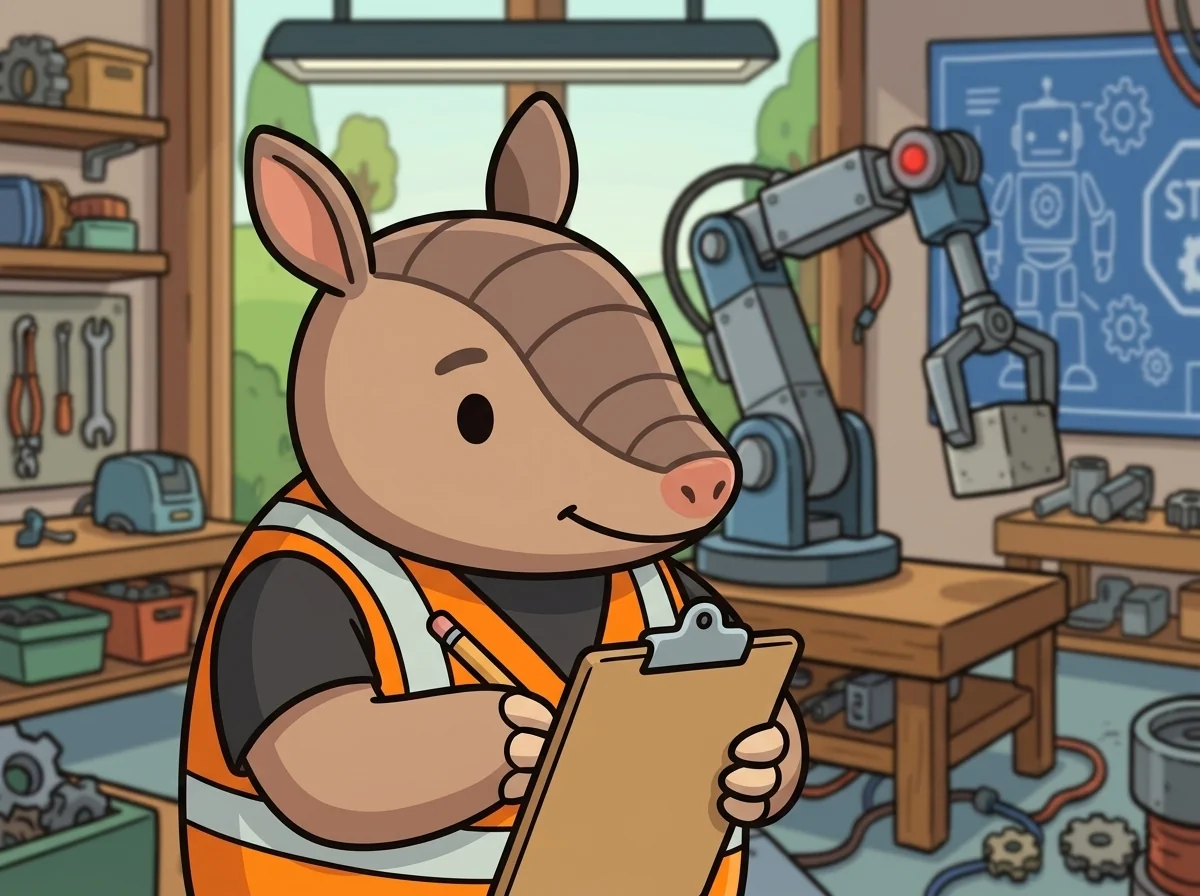
He walked to RoboForge at twelve, because a place that built robots ought to build them to break safely.
Servo, his mentor, met him at the workbench. "What does your robot do when it breaks?"
Halt didn't answer with a speech. He took a robot and, mid-task, yanked a wire loose on purpose. The robot — which he'd designed fail-safe — instantly noticed the fault, gently lowered what it was holding, powered down its motors, and blinked a calm red light: I have a problem, I've stopped safely, please check me. "There," Halt said. "It broke. And instead of grinding or racing or dropping something, it stopped, safely, and asked for help. That's the behavior I care about most. Not what it does when it works. What it does when it doesn't."
Servo watched the robot fail gently. "You are appointed," he said.
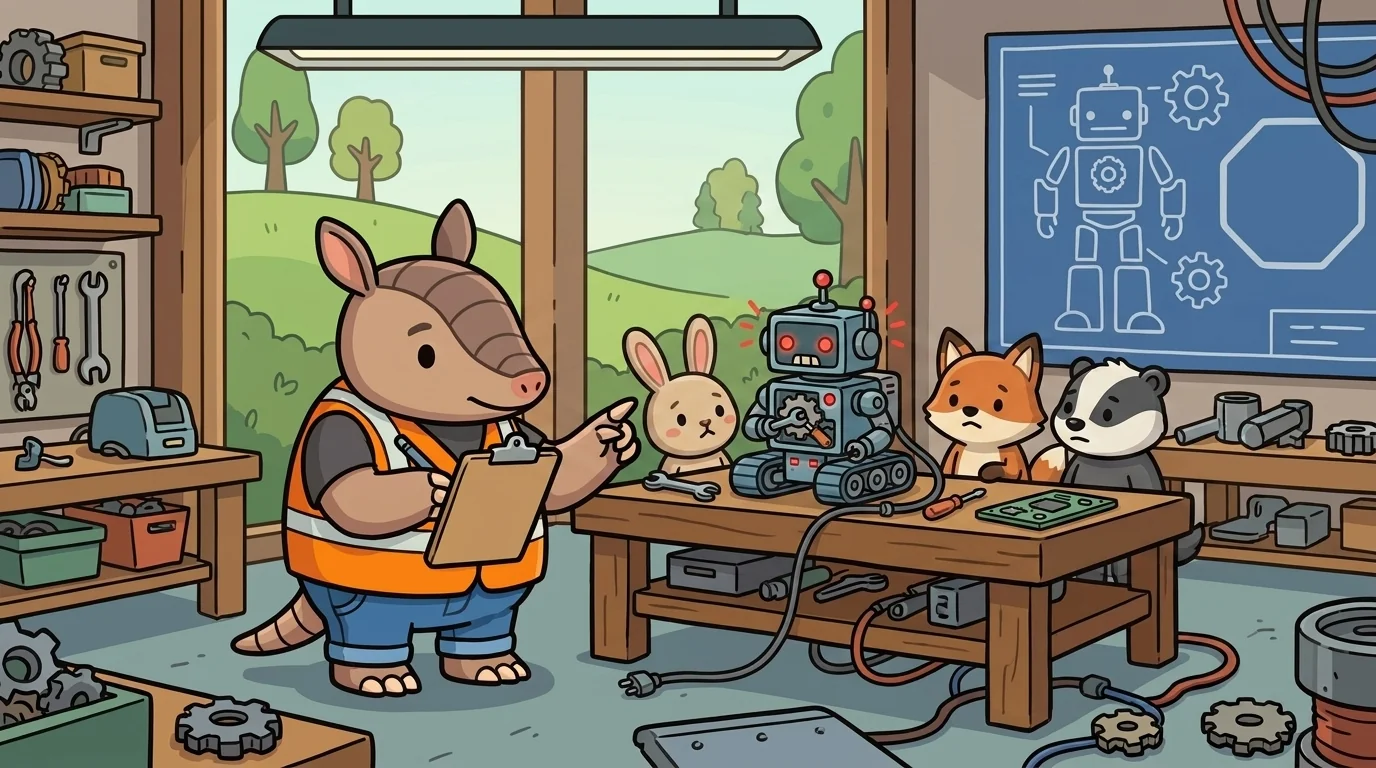
At Halt's workbench, he taught fail-safe design by breaking things on purpose. He'd have the kids build a robot, then he'd sabotage it — jam a wheel, unplug a sensor, drain the battery — and ask: "What did it do? Was that safe?" A robot that kept forcing a jammed wheel (overheating) — not safe; add a rule: "if the wheel won't turn, stop." A robot that guessed blindly when its sensor died (crashing) — not safe; add a rule: "if you can't see, slow down and stop." Then he gave the working rules: assume every part will fail eventually, and decide in advance what the robot does when each one does; the golden rule is fail toward safe — when something's wrong, stop, slow, park, or power-down gently, never grind, force, race, or guess; and a clear "I have a problem" signal (a light, a beep) so a human can help beats a robot that hides its failure and struggles on. "A student thought planning for failure was 'giving up before you start,'" Halt said, curling calm. "But it's the opposite. Because his robot always failed safely, he could finally try the bold, fast, risky things he'd been afraid of — knowing that if they broke, they'd break gently. Fail-safe design doesn't make you timid. It makes you free to be brave."
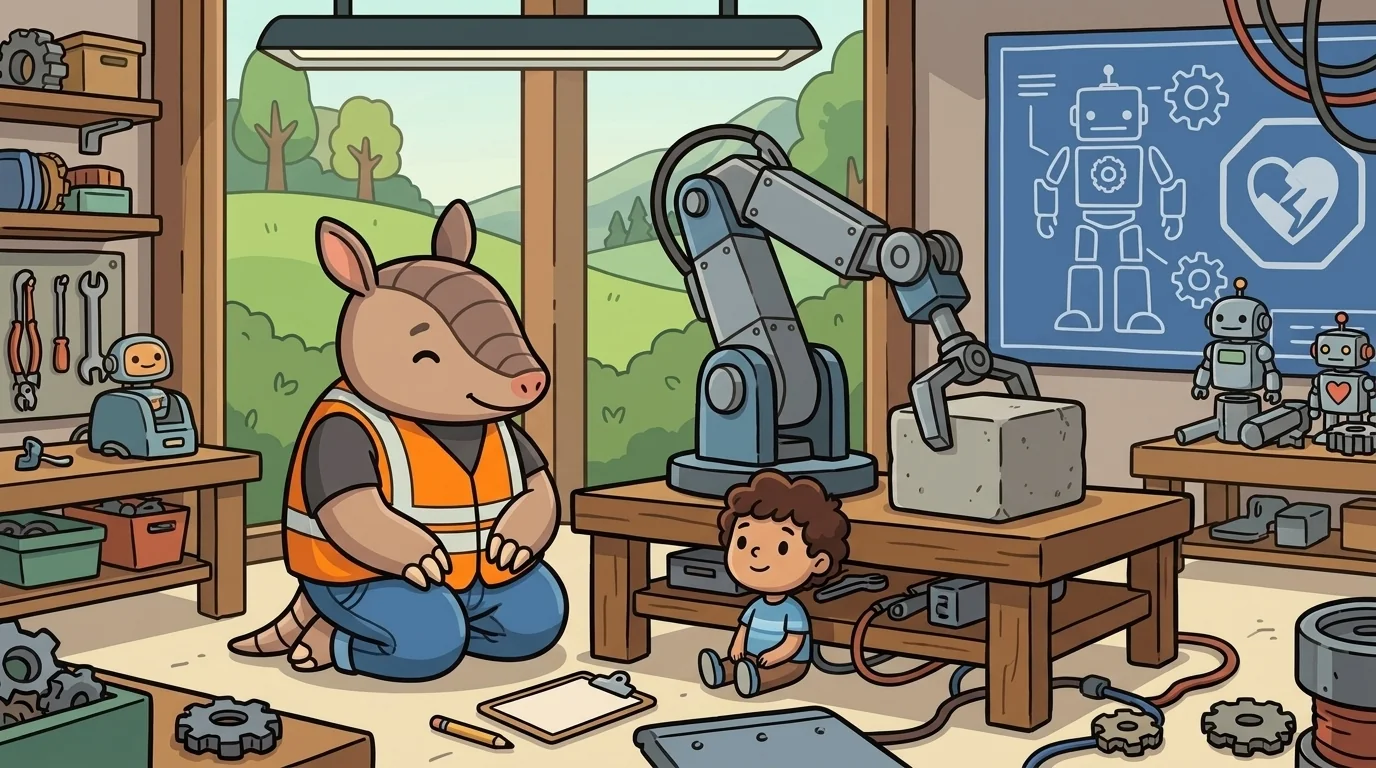
"So planning for the worst is what lets me try the boldest things?" a student said slowly.
"Fail safe, and you're free to be brave," Halt agreed, and he settled onto his sturdy haunches beside his always-safe robots, feeling the deep, unworried calm of one who had made peace with the fact that everything breaks — and had made sure that when it did, nothing would go wrong that mattered. There was a warm, protected happiness in it — the settled contentment of an armadillo who had stopped fearing failure by planning for it, who knew that a robot built to break gently was a robot he could send off on any wild mission with an easy heart. It made him feel calm, and safe, and — surprisingly — bold. That fail-toward-safe, plan-for-the-break, free-to-be-brave warmth — the protected gladness of a creature who feared no breakdown — was, to Halt, the quiet courage hidden inside a failure plan. "Everything breaks," he said softly, curled and calm. "So decide, now, how it breaks — and then go be as brave as you like."
The RoboForge ensemble
Halt is part of RoboForge's distributed-narrative cast. Each character embodies a different curricular primitive; together they teach the full subject.
-

Bolt
Chassis + mechanical structure — 'the frame holds everything; build the chassis like you mean it'
-

Sense
Sensors + perception — 'the robot only knows what it can sense; choose the senses for the job'
-
Drive
Motors + actuators + movement — 'motors turn power into motion; balance speed and control'
-

Loop
Iteration + sensor-driven control loops — 'read. decide. act. repeat. that's the whole robot brain'
-

Tune
Testing + calibration + iteration — 'first run fails. that's information. tune + run again' (closes cast arc)
-
Charge
Power budget + energy management — 'every part sips power; know your battery budget or your robot dies mid-mission'
-

Clamp
Grippers + manipulation — 'grabbing is harder than it looks; hold firm enough not to drop, gentle enough not to crush'
-

Hail
Communication + signals — 'a robot alone knows only its own corner; robots that talk share what they each can see'
-
Rove
Navigation + pathfinding — 'don't just go toward the goal; find a PATH around what is in the way'