
Clamp
CLAMP — grabbing is harder than it looks. hold firm enough not to drop, gentle enough not to crush.
Loading audio…
Press play to listen along. The line being read lights up as you go.
Show full transcript
Loading transcript…
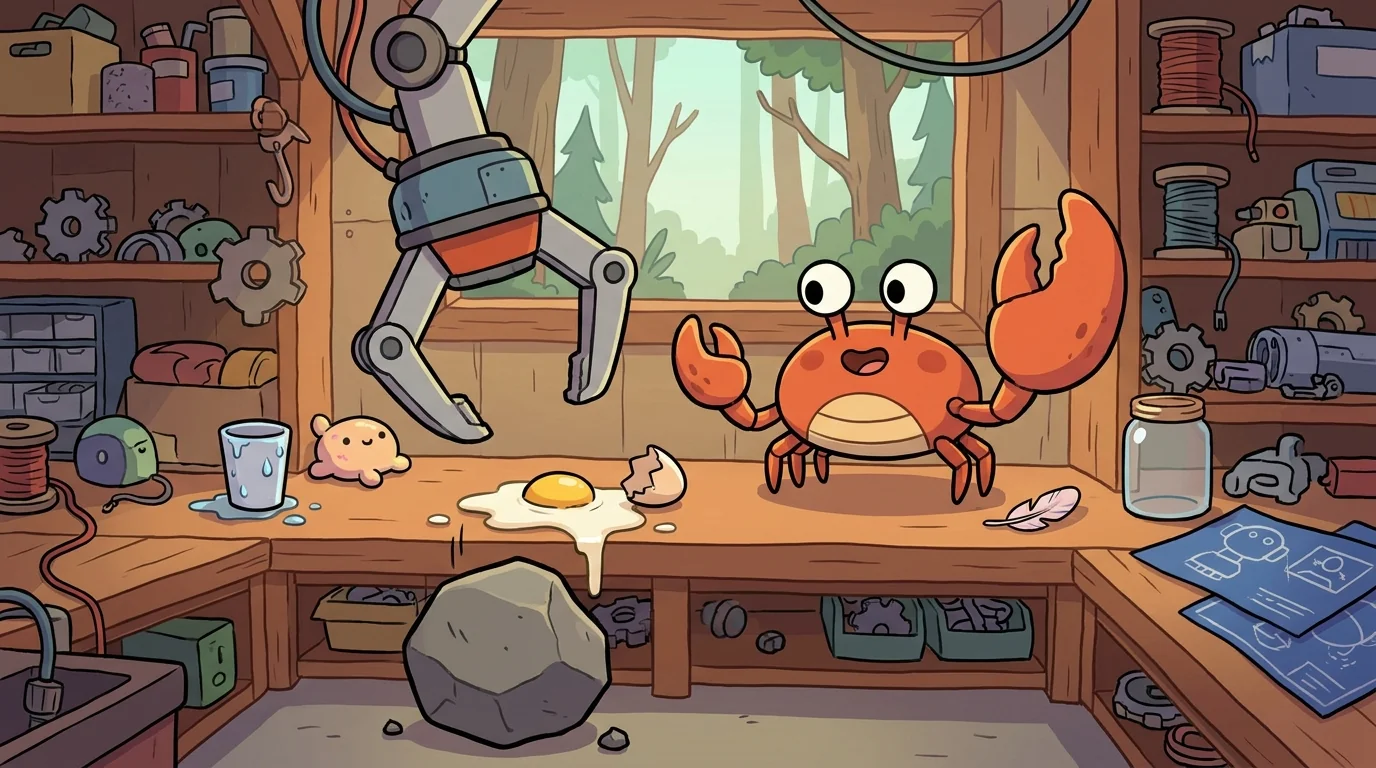
At Clamp's workbench a robot claw hovered over a raw egg and a heavy rock, and Clamp — a wide-eyed crab with two mismatched pincers — was about to show why picking things up is the hardest thing a robot ever does.
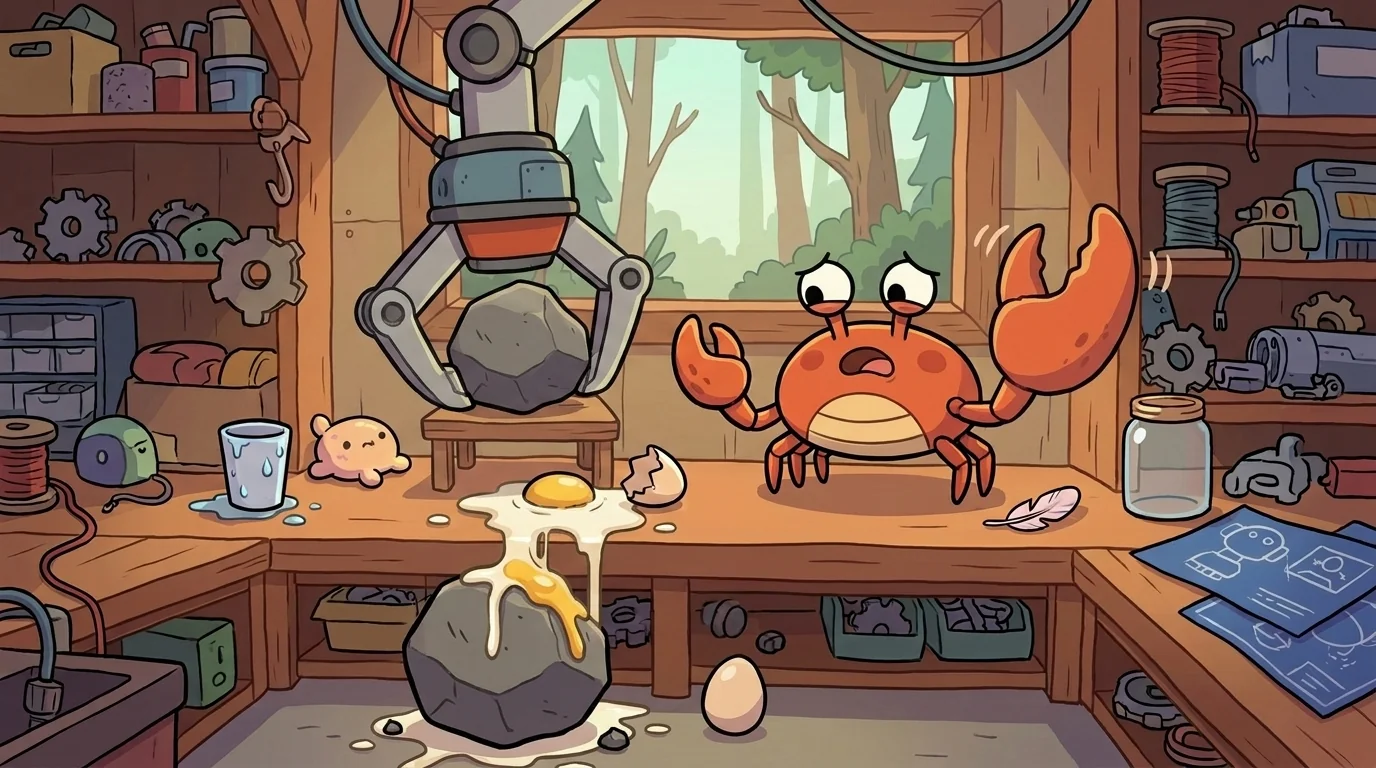
"Everyone thinks the hard part of a robot is the brain," she said, clicking a pincer. "Then they watch it try to pick something up. This is manipulation, and it's brutal." She lowered the claw onto the egg with a fixed grip — splat. "Too firm." She tried the rock with the same gentle setting — it slipped and thudded. "Too soft. And here's the trap: a claw that squeezes with a fixed force is doomed, because the right force is different for every object, and it changes moment to moment."
She held up a plain claw. "A naive gripper is open-loop — you command a position, it closes to there, done. It has no idea what it's holding or whether it's working. To grip well you need a closed loop: the claw senses and adjusts continuously. So I add force feedback — a sensor that reads how hard the fingers are actually pressing. Now the claw closes not to a fixed position but to a target force: a whisper for the egg, a real squeeze for the rock. Same command, right pressure for each."
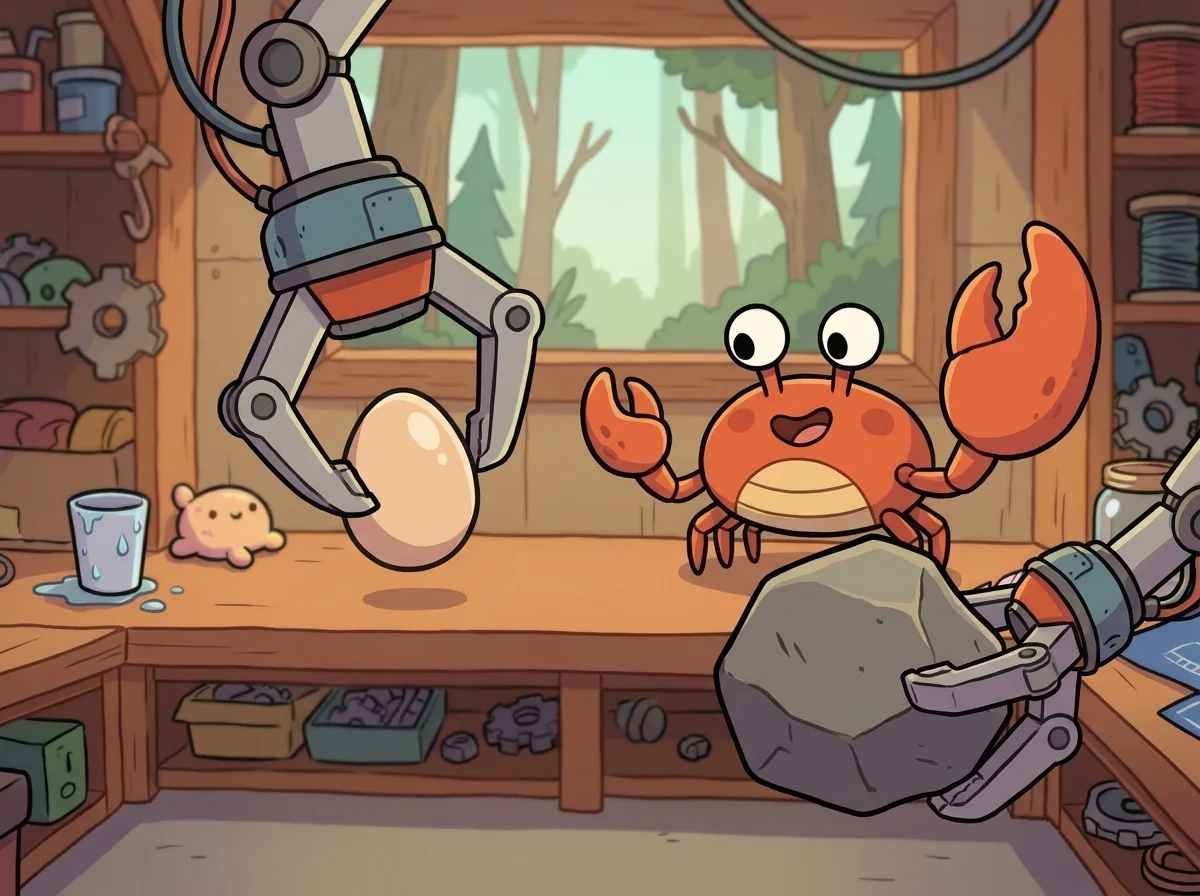
"How does it know when it's about to drop something?" a builder asked.
"Slip detection," Clamp said. "A tiny sensor feels the object beginning to slide — micro-vibrations, a shift — before it's gone. The moment it feels a slip, the loop firms up just enough to catch it, then eases back. And when it feels the object straining — starting to deform — it eases off. That's the whole art: firm on a slip, gentle on a strain, all in a fast feedback loop, dozens of times a second."
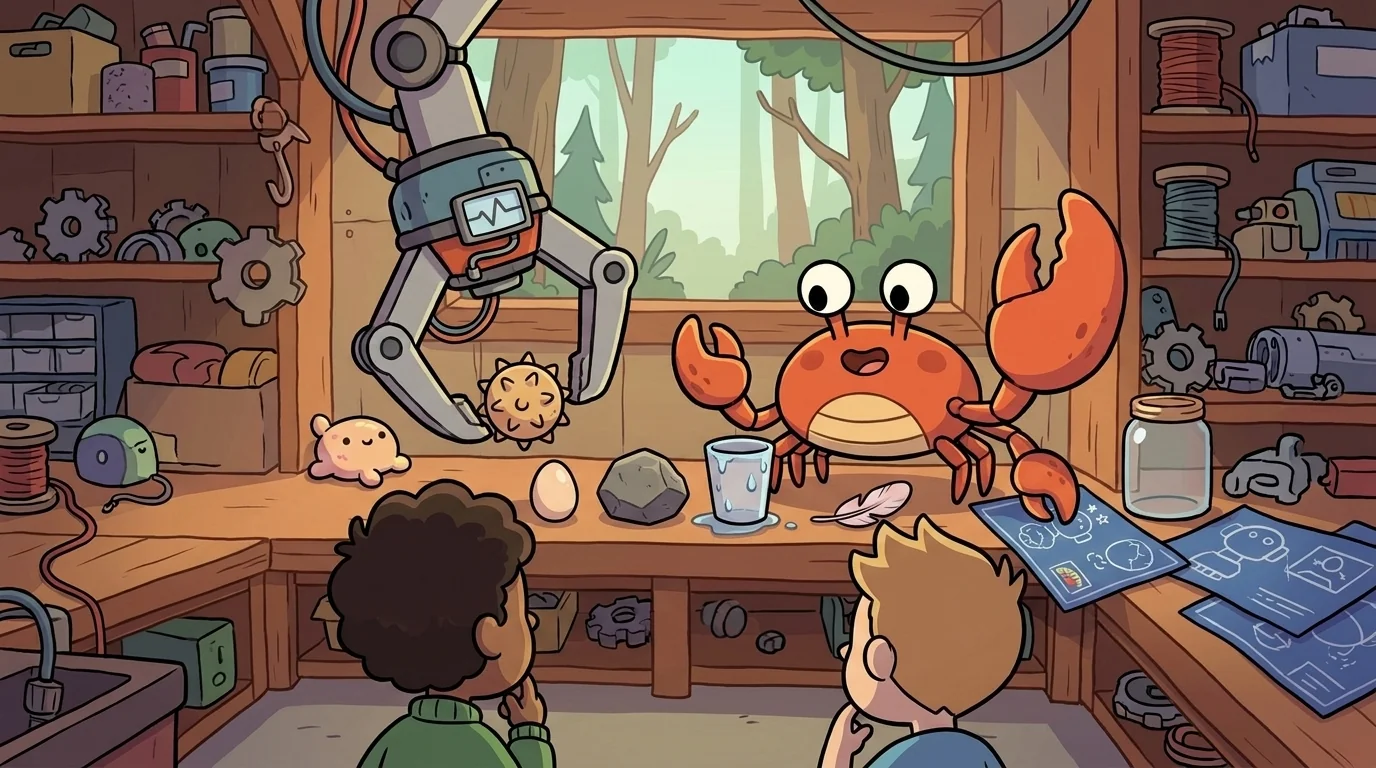
She picked up a soft foam ball without denting it. "There's one more trick: compliance. A rigid claw fights every bump; a compliant gripper — one with a little built-in give, like a spring or a soft pad — automatically conforms to odd shapes and forgives small errors. Softness, engineered on purpose, grips better than raw stiffness."
"So the right grip depends on the thing," the builder said slowly, "not on how hard I can squeeze."
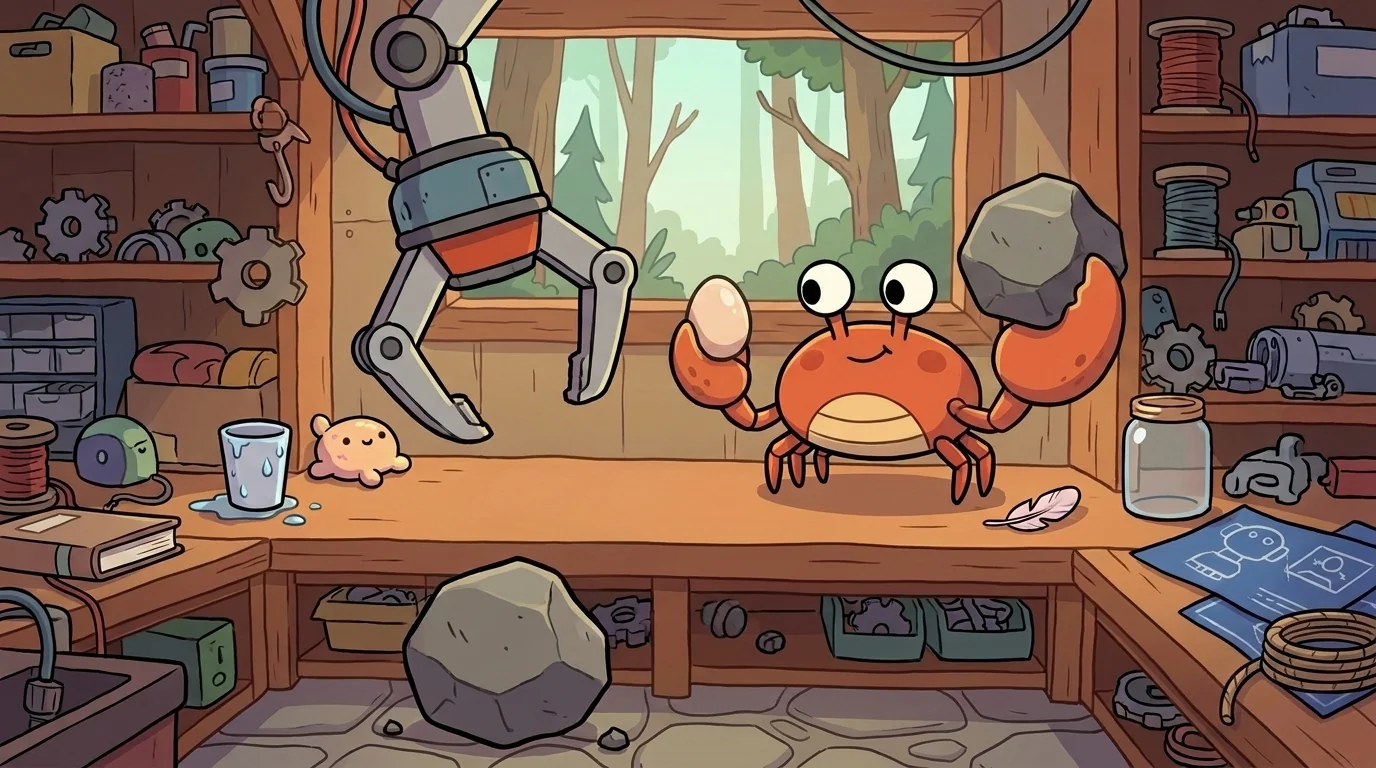
"Fit the grip to the thing," Clamp agreed, and she settled at her bench and cradled a raw egg whole in one careful pincer while holding a heavy stone secure in the other — each held exactly as it needed. A warm, attuned happiness settled in her: the gladness of a crab who had stopped prizing raw strength and learned the subtler art of fitting, of listening with her hands.
Both held safe, she let her pincers rest. "Firm enough not to drop," she said softly, "gentle enough not to crush — and different for everything you hold."
The RoboForge ensemble
Clamp is part of RoboForge's distributed-narrative cast. Each character embodies a different curricular primitive; together they teach the full subject.
-

Bolt
Chassis + mechanical structure — 'the frame holds everything; build the chassis like you mean it'
-

Sense
Sensors + perception — 'the robot only knows what it can sense; choose the senses for the job'
-
Drive
Motors + actuators + movement — 'motors turn power into motion; balance speed and control'
-
Loop
Iteration + sensor-driven control loops — 'read. decide. act. repeat. that's the whole robot brain'
-

Tune
Testing + calibration + iteration — 'first run fails. that's information. tune + run again' (closes cast arc)
-
Charge
Power budget + energy management — 'every part sips power; know your battery budget or your robot dies mid-mission'
-
Hail
Communication + signals — 'a robot alone knows only its own corner; robots that talk share what they each can see'
-
Halt
Fail-safe + safe failure — 'everything breaks eventually; plan for it — fail safe, not dangerous'
-
Rove
Navigation + pathfinding — 'don't just go toward the goal; find a PATH around what is in the way'