
Rove
ROVE — don't just go toward the goal — find a PATH to it, around what's in the way.
Loading audio…
Press play to listen along. The line being read lights up as you go.
Show full transcript
Loading transcript…
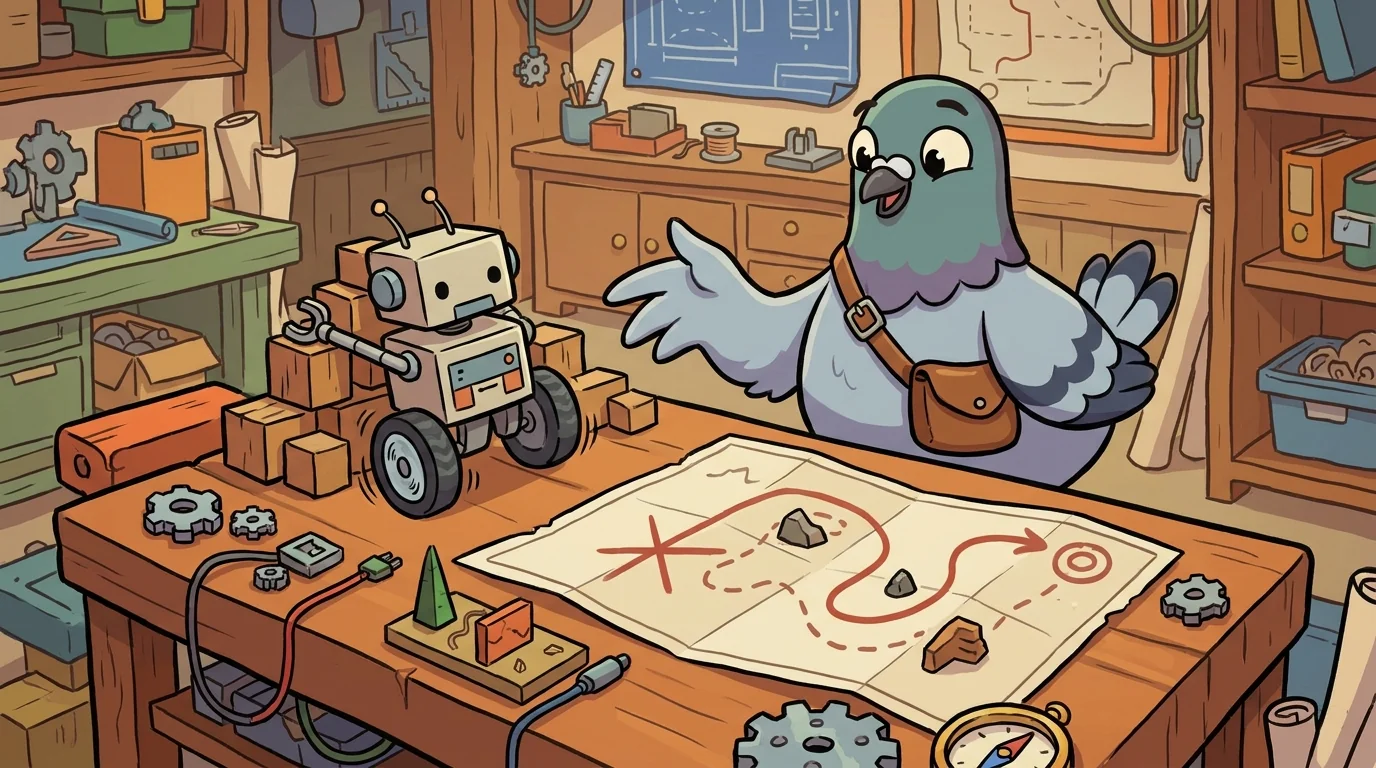
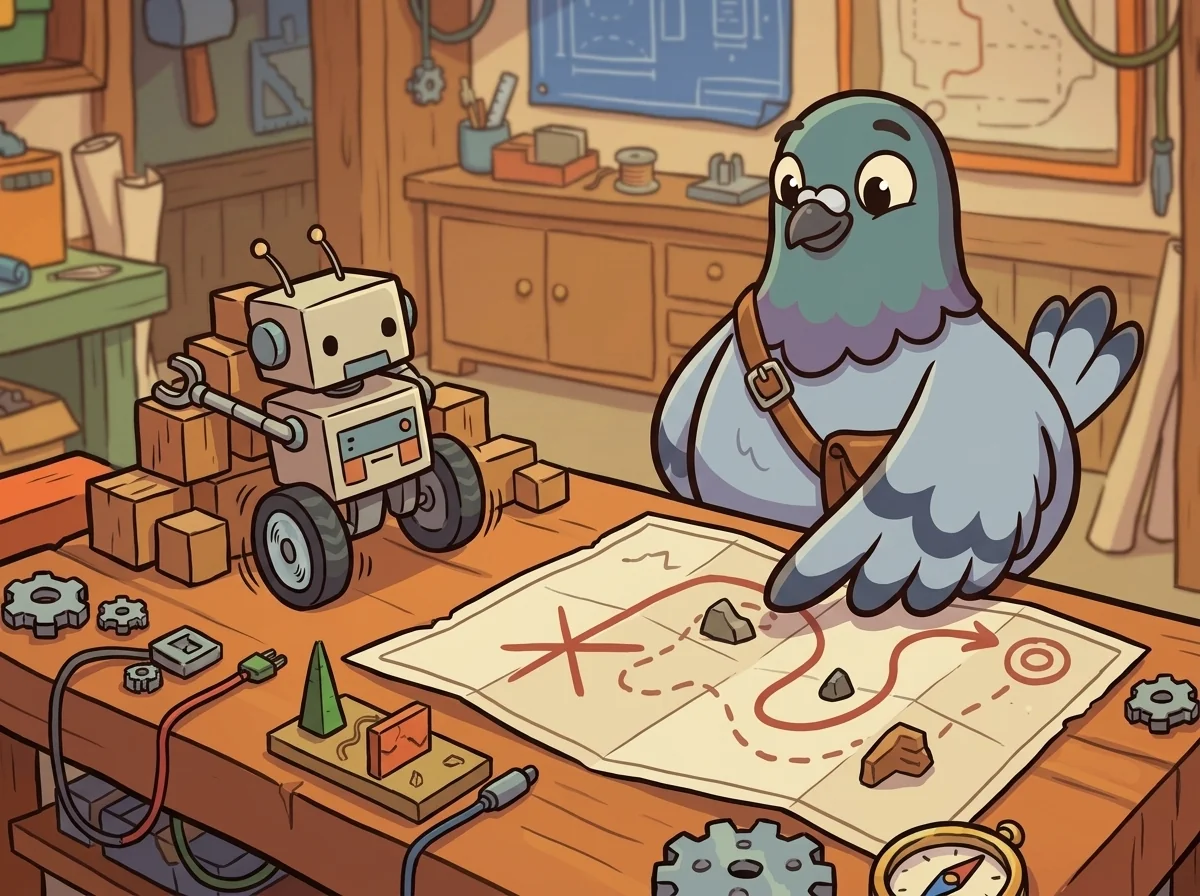
At Rove's workbench sat a little robot in a cluttered maze of blocks, and Rove — a plump homing pigeon with a map-pouch — was teaching it the difference between wanting to reach the goal and knowing how to get there.
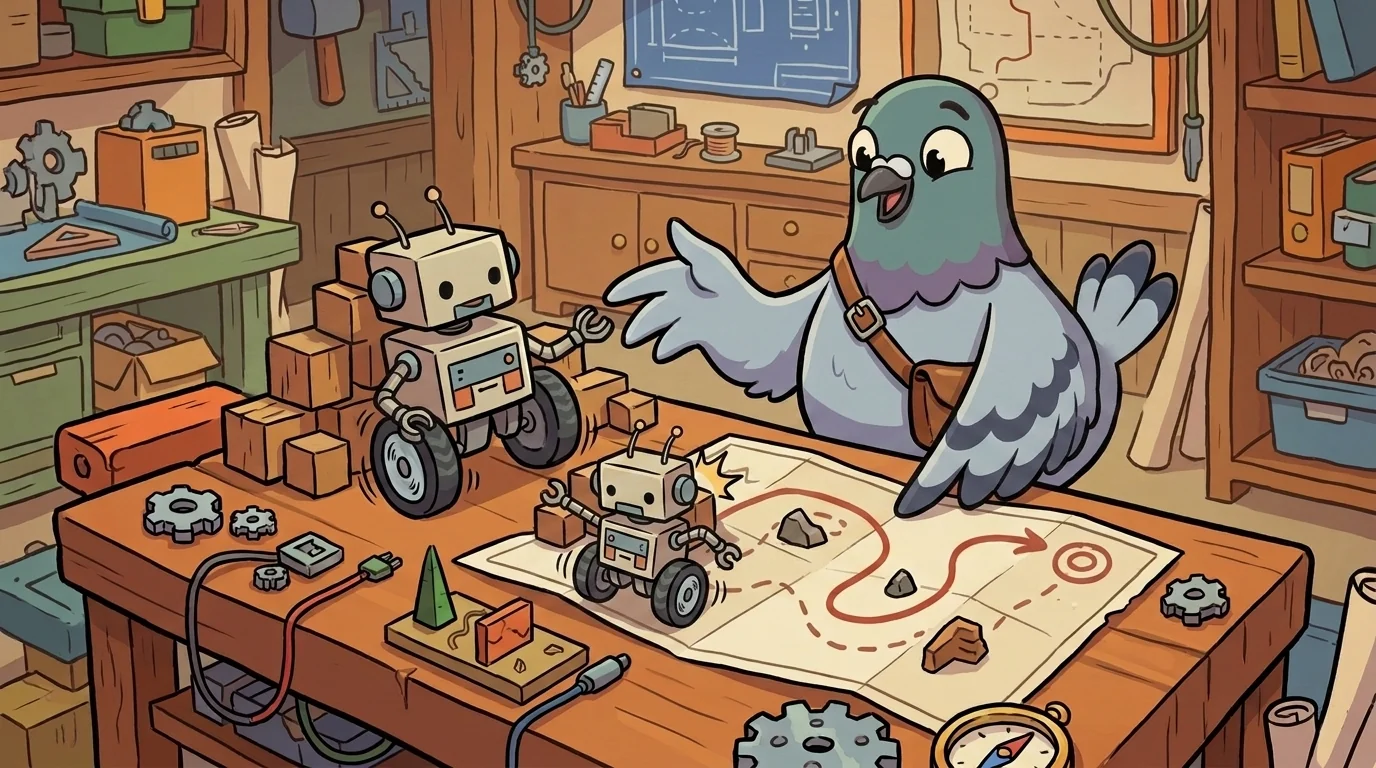
"Everyone thinks getting somewhere means heading straight at it," he cooed. "A naive robot does exactly that — the 'greedy' method: point at the goal, drive forward. Watch." The robot aimed straight and rammed a block, wheels spinning. "It wanted the goal. It just had no path. Wanting isn't a plan — and greedy-toward-the-goal gets stuck at the first wall."
He spread a grid over the maze. "Real navigation has two halves. First, the robot needs a map of what's in the way — an occupancy grid, where each little square is marked free or blocked from its sensors. You can't plan a route through a world you haven't mapped. Second, path planning: a search over that grid for a route of free squares from here to the goal. A good planner — the kind that powers real robots — explores outward, always expanding the most promising square first, until it finds the shortest clear path. And crucially, it will happily route away from the goal to get around an obstacle, because the shortest straight line is usually blocked and the shortest real path curves."
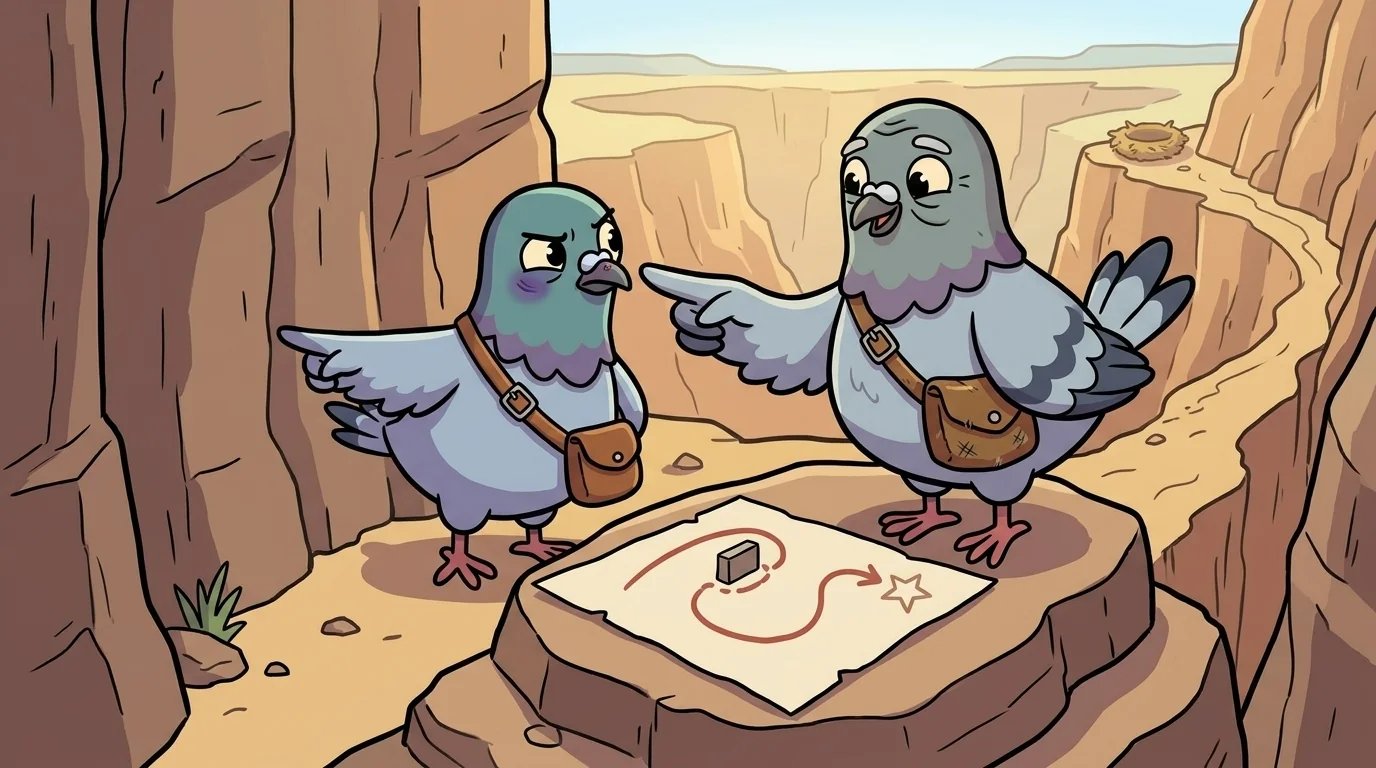
"Why can't it just turn when it hits the wall?" a builder asked.
"That's the greedy trap — the local minimum," Rove said. "Drive toward the goal, hit a wall, follow the wall... and a U-shaped obstacle can catch you in a pocket forever, endlessly 'closest' to the goal but never reaching it. A planner that looks at the whole map escapes the pocket, because it can see that the way out leads backward first. That's the difference between reacting and planning."
He traced a winding line. "Once the planner finds the route, it doesn't need every square — it picks waypoints, a few key turning points, and drives from one to the next, re-checking for anything new that moved into the way. Map the obstacles, plan a route over the map, follow the waypoints, replan if the world changes."
"So reaching a goal isn't about going straight at it," the builder said slowly. "It's about finding the path around what's in the way."
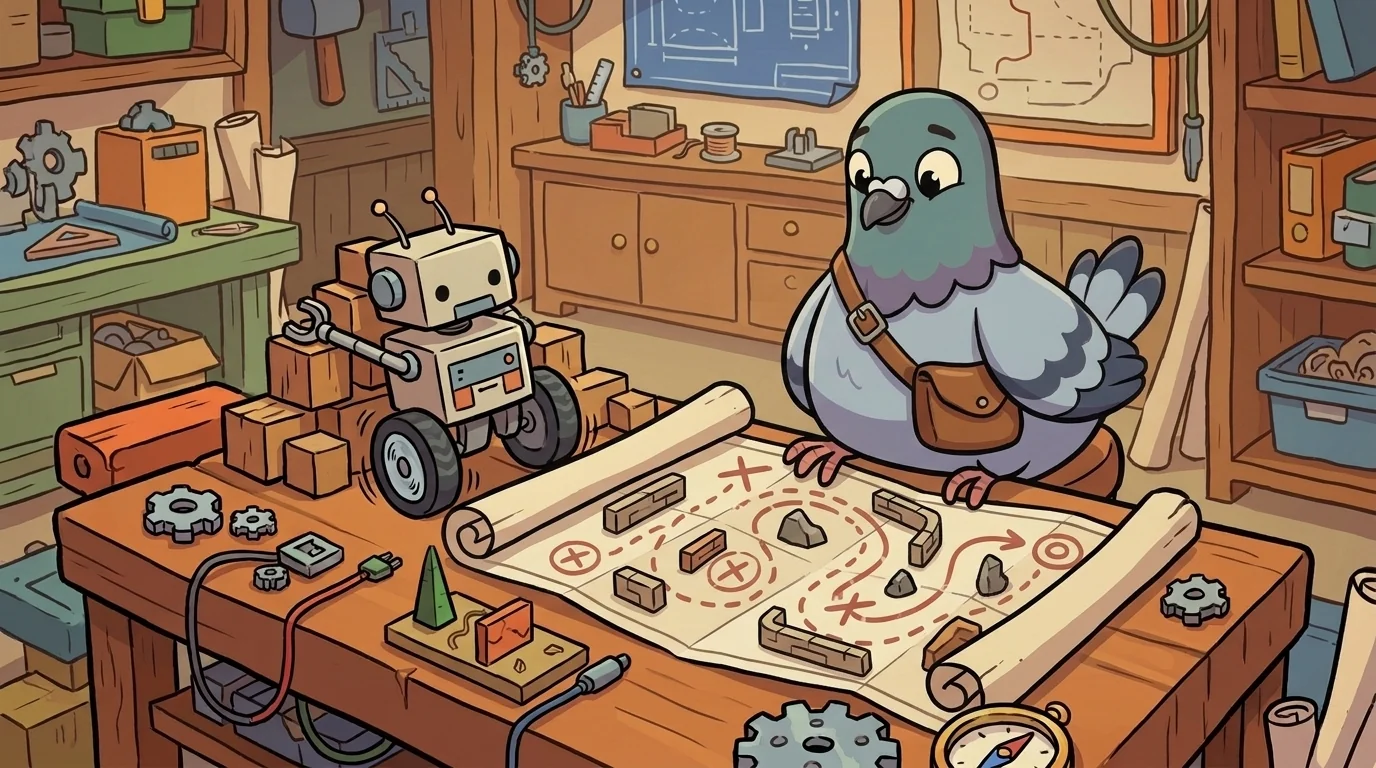
"Find the path, not just the goal," Rove agreed, and he settled on his perch and unrolled his well-worn map, tracing the winding, around-the-walls routes that always, eventually, led home. A warm, resourceful happiness settled in him — the gladness of a pigeon who had stopped battering himself against walls and learned to find the way around, who knew a goal blocked by a wall was never lost, only in need of a cleverer route.
He smoothed the map. "The goal tells you where," he said softly, "but the path — the winding, around-the-walls path — tells you how."
The RoboForge ensemble
Rove is part of RoboForge's distributed-narrative cast. Each character embodies a different curricular primitive; together they teach the full subject.
-

Bolt
Chassis + mechanical structure — 'the frame holds everything; build the chassis like you mean it'
-

Sense
Sensors + perception — 'the robot only knows what it can sense; choose the senses for the job'
-

Drive
Motors + actuators + movement — 'motors turn power into motion; balance speed and control'
-

Loop
Iteration + sensor-driven control loops — 'read. decide. act. repeat. that's the whole robot brain'
-

Tune
Testing + calibration + iteration — 'first run fails. that's information. tune + run again' (closes cast arc)
-
Charge
Power budget + energy management — 'every part sips power; know your battery budget or your robot dies mid-mission'
-

Clamp
Grippers + manipulation — 'grabbing is harder than it looks; hold firm enough not to drop, gentle enough not to crush'
-

Hail
Communication + signals — 'a robot alone knows only its own corner; robots that talk share what they each can see'
-

Halt
Fail-safe + safe failure — 'everything breaks eventually; plan for it — fail safe, not dangerous'