
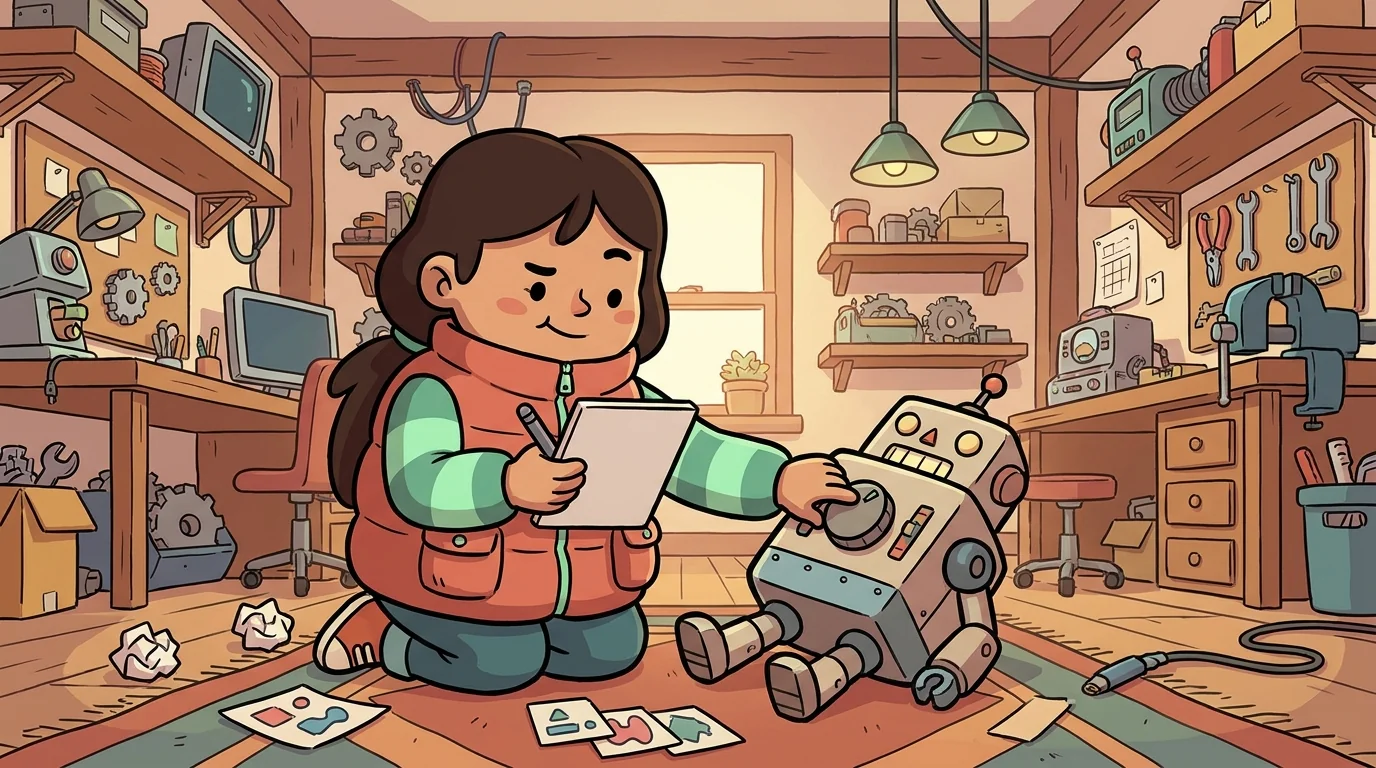
Tune
TUNE — *first run fails. that's information. tune + run again.*
Listen along — Tune
Loading audio…
Press play to listen along. The line being read lights up as you go.
Show full transcript
Loading transcript…
Chapter 5 — Tune and the Failure-Is-Data
The maze-solving robot rolled forward with great confidence, hit the first wall head-on, and got stuck spinning in a circle. The cast groaned.
Tune did not groan. Tune held up the log-tracker and smiled. “That’s data, not failure,” Tune said gently. “Watch what it actually told us. The robot DETECTED the wall — Sense’s sensors worked. It TRIED to turn — Drive’s motors worked. But it spun in place, because the turn was too sharp and it wedged itself. So we don’t rebuild everything. We change ONE thing: make the turn forty-five degrees instead of ninety. Run again.”
Run two. The robot took the first corner cleanly — and smacked into the second wall. A different failure this time. The cast winced, but Tune’s pencil was already moving. “Now the issue is detection-distance. The sensor triggered too late, so it couldn’t slow down in time. Increase the slow-down distance. Run again.”
Run three. The robot threaded the first corner, then the second, then rolled out the far side of the maze. The cast cheered.
“Five iterations from an idea to a working maze-solver,” Tune said, closing the log. “And here’s the thing people get wrong about robots: they think the first run is supposed to work, and when it doesn’t, they feel like they failed. But the first run is never supposed to work. Each failure was a signpost pointing at the exact next thing to change. The failures weren’t in the way of the robot working. They WERE the way.”
Servo the mentor smiled. “Tune closes the cast,” Servo said quietly. “Bolt built the frame. Sense gave it eyes. Drive gave it motion. Loop gave it the brain-cycle. But Tune teaches the way of iterating that makes all of it survive contact with the real world — where nothing works on the first try, and everything can work by the fifth, if you’ll read each failure instead of fearing it.”
“First run fails. Change one thing. Run again. Repeat.”
The RoboForge ensemble
Tune is part of RoboForge's distributed-narrative cast. Each character embodies a different curricular primitive; together they teach the full subject.
-

Bolt
Chassis + mechanical structure — 'the frame holds everything; build the chassis like you mean it'
-

Sense
Sensors + perception — 'the robot only knows what it can sense; choose the senses for the job'
-
Drive
Motors + actuators + movement — 'motors turn power into motion; balance speed and control'
-
Loop
Iteration + sensor-driven control loops — 'read. decide. act. repeat. that's the whole robot brain'
-
Charge
Power budget + energy management — 'every part sips power; know your battery budget or your robot dies mid-mission'
-

Clamp
Grippers + manipulation — 'grabbing is harder than it looks; hold firm enough not to drop, gentle enough not to crush'
-
Hail
Communication + signals — 'a robot alone knows only its own corner; robots that talk share what they each can see'
-
Halt
Fail-safe + safe failure — 'everything breaks eventually; plan for it — fail safe, not dangerous'
-
Rove
Navigation + pathfinding — 'don't just go toward the goal; find a PATH around what is in the way'