Chrono
LONGITUDE FROM A CLOCK
Chrono Must Not Drift
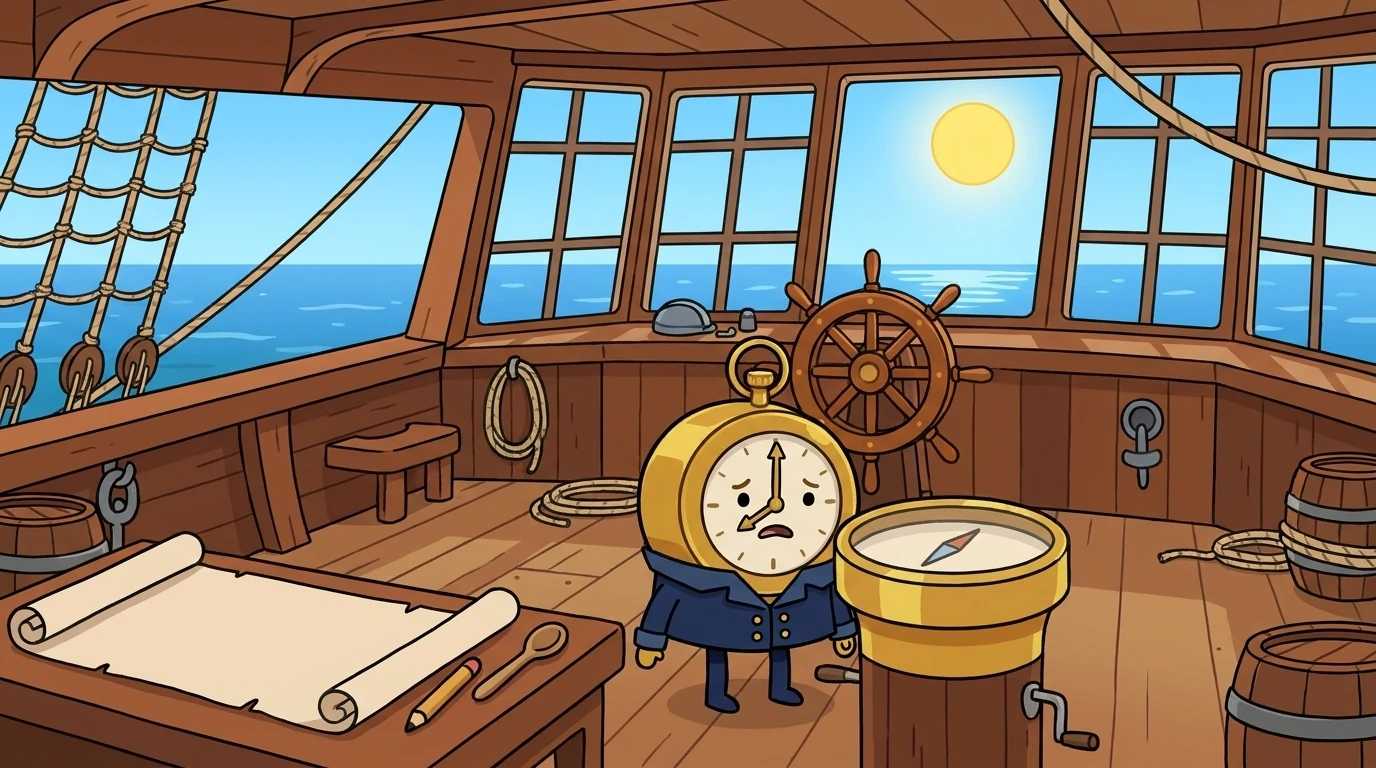
Chrono is a brass ship’s clock with a round, worried, honest face and a navy coat buttoned all the way up, and Chrono has the most careful job on the ship. Chrono keeps the time of a place the ship left behind weeks ago.
“Home time,” Chrono says, ticking softly. “Not the time here. The time back in the port we sailed from. I hold it, second by second, all the way across the sea.”
Why would anyone want the wrong time? Because of the way the Earth turns. The Earth spins once every twenty-four hours, all the way round, three hundred and sixty degrees. Divide three hundred and sixty by twenty-four, and you get fifteen. So every hour, the Earth turns fifteen degrees.
That means noon, the moment the Sun is highest, does not arrive everywhere at once. It sweeps around the world from east to west. A town fifteen degrees west of yours gets its noon one hour later than you do.
So here is the trick. Out at sea, the captain watches the Sun climb and catches the moment it stops rising and starts to sink. That is local noon, the ship’s own noon. Then the captain asks Chrono, “What time is it at home?”
“Two in the afternoon,” says Chrono.
Home is two hours ahead. Two hours times fifteen degrees is thirty degrees. “We are thirty degrees west of home,” the captain says, and marks the chart. That number is the ship’s longitude, the east-west part of its position, which the stars alone cannot easily give.
Chrono glows a little with each correct answer. But Chrono also carries a tight, careful worry, all the time, like holding a full cup across a rocking deck.
“Every four minutes I gain or lose,” Chrono says quietly, “puts the ship one whole degree wrong.” Fifteen degrees in sixty minutes is one degree in four minutes. And near the equator, one degree is about sixty nautical miles of sea. A clock that drifts by seven minutes could put a ship a hundred miles from where the captain thinks it is, with rocks waiting in the dark.
For a very long time, clocks could not keep good time at sea. Ships roll and pitch. The air is damp, then hot, then freezing. Pendulum clocks that ticked perfectly on a shelf went wild on the waves. Sailors knew how far north they were from the stars, but east and west were a guess, and ships ran aground because of it. In 1714 a government offered a great prize to anyone who could find longitude at sea to within half a degree. Half a degree is two minutes of time over a voyage of weeks.
In the 1700s, a clockmaker spent most of his life building sea clocks that could do it. His finest, a large watch, sailed across the Atlantic on a trial voyage of many weeks and lost only a handful of seconds. Sailors could finally carry home time across an ocean.
“I come from that idea,” Chrono says, and stands a little straighter. “A clock that does not drift.”
But even a good clock needs checking. So on clear nights, the navigator measures the sky, and sometimes the stars and the Moon give a second answer for longitude. When the sky’s answer and Chrono’s answer agree, Chrono’s tight worry loosens, just a little, like a deep breath.
“I am not perfect,” Chrono admits. “Nobody’s clock is. But I try very hard not to drift, and I am glad when someone checks me. Being checked is not the same as being doubted. It is how we stay safe together.”
Every morning at the same hour, the navigator winds Chrono with a small brass key, never too tight, never forgotten. A clock that is not wound simply stops, and a stopped clock keeps no home time at all.
On this ship, Chrono is not alone. Two more clocks sit beside it in a padded wooden box, each in its own little bed. The young navigator once asked why.
“With one clock, you trust it and hope,” the captain said. “With two, if they disagree, you cannot tell which one has drifted. With three, the two that agree are probably right, and the odd one out gets checked.”
Chrono did not like the idea of being the odd one out. It felt like being caught. But one grey morning it happened: Chrono was eleven seconds away from the other two. Nobody scolded it. The navigator simply wrote the difference in the log and kept track of it, day after day, so the ship could still use Chrono’s answer, corrected.
“Oh,” Chrono thought, surprised. “Being wrong by a little, and saying so, is still useful.”
The captain taps Chrono’s glass gently. “Home time?”
“Three minutes past four,” says Chrono, steady and careful, and the ship sails on through the dark, exactly where it means to be.
The SextantForge ensemble
Chrono is one of the friends in SextantForge. Each friend shows you one idea by how they act; meet them all and you have the whole subject.