Meridian
ONE HOUR = 15 DEGREES
Meridian Draws the Lines
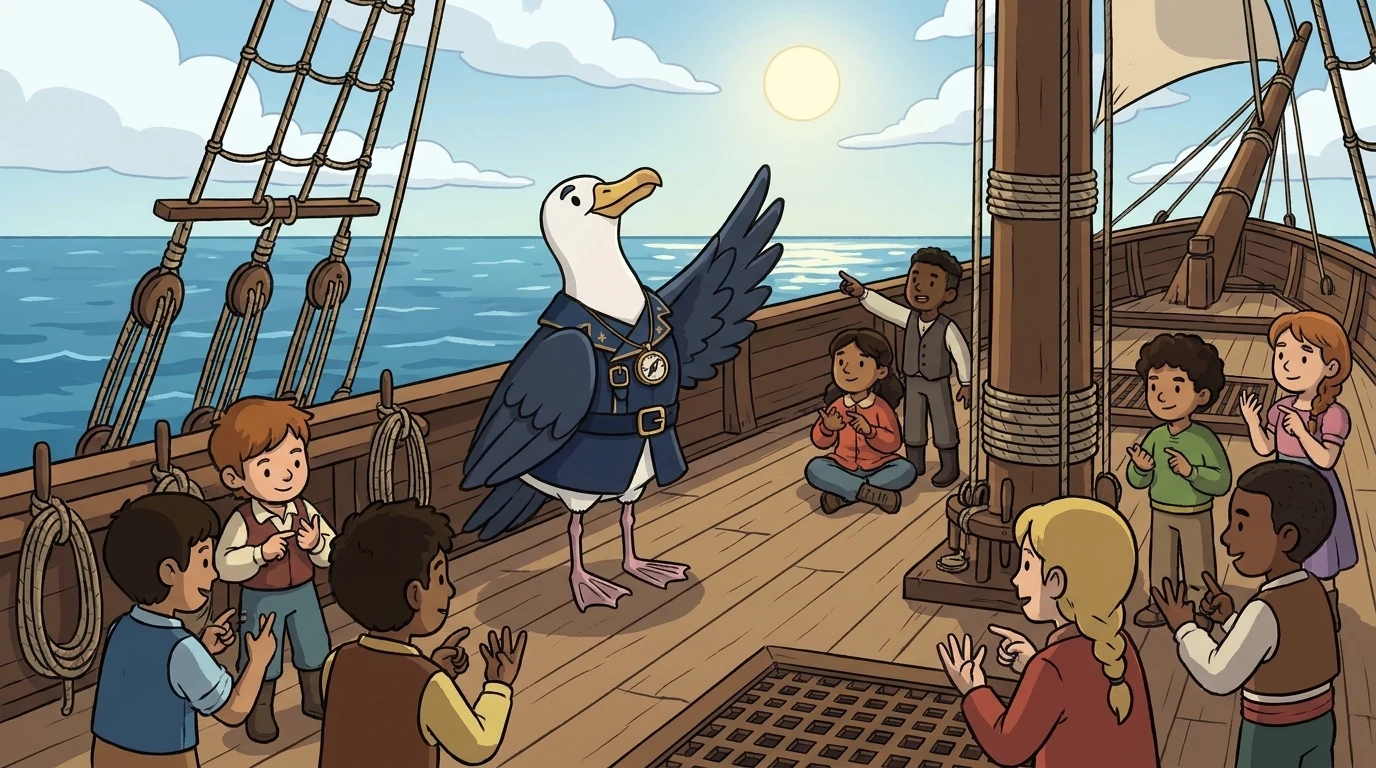
Meridian is an albatross in a navy coat, with a compass hanging from a cord around her neck, and her wings, when she spreads them, are wider than a tall grown-up is high. Albatrosses can glide for hours without a single flap, riding the wind over the Southern Ocean, sometimes circling the whole world. So Meridian has seen the Earth from above more times than she can count.
Meridian is the crew’s teacher. But she almost never tells anyone the answer. She asks.
“The Sun came up this morning,” she said to the young crew gathered on the deck. “Where did it go?”
“Across the sky,” said one. “And then down,” said another.
“Did the Sun move,” Meridian asked, “or did we?”
There was a long pause. Then someone said slowly, “We did. The Earth turns.”
Meridian tipped her head. “How long does one whole turn take?”
“A day. Twenty-four hours.”
“And how far is one whole turn, all the way round?”
“Three hundred and sixty degrees.”
“So in one hour,” Meridian asked, “how far does the Earth turn?”
The crew did the sum together, out loud, counting on their fingers. Three hundred and sixty divided by twenty-four. Fifteen.
“Fifteen degrees every hour,” Meridian said, and that was all. She did not say well done. She just looked out at the sea with a quiet, glowing kind of wonder, and the crew felt it too: the whole enormous Earth, rolling steadily through fifteen degrees every single hour, carrying all of them with it.
Next, Meridian unrolled a big paper globe and showed them the lines. “Mapmakers draw lines from the North Pole to the South Pole,” she said, “like the segments of an orange. Each one is called a meridian. You can draw as many as you like. Why do you think the person who made this globe drew these ones?”
The crew counted. Twenty-four segments. Each one, fifteen degrees apart.
“One for every hour,” someone said. “This globe’s lines follow the turning.”
“So if it is noon on one line,” Meridian asked, “what time is it on the next line to the east?”
“One in the afternoon. The Sun got there first.”
Meridian nodded and moved on, which is how the crew knew they were right.
Then she asked the hardest question of the evening. “Every one of these lines is the same. So which one is zero? Where do we start counting?”
Nobody knew. On a spinning ball, there is no natural starting line for east and west the way the equator is a natural line for north and south.
“People had to choose,” Meridian said. “For a long time, different countries used different starting lines, and their maps did not match. Then, in 1884, people from many countries met and agreed to count from a line that runs through Greenwich, in London. Not because that place is special to the Earth. Because a starting line only works if everyone uses the same one. Even then, agreeing in a meeting was the easy part. Some countries kept their old lines for years. France kept its clocks on Paris time until 1911, and some of its maps counted from Paris long after that.”
“So zero is a promise,” said the youngest sailor.
Meridian’s eyes shone, but she only asked, “What would happen if everyone kept their own zero?”
The crew argued about it happily until the stars came out: ships misreading each other’s charts, clocks that never matched, two maps of the same island in two different places.
When the arguing slowed, Meridian asked one more question. “If it is noon at Greenwich, what time is it on the line halfway round the world, a hundred and eighty degrees away?”
The crew went quiet and worked it out. A hundred and eighty divided by fifteen. “Twelve hours,” said the sailor who liked numbers best. “It’s the middle of the night there.”
“So right now,” Meridian asked, “somebody far away is asleep in the dark, under the same sky we are looking at. How does that feel?”
Nobody had a neat answer. One sailor said it felt big. Another said it felt a little lonely, and a little nice, all at the same time.
Then the youngest sailor frowned. “But how does a ship know how many hours away from Greenwich it is? You can’t see Greenwich from the middle of the sea.”
Meridian turned her head toward the captain’s cabin, where a brass clock was ticking softly in its padded box. “Who on this ship remembers what time it is at home?”
“Chrono!” said three sailors at once.
“Then you know what to ask Chrono tomorrow,” said Meridian, and that was all she said.
Later, when the deck was quiet, Meridian spread her great wings and rose into the dark wind, gliding east across the lines, one hour at a time, over a world that never stops turning.
The SextantForge ensemble
Meridian is one of the friends in SextantForge. Each friend shows you one idea by how they act; meet them all and you have the whole subject.