Polaris
LATITUDE FROM POLARIS
Polaris Holds Still
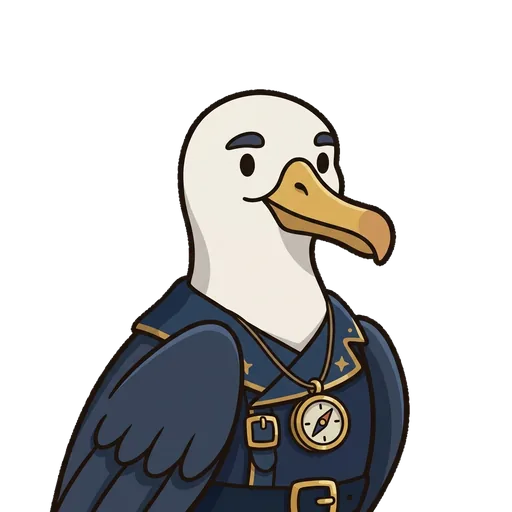
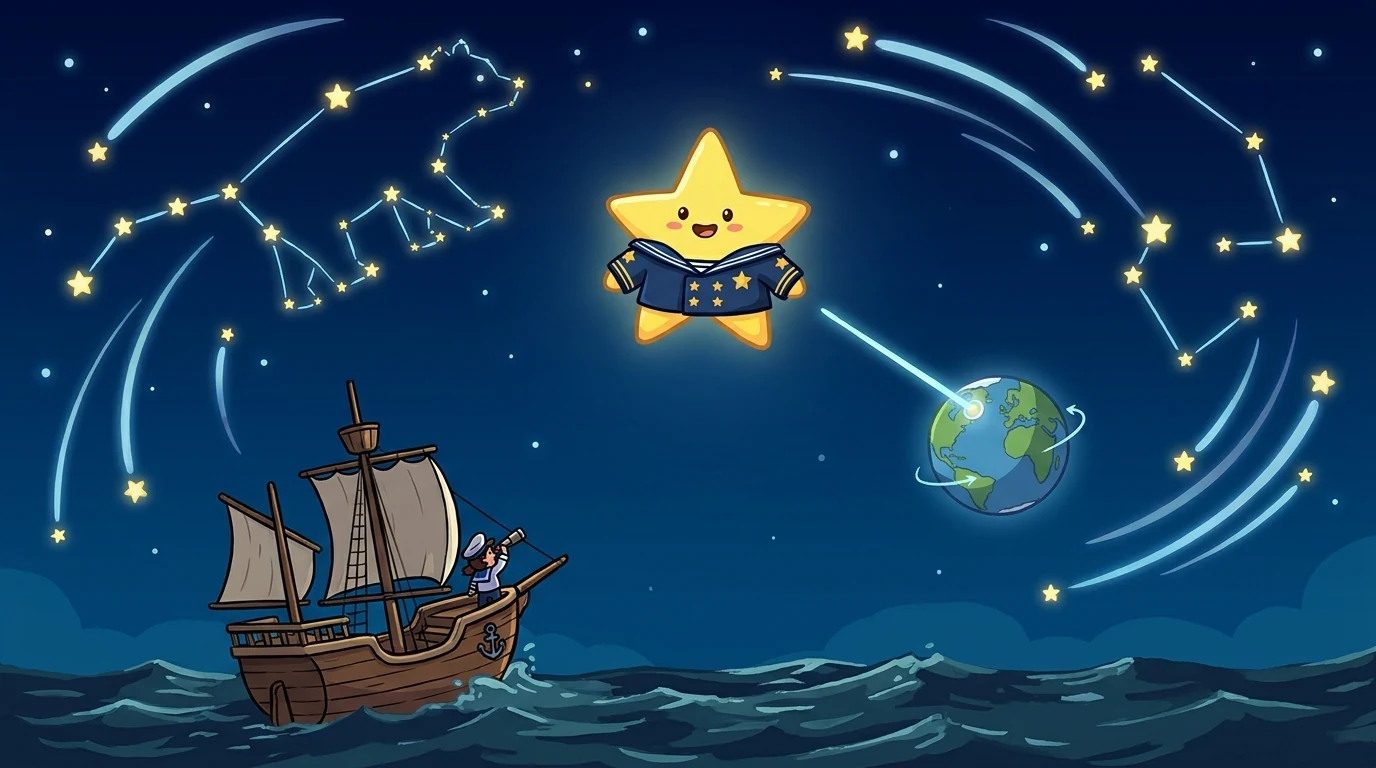
Polaris is a small, bright star with a sailor’s navy jacket and a serious, friendly face, and Polaris has one job that no other star in the northern sky can do. Polaris holds still.
Every night, the whole sky turns. Stars rise in the east like sparks from a fire, sweep across the dark in long, slow arcs, and sink into the sea in the west. The Great Bear swings around like the hand of a giant clock. Even the Moon drifts. And in the middle of all that turning, there is one point that barely moves at all. That is where Polaris lives.
“Everyone thinks I must be the brightest star,” Polaris says, a little shyly. “I am not. There are about forty-seven stars brighter than me. But I am the one that stays.”
Here is why. The Earth spins like a top, and the spinning top has an axis, an invisible rod through the North Pole and the South Pole. Stretch that rod up from the North Pole, out past the clouds, out into space, and it points almost exactly at Polaris. So as the Earth turns, every other star seems to circle around, but Polaris, sitting at the end of the rod, hardly moves at all.
On the deck of a ship, far from any land, a young sailor named Ines kept the night watch. The sea was black. There was no coast, no lighthouse, no road sign. “How do we know where we are?” she whispered.
“Look for me,” said Polaris. “Then look at how high I am.”
Ines held out her arm and measured from the flat line of the sea up to the little star. Polaris was about halfway between the horizon and straight overhead. Halfway to overhead is about forty-five degrees.
“Then you are about forty-five degrees north of the equator,” said Polaris. “How high I stand is how far north you are.”
It works because of the way the Earth curves. If you stood at the North Pole itself, Polaris would be straight above your head, ninety degrees up, and the North Pole is at ninety degrees north. If you stood on the equator, Polaris would sit right on the horizon, zero degrees up, and the equator is at zero degrees. Everywhere in between, the star’s height and your latitude match. Sail north and Polaris climbs. Sail south and Polaris sinks a little lower every night.
Ines grinned. Nobody on board could see land, but she could see that they were moving. A week later, Polaris stood about a degree higher. They had sailed north, and the sky had told her, quietly, without a single word on a map.
Polaris felt something warm when that happened, a steady kind of pride. Not the flashy pride of being the brightest, but the quiet pride of being the one people could count on.
“I should tell you the truth, though,” Polaris added, because a good guide is honest about its limits. “I am not exactly on the pole. I am a tiny bit off, less than one degree, so I make a very small circle of my own each night. If you measure me, you will be right to within about a degree. That is good enough to cross an ocean. It is not good enough to find a single front door.”
And there is one more secret. The Earth’s axis wobbles, very, very slowly, like a spinning top that is starting to lean. Over thousands of years, the rod swings around and points at different stars. Polaris has not always been the North Star, and one day it will hand the job to someone else.
“In about twelve thousand years,” Polaris said, “the bright star Vega will be close to the pole instead of me. I do not mind. Holding still is a job you do for a while, as well as you can, and then you pass it on.”
“What if we sail south of the equator?” Ines asked. “Past the middle of the world?”
Polaris was quiet for a moment, which is how a star thinks. “Then I sink into the sea behind you, and you will not see me at all. The southern sky has no bright star holding still above its pole. Sailors down there find the pole another way. They look for a group of stars shaped like a little cross, follow its long arm across the sky, and imagine the empty spot where the arm points.”
“So the sky still works,” Ines said. “It just works differently.”
“It always works,” said Polaris, “for someone who keeps looking. That part is yours, not mine. I only hold still. You are the one who measures.”
Ines thought about that for a long time. Then she wrote in her log, in careful letters: Polaris, about 46 degrees up. We are about 46 degrees north. The sky is a map, if you know which star is holding still.
The SextantForge ensemble
Polaris is one of the friends in SextantForge. Each friend shows you one idea by how they act; meet them all and you have the whole subject.