Wayfinder
THE STAR COMPASS
Wayfinder Reads the Horizon
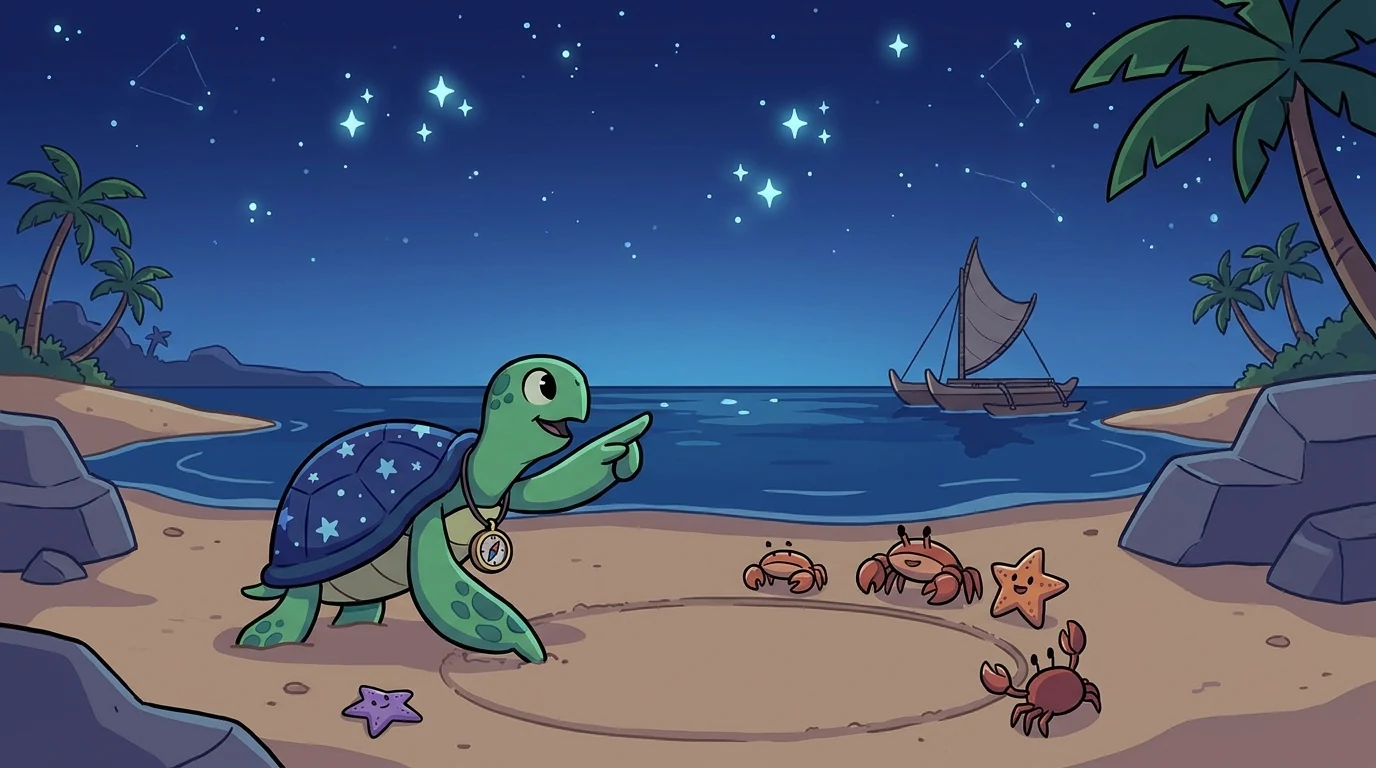
Wayfinder is a green sea turtle with a navy shell patterned like a night sky, bright, steady eyes, and a small brass pendant on a cord, and Wayfinder has crossed whole oceans with no map, no compass and no clock at all.
“I carry my instruments in here,” Wayfinder says, tapping the side of her head with one flipper. “And out there.” She waves at the horizon.
Wayfinder learned her craft from the great navigators of the Pacific Ocean, people who have sailed between islands thousands of miles apart for many hundreds of years. They did it by reading the world around them, and they still do. In 1976, a double-hulled voyaging canoe sailed from Hawaiʻi to Tahiti, more than two thousand miles, steered with no instruments at all. That knowledge is alive today, taught by navigators to their students, and Wayfinder treats it with great respect.
The heart of it is a simple, beautiful fact. Seen from the same stretch of ocean, each star that rises comes up at the same point on the horizon every night. A star that rises over a certain place on the sea tonight will rise over that same place tomorrow, and next week, and next year. It sets at a matching point on the opposite side. Sail a long way north or south and the rising points slide a little, and navigators learn how to allow for that too.
“So the horizon is a ring of houses,” Wayfinder explains, drawing a circle in the sand with her flipper. “Each star has a house where it rises and a house where it sets. If you want to sail toward a certain island, you learn which star rises in that island’s direction. Then you steer toward that star while it is low. When it climbs too high to be useful, you switch to the next star that rises from the same house.”
It is called a star compass: a circle of named points around the horizon, held in the navigator’s memory instead of in a box.
Wayfinder’s grandmother taught her the houses one night at a time, lying on a warm deck under the sky. “You will not learn them all at once,” her grandmother said. “Learn one. Then learn its neighbour. Then the next.” Some nights Wayfinder felt she would never remember them all. But she kept going, one star at a time, and slowly the ring filled in.
The stars are not the only sign. By day, and when clouds hide the sky, Wayfinder reads the waves. The ocean has long, steady swells that roll in from far-off storms, and they keep their direction for days. Feel which way the canoe rocks and you know which way you are facing. She watches birds that fish at sea and fly home to land at dusk. She watches clouds that pile up and turn greenish over islands still hidden below the horizon.
“No single sign is enough,” Wayfinder says. “I trust them most when they agree. If the star, the swell and the birds all point the same way, my heart goes quiet and sure.”
That quiet is what Wayfinder loves most. Out on the open ocean, with nothing in sight but water in every direction, some people feel lost and frightened. Wayfinder feels calm, the deep calm of paying close attention. She is not hoping. She is noticing.
Sea turtles know something about finding their way, too. Wayfinder’s own great-great-grandmother swam thousands of miles across the ocean and came back to the very beach where she had hatched, to lay her eggs. Nobody gave her a map.
One night, long ago, the clouds rolled in thick and low, and every star went out at once. A young crew member on Wayfinder’s canoe felt his stomach drop. “We have lost the houses,” he said.
“We have lost the stars,” Wayfinder said gently. “We have not lost the ocean.” She lay down flat on the deck and closed her eyes, so she could feel the canoe instead of looking for it. There: the long, slow lift and fall of the swell, rolling under the hull from the same side it had come from all day. She kept the canoe at that same angle to the waves, hour after hour, through the dark.
And all the while, she kept a quiet count in her head: how fast they were moving, for how long, in which direction. Navigators keep that count the whole voyage, so they always carry a picture of where the canoe has got to, even when the sky gives them nothing.
At dawn the clouds tore open. The first star she found was low in the east, rising from exactly the house she expected.
Tonight, a bright star is rising on the edge of the sea, right in the house that points toward home. Wayfinder turns the canoe gently until the star sits just above the bow.
“There,” she says softly. “Follow that one for a while. When it climbs too high, I will show you the next.”
The SextantForge ensemble
Wayfinder is one of the friends in SextantForge. Each friend shows you one idea by how they act; meet them all and you have the whole subject.