
Nabo
THE 1089 ROUTINE — *take a 3-digit number with different first and last digits; reverse and subtract; reverse that result and add; the answer is always 1089.*
Loading audio…
Press play to listen along. The line being read lights up as you go.
Show full transcript
Loading transcript…
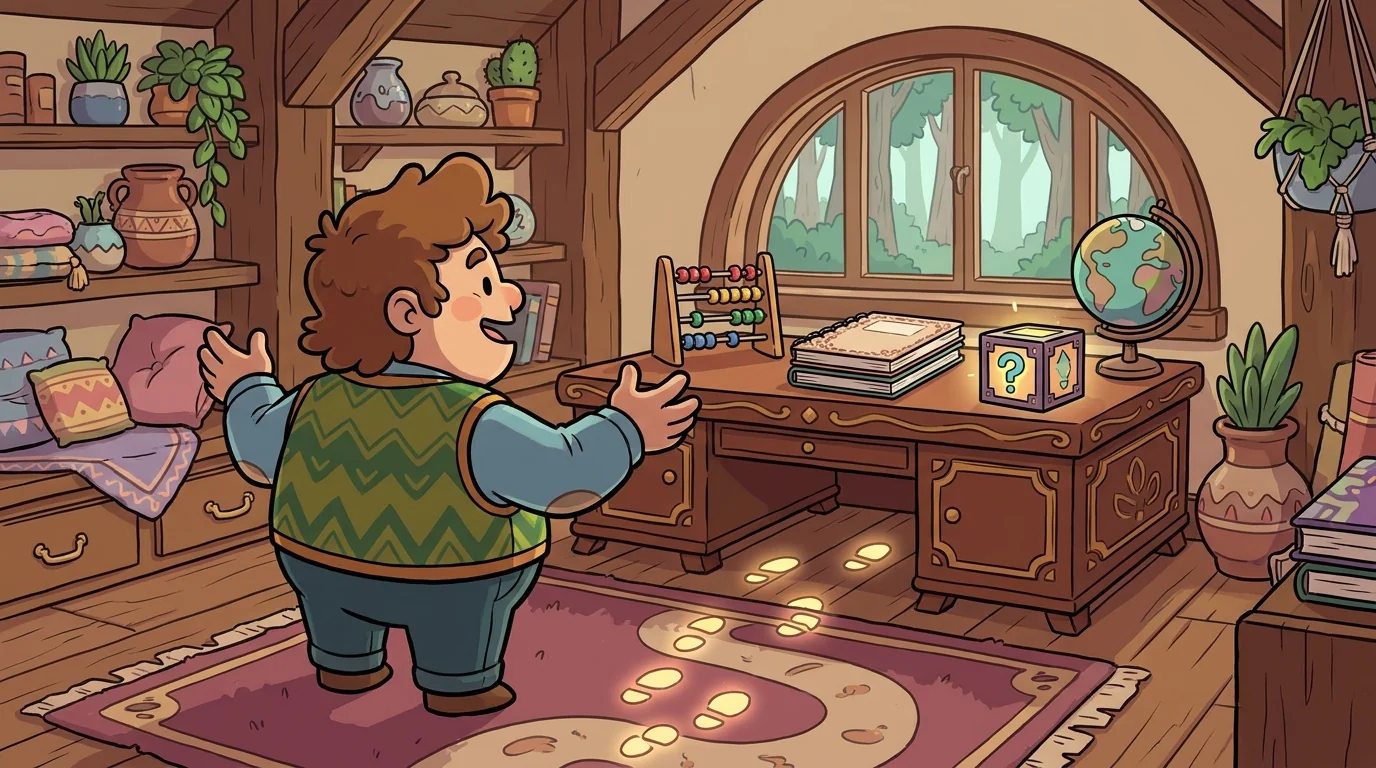
Backstage smelled of cold iron, dusty velvet curtains, and the soft white chalk Nabo kept in his vest pocket. For forty years, the theater had swallowed performers who tried too hard to impress the crowd. Nabo never bothered with flashy illusions, preferring the quiet trick where the visitor did every scrap of the arithmetic.
"Pick any three-digit number," Nabo would tell whoever drifted behind the heavy stage drapery. "Make sure the outside digits are different, and do not whisper your choice to your shoes."
He would turn his back completely, facing the flaking brick of the prop shop wall. Folding his hands behind his coat, he listened to the dry scratch of graphite on rough butcher paper.
"Reverse your number," he called out, "and subtract the smaller value from the larger one."
He gave them plenty of time, knowing how easily people panicked when borrowing across a middle zero. The pencil lead scraped against the coarse fiber, accompanied by the muffled thud of footsteps overhead.
"Now reverse that remainder," Nabo added, keeping his tone as calm and steady as a plumb line. "Write the reversed result beneath your difference, and add those two numbers together."
He turned around slowly, without any theatrical flourishes, fluttering silk scarves, or clattering brass gongs. He simply looked at the crumpled scrap of paper resting between the visitor's ink-stained fingers.
"You are holding one thousand eighty-nine."
They always were. Whether they began with nine hundred twelve or three hundred four, they landed at that exact door.
In mathematics, people called that kind of stubborn, inescapable outcome an invariant. An invariant did not care about your mood, your hometown, or how clumsy you felt around long division. It was a structural funnel, an architecture where every winding corridor squeezed down into a single courtyard. Once you took that first step and obeyed the simple rules, the final destination was entirely guaranteed.
Nabo loved the trick because he had spent his own youth paralyzed by the terror of starting.
Forty years earlier, as a gangly stagehand at the Grand Majestic, he froze at every single threshold. The theater felt like a colossal machine designed specifically to catch him making a ruinous mistake. Heavy hemp ropes hung from the pin-rail, each holding an iron counterweight suspended forty feet above the stage. If you pulled the wrong cleat, a sandbag plummeted toward the orchestra pit like an iron anvil. If you missed an amber spotlight cue by four seconds, the lead singer wandered into total darkness.
Every decision felt like stepping off an icy pier into a thick bank of freezing fog. Should he oil the winch drum, or would grease splatter down onto the expensive velvet seating? Should he suggest a cleaner knot, or would the veteran carpenters laugh him out of the building? Nabo spent whole afternoons hovering by the prompt corner, clutching his wooden clipboard like a shield.
Other crew members sprinted across catwalks without checking their boots, trusting the iron rungs to hold them. Even the dancers leaped blindly toward the pit, confident that the stage floor would meet their heels. Nabo could not fathom that faith, because to him, every beginning carried the sharp risk of disaster. It was a gray, stuck way to live—standing endlessly at the trailhead, terrified of walking forward.
Marlow, the veteran stage manager, finally broke that spell on a cold, sodden Tuesday afternoon. Rain drummed against the corrugated tin roof, leaking into galvanized buckets set along the drafty iron catwalks.
"You're hovering over that switchboard again, Nabo," Marlow said, chewing on the stub of an unlit cigar.
"I'm making sure the dimmer handles don't catch," Nabo muttered, staring hard at the floorboards.
"Those brass switches haven't jammed in fifty years," Marlow said, leaning his bulk against an equipment trunk. "You aren't checking equipment, kid; you're just petrified that taking an action will break the whole universe."
Nabo felt his neck burn, though he kept his hands jammed deep inside his canvas work apron. Marlow pulled a crumpled cue sheet from his pocket, tore off a yellow strip, and flattened it.
"You treat every choice like a crooked gamble," Marlow said, handing over a blunt carpenter's pencil. "So let me show you a trail that has no cliffs, no wolves, and no sudden drops."
Marlow leaned over the trunk, tapping the yellow paper with a rough, tobacco-stained thumbnail. "Write down any three-digit number where the first and last figures are different."
Nabo hesitated before scrawling seven hundred twenty-one across the coarse fiber of the scrap.
"Now reverse it beneath the line, and subtract the smaller number from the larger one."
Nabo reversed the digits, borrowed across the tens, and carefully wrote down five hundred ninety-four.
"Flip that remainder," Marlow commanded, "and add the two values together on the page."
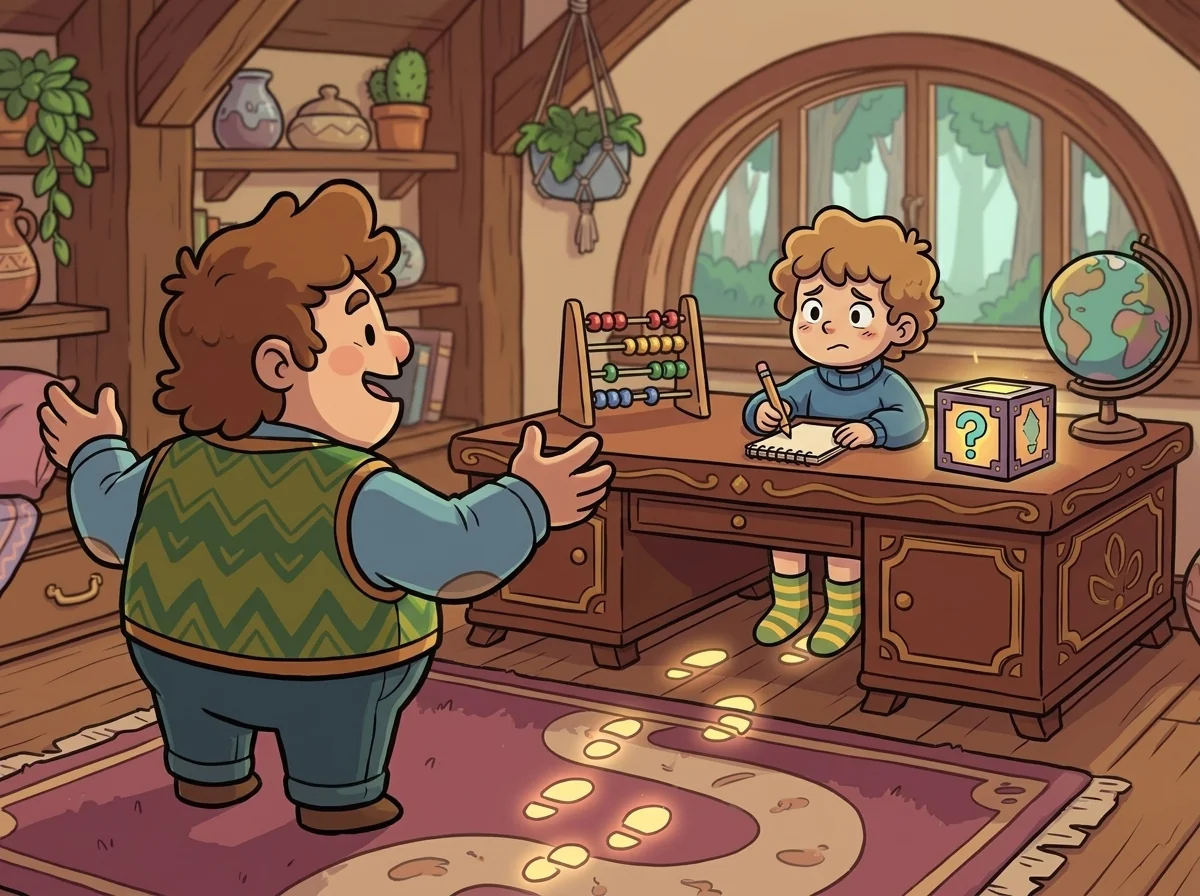
Four hundred ninety-five went beneath five hundred ninety-four, and Nabo added the three columns. He carried the digits carefully, his pencil digging into the paper until the lead nearly snapped off.
The final sum sat plainly on the yellow scrap: 1089.
"Now do it again with eight hundred forty-one," Marlow ordered without cracking a smile.
Nabo worked through the reversal and subtraction, his pulse thumping against his collar as he wrote. When he added the final two lines, the result was once again one thousand eighty-nine.
"Try six hundred two," Marlow said, his voice quiet against the drum of the roof rain.
Nabo tried it, half-hoping the arithmetic would fail and prove his chronic skepticism was justified. Instead, the columns folded together like clockwork, producing the exact same four digits once more.
"You believe every path is an ambush," Marlow said, tapping the paper with a blunt knuckle. "But some roads are built like stone aqueducts where the water has nowhere else to go. If you take the steps, you arrive. It is not luck, Nabo. It is a promise."
That afternoon, Nabo walked out across the center stage without checking his footing a single time.
Now, four decades later, a kid with scuffed sneakers and fraying sleeves hovered near the shop door. They clutched a spiral notebook against their ribs, watching Nabo with sharp, guarded eyes from beneath their hair.
"My brother told me you can read minds," the kid said, shifting their weight across the sawdust.
"Your brother is mistaken," Nabo said, setting his heavy ceramic mug onto an upturned packing crate. "Reading minds is messy business, but I do understand how numbers behave when you let them."
The kid wrinkled their nose, clearly debating whether to retreat back into the dim alleyway outside. "I'm terrible at math," they announced bluntly, daring Nabo to contradict the bitter statement.
"Most people distrust what they cannot predict," Nabo replied, sliding a round wooden stool toward the bench. "Sit down for three minutes, and let us see if the road holds your weight."
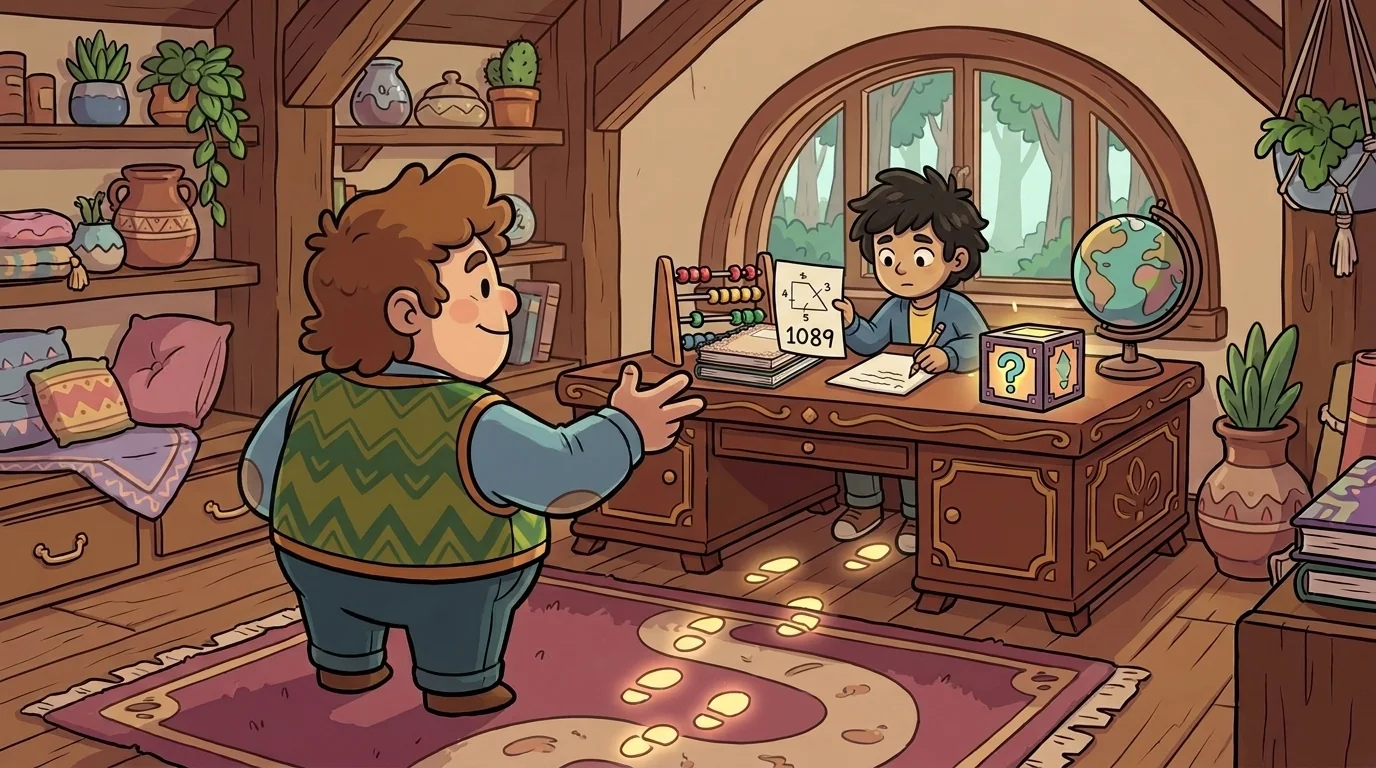
The kid hesitated, then dropped their backpack and slumped onto the stool with a weary sigh. Nabo slid a sheet of slate-gray cardstock and a freshly sharpened yellow pencil across the wood.
"What happens if I mess up?" the kid asked, keeping both hands tucked inside their pockets.
"Then we borrow an eraser and try again," Nabo answered with an easy, untroubled smile. "The paper will not judge you, and nobody here is keeping score of your mistakes."
The kid pulled out a hand, picked up the pencil, and hovered over the clean cardstock.
"Write a three-digit number with different outside digits," Nabo instructed, turning his back to the shelf.
Graphite scraped firmly against paper as the kid scribbled in the quiet, drafty warmth of the room.
"Now reverse it, subtract the smaller from the larger, and take your time with the borrowing."
The brass wall clock ticked steadily while the kid worked through the columns in focused silence.
"Now reverse that answer, write it underneath, and add those two lines together," Nabo said.
The pencil worked furiously for several seconds before stopping with a sudden, rigid tap against the grain. Nabo did not rush to turn around, giving the kid time to examine their own neat work.
When he finally pivoted, the kid was staring at the paper in complete, motionless disbelief.
"One thousand eighty-nine," the kid whispered, as if speaking aloud might ruin the ink.
"Welcome home," Nabo grinned, resting his forearms against the weathered bench.

"You looked," the kid accused instantly, scanning the cluttered tool shelves for hidden mirror glass.
"My back was turned the whole time, facing solid brick," Nabo replied, tapping his own chest.
"You rigged the pencil," the kid insisted, dropping the yellow wood onto the table as evidence.
"Pencils cannot do three-column arithmetic on their own," Nabo said with a dry, quiet laugh. "Pick another number from your head, and write it on a page from your personal notebook."
Determined to catch him in a trick, the kid tore a lined sheet from their spiral pad. They wrote eight hundred fifty-two, reversed the digits, and subtracted with quick, defensive strokes. The remainder was five hundred ninety-four, which they promptly reversed into four hundred ninety-five below it. They added the columns together, their pencil gouging the lined paper as they carried the ones.
The final sum stood in bold, undeniable graphite: 1089.
The kid dropped their forehead against their knuckles and let out a startled, breathless laugh. "It happened again," they said, staring back and forth between the two scraps of paper on the table.
"It happens every time," Nabo told them, watching the tight anxiety drain from the kid's shoulders. "You could start in six hundred different bedrooms, but the math funnels every single traveler home."
The kid smoothed the torn page, tracing the dark numbers with the tip of their thumb. "I thought if I picked the wrong number, the whole thing would just spin out into nothing."
"That is what fear tells you," Nabo said, folding his hands loosely across his canvas apron. "Fear insists that every beginning is an ambush waiting to make a fool of you. Yet some journeys are engineered so that walking the path brings you directly where you belong."
The kid folded the paper into a neat little square and slid it deep inside their coat pocket. When they stood up from the stool, their shoulders were looser and their chin was lifted.
"Ten eighty-nine," the kid said near the doorway, like a password shared between fellow travelers.
"Ten eighty-nine," Nabo agreed, watching the heavy oak door click shut behind them.
Nabo wiped down the table with an oiled rag, setting the pencil straight beside the fresh cardstock. Life still held plenty of blind turns and dark corridors, but some structures were true invariants. You did not need to see the ending in advance to find the courage to begin.
The ShowMath ensemble
Nabo is part of ShowMath's distributed-narrative cast. Each character embodies a different curricular primitive; together they teach the full subject.
-

Wendel
The Calendar-Keeper — anchors the year's doomsday and steps by sevens to name the weekday of any date
-

Elvi
The Eleven-Splitter — pries a number's digits apart and drops their sum into the gap (times-eleven shortcut)
-

Fiva
The Fives-Finisher — rounds a number ending in 5 to a friendly pair, then tacks on 25 to square it
-

Missa
The Missing-Digit Diviner — sums the shown digits and reads the hidden one as the shortfall to the next nine (casting out nines)
-

Squarl
The Squaring-Bouncer — bounces to the nearest round number and back to square any number in her head
-

Dashel
The Left-to-Right Racer — answers biggest-place-first, out loud, before the calculator finishes
-

Magda
The Magic-Square Weaver — seeds a four-by-four square from a date so every row, column, and diagonal sums the same
-

Halvra
The Double-and-Halver — doubles one factor and halves the other until multiplying is easy
-

Modo
The Clock-Winder — wraps numbers around a clock of any size, the engine under the calendar and missing-digit tricks
-

Marlow
The Stage Manager (mentor) — a warm, attentive adult who coaches rehearse-then-perform and reveal-the-secret, and never performs for the kid