Modo
MODULAR ARITHMETIC — *count on a clock of size m: after m, you wrap back to zero, so only the remainder (the landing spot) matters. Size 7 runs the calendar; size 9 runs the missing-digit trick.*
Loading audio…
Press play to listen along. The line being read lights up as you go.
Show full transcript
Loading transcript…
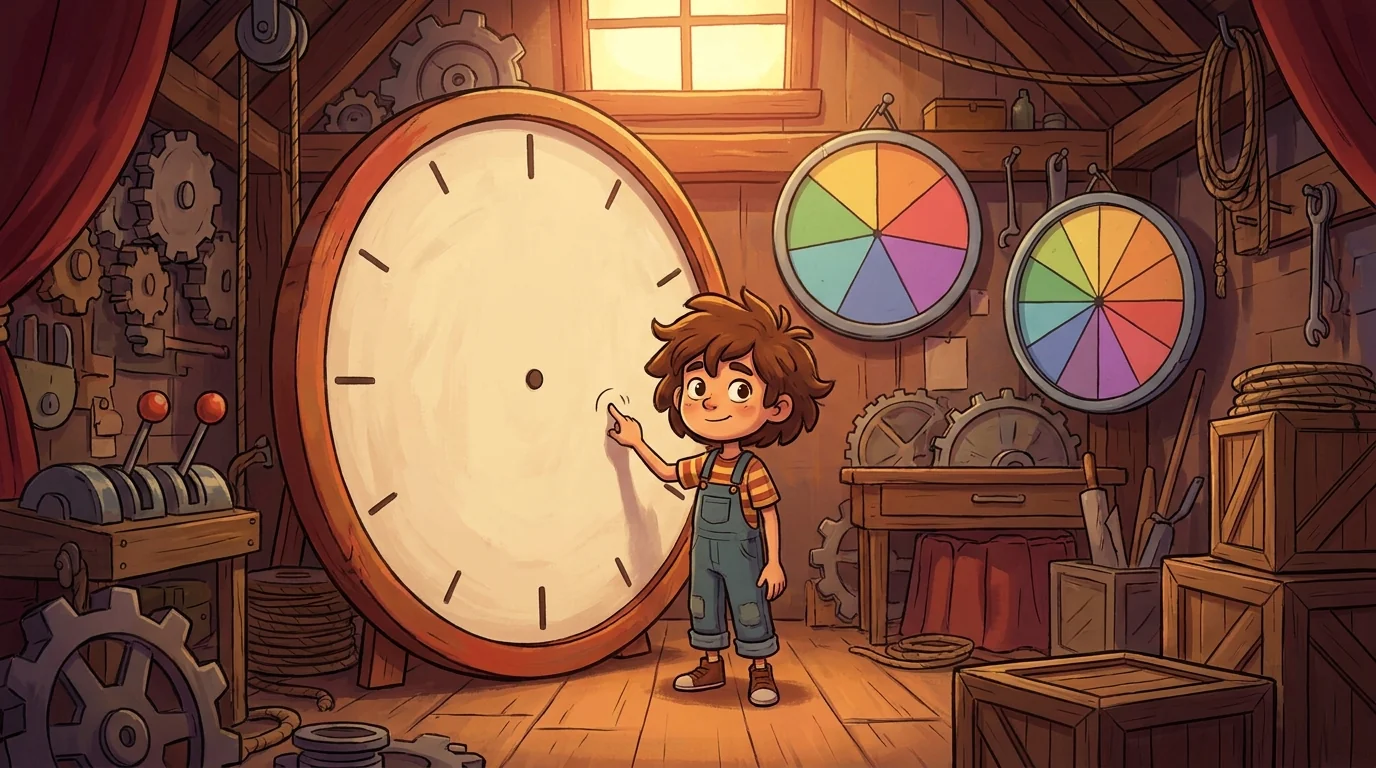
Modo was the quiet one, the engineer backstage, and the rest of the crew half-suspected Modo secretly powered all their tricks. They were right. "Every clever routine you've seen," Modo would say, tapping a big blank clock face, "is really just this — counting on a clock, where after you pass the top you wrap back to the start." A clock of twelve wraps at twelve. But a clock can be any size. "Make it size seven, and you've got Wendel's calendar — days of the week wrap every seven. Make it size nine, and you've got Missa's missing-digit trick — remainders wrap every nine."
The whole idea was that on a clock, you don't care how far you've walked — only where you land. "Count twenty steps on a clock of seven? You go around twice and land on six. Twenty and six sit in the exact same spot," Modo said. "That's the secret hum under half the show: only the landing place matters. Everything past a full loop just... wraps."
Modo had spent years feeling like all that wrapping was going nowhere.
As a young apprentice, Modo did the same small backstage jobs over and over — reset the props, coil the ropes, reset again — round and round, and it felt like a life on a loop, effort spent with nothing to show, always ending up back where it started. Modo grew quietly hopeless about it: I just go in circles.

Marlow, the stage manager, sat with Modo by the clock face one night. "You think going around means going nowhere," Marlow said. "But watch what the circle does." Marlow counted around the clock — past the top, wrapping, landing somewhere new. "The loop isn't wasted motion. It's what lets a small clock keep track of enormous numbers. Wrap seven and you can find any weekday forever. Wrap nine and you can catch any hidden digit. The circle isn't a trap — it's an engine." Marlow smiled. "The thing you thought made you useless is the thing that runs the whole show." Something in Modo that had felt like a hamster wheel became, quietly, a turbine.
The kid who came to Modo seemed tired, like they'd been repeating something without progress.
"I feel like I just keep going over the same stuff," they admitted.

"Then you'll like this," Modo said, spinning the clock. "Let's count twenty on a clock of seven. Go past the top and wrap. Where do you land?"
The kid counted around. "...Six."
"Right. So twenty and six live in the same spot on a seven-clock. That one idea — only the landing matters — runs Wendel's calendar. And on a nine-clock, it runs Missa's hidden digit. Same quiet engine, two different shows."
They ran a few laps — 15 on a clock of seven lands on 1; 11 on a clock of nine lands on 2 — and Modo pointed each time to the trick it powered upstairs. The kid's tiredness lifted into something like wonder, watching one small circular idea turn out to be humming underneath things that had looked completely separate.
The feeling that grew in the kid then wasn't only the neatness of clock counting. It was more hopeful than that: the sense that going around and around isn't the same as going nowhere — that a loop can be an engine, that the same patient idea repeated is exactly what powers the big, dazzling things on the surface. If a plain clock could secretly run the whole show, maybe their own repeated laps were building something too. That warm, quiet hope — the circle isn't a trap; it's what makes everything run — spread all the way through, and Modo felt the old hamster-wheel ache turn back into a hum, because it was the exact hope Marlow had once handed an apprentice who thought they only went in circles.
"Wrap the numbers around a clock of size m; only where they land matters," Modo said, giving the clock a slow, satisfied spin. "The loop isn't nowhere. It's the engine under everything."
The ShowMath ensemble
Modo is part of ShowMath's distributed-narrative cast. Each character embodies a different curricular primitive; together they teach the full subject.
-

Wendel
The Calendar-Keeper — anchors the year's doomsday and steps by sevens to name the weekday of any date
-

Elvi
The Eleven-Splitter — pries a number's digits apart and drops their sum into the gap (times-eleven shortcut)
-

Fiva
The Fives-Finisher — rounds a number ending in 5 to a friendly pair, then tacks on 25 to square it
-

Missa
The Missing-Digit Diviner — sums the shown digits and reads the hidden one as the shortfall to the next nine (casting out nines)
-

Squarl
The Squaring-Bouncer — bounces to the nearest round number and back to square any number in her head
-

Dashel
The Left-to-Right Racer — answers biggest-place-first, out loud, before the calculator finishes
-

Magda
The Magic-Square Weaver — seeds a four-by-four square from a date so every row, column, and diagonal sums the same
-

Nabo
The 1089 Conjurer — reverses, subtracts, reverses, adds, and always lands on 1089
-

Halvra
The Double-and-Halver — doubles one factor and halves the other until multiplying is easy
-

Marlow
The Stage Manager (mentor) — a warm, attentive adult who coaches rehearse-then-perform and reveal-the-secret, and never performs for the kid