Wendel
MOD-7 CALENDAR — *anchor the year's Doomsday weekday, then step forward or back in sevens to name the weekday of any date.*
Loading audio…
Press play to listen along. The line being read lights up as you go.
Show full transcript
Loading transcript…
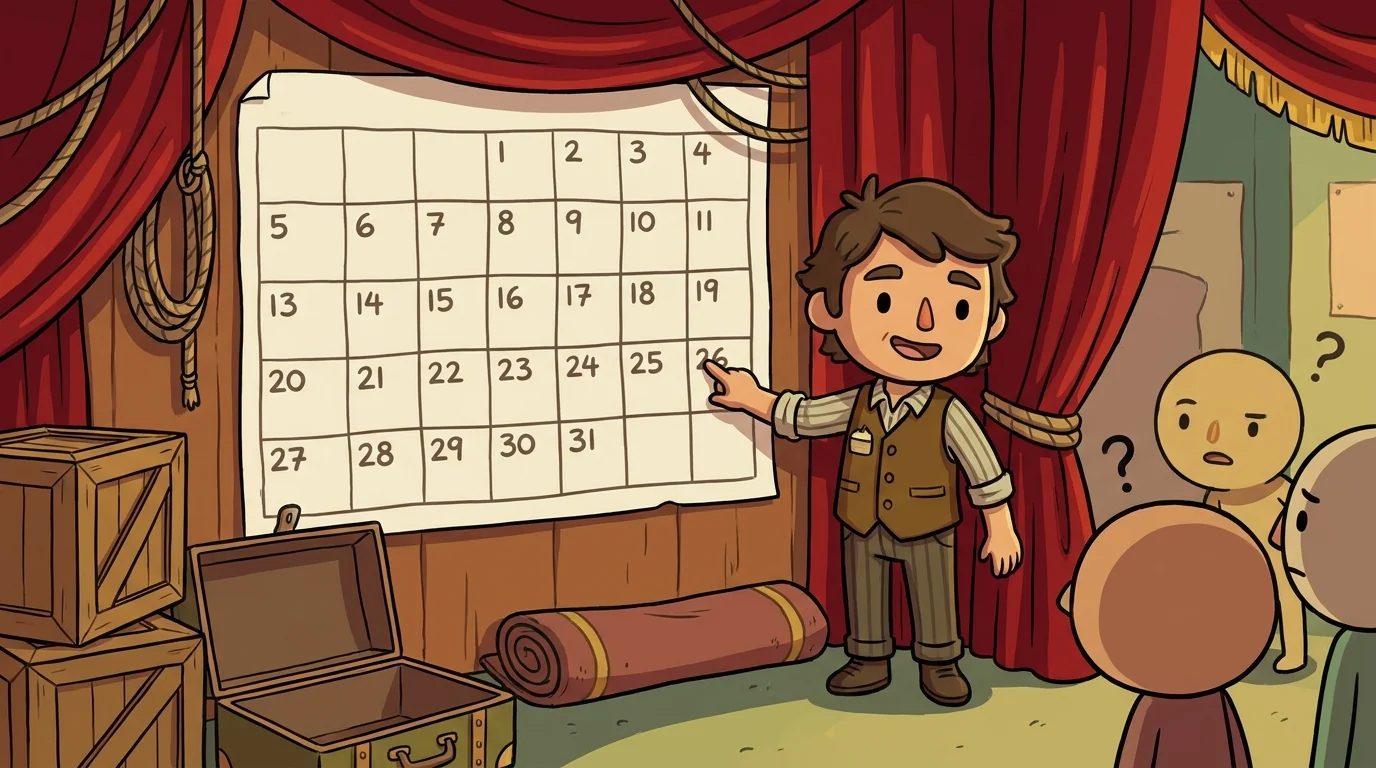
At the back of the ShowMath stage, past the ropes and the folded curtains, Wendel kept a single calendar pinned to the wall — and it had no weekdays printed on it at all. Just the numbers. Visitors always frowned at it. "How do you know what day anything is?" they'd ask. Wendel would grin and tap one date, the same one every time. "This is my anchor. Every year has one — I call it the year's Doomsday. Once I know the weekday of the anchor, every other date is just a walk away from it, seven steps at a time."
Someone would call out a birthday — say, October 31st — and Wendel wouldn't reach for a phone. Wendel would find the nearest anchor date in October, then count: seven, fourteen, twenty-one, twenty-eight — those all land on the same weekday as the anchor. "Twenty-eight is my anchor's twin. Thirty-one is three more steps." Three steps forward around a seven-day loop. "Wednesday." And it would be Wednesday. Every single time.
Wendel had not always felt so at home in time.
As a young stagehand, Wendel was the one who was always a beat behind — showing up on the wrong day for rehearsal, missing the Tuesday call because it felt like a Monday. Days blurred together into one long anxious smear, and Wendel carried a quiet shame about it: everyone else just knows, and I don't. The other crew would say the date and Wendel would nod along, secretly lost.
Then Marlow, the stage manager, noticed. Marlow didn't scold. Marlow sat down and said something strange: "You don't have to remember every day. You only have to remember one, and know how to walk from it." Marlow drew a little loop of seven dots. "The week is a circle. Land on your anchor, then step around the circle. You'll never be lost again — because you're not memorizing a thousand facts. You're rebuilding one, whenever you need it." Wendel felt something unclench that had been clenched for years.

When the nervous kid climbed onto the stage, they had that same lost look Wendel remembered from the mirror.
"I can never keep track of days," the kid admitted. "I feel like I'm always guessing."
"Then stop guessing and start walking," Wendel said gently, pointing to the numbers-only calendar. "Pick a date. Any date this year. We won't memorize it. We'll build it." The kid pointed at their own birthday. Wendel smiled. "Perfect. Let's find the nearest anchor, and step."

Together they found the anchor date for the month and marked it. "This one is, let's say, a Friday — that's our anchor," Wendel said. "Now here's the whole secret." Wendel counted aloud, tapping. "Add seven, and you land on the same weekday. Add seven again — still the same. So I jump by sevens until I'm close to your birthday, then I take the last few small steps one at a time, looping around: Friday, Saturday, Sunday..."
The kid's birthday landed on Sunday. They checked it against a real calendar. Sunday. The kid stared. "But I didn't memorize anything."
"No," Wendel said, warm right down to the boots. "You built it. That's the difference. A memorized fact can slip away and leave you lost. A fact you can rebuild is yours forever — you can drop it and pick it right back up." Wendel tapped the anchor one more time. "You are not behind. You never were. You just needed the one thing to walk from."
The kid tried three more dates on their own, stepping by sevens, and got every one. And the feeling that rose in them wasn't only the little thrill of being right — it was a deeper steadiness, the exact opposite of that old out-of-step smear. For the first time, time felt like something they could stand inside instead of chase. That quiet, grounded calm — I am not lost; I know where I am — spread all the way through them, and Wendel watched it happen with a full heart, because it was the very calm Marlow had once handed a lost young stagehand who thought everyone else simply knew.
"Anchor, then step by sevens," Wendel said softly, tapping the calendar with no weekdays on it. "One fact you can rebuild beats a thousand you have to remember. Walk the circle, and you're never late again."
The ShowMath ensemble
Wendel is part of ShowMath's distributed-narrative cast. Each character embodies a different curricular primitive; together they teach the full subject.
-

Elvi
The Eleven-Splitter — pries a number's digits apart and drops their sum into the gap (times-eleven shortcut)
-

Fiva
The Fives-Finisher — rounds a number ending in 5 to a friendly pair, then tacks on 25 to square it
-

Missa
The Missing-Digit Diviner — sums the shown digits and reads the hidden one as the shortfall to the next nine (casting out nines)
-

Squarl
The Squaring-Bouncer — bounces to the nearest round number and back to square any number in her head
-

Dashel
The Left-to-Right Racer — answers biggest-place-first, out loud, before the calculator finishes
-

Magda
The Magic-Square Weaver — seeds a four-by-four square from a date so every row, column, and diagonal sums the same
-

Nabo
The 1089 Conjurer — reverses, subtracts, reverses, adds, and always lands on 1089
-

Halvra
The Double-and-Halver — doubles one factor and halves the other until multiplying is easy
-

Modo
The Clock-Winder — wraps numbers around a clock of any size, the engine under the calendar and missing-digit tricks
-

Marlow
The Stage Manager (mentor) — a warm, attentive adult who coaches rehearse-then-perform and reveal-the-secret, and never performs for the kid